%20(1).png)
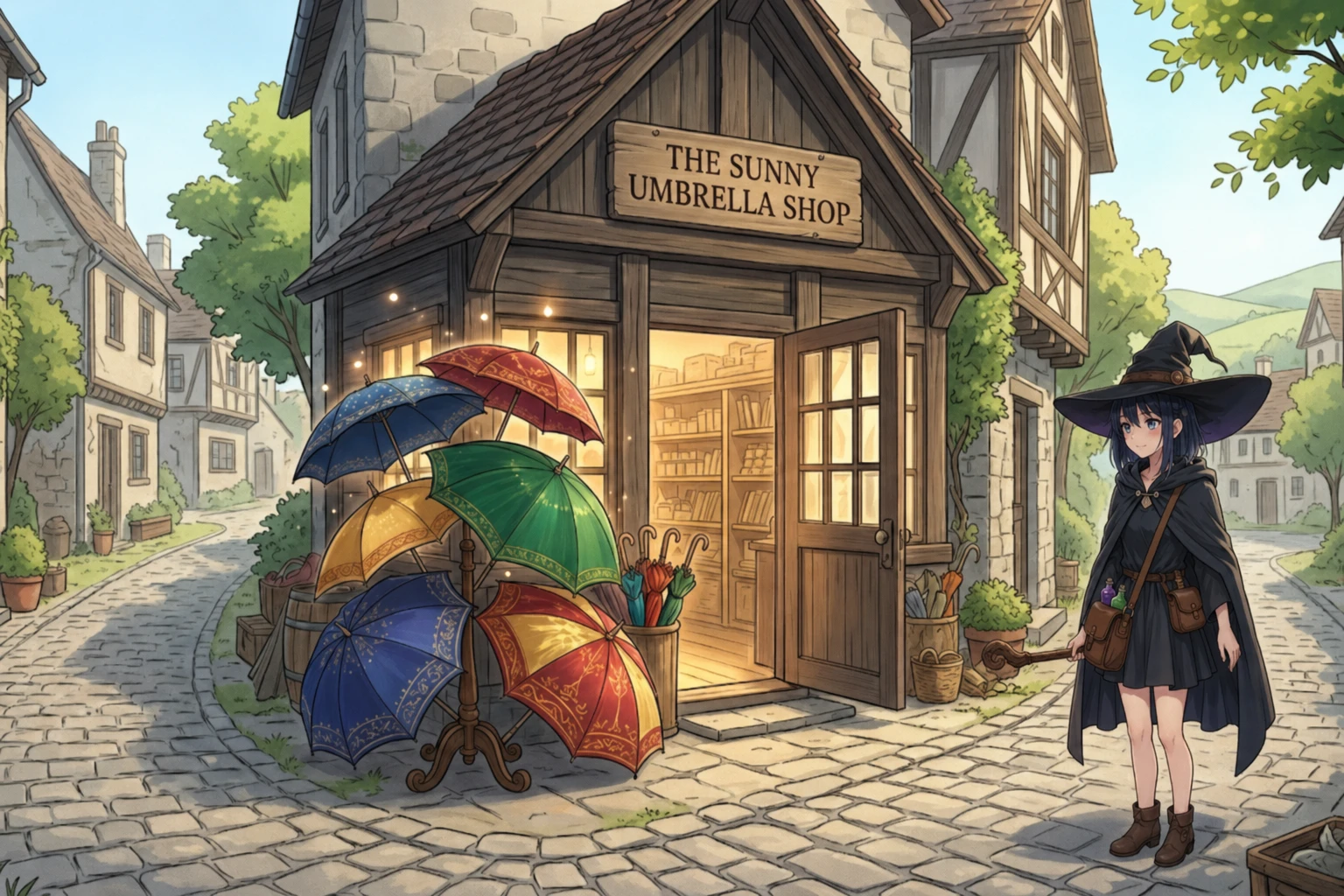
The shop was only open when it had absolutely no business being open.
Kuroha noticed it on her second day in Torigane, a hill town with steep streets and good views and the general atmosphere of a place that had learned to exist at an angle to everything else. The shop was tucked between a rice merchant and a place that repaired clocks, narrow-fronted, with a faded curtain and a painted sign showing an umbrella mid-bloom. On the rainy morning she arrived, it was shuttered. On the grey afternoon that followed, still shuttered. On the overcast morning after that, shuttered again.
On the third morning, the sky opened into the kind of clear blue that made people stop in the street and look up, and the umbrella shop opened its curtain and put out a small wooden stand displaying three umbrellas in the full sunlight, and Kuroha stopped walking and looked at it for a long moment.
She filed it away and kept walking. She had learned not to approach things directly.
She saw the first one that afternoon.
A woman in a grey kimono, perhaps fifty, walking along the upper street with an open umbrella held over her head despite the cloudless sky above her. People glanced at her and said nothing, which told Kuroha that people in Torigane were either unusually polite or the woman with the umbrella was someone whose grief had been visible long enough that they had learned to move around it.
Under the umbrella, in the small circle of shade it cast, flower petals fell.
Not many — a slow and steady drift of pale pink, the kind that came from cherry trees in spring except there were no cherry trees on this street and it was not spring. They fell only inside the umbrella's radius. They landed on the woman's shoulders and dissolved before they touched the ground. She walked through them with the expression of someone who was feeling something enormous and had nowhere particular to put it, and the petals kept falling, silent and constant, as if the umbrella had simply decided that this was the weather she was living in and had committed to representing it accurately.
Kuroha watched her turn the corner and vanish.
She saw the second one the following morning.
A boy, perhaps eleven, sitting on the stone wall outside the school with an umbrella open over his head in the full sun, arguing with another boy about something that had the heated but low-stakes quality of an argument between children who would be friends again by afternoon. The second boy was gesturing. The first boy — the one under the umbrella — was clearly saying something that wasn't entirely true, and Kuroha, watching from the tea shop across the lane, saw the moment it happened: a small tap, like a finger on a drum skin, directly above him, and then another, and another, until a fine invisible rain pattered against the underside of the umbrella while the sun blazed on and the second boy stood completely dry two feet away, noticing nothing.
The boy with the umbrella faltered mid-sentence, looked up, said something more honestly, and the sound stopped.
The second boy looked satisfied. The first boy looked startled, and then sheepish, and then — briefly, in the way children recovered from honesty — entirely fine again.
Kuroha drank her tea.
The fisherman she saw down at the lower road the same evening, coming up from the river with his catch and a pale blue umbrella tucked under one arm, open, trailing a faint salt-smell that did not belong to any river she had ever encountered. He walked in a small permanent mist of it — the smell and the slight cool damp of something that was either memory or guilt or some weathered combination of the two, following him up the hill with the patient loyalty of a thing that had been following him for a long time and had no intention of stopping.
He walked like a man who had gotten used to it. Not comfortable with it, precisely, but used to it, the way people got used to aches.
She wondered what coast he had left, and when, and why, and whether the umbrella was helping or simply making the mist legible.
The fourth one she nearly missed.
A couple on the bridge — middle-aged, the particular tension of two people in the middle of an argument they had been in the middle of for longer than today. They shared a single umbrella, held between them at an awkward height that suited neither of them, and every time their voices sharpened — not loud enough for Kuroha to hear the words, only the shape of them — a low rumble moved through the sky above the umbrella, not quite thunder, more the memory of thunder, the sound a storm made when it was reminding you it existed and could come back whenever it chose.
But they didn't separate. That was the thing. The umbrella was awkward and the almost-thunder was clearly audible to both of them and they kept walking, close together, underneath it, holding the handle between them in a grip that had started as dispute and was quietly, without either of them appearing to notice, becoming something more like a handhold.
The almost-thunder faded as they crossed the bridge and turned up the hill.
Kuroha went back to the umbrella shop the next morning, which was also a clear day, and ducked through the curtain.
Inside was the smell of old wood and waxed cloth and something she couldn't name — not incense, not quite, something older than incense, the way certain places smelled of being themselves long enough that the smell had become structural. Umbrellas lined the walls in every size and color: plain ones and patterned ones and ones so old the fabric had faded to something between colour and memory. A single lamp burned on the counter, unnecessary in the morning light that filtered through the curtain, but lit anyway, the way lamps in certain shops were lit as a matter of principle.
Behind the counter was a small old woman who could have been seventy or considerably more, with white hair pinned simply and the calm, settled quality of someone who had been exactly where they were for a very long time and found it sufficient. She looked at Kuroha the way the mechanical chicken Fumiko had looked at her in Sono's walking house — with the specific attention of something that was deciding, methodically, whether she was trustworthy.
Then she smiled, which resolved the question.
"Witch," she said.
"Traveling through," Kuroha said. Then, because this woman clearly did not need the usual deflection: "You know why I'm here."
"I know why everyone comes in eventually," the shopkeeper said. "The ones who notice, anyway. Most people who come in just want to stay dry."
"And the ones who notice?"
"They want to understand it." She folded her hands on the counter. "What did you see?"
Kuroha told her — the woman with the petals, the boy and the lie-rain, the fisherman's salt mist, the couple under the thunder. The shopkeeper listened the way very old things listened, without interruption, with the quality of attention that had nowhere else to be.
"The petals," Kuroha said, "are grief she hasn't let fall yet. She's holding it up over herself instead of letting it land."
"Yes," the shopkeeper said.
"The rain on the boy is consequence. Small and immediate — it only comes when he isn't telling the truth. Training, almost."
"He bought it himself," the shopkeeper said. "With his own money. Children often choose the right thing when you give them the means."
"The fisherman's mist is something he left behind and hasn't decided how to feel about yet."
"Hasn't decided or hasn't let himself," the shopkeeper said, with the gentle precision of someone making an important distinction.
"And the couple—" Kuroha paused. "The thunder isn't a warning. It's a mirror. They already know the argument. They just need to hear how it sounds from the outside."
The shopkeeper looked at her steadily. "And the umbrellas?"
"Don't protect anyone from rain," Kuroha said. "They make the inner weather visible. So the person carrying them can finally see what they've been standing in."
"Not everyone wants to see," the shopkeeper said.
"No," Kuroha agreed. "But the ones who come in on a clear day, when there's no practical reason for an umbrella — I think they already know something is coming. They just haven't named it yet."
The shopkeeper was quiet for a moment.
"I have been selling umbrellas in this town for a very long time," she said. "Before the rice merchant next door. Before the clock shop. Before the road was paved." She looked at the rows of umbrellas on the walls. "The sky doesn't warn people. It just rains, and people get wet, and some of them never understand why the storm came. I thought someone should be a little more considerate than the sky."
"That's very kind," Kuroha said.
"It's practical," the shopkeeper said, with a small firm correction that was not unlike the baker Heizo telling her the legs were part of the house. "Storms are easier when you've had some preparation."
Kuroha looked at the umbrellas on the walls for a long moment.
"I'll take one," she said.
The shopkeeper looked at her without surprise. "You know what it will do."
"I know what it might do."
"You're not worried?"
Kuroha looked at her honestly. "I've been wandering for a long time," she said. "I see things clearly. I notice things other people don't. I'm very good at standing outside of situations and understanding them." She paused. "I'm a little curious what weather I've been walking in without noticing."
The shopkeeper held her gaze for a moment — the same methodical assessment as before, deeper this time.
Then she reached under the counter and produced an umbrella that Kuroha hadn't seen on the walls: plain, dark blue, with a handle of smooth dark wood worn pale at the grip. It looked like it had been used a great deal and cared for a great deal and had the unpretentious solidity of something that had been made to last rather than to impress.
"This one has been waiting for a while," the shopkeeper said.
Kuroha paid for it and left.
She carried it through the rest of her days in Torigane without incident. It didn't open in the light rain that came on her last afternoon. It didn't open when she walked under the cedars near the shrine and the wind shook water from the branches. She tipped it experimentally toward puddles, held it up in a passing drizzle, tested it against all the ordinary weather Torigane offered. It stayed closed.
She left on a clear morning, and she had been walking for three hours — out of the hills and down into the flatland, the road long and empty ahead of her, the sky going the particular deep blue of late evening — when she stopped.
She was not sure why she stopped, exactly. The road was fine. Her feet weren't tired. There was nothing ahead of her requiring attention. She had been in this exact situation ten thousand times — alone on a road between towns, no particular urgency in either direction — and had never once felt it the way she felt it now: not the comfortable solitude of someone who had chosen this life and found it sufficient, but the specific silence of an evening with no one to tell about the day.
The umbrella opened.
She hadn't moved her hand. It simply opened — slow, the way umbrellas opened when someone wasn't fighting the mechanism, clicking gently into place and spreading into the darkening sky above her like an ordinary thing happening in an ordinary way.
She looked up at the inside of it. Blue fabric, a small crack of evening sky where one rib didn't quite seat. Nothing falling. No petals, no rain, no mist. Just the sound of the road, and the first insects of the evening, and her own breathing.
"Ah," she said aloud, to nobody.
She stood there for a while under the open umbrella in the clear sky. The evening went on around her, indifferent and beautiful. Somewhere behind her, Torigane sat in its hills. Somewhere ahead, a town whose name she hadn't yet learned was going about its evening without knowing she was coming.
She closed the umbrella.
She shouldered her bag, and straightened her hat, and kept walking.
The road went on. It always did. That was the thing she had always loved about roads — they didn't wait, and they didn't ask questions, and they went somewhere with a certainty she found, most days, very reassuring.
Most days.
She walked until the stars came out, and the walking helped, the way it always had, and by the time the first lights of the next town appeared in the distance she was already thinking about what there was to see, who there was to meet, what small impossible thing this new place might be quietly keeping to itself.
The umbrella was ordinary and a little heavy in her hand.
She carried it anyway.


.png)
.png)
.png)