%20(1).png)
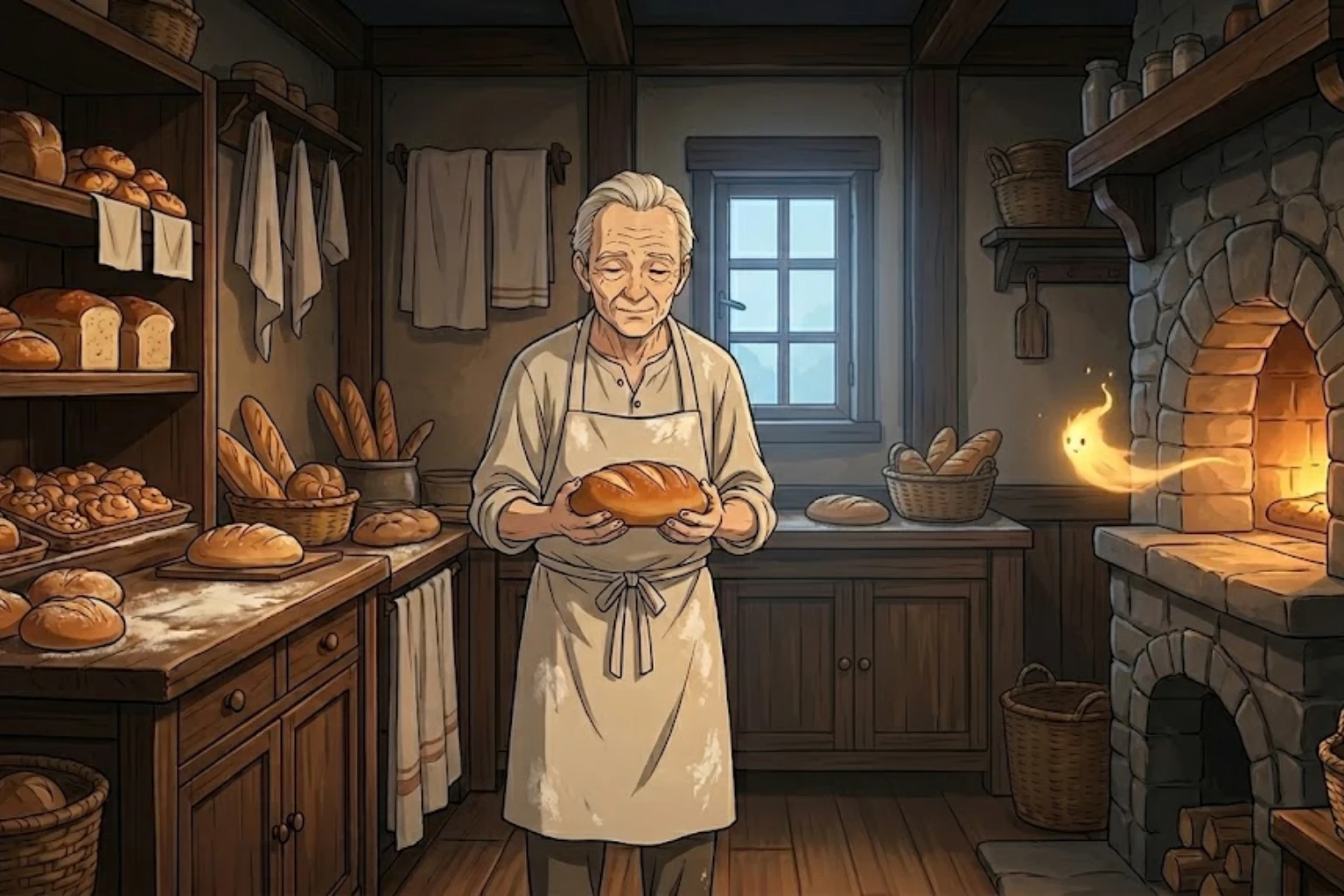
The town of Mizukomori smelled like bread before it smelled like anything else, which Kuroha decided within her first ten minutes of walking the main street was one of the finer ways a town could introduce itself.
It was a small place, built along a slow bend in a river too modest to have a name anyone agreed on, with a single main street and the unhurried rhythm of somewhere that had never needed to be anything other than what it already was. Houses with deep eaves. A shrine at the north end, half-swallowed by old cedars. And at the center of it all, the bakery — a low wooden building with a blue curtain in the doorway and a hand-painted sign reading simply Bread, as if further specificity would have been showing off.
She went in because the smell made it nearly impossible not to.
The bread was extraordinary. Not in the dramatic way — nothing about it announced itself — but in the quiet, complete way of something made correctly by someone who had been making it for a very long time. Soft inside, good crust, the kind of loaf that tasted like it had been made by a person who loved the people eating it, even if that person was a stranger.
The baker who handed it to her across the counter was an old man named Heizo, stooped and white-haired, with hands that moved with the steady economy of decades of practice and eyes that had the soft, slightly distant quality of someone listening to a sound only he could hear.
"First time in Mizukomori?" he said.
"First time," Kuroha said. "The bread is very good."
"It's my wife's recipe," Heizo said, and something moved through his face when he said it — brief, gone before it fully arrived. "Come back tomorrow. The morning loaves are best early."
She thanked him and left, and didn't think much of it, because there was nothing yet to think much of. A baker proud of his late wife's recipe was not a mystery. It was, if anything, the most ordinary kind of grief — worn smooth at the edges, folded into the daily motion of a life that had kept going.
It was the second morning that she noticed the first wrongness.
She had come early, while the street was still grey and the shrine bell hadn't yet rung for the day, mostly because she had not been sleeping well and a walk had seemed preferable to lying in the inn's narrow bed listening to the river. The bakery's shutters were open. Warm light spilled from the doorway, and the smell of fresh bread was already thick in the cool air, and through the gap in the blue curtain she could see the shelves — full. Loaves stacked in neat rows, each one glistening faintly with the particular sheen of bread that had just come out of an oven.
But there was no oven heat coming through the doorway. No flour dust hanging in the light. No sound of a man moving through the small ordinary business of cleaning up after a morning's baking.
Heizo was sitting on a stool behind the counter, very still, looking at the shelves of bread as if he had never seen them before.
"Good morning," Kuroha said, stepping through the curtain.
He looked at her with a half-second of genuine confusion — the look of someone surfacing from somewhere deep — before his expression resolved into the same polite warmth from the day before.
"Good morning," he said. "You're up early."
"So are you."
"I'm always up early," he said. "The bread doesn't bake itself."
She looked at the shelves. At the absence of heat. At the small dusting of flour on the counter that looked, on closer inspection, undisturbed — as if it had been there for days rather than hours.
"It smells wonderful," she said, which was true, and also the kind of thing a traveler said, and she had learned long ago that the kind of thing a traveler said was often the best way to keep watching without anyone noticing they were being watched.
She bought a loaf. She left.
She came back the next morning before dawn, and did not go in.
She stood instead in the shadow of the shrine's outer gate, where the cedars blocked the worst of the wind, and watched the bakery's dark windows with the patient attention of someone who had spent a great deal of her life waiting for things that did not want to be seen.
At some hour she couldn't precisely name — not quite dawn, not quite the deep dark before it, the kind of hour that belonged to neither night nor morning — the windows began to glow.
Not with lamplight. Lamplight flickered, breathed, had the small living unevenness of fire. This was steadier than that, the same gold from corner to corner, the light of something that wasn't burning so much as remembering.
She crossed the street and went around to the small window at the back of the bakery, the one that looked into the kitchen, and looked through the gap in the curtain.
The kitchen was full of warmth and motion, and none of it belonged to Heizo, who was sitting at the small table in the corner with his hands folded and his eyes open, watching.
The oven door opened and closed by itself. Flour rose from the bin in a slow unhurried column and settled into a bowl already mixing, stirred by a wooden spoon that moved with no hand on it, turning in the same circular pattern, around and around, with the unthinking confidence of a motion performed ten thousand times. Dough rose and was folded and rose again. Loaves slid onto trays. Trays slid into the oven, and came out, gold and steaming, and were set on the cooling racks in the same order, in the same spacing, every single time.
In the corner of the kitchen, barely visible, a small shape moved through the warmth like a flicker of heat above a flame — no larger than a folded hand, formless in the way that very young or very simple spirits often were, more presence than shape, more warmth than form. It moved through the kitchen with the absolute familiarity of something that had done this every day for longer than it could count, and did not seem to notice Kuroha at the window at all.
Heizo watched it work. His face, in the gold light, looked unbearably tired, and unbearably grateful, and like a man watching something he loved very much that he could not bring himself to stop.
Kuroha stepped back from the window and did not go in.
She walked the riverbank instead, in the cold not-quite-morning, and thought.
A hearth spirit was not, in itself, unusual. They formed in places where the same warmth had been made the same way for long enough — kitchens, forges, the hearths of houses that had stood for generations. They were small things, born of repetition and care rather than intention, no more aware of their own origin than a fire was aware of the wood that fed it. Most were harmless. Most simply kept a small corner of the world a little warmer than it should have been, and asked nothing in return.
This one had been born from grief, and grief had given it a single morning to repeat, and it had been repeating that morning for long enough that the only person who could see it clearly — the only person it was, in its small unthinking way, doing all of this for — had grown old waiting for a wife who was never going to walk back through that kitchen door.
The bread stayed perfect because the spirit had no concept of time passing. Heizo did not.
She found him on the bakery's back step the next evening, after the shop had closed and the street had gone quiet, sitting with a cup of tea he wasn't drinking and the specific stillness of a man who had run out of ways to fill his evenings.
"You've been watching," he said, without looking up, when she sat down beside him.
"I have," Kuroha said. "I'm sorry. I should have asked first."
"No." He turned the cup slowly in his hands. "I think I wanted someone to notice. I just didn't know how to be the one to say it."
The river moved past the end of the street, dark and unhurried.
"Tell me about her," Kuroha said.
Heizo was quiet for a long moment.
"Asa," he said. "My wife. She baked. I built the ovens and carried the flour and did the parts that needed strength instead of patience, and she did the rest, and she was better at it than I ever was, and she never once let me forget it, and I never wanted her to." Something that was almost a laugh moved through him and didn't quite finish. "We had forty-one years. I thought that would be enough. You always think the number you get will be enough, until you have it."
"What happened?"
"Her heart," he said. "In her sleep. Beside me. I didn't even —" He stopped. Started again. "The last morning she was alive, she made the bread the way she always did. Hummed while she worked, the way she always did. Kissed my forehead on her way out to open the shutters, the way she always did. It was an entirely ordinary morning. I didn't know it was the last one. You never know which one is the last one."
"And then the bread kept coming," Kuroha said gently.
"Three days after we buried her," Heizo said. "I came down to the kitchen because I couldn't sleep, and the oven was warm, and the bread was on the shelves, and for one moment — one whole moment — I thought she was alive and none of it had happened." He pressed his palm flat against his knee, as if steadying something. "It was the cruelest and kindest thing that has ever happened to me, in the same breath."
"And you let it keep happening."
"I didn't know how to stop it," he said. "And then I didn't want to know how to stop it. And now—" He looked at his own hands, the spotted skin, the slight tremor that had not been there, she suspected, in the man who had carried flour sacks and built ovens for his wife for forty-one years. "Now I look in the mirror most mornings and I don't entirely recognize who's looking back. I think I've been getting older every day, and the bread hasn't aged a single morning, and I think that's because the morning it remembers isn't moving forward. Only I am."
"It loves you," Kuroha said. "The thing in your kitchen. It isn't her. But it grew out of everything she did for this house, every morning, for forty-one years, and it doesn't know how to do anything except keep doing that, because that's the only thing it's ever been. It's trying to take care of you the only way it knows. It just doesn't understand that the way to take care of you isn't to freeze the morning she died. It's to let it become a memory instead of a loop."
Heizo's eyes were wet, and he did not try to hide it, which she appreciated.
"Can you make it stop?" he said.
"I could," Kuroha said. "But I won't. Not without you. It isn't mine to end. It's yours."
"I don't know if I can."
"I think you can," she said. "I think you've been ready for longer than you've let yourself believe. I think that's why you let me watch through the window instead of closing the curtain."
He was quiet for a long time, looking at the dark shape of the bakery against the darker sky.
"Tomorrow," he said finally. "Let it be tomorrow morning. One more time. I want to ask her — ask it — properly. Not just let it end on an ordinary day like all the others."
"Tomorrow," Kuroha agreed.
She came before dawn, as she had the morning she'd first watched, and stood beside Heizo in the doorway of the kitchen while the spirit moved through its small golden ritual, exactly as it always had — flour rising, dough turning, the oven door breathing open and shut.
"It can see you," Kuroha said quietly. "It's always been able to see you. It just doesn't know any other way to be near you except like this."
Heizo stepped into the kitchen.
The spirit paused — the first time, Kuroha suspected, that it had paused in longer than anyone could count. The small warm shape hung in the air above the worktable, formless, flickering, watching him with whatever a thing like that watched with.
"Asa," Heizo said, and his voice broke fully on the second syllable and he let it. "Thank you. For all of it. For every morning you gave me, even after you were already gone. I didn't deserve a single one of them, and you gave me hundreds." He took a slow breath. "But I think you're tired. I think you've been tired for a long time, and you didn't know how to stop, because you didn't want to leave me alone in a house with no bread in it."
The light in the kitchen wavered, gentled, came down lower and closer, until it hovered near his chest like something resting against him.
"I won't be alone," Heizo said. "I have the recipe. I have forty-one years of watching you do it. I can bake the bread myself now. Badly, probably, at first. But I can do it. And every morning I do, I'll be doing it because I remember you, not because something is trying to make me forget you're gone." His hands were shaking. "You can rest now. Please. Let the morning end."
For a long moment nothing happened, and Kuroha thought, with the specific ache of someone who had seen this shape of thing before, that perhaps it would not be enough — that grief this old did not always listen, even when the person it loved asked it kindly.
Then the oven door opened on its own, one final time.
And the bread inside — not dough now, but a single finished loaf, golden and whole — lifted gently from the rack and floated across the small kitchen, unhurried, and settled into Heizo's waiting hands, still warm.
The light went with it. Not extinguished — gathered, the way a candle's flame draws itself in before going out, the way warmth doesn't vanish so much as it simply finishes being warmth and becomes, quietly, the absence of cold. The golden flicker in the corner of the kitchen dimmed, and softened, and folded itself smaller, and smaller, and was, finally, only morning light coming pale through the eastern window, ordinary and grey and turning slowly gold the way every morning eventually does.
The oven, when Kuroha touched the iron door, was cool.
Heizo stood holding the last loaf his kitchen would ever make on its own, and wept without trying to stop, and Kuroha stood beside him and did not try to make him stop either, because some mornings were owed exactly the size of grief they came with, and this was one of them.
She left Mizukomori three days later.
Heizo had reopened the shop the morning after, with bread he had baked himself, lopsided and slightly overdone on one side, and had sold every loaf by midday to customers who said nothing about the shape and everything about the taste, which Kuroha suspected was a kindness extended on both sides without anyone quite naming it.
"It's not as good as hers," Heizo told her, on her last morning, handing her a loaf for the road. The crust was uneven. The crumb was a little dense.
"It's good," Kuroha said, and meant it. "It tastes like someone who loved her made it."
Heizo's eyes went soft and wet again, briefly, and he didn't try to hide that either.
"Come back sometime," he said. "I'll have gotten better by then."
"I might," Kuroha said.
She crossed the small bridge at the edge of town with the loaf warm in her bag and the smell of Mizukomori's bread still on her hands, and somewhere behind her a bakery with a hand-painted sign that simply said Bread opened its shutters to an ordinary morning, the first one in longer than anyone but Heizo would ever know, and the street filled slowly with the smell of something good, baked by hands that remembered, on purpose, every single time.


.png)
.png)
.png)