%20(1).png)
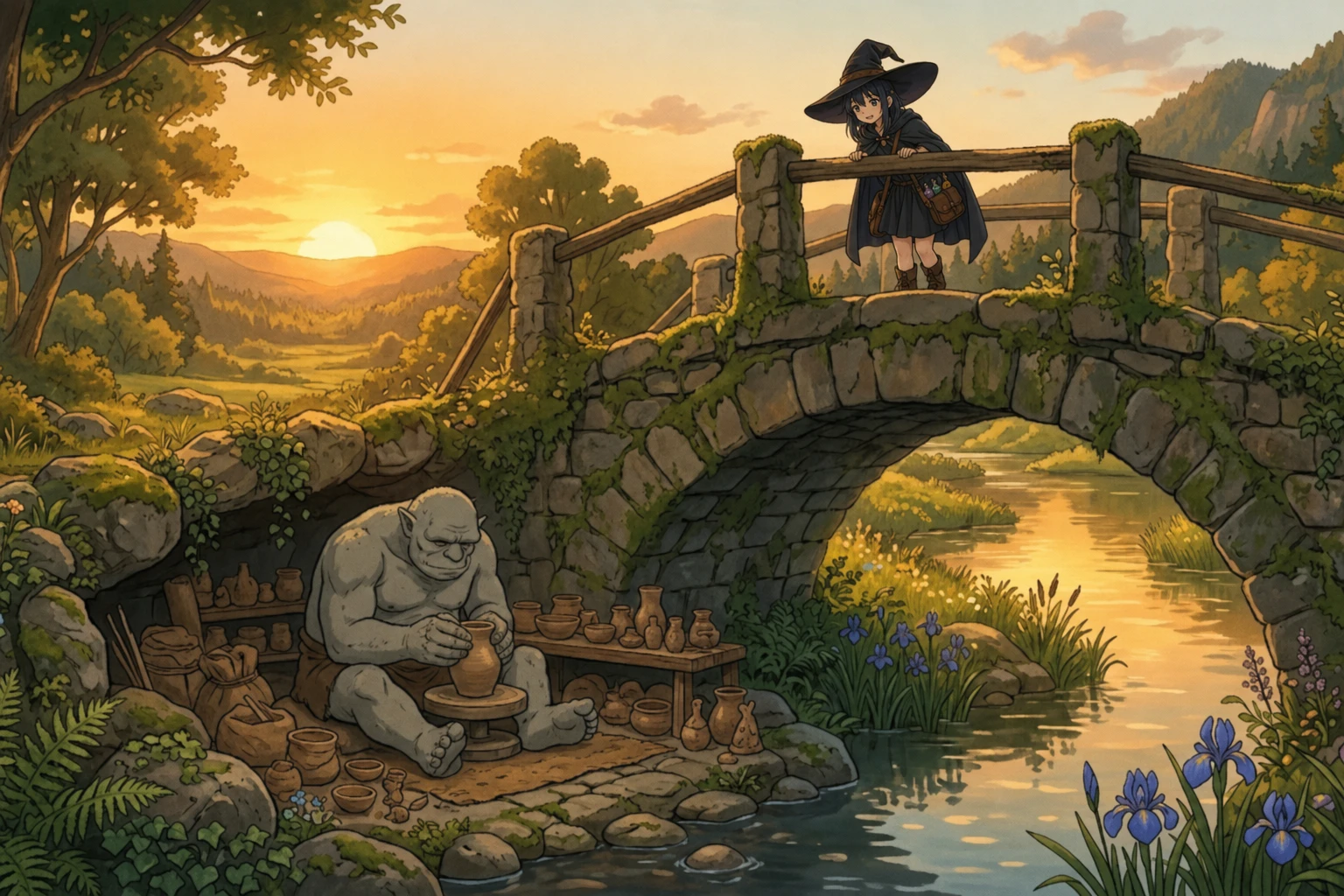
The first thing anyone said to Kuroha in Ishidome was a warning.
This was not unusual. First things in new towns were frequently warnings — about roads, weather, local customs, suspicious strangers, and occasionally supernatural entities of varying credibility. Kuroha had developed a way of receiving warnings that conveyed attentiveness without commitment, which she deployed now as the man at the town gate — self-appointed, by the look of him, the kind of person who positioned himself where information could be distributed — held up a hand as she approached.
"Witch?" he said, looking at the hat.
"Traveling through," Kuroha said.
"North road or south?"
"North, eventually."
He sucked air through his teeth in the manner of someone about to deliver important information. "North road crosses the old bridge," he said. "You'll want to cross before dark. Don't linger on it. Don't look over the sides. Don't drop anything into the water."
"The troll," Kuroha said.
He pointed at her. "You've heard."
"I heard something on the road."
"Big," he said. "Grey. Lives right under the bridge, been there for generations. Caused all manner of trouble — missing livestock, strange sounds at night, the Toda family's fence collapsed last spring." He paused. "Probably the troll."
"Probably," Kuroha said.
"Cross before dark," he said again. "And keep moving."
She thanked him and walked into town, making a mental note of the bridge and a separate mental note of the Toda family's fence, which had almost certainly collapsed due to the frost-weakened posts she had noticed from the road and had nothing whatsoever to do with trolls.
Ishidome was a small town built around a crossroads — the north-south road and an east-west trading route meeting at a square that contained a well, a notice board, and a large tree that had been there long enough to have opinions about the buildings around it. The bridge in question was a ten-minute walk north of the square, a broad stone arch over the river that connected the town to the mountain road beyond.
The inn was run by a woman named Sato Reiko, who had the efficient manner of someone who had been running things alone for long enough that she had stopped noticing the effort. She was perhaps forty, with the kind of face that defaulted to skepticism not from unfriendliness but from experience — the expression of someone who had heard many things and updated their beliefs accordingly.
She looked at Kuroha the way she probably looked at most things. Thoroughly.
"Room?" Kuroha said.
"How many nights?"
"Two. Possibly three."
Reiko wrote it down. "North road?"
"Eventually."
"Cross the bridge in the morning," Reiko said. "Before eight. The troll is quieter in the morning."
"I'll keep that in mind," Kuroha said.
"I'm serious," Reiko said, with the tone of someone who had said this before and been dismissed before. "I know how it sounds. But that bridge has been a problem for thirty years and the troll is the reason. You're young and you're traveling alone and I'd rather tell you plainly than have you find out the hard way."
Kuroha looked at her.
There was something in Reiko's manner that was different from the man at the gate — less performance, more genuine concern. The gate man had been distributing information. Reiko was trying to protect someone.
"Thank you," Kuroha said, and meant it. "I'll be careful."
Reiko held her gaze for a moment, as if checking the sincerity of this, and then handed over the room key and went back to her ledger.
Kuroha went to the bridge that evening.
Not to cross it — just to look. She walked the north road in the long summer dusk, the light going gold through the trees, the river audible before it was visible — a broad, steady sound, the kind of river that had been doing this for a very long time and was not in any hurry.
The bridge was old. Really old — the stonework had the rounded, settled quality of something that had been here long enough to become part of the landscape rather than an addition to it. Moss covered the lower courses. The arch was wide and graceful, built by people who had understood that a bridge was not just a crossing but a permanent thing, a commitment to a place.
She leaned on the railing and looked down at the water.
Under the bridge, in the shadow of the arch where the light barely reached, something very large was sitting in the shallows.
It was grey. It was big. It was holding a small clay pot in hands the size of dinner plates, turning it carefully, examining the underside with the focused attention of someone assessing craftsmanship.
It looked up.
Two amber eyes, large and calm, looked back at her from under the bridge.
Neither of them moved for a moment.
Then Kuroha said: "Nice pot."
The troll looked at the pot. "River clay," he said. His voice was low and slow, the kind of voice that had never been in a hurry. "From the eastern bend. Good clay there. Dense."
"Do you make them yourself?"
"I try." He turned the pot again. "The bottoms are uneven. I can't get them right."
Kuroha looked at the pot from her angle. "Your thumb pressure is uneven on the left side," she said. "You're right-handed?"
A pause. "How did you know."
"The left wall is thinner. You're compensating with your off hand and not quite matching the pressure." She tilted her head. "Even out the grip at the base. Use three fingers instead of two on the left."
The troll looked at his hands. Then at the pot. Then up at her.
"You know pottery," he said.
"I know a little of most things," she said. "My name is Kuroha."
Another pause. Longer. The river moved around his legs with the comfortable indifference of water that had been moving around this particular obstacle for a long time.
"Grum," he said.
She climbed down the bank and sat on a rock at the water's edge, which put her approximately at Grum's eye level when he was sitting, which seemed like the right way to have a conversation.
He was, up close, exactly what a bridge troll should look like — massive, grey-skinned, built with the solid density of something that had grown up in stone and water. He had a broad flat nose and ears like the fins of some ancient fish and hands that could have lifted the bridge itself without particular difficulty. He was also, she noted, surrounded by things — the clay pot in his hands, several others in various stages of completion arranged carefully on a flat stone, a collection of smooth river rocks sorted by size and color, and, tucked in a crevice of the bridge foundation, a small but clearly tended arrangement of river plants growing in packed river mud.
"Your garden?" she said.
He looked at the plants with an expression that was difficult to read on a face built for a different range of expressions, but which resolved, on examination, into something like pride.
"River mint," he said. "And water iris. The iris is difficult. It keeps trying to grow toward the light and the bridge blocks it."
"You could move it to the sunny side of the bank."
"People walk there," he said. And then, after a pause: "They don't always look where they step."
Kuroha looked at the iris. At the careful way it had been positioned to catch the limited light that made it under the arch.
"How long have you been here?" she said.
"Always," Grum said. "My mother was here. Her mother before her. The bridge was built while our family was already here — we didn't choose it, exactly. It just became ours." He turned the clay pot in his hands again. "We guard it. That's what we do. That's what we've always done."
"From what?"
He looked at the water. "Floods. Structural problems. Travelers in trouble. A family tried to cross in a storm once, fifty years ago — my mother pulled them out of the current. All four of them." He paused. "They ran away when they saw her."
Kuroha said nothing.
"She didn't mind," Grum said, in the tone of someone who had decided, a long time ago, that something didn't bother them and had mostly made it true. "She said the important thing was that they were safe."
The river moved between them and the evening light faded slowly from the stones.
"They blame you for things," Kuroha said. "In town."
"I know."
"The Toda fence."
"Frost," Grum said. "I saw the posts last winter. I thought about saying something but—" He stopped.
"But."
"Who would I say it to," he said. Simply. Without self-pity, which made it worse.
She heard about the goat the next morning at breakfast.
Reiko set down her rice with the focused energy of someone who had already been managing a situation for two hours and was not finished. "Nakamura's goat," she said. "Missing since last night. Old Nakamura is beside herself."
"Missing how?" Kuroha said.
"Wasn't in the pen this morning. Gate was open — she thinks the latch failed." Reiko's expression settled into the specific configuration of someone about to say something they had already decided. "People are saying the troll took it."
"Are they."
"Three people have said it to me this morning. I told them the troll has never taken livestock in thirty years and there's no reason to start now, but—" She pressed her lips together. "Once people have a story they find it difficult to give it up."
Kuroha ate her rice.
She thought about Grum and his clay pots and his water iris and the careful way he had described his mother pulling a family from a flood current.
"Which direction does Nakamura's pen face?" she said.
Reiko looked at her. "East. Why."
"The ravine is east of town," Kuroha said. "The rocky one, past the mill."
A pause.
"You think the goat wandered," Reiko said.
"I think goats go where they want when latches fail," Kuroha said. "And I think the ravine has ledges."
Reiko was quiet for a moment — the recalibrating expression, the one Kuroha had noticed on her first day. She was a person who updated her beliefs when presented with better information. That was a useful quality.
"I'll come with you," Reiko said.
"I'll handle it," Kuroha said.
"You don't know where the ravine—"
"East of the mill," Kuroha said. "Past the old cedar. You described the road yesterday when you were telling me about the north route."
Reiko looked at her for a moment.
"You pay attention," she said.
"Habit," Kuroha said.
She found Grum at the bridge and explained the situation in approximately forty words, which was the right number for Grum, who processed information slowly and thoroughly and did not benefit from excess.
He listened. Looked east toward the ravine. Looked at his hands.
"The ledges on the east face are dangerous," he said. "Narrow. Loose rock."
"I know," Kuroha said.
"I can climb them," he said.
"I know that too," she said.
He looked at her with the amber eyes that had looked at this river for his entire life.
"Will people see?" he said.
"Probably," she said. "Nakamura will be looking for her goat. Reiko might follow despite what I said."
"And they'll be afraid."
"Maybe," Kuroha said. "Or maybe they'll see what you're doing and think about it."
He was quiet for a long moment. The river moved. The water iris in its crevice caught the morning light.
"The goat might be hurt," he said.
"Yes."
"Someone should go soon."
"Yes," Kuroha said.
He set down the clay pot he had been holding — carefully, on the flat stone, right-side up — and stood.
Standing, he was considerably larger than sitting. The bridge arch behind him framed him completely, which was, she thought, probably not a coincidence. He had been built for this place and it had been built around him, and the two things had grown into each other over generations until they were difficult to separate.
"Alright," he said.
They went east.
Old Nakamura was at the ravine edge when they arrived, which meant Reiko had told her, which meant the situation was exactly as socially complicated as Kuroha had predicted and slightly more than Grum had hoped for.
Nakamura was perhaps seventy, small and sturdy, with the weathered face of someone who had spent a lifetime outdoors and the expression of someone who had just seen a very large grey creature emerge from the tree line with a witch.
She went completely still.
Kuroha walked up beside her and looked over the ravine edge.
The goat was on a ledge twelve feet down — a small brown and white animal with the specific expression of something that had made a decision it now regretted, standing on a shelf of rock perhaps two feet wide with loose stone above and a long drop below.
"Hana," Nakamura said, very quietly.
The goat looked up at the sound of her name and made a sound that contained everything about the situation.
Grum crouched at the ravine edge and examined the face of the rock with the assessment of someone who had been climbing things since before anyone in this town was born. He found his route — Kuroha could see him tracing it with his eyes — and went over the edge without ceremony, his large hands finding holds in the rock face with a sureness that suggested he had done this, or things like this, many times.
Nakamura watched.
Reiko, who had appeared from the tree line two minutes after Kuroha had predicted, watched from the other side.
Grum reached the ledge. The goat startled and pressed against the rock wall, but he moved slowly — very slowly, with the deliberate patience of something that understood it was frightening and was doing everything possible not to be — and crouched down and held out one enormous hand, palm up, and waited.
The goat looked at the hand.
Looked at Grum.
Sniffed the hand.
And then, with the pragmatic trust of an animal that was cold and scared and had been on this ledge since last night, stepped forward and allowed itself to be gathered up against his chest with a gentleness that was completely at odds with the size of the hands doing the gathering.
He came back up the rock face one-handed, which should not have been possible and was, and set the goat on the ground at Nakamura's feet and stepped back.
The goat walked directly to Nakamura and pressed its head against her legs.
Nakamura crouched and held it and said nothing for a moment.
Then she looked up at Grum, who was standing at a careful distance with his hands at his sides and the expression of someone who was not sure whether to stay or go and had defaulted to stillness as the least alarming option.
"Thank you," Nakamura said.
Grum looked at her. At the goat. At his own hands.
"She's not hurt," he said. "Cold and hungry. But not hurt."
"I can see that." Nakamura stood slowly, one hand still on the goat's back. "I'm sorry," she said. "About the things people say. About what I — thought, this morning, when she went missing."
Grum was quiet.
"I should have known better," Nakamura said. "You've been under that bridge my whole life and you've never once—" She stopped. "I should have known better," she said again.
It was not a comfortable speech. It was honest, which was better.
Grum looked at the river, visible through the trees to the west.
"People believe what they're told," he said. "I don't hold it against anyone."
"You should," Nakamura said. "A little. It would be reasonable."
Something moved in Grum's expression — slow and difficult to read, but real.
"Maybe a little," he said.
Reiko walked back to town beside Kuroha while Nakamura carried the goat ahead of them.
She was quiet for a long time in the way of someone reorganizing something internal.
"Thirty years," she said finally.
"Of what?" Kuroha said.
"Of blaming him. For the fence. For the missing chickens — those were foxes, I always thought it was foxes. For the sounds at night." She paused. "For the general sense that something was wrong."
"Something was wrong," Kuroha said. "Just not what anyone thought."
Reiko looked at her sideways. "You knew," she said. "Last night. You already knew he wasn't dangerous."
"I thought it was worth checking," Kuroha said.
"How did you know."
Kuroha considered how to answer this honestly without answering it completely.
"Dangerous things don't tend to stay in one place for thirty years without causing more damage than a fence and some missing chickens," she said. "Something that stays in one place for thirty years is usually something that belongs there."
Reiko walked for a while with this.
"He gardens," she said.
"River mint and water iris," Kuroha said.
"Under a bridge."
"Limited sunlight," Kuroha said. "He manages."
Reiko made a sound that might have been the beginning of a laugh that had decided to be something more thoughtful instead.
"You're strange," she said. "For a traveling witch."
"Most traveling witches are strange," Kuroha said. "It's a prerequisite."
She left Ishidome on the third morning.
The north road took her past the bridge, as it always would — it was the only way. She stopped at the railing and looked down.
Grum was in his usual spot in the shallows. He was working on a clay pot, and from this angle she could see he had adjusted his grip at the base — three fingers on the left side, evenly distributed.
The pot looked better.
"North road," he said, without looking up.
"Mountain pass, then the valley beyond," she said. "There's a village called Tamori three days out. I've been meaning to visit."
"Safe road," he said. "The pass is clear this time of year. The bridge before Tamori is wood — old. Mind the third plank from the east end, it's soft."
She looked at him.
"I walk the roads sometimes," he said. "At night. When it's quiet." He turned the pot. "Someone should check the bridges."
"Thank you," she said.
He nodded, which for Grum was a significant gesture.
She adjusted her bag and started across the bridge. Halfway across she stopped and looked over the railing on the downstream side — at the water moving south, at the morning light on it, at the river mint visible in the crevice of the foundation below, green and quiet and tended.
She kept walking.
Four hours later, back in Ishidome, a traveler stopped at Sato Reiko's inn for lunch and mentioned that he had come down from the mountain road that morning.
"Safe crossing?" Reiko said, setting down his tea.
"Perfectly fine," he said. "Though I'll tell you, I nearly lost my nerve at the old stone bridge. Heard there's a troll under it."
Reiko looked at him.
"There is," she said.
The traveler blinked.
"His name is Grum," Reiko said. "He's been there his whole life. If you dropped anything in the water he probably would have handed it back." She picked up his empty cup. "More tea?"
The traveler stared at her.
"More tea," he said faintly.
She poured it.
Outside, Nakamura's goat was back in her pen, eating with the focused enthusiasm of an animal that had been through an ordeal and was ready to put it behind her. The town went about its morning. The bridge stood at the north end of the road, grey and solid and exactly where it had always been.
Under it, Grum set down his finished pot and looked at the bottom.
Even. Both sides.
He set it carefully beside the others and picked up more clay.


.png)
.png)
.png)