%20(1).png)
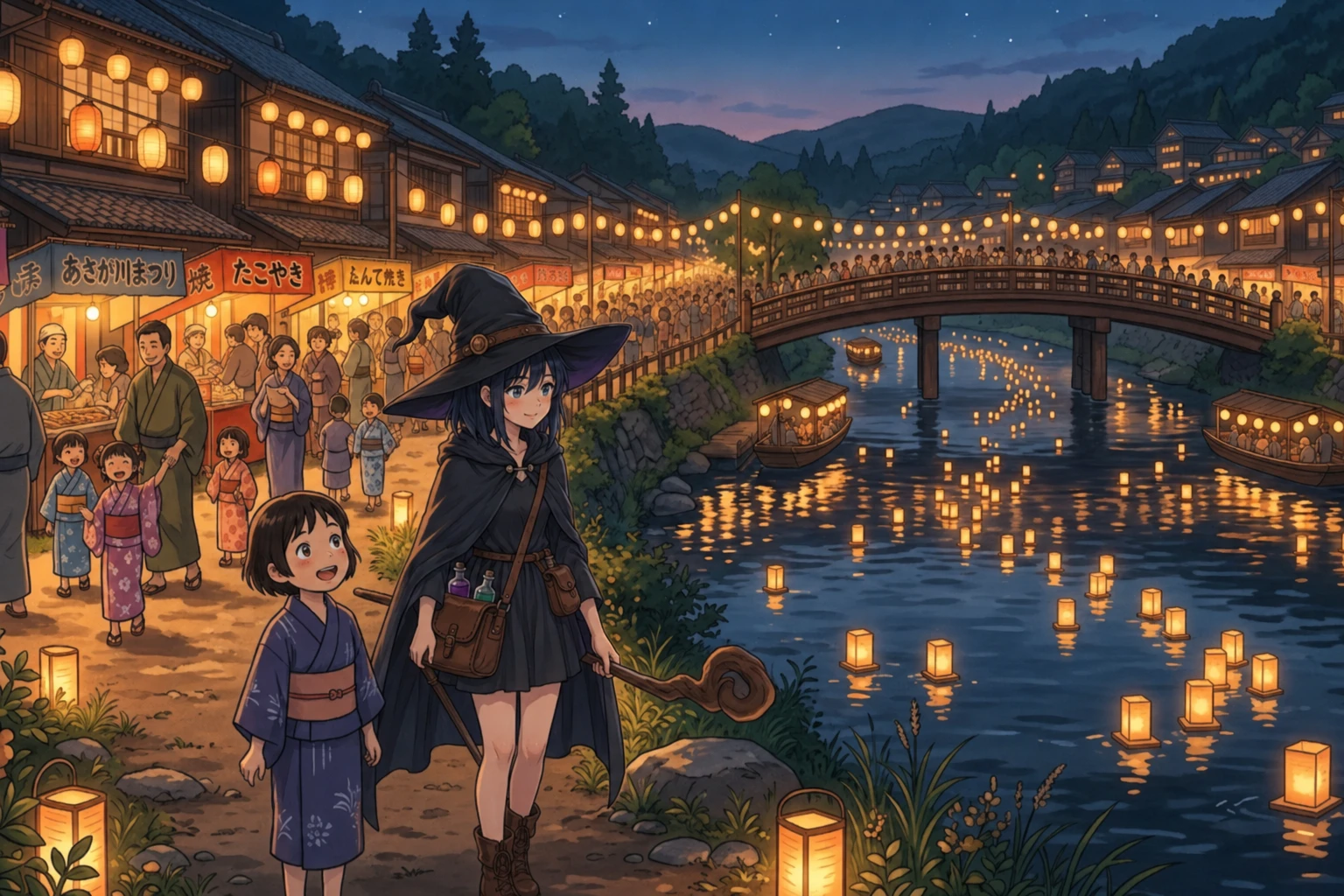
She arrived on the afternoon before the festival, which was either good timing or the kind of coincidence that stopped being coincidence after it happened enough times.
The town of Asegawa sat where two rivers met, which was why it existed and why it thrived and why, every year in late summer, it held a lantern festival that sent paper lights downstream on both currents simultaneously — a tradition older than the town's current name, older than most of the buildings, older than anyone could reliably trace, rooted in the kind of folk memory that persisted because the alternative had consequences nobody wanted to test.
Kuroha walked in across the stone bridge with her hat slightly askew from the road and her bag over one shoulder and the general appearance of someone who had been walking for several hours and was ready to stop. Which she had been, and was.
The children found her before she reached the main street.
This was normal. Children had a sense for her that adults had largely outgrown — some residual instinct for recognizing things that were slightly outside the ordinary, still intact in the young and worn smooth in everyone else by the accumulated mundanity of daily life. They appeared from a side street in a small cluster, four of them, ranging in age from perhaps five to perhaps ten, and stopped in front of her with the direct unselfconsciousness of children who had not yet learned to pretend they weren't looking at something interesting.
Kuroha stopped walking.
"Hello," she said.
"Your hat is crooked," said the youngest.
"It does that," Kuroha said. She reached up and straightened it. It immediately began listing to the left again. She left it.
"Are you a witch?" said the tallest one, a girl with two neat braids who had the air of designated spokesperson.
"I'm a traveler," Kuroha said.
"You have a witch hat."
"Travelers can have hats."
"Not that kind."
Kuroha considered this. "Fair point," she said.
She reached into her bag and produced a small paper bird — folded simply, the kind of origami that looked unremarkable until she held it on her palm and breathed on it once, lightly, and it shook its wings and lifted into the air and circled the group twice in a slow blue-glowing arc before settling on the braided girl's outstretched finger as if it had always intended to land there.
The children made the sound children made for this — the sharp collective intake, the immediate cascade of delight — and Kuroha smiled and adjusted her hat and continued toward the main street, and four children followed her, which she had expected, and then a fifth appeared from somewhere, which she had also expected, and that was how she acquired Rin.
Rin was seven, small for seven, and had the particular quality of a child who asked questions in the way some people breathed — continuously, without apparent effort, as a natural function of existing.
She had detached from the group within the first block and positioned herself at Kuroha's left side with the proprietary confidence of someone claiming a spot before someone else could, and had not left it since.
"Where did you come from?" Rin said.
"North," Kuroha said.
"How far north?"
"Quite far."
"Did you walk the whole way?"
"Most of it."
"That's a lot of walking."
"It is."
"Do your feet hurt?"
"Sometimes."
"My feet hurt when I walk a lot too," Rin said, with the gravity of someone establishing common ground. "I wore new sandals to the festival last year and I had a blister for two weeks."
"That's a serious blister," Kuroha said.
"It was enormous," Rin agreed. "My grandmother said it was the biggest she'd ever seen."
They walked in companionable silence for approximately four seconds, which appeared to be Rin's upper limit.
"What's in your bag?" she said.
"Things I need."
"Like what?"
"Tools. Maps. Spare paper for birds."
"What else?"
"Dried fruit. A change of clothes. A small book."
"What's the book about?"
"Rivers," Kuroha said.
Rin looked up at her with the expression of a child recalibrating. "Rivers?"
"I find them interesting."
"Why?"
Kuroha thought about this honestly. "Because they go somewhere," she said. "And they always know where."
Rin considered this with the serious face she apparently reserved for things that required processing.
"I don't always know where I'm going," she said.
"You're seven," Kuroha said. "You have time."
The inn was run by a woman named Oba-san Tsuji who was approximately seventy and had the efficient warmth of someone who had been welcoming travelers for so long that hospitality had become indistinguishable from personality. She looked at Kuroha's hat and said nothing about it, which Kuroha appreciated, and showed her to a room that faced the river.
"Festival's tomorrow evening," Oba-san Tsuji said, setting down the room key. "You've arrived at a good time."
"I heard it was lovely," Kuroha said.
"It is." A brief pause. "Though I'd stay close to town after dark if I were you. The riverbanks get strange this time of year." She said it in the tone of someone relaying established local wisdom rather than anything dramatic — the same tone you'd use to advise a traveler that a particular road got muddy in rain. Practical. Accepted.
"Strange how?" Kuroha said, because it was the question a normal traveler would ask.
"Lights on the water," Oba-san Tsuji said. "Sounds. The kind of thing you don't want to investigate." She picked up her tray. "Old town, old river. Some things you just leave alone."
"Sound advice," Kuroha said.
After Oba-san Tsuji left, Kuroha stood at the window and looked at the river in the late afternoon light — at the place where the two currents met below the bridge, the water moving in slow overlapping circles, the surface catching the sun in a way that was almost entirely ordinary.
Almost.
She set her bag on the bed and began unpacking the things she actually needed.
Not the dried fruit. Not the change of clothes.
The other things.
Rin found her again the following morning at the sweet shop.
Kuroha was examining a tray of wagashi with the focused consideration of someone for whom this was a serious decision, and Rin appeared at her elbow with the seamless inevitability of a child who had simply decided that wherever Kuroha was, that was where Rin was.
"You're still here," Rin said.
"I'm still here," Kuroha agreed.
"I thought you might have left."
"I said I was staying for the festival."
"Adults say things," Rin said, with the philosophical resignation of someone who had been promised things and seen those promises revised. "Then they change."
Kuroha looked at her. "I don't change plans without reason," she said.
Rin considered this and apparently found it satisfactory. She looked at the wagashi tray. "The ones with the red bean are best," she said. "The green ones look nicer but they're disappointing."
"Duly noted," Kuroha said, and bought two of the red bean ones, and gave one to Rin, who accepted it with the gravity of someone receiving something they had earned.
They ate on the low wall by the river and watched the town prepare for the evening — paper lanterns being strung between buildings, folding tables set up along the main street, the smell of festival food beginning to drift from the direction of the market square. Children ran. Adults moved with the purposeful bustle of people who had done this many times and knew the sequence by heart.
"Do you have a festival where you're from?" Rin said.
"I don't really have a from," Kuroha said. "I travel."
"Always?"
"For a long time now."
Rin swung her feet against the wall. "Don't you get lonely?"
Kuroha looked at the river. At the place where the two currents met.
"Sometimes," she said honestly. "But I like arriving places. I like the moment when a town is new and everything is interesting." She paused. "And I like meeting people."
"Like me?"
"Like you."
Rin seemed pleased with this in the way children were pleased with things — directly, without qualification. She ate the last of her wagashi and looked at the river.
"My grandmother says something lives in the water," she said. "Where the two rivers meet."
"What does she say it is?"
"She doesn't know exactly. Something old." Rin picked at the edge of the wall. "She says it's been there longer than the town. She says the lantern festival is partly for it — to keep it happy so it stays in the water and doesn't wander."
Kuroha was quiet for a moment.
"Your grandmother sounds wise," she said.
"She's very old," Rin said. "Old people know things."
"They do," Kuroha agreed.
The festival was everything a festival should be.
Kuroha moved through it in the comfortable state of someone who had attended many festivals in many towns and had come to understand them as one of the finest things ordinary human life produced — the specific combination of light and noise and smell and collective happiness that existed in no other context, that required exactly this density of people in exactly this mood in exactly this place.
She bought grilled corn. She watched a performance by local children that involved a great deal of confident singing and some creative interpretations of the choreography. She let Rin drag her to three different game stalls, and won a small ceramic fox at the ring toss that she gave to Rin immediately, and Rin accepted it with the proprietary satisfaction of someone who had known this would happen.
Rin's parents found them near the food stalls — a gentle-looking couple who looked at Kuroha with the mild assessment of people encountering the person their child had apparently adopted without permission.
"She's been talking about the witch since yesterday," Rin's mother said, with a smile that suggested this was not entirely surprising.
"I'm a traveler," Kuroha said.
"You have a witch hat," Rin's father said.
"Travelers can—" Kuroha started.
"She does tricks," Rin interrupted. "Paper birds that fly. Show them."
Kuroha showed them. The paper bird circled once and landed on Rin's ceramic fox and Rin's parents made the adult version of the children's sound — quieter, more contained, but genuine.
"Stay for the lantern release," Rin's mother said. "It's the best part."
"I was planning to," Kuroha said.
She left during the lantern release.
Not obviously — she waited until the lanterns were lit and the crowd had moved to the riverbank and every face was turned toward the water, the collective attention of the entire town given over to the lights drifting downstream on both currents, and in that window she slipped away through the back streets and down to the riverbank east of the bridge, where the two currents met in their slow overlapping circles and the water had the quality she had noticed from her window the previous afternoon.
The spirit was there.
It had been drawn to the surface by the lanterns — by the lights and the intention behind them, the old folk memory of the town sending its acknowledgment downstream. But something had shifted in it this year. It was larger than it should have been. More present. The kind of more-present that happened when something old had been patient for a very long time and had decided, recently, that patience had limits.
Kuroha stood at the water's edge and looked at it.
It looked back — not with eyes exactly, more with the quality of attention that very old things had, the kind that was the accumulated weight of centuries of simply being aware.
"I know," she said quietly. "It's been a long time."
The water moved in a way that wasn't the current.
"The lanterns are for you," she said. "They've always been for you. They haven't forgotten." She crouched at the bank. "But you can't come into the town. You know that."
The water stilled.
She reached into her bag and produced a single lantern — not the paper kind from the festival, but an older kind, the kind she made herself from materials she didn't explain to people who asked. She lit it with a word she said under her breath and set it on the water and let it go.
It moved upstream, against the current, which lanterns didn't do.
The spirit followed it.
Slowly. The water settling behind it as it moved, the surface returning to ordinary behavior, the place where the two currents met becoming simply the place where two rivers came together and nothing more unusual than that.
Kuroha watched until the light disappeared around the upstream bend.
Then she stood, brushed off her knees, and walked back toward the festival sounds.
She found Rin at the riverbank with her family, watching the last of the lanterns drift downstream on both currents.
Rin looked up when she appeared.
"Where did you go?" she said.
"I needed some air," Kuroha said.
"You missed the best part."
"Did I."
"All the lanterns going at once. It was—" Rin searched for the word. "It was like the river was on fire. But friendly fire."
"Friendly fire," Kuroha said. "That's a good description."
Rin looked at the water. "Grandmother says this year felt different," she said. "She says the water felt — satisfied. More than usual." She tilted her head. "She says that's good. That when the water is satisfied the town has a good year."
"Your grandmother sounds right," Kuroha said.
Rin looked at her with the focused, unguarded assessment of a seven-year-old.
"You went to the water," she said.
Not a question. Just a statement, offered plainly, in the way children sometimes said true things without fully understanding why they were true.
Kuroha looked at the river.
"I told you I find rivers interesting," she said.
Rin held this for a moment.
Then she slipped her hand into Kuroha's — small and warm and entirely unselfconscious — and looked back at the water.
"Will you come back next year?" she said.
Kuroha looked at the festival lights reflecting on the river, at the town going warm and bright around them, at the ordinary beautiful life of a place that had just come closer to something dangerous than it would ever know and was now sending its children to bed full of festival food, none the wiser, exactly as it should be.
"I might," she said.
"That's not a yes," Rin said.
"It's not a no either."
Rin considered this with her serious face.
"Okay," she said. "But if you come back, I want to learn the bird."
"The paper bird?"
"How to make it fly. Not the folding part. The other part."
Kuroha looked at her.
"We'll see," she said.
Rin accepted this with the patience of someone who had decided that we'll see from this particular person was worth more than yes from most others.
They stood at the riverbank until Rin's father came to collect her for bed, and Rin let go of Kuroha's hand and ran to him and looked back once from the edge of the crowd with the ceramic fox tucked under her arm.
Kuroha raised one hand.
Rin waved.
Then the crowd closed between them and the festival continued its warm conclusion and the river ran on, both currents, toward wherever rivers went.
The following morning Oba-san Tsuji made breakfast and poured tea and sat across from Kuroha with the comfortable directness of an innkeeper who had decided a guest was worth talking to.
"Leaving today?" she said.
"After breakfast," Kuroha said.
"The festival went well this year," Oba-san Tsuji said. "Better than last year. The water felt right." She poured more tea. "I don't know how to explain that to someone who doesn't know this town."
"You don't need to explain it," Kuroha said. "Some things you just feel."
Oba-san Tsuji looked at her with the careful eyes of a woman who had seen many travelers pass through and had learned to read something in each of them.
"You should be careful on the road north," she said. "Traveling alone — a young woman—"
"I'll be careful," Kuroha said.
"There are strange things in the mountains this time of year. Old things." She set the teapot down. "I worry about travelers who don't know the roads."
"That's kind of you," Kuroha said.
Oba-san Tsuji nodded, satisfied. She refilled the tea. She said nothing else about it.
Kuroha drank her tea and looked at the river through the window — ordinary and bright in the morning light, running clean and easy between its banks, carrying nothing downstream now but water and the occasional leaf.
She finished breakfast. She paid. She shouldered her bag and straightened her hat, which listed immediately to the left, and walked out into the morning.
The town was waking up around her — shutters opening, the sweet shop putting out its morning tray, a cat moving across a rooftop with the unhurried purpose of a cat that owned the route. Two small children she didn't recognize ran past and looked at her hat with wide eyes but kept running, too busy with their own urgency to stop.
She crossed the stone bridge.
On the other side she paused and looked back at Asegawa — at the river town with its festival streamers still hanging, its two currents still meeting below the bridge in their slow circles, its ordinary morning life proceeding in full ignorance of what had been on the water's edge the night before.
Children still playing.
Merchants opening their stalls.
The bakery already smelling of bread.
She turned north and walked into the morning, and the road went on ahead of her through the hills, and somewhere behind her a seven-year-old girl was probably already asking her grandmother where the witch had gone.


.png)
.png)
.png)