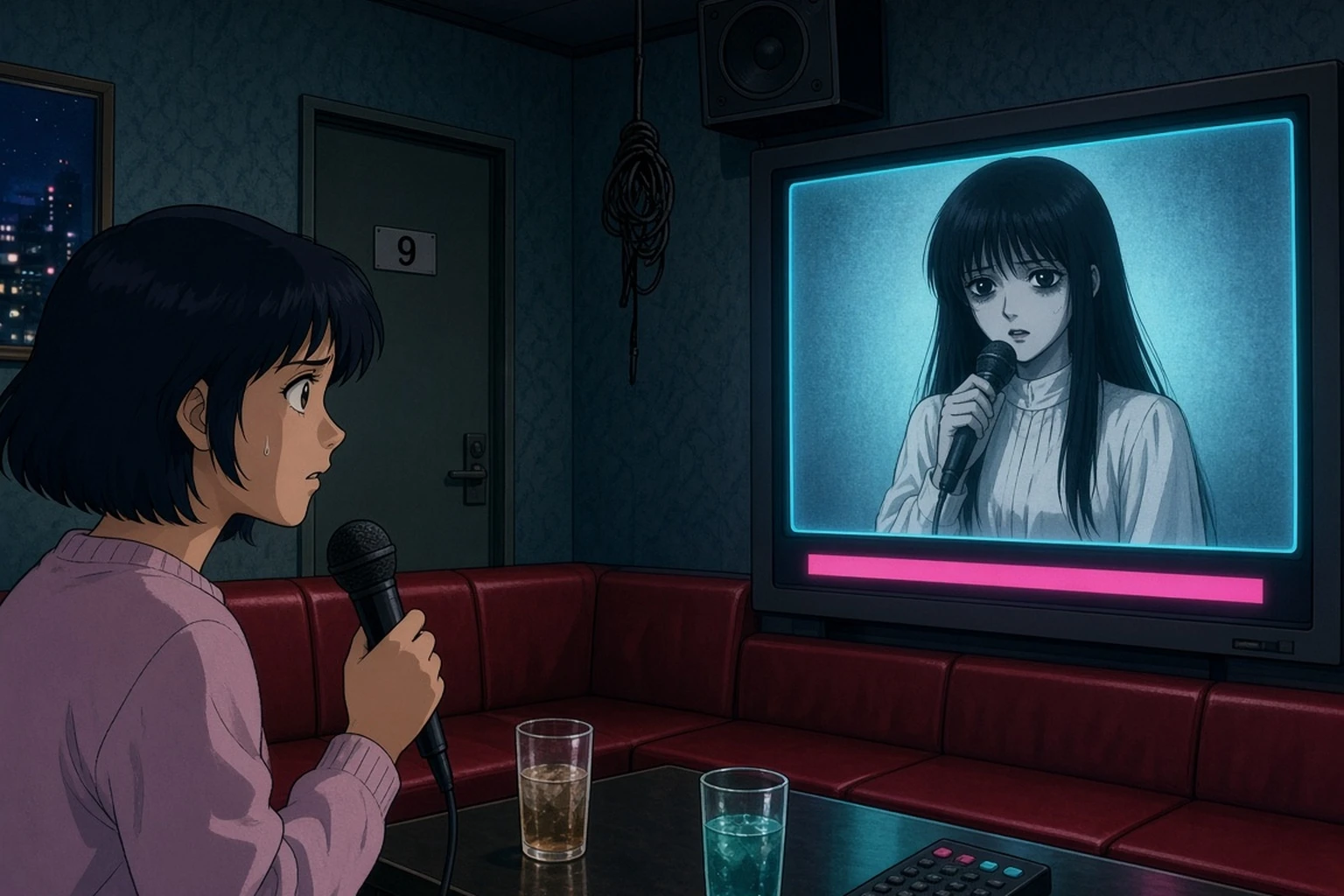
Rina had burned the demo herself on the computer at the internet café by the west exit. She wrote the title on the disc with a silver paint pen, slowly, so the letters wouldn’t smear.
Garasu no Asa. Morning of Glass.
She held the jewel case up in Room 9 like a trophy. The room smelled of fried chicken, cigarette smoke, and the lemon cleaner the staff sprayed on the vinyl seats.
“Nakagawa-san listened to it twice,” she said. “Twice. All the way through. He said he’d call me on Monday.”
“Play it, then,” said Saya.
Saya was smiling. Her flip phone lay open on the table, and the little plastic strawberry on its strap caught the light from the mirror ball and threw it around the walls.
Rina slid the disc into the player the shop kept for customers who brought their own backing tracks. Her voice came out of the speakers, bright and a little nervous. It always sounded better in this room than it did in her head.
“The last verse isn’t on it,” she said. “I only wrote it on the train tonight. I’m going to sing that part live. It’s about you guys. You’ll cry.”
“Turn it up,” somebody said.
Somebody did.
She was swaying and mouthing along to her own chorus. When she turned around, all of them were standing.
Nobody was smiling now. Not even Saya.
“Rina,” said Erika. Her voice was very calm. “We need to talk about Monday.”
Rina laughed, because she thought it was a joke. She was still laughing when Tōru caught her wrists. She stopped when Shō pressed her shoulders into the vinyl and Haruka sat on her legs, crying and apologizing and refusing to move.
Saya wound the microphone cord around her hand. The strawberry swung from her phone strap.
“If you can’t sing,” Saya said, “it goes to one of us. That’s fair. Isn’t that fair?”
The cord tasted of rubber and other people’s spit. It went in where the words came out.
Above it all, her own voice kept singing about a morning made of glass.
She never got to the last verse.
The after-party for the Kantō Intercollegiate A Cappella Championship ran past the last train. Their group had placed second, behind a team from Waseda that did choreography, which Nanami considered cheating.
“Karaoke,” Nanami announced on the pavement outside. She was a little drunk and much louder than usual. “We are going to karaoke. We did not rehearse that arrangement for three months to lose to jazz hands.”
“We sang it fine,” said Aoi quietly.
“We sang it fine. I want to sing it great.” Nanami hooked her arm through Mio’s. “Mio-chan agrees. Look at her face. That’s an agreeing face.”
“That’s a tired face,” Mio said. Then, after a moment: “I know a place.”
They were five, all from the same circle at university. Nanami, who arranged everything and announced it afterward. Ryōta, Nanami’s boyfriend, who wasn’t in the circle but came to everything and heckled lovingly. Ren, who did their sound and recorded every rehearsal on a little Zoom recorder he treated like a pet. Aoi, who had perfect pitch and apologized for it. And Mio.
Mio sang the top line. She’d been taking voice lessons since she was small enough to stand on a beer crate in her mother’s kitchen. She was good. Everyone said so. Her mother said so most of all, usually followed by the word but.
“Hoshizora,” she said. “Behind the Tōhō cinema. One of the rooms still has an old machine. The kind where you type the codes in by hand.”
“How old?” Ren said.
“Old.”
Ren was already walking.
Kabukichō on a Saturday was hot and glittering and smelled of rain on asphalt. Host club billboards loomed overhead, beautiful boys with impossible hair. Karaoke Hoshizora sat on the fourth floor of a narrow building, and the elevator was papered with flyers for a closed-down girls’ bar.
The young man behind the counter had a name tag that read HAYASHI. He had the face of somebody who had been awake too long.
“Five people,” Nanami said. “Free time till morning. Please.”
Hayashi scrolled his screen. He hesitated. “We’re full. Sorry.”
“Nine’s empty,” Mio said.
Hayashi didn’t look at the screen. “That room’s not really in use. It’s got an old machine. People complain.”
“What kind of old?” said Ren. “What model?”
A voice came from the staff room. Gravelly, older. “Give it to them, Hayashi-kun.”
A man in his fifties leaned in the doorway, wiping his hands on a towel. His name tag read SUGIURA, NIGHT MANAGER.
“It’s Saturday,” Sugiura said. “Room’s a room.”
Hayashi printed the slip and handed it to Mio, because she was the one who’d asked.
“Drink bar’s at the end,” he said. “Call if you need anything. Please don’t call.”
Ryōta laughed. Hayashi didn’t.
Room 9 had new grey sofas, LED strips along the ceiling, and a flat-screen television on the wall. But below the screen sat a bulky beige cabinet with a smoked plastic front and a laminated sticker: DO NOT MOVE. DO NOT UNPLUG. CONTACT HEAD OFFICE.
There was no touch-panel remote. The table held a thick songbook, its laminated pages swollen with damp, and a chunky remote control from a hotel room in 1998.
“No way,” Ren breathed. He knelt in front of the cabinet as if it were an altar. “This is from before I was born.”
“It’s ugly,” Ryōta said. He flopped onto the sofa with the songbook. “Look at this. All the songs our mums used to sing in the car.”
Mio sat nearest the cabinet. While the others argued over codes, she ran her thumbnail along the seam of the disc tray on its front. There was no eject button. The tray didn’t move.
The room had a faint smell under the new-carpet smell, something sweet and sour, like fruit left in a bag.
“Mio, you start,” Nanami said. “Something sad.”
Mio took the remote. Before she could press anything, the screen flickered.
The cabinet’s fan rose to a whine. Text scrolled across the television in a font Mio hadn’t seen since she was a child. White letters with a blue outline.
ラストバース / LAST VERSE
歌:藤村りな
“Fujimura Rina,” Aoi read. “Who’s that?”
“Indie track,” Ren said, delighted. “These machines sometimes had amateur submissions loaded. This is like finding a fossil.”
A piano intro began. Thin, slightly out of tune, recorded in a small space. Then a girl’s voice, clear and young, humming over it.
The background video wasn’t stock footage of beaches and couples on bridges. It showed a karaoke room from a high corner, grainy as a security camera.
A grey sofa. A table with a damp songbook.
Five people.
“That’s us,” said Aoi.
Mio looked up at the corner of the ceiling. There was no camera. Just a smoke detector and a smudge on the plaster.
Ryōta waved at the screen. On the screen, a smeared version of him waved back, a little late.
The lyrics began.
Boy with the name tag, Hayashi-kun,
when the back shutter rattles down tonight,
in the corridor behind the kitchen
where they left me with the grease and flies,
the orange cord goes in where the words come out.
Rina’s voice sang it sweetly, like a love song.
The door opened. Hayashi stood there with a tray of melon sodas.
“Your welcome drinks,” he said. Then he saw the screen. The color drained out of his face.
He put the tray down so hard the drinks slopped, grabbed the remote out of Mio’s hand and stabbed at the stop button. Nothing happened.
On the screen, the grainy Hayashi stabbed at the remote too.
Laughing boy, when the rice is ready
and the cooker plays its little tune,
the shower hose will hold your hands for me
and you will swallow everything you said.
“That’s me,” Ryōta said. His smile stayed on a moment too long. “Who’s the laughing boy? Is that me?”
The verses came faster.
Collector, when the blue bar fills,
your cables will remember me.
Every jack a finger, every wire a hand.
Ren had stopped smiling.
Loud girl, you’ll cut what you think will save you,
and the first train’s breath will carry it to the water.
Under a bridge in the city of water,
what you cut away will hold you down.
“Pull the plug,” Nanami said. “Hayashi-san, pull the plug.”
“I can’t. It says on the—”
“I don’t care what it says on the sticker!”
Clear voice, you’ll come back and sing for me,
and I will listen, I will listen.
And when the bridge comes, so will I.
Aoi put her hands over her mouth.
Mio waited for her verse. Her heart was banging against her ribs.
The piano stopped. The screen showed two lines.
The last verse isn’t ready.
Not yet, Saya’s girl. Not yet.
The machine clicked and went silent. The screen went back to the advertisement loop. A cartoon cat recommended the shop’s honey toast.
“Who’s Saya?” Nanami asked.
Mio didn’t answer.
Nanami tried to pay. Hayashi waved the money away, staring at nothing.
“Has that happened before?” Ren asked him.
“People say they hear a girl singing in there when it’s empty. That’s all.” He swallowed. “It’s never said my name before.”
“It’s a prank,” Ryōta said. “There’s a camera in the ceiling and somebody typed in your name tag.”
“How did it know what we’d do before we did it?” Aoi said.
Sugiura came out of the staff room. He looked at Hayashi’s face, and his own face changed.
“What did it say?”
“The shutter,” Hayashi said. “Tonight.”
Sugiura stood very still. “I’ll do the garbage. You stay at the counter. You stay where people can see you.”
He went through the staff door. They heard his footsteps go down the corridor toward the back.
Nobody left. Ryōta made a joke about overtime pay. Nobody laughed. Hayashi stood behind the counter with both hands flat on it, and the five of them stood in front of it, and they watched him. Mio thought later that they’d all agreed without saying so. If they watched, nothing could happen.
From the back of the building, metal rattled. A roll shutter coming down.
“I didn’t touch it!” Sugiura shouted, far away. “Hayashi, I didn’t—”
The ceiling speakers clicked. A piano intro. A girl’s voice.
Morning of glass, morning of glass,
I can see right through you.
Hayashi’s wrists snapped together behind his back.
Nobody had touched him. Mio was a meter away and nobody had touched him. His arms wrenched up behind him until his shoulders popped, and his face slammed down onto the counter beside the cash tray. His shirt tore at both shoulders. Mio saw the cloth dent in under the tears, small dents, finger-sized. Too many fingers for two hands.
“Help me,” he said into the countertop.
Then he was dragged backward off his feet, through the staff door, his heels squeaking on the tiles.
Ren went over the counter. Mio went after him without deciding to.
The service corridor was narrow, tiled, greasy, lit by one caged bulb. Hayashi was sliding down it on his back, fast, toward the grease trap at the far end. A coil of orange extension cord dropped from its hook on the wall as he passed and uncoiled across the floor after him, plug end first.
Mio caught his ankle. Ren caught the other. They pulled.
Whatever had him pulled harder. Mio was dragged to her knees and kept going, her palms skidding through grease, and she didn’t let go. Hayashi kicked in her hands. Black zip ties, the kind they used to close garbage bags, slithered off the shelf, looped his wrists and ankles, and cinched with a zipping sound so tight the skin bulged white around them. His ankle tore out of Mio’s grip.
The orange cord rose off the tiles and turned toward his face.
He clamped his mouth shut. Something forced his jaw. Mio heard it crack sideways.
The cord went in.
It went in deep, the plug end first, and kept going. His cheeks bulged around it. His throat swelled. He bucked against the tiles, and the invisible hands held him down, shoulders and knees and wrists, and his eyes rolled toward Mio, wet and enormous. Then the trailing end of the cord whipped once around his neck and pulled tight. His face went dark purple. Blood ran from his nose and from the corners of his eyes.
Above them, Rina’s voice reached the chorus and held the high note beautifully.
Hayashi stopped moving.
The music stopped.
Sugiura stood at the end of the corridor with the shutter chain still in his hands.
“I told him,” he said. “I told him to stay at the counter. He was at the counter. I saw him at the counter.”
The police came. Every one of them told the same story: it happened too fast, they hadn’t seen who. Nobody mentioned the song. They’d agreed in a whisper on the stairs. They’d sound insane.
They sat in a twenty-four-hour family restaurant until the sun came up grey.
“It’s a schedule,” Ren said. He’d recorded the whole song on his Zoom recorder, because of course he had. “Not a threat. It said Hayashi-san. The corridor. The cord. Tonight. All of it happened.”
“Stop,” Nanami said.
“Okay,” Ryōta said. He hadn’t stopped jigging his knee all night. “So I don’t make rice. Done. I’m never eating rice again. I’ll live on bread like a Frenchman.”
He laughed. It came out wrong.
“Who’s Saya?” Nanami asked Mio again. Gently this time. “It was looking at you.”
“My mother’s name is Sayaka,” Mio said. “Lots of people are called Sayaka.”
Ryōta was the joke that night in the group chat. It was how he coped.
RYŌTA: status update: every grain of rice in this apartment is in the bin downstairs. cooker unplugged and in the closet. the ghost can come at me
NANAMI: please don’t joke
RYŌTA: I’m not joking I’m thriving
REN: don’t be alone tonight
RYŌTA: Nanami’s coming after her shift. I’ll be fine.
At eleven, Nanami started a group call from the train. Ryōta answered from his apartment in Nakano.
“I’m in the shower,” he said. “Don’t come in yet, I’m hideous.”
“I’m at Kōenji,” Nanami said. “Ten minutes.”
Mio lay on her futon in the dark, phone on her chest. Her mother was asleep down the hall.
Over the call, faintly, came a little electronic melody. Eight bright notes. Twinkle, twinkle.
“That’s my rice cooker,” Ryōta said. His voice echoed off tile.
“You said it was in the closet,” Ren said. “You said it was unplugged.”
“It is.”
The melody played again. Then came a sound Mio couldn’t place at first. A dry, steady hiss, like sand poured into a bucket.
“Ryōta,” Nanami said. “Get out of the bathroom.”
“The door’s stuck. That’s normal. It always—” A thump. His voice went very fast. “It’s rice. Nana, it’s coming out of the drain, it’s rice, it’s all over the—”
Over his voice came a piano.
Morning of glass, morning of glass—
They heard the metallic squeal of a shower hose pulled taut against its bracket. They heard him say, quite clearly, “No, I’m sorry, I didn’t mean it, I’m sorry,” as if he’d been caught at something. Then the hiss got louder, and his voice turned to a wet, packed choking that went on and on, under Rina singing, I can see right through you.
Nanami was screaming his name. Someone on her train asked if she was all right.
The choking stopped. The song played to the end of the chorus. Then the call disconnected.
Nanami found him. She had a key.
He was in the bathtub, naked and still wet. The shower hose was wrapped around both his wrists and tied off on the tap, wrenching his arms up and back until his shoulders had dislocated. His mouth was packed with raw rice. So was his throat, so full that his neck bulged with it and the corners of his lips had split. Grains were stuck to his chin, his chest, the tiles. The bag in the bin downstairs was empty.
The rice cooker was on the kitchen counter, plugged in, its lid open. Ready, the little display said.
“His eyes,” Nanami said the next day. She sat on the floor of Aoi’s apartment with her knees up. “They were so surprised. He always made that face when I said I loved him. Like it surprised him every time.”
Sugiura texted Mio on Monday afternoon. She’d given him her number at the police station.
Golden Gai. A bar called Tsukiyo. Come at six. There’s someone you need to hear.
Nanami wouldn’t come. She said she was never going within a kilometer of Kabukichō again. Aoi stayed with her. So it was Mio and Ren who climbed the ladder of a staircase into a room so small that if more than seven people came in, the eighth had to sit on someone.
Sugiura was already on a stool. The woman behind the counter had a cigarette voice, acid-yellow hair, and a face that had been pretty and then had been punished for it.
“Kajiwara Erika,” Sugiura said. “She was there that night.”
“Thanks for the introduction.” Erika poured two glasses of shōchū without asking and slid them over. “Drink it. You’ll want it.”
Mio told her everything. The room, the song, the verses. Hayashi. Ryōta. Erika smoked through three cigarettes and didn’t interrupt.
“She was found a week after,” Sugiura said when Mio was done. He spoke to his glass. “I was a part-timer. Doing the garbage. There was a smell for days. She was behind the old freezer by the grease trap, wrapped in a vinyl tablecloth from the party room. The microphone cord was still in her.” He drank. “Six kids went into Room 9 that night. I brought them fried chicken. Five came out. I told the police that. They said the girl had left early, and the five all said the same thing, and I was a part-timer having a smoke out back.”
“Nakagawa was going to sign her,” Erika said. “Himawari Production. A tiny agency in a walk-up in Shibuya, but it was real. And we’d all been doing the same thing she was. Lessons. Demos. Auditions. Saya most of all. Saya was the best of us, technically. Better range than Rina. Better training.”
“But Rina got it,” Ren said.
“Rina had something.” Erika laughed through her nose. “Saya sang like she was proving something. Rina sang like she was telling you a secret.”
She stubbed out the cigarette.
“It was Saya’s idea. I’ve had a long time to decide whether to lie about it, and I’m too tired. We were going to scare Rina. Hold her down and make her promise to give the contract to one of us. Like children. Like a game. And Rina laughed at us. And Saya wrapped the mic cord around her fist and said, If you can’t sing, it goes to one of us. And she pushed it in.”
Mio held her glass to keep her hands still.
“I held her arm,” Erika said. “Nobody stopped it. Haruka was crying so hard she couldn’t breathe, and she didn’t get off Rina’s legs. We kept holding because we’d started. Because Saya was so sure. And Saya was laughing. The whole time. Because she was scared. But she was laughing.”
“Saya,” Mio said. “What was her full name?”
Erika looked at her properly for the first time. Something moved behind her eyes.
“Ōshima Sayaka,” she said. “And you have her nose.”
Ren turned on his stool.
“It was my mother’s maiden name,” Mio said.
Nobody said anything. The little stereo behind the counter hummed with nothing on it.
“Where are the others?” Ren asked finally.
“Haruka hanged herself years ago with a phone charger. Tōru’s a salaryman in Osaka. Shō’s in prison for fraud. Nakagawa signed me a month after Rina died. My single sold fewer copies than this building has cockroaches.”
“Is there a way out?” Ren said. “Of a verse?”
Erika looked at Sugiura.
“The song’s played twice since,” Sugiura said. “For customers. Most years it doesn’t play at all. A salaryman in 2011 got a verse. Dead in a week, just like it said. Then a high-school girl in 2016. She was alone in Nine, crying, and she sang it right back at the screen. The whole thing. Badly. She walked out.” He turned his glass. “Her verse only ever said she’d sing. That’s all it said.”
“She doesn’t want good,” Erika said. “Good is what killed her. She wants true. Her own song, in her own room, sung to her face, by somebody who isn’t singing to save themselves.” She lit another cigarette. “And the verses already know who’s capable of it. That’s what they are. Not a curse. A reading of the room.”
“I can’t sing,” Ren said. “I do sound. I can’t hold a note.”
“Then I’m sorry, love.”
At the bottom of the ladder-stairs, Mio heard the bar’s stereo click on above them. A piano intro. Then Erika’s cigarette voice, singing along to a girl who’d been dead half her life, word for word.
“I’m going to upload it,” Ren said at the station.
“Upload what?”
“The recording. To Himawari’s demo submission page. She had an appointment with Nakagawa. She never kept it.” He pushed his glasses up his nose. “When the blue bar fills. I can’t stop the bar. Ryōta tried with the cooker. But I can choose where it goes. Maybe if the label finally hears her, it means something. Maybe it’s enough.”
“Ren.”
“Video call me tonight. Stay on. I don’t want to die alone, Mio.”
She called him at nine. His room in Takadanobaba was more studio than bedroom. Cables hung coiled on hooks on every wall. Mic stands stood in the corner. He was wearing his old wired earbuds so the call wouldn’t feed back.
“File’s big. Upload’s slow. Twenty minutes, maybe.” The blue bar crept across his second monitor. “Tell me about your mum. I need something to listen to that isn’t my heartbeat.”
So she did. The beer crate in the kitchen. Scales every morning before school. The talent show where Mio had come second, and her mother hadn’t spoken to her on the train home.
“She used to say, Sing for Mama,” Mio said. “When I cried, when I was sick. Sing for Mama and you’ll feel better.“
“Did it work?”
“It made her feel better.” She looked at the ceiling. “She looks at me sometimes like I’m a bill she can’t pay.”
The bar jumped. Not crept. Jumped, to nearly full.
“Okay,” Ren said. “Okay, okay.”
A black XLR cable uncoiled from its hook on the wall and wrapped twice around his wrist. Another took the other wrist. They pulled his arms out wide against the arms of his chair. Two mic stands slid across the floor and their heavy bases settled on his feet.
From every speaker in the room came the piano.
“I’m sorry,” Ren said to someone Mio couldn’t see. “I just wanted someone to hear you. That’s all.”
The earbuds moved.
They crawled out of his ears on their own and up across his cheeks, two white beads on a white cord, and slipped between his lips. He clamped his teeth on them. The cables at his wrists pulled until something in his elbow popped and he cried out, and they went in.
The earbud cord fed itself down his throat. Then the cable from his headphone jack, unplugging itself from the laptop and following. Then a USB cable off the desk. Mio watched his throat bulge as each one went down. His stomach swelled under his T-shirt. A vessel burst in his eye and spread red across the white.
Every jack a finger, every wire a hand.
The progress bar turned green. Upload complete.
Ren went still. The cables slackened and set him down in his chair, almost tenderly.
Under the music, very close to the microphone, a girl spoke.
“Thank you for listening.”
The call ended.
Mio walked down the hall.
Sayaka was in the living room, ironing Mio’s blouses for the week. A Korean drama murmured on the television.
“You’re up late,” Sayaka said without looking. “You’ll ruin your voice.”
“Who was Fujimura Rina?”
The iron stopped for a moment. Then it moved again, steam hissing up from the cotton.
“I don’t know that name.”
“Ren is dead, Mama. I watched him die twenty minutes ago, he had cables inside him—”
Her voice cracked on the last word. Sayaka winced, actually winced, as if the broken note offended her more than the content.
“Sit down,” her mother said. “You’re hysterical.”
“There was a song in Room 9. It called me Saya’s girl. Nobody calls you Saya. Who called you Saya?”
Sayaka set the iron on its heel.
“Rina did,” she said.
Then she picked the iron back up. Her hand was perfectly steady.
“Whatever you think you know, you will not repeat it. Not to the police, not to your friends. I have spent your entire life building you a future.”
“You mean you spent my life building you a future.”
The iron came down. Hiss.
“Do you know what Nakagawa did to the girls he signed?” Sayaka said. “Erika told me. Afterward. You think it was a fairy tale.”
“So you saved her,” Mio said. “By killing her.”
Her mother pressed a collar flat with the tip of the iron.
“Go to bed,” she said. “You need your voice.”
Nanami called at four in the morning, whispering.
“I’m in Osaka. My grandmother’s place in Miyakojima. I got the last Shinkansen.” A shaky laugh. “I wanted to be anywhere but Tokyo, and halfway here I remembered what they call Osaka. Mizu no miyako. The city of water. It’s in the textbooks.” She was crying. “I didn’t think. I just wanted my grandma.”
“Stay inside,” Mio said. “Lock the door. Stay away from the river.”
“I did the chain. And I cut it, Mio. My hair. She uses hair, so I cut it all off with Grandma’s kitchen scissors. I look like a crazy nun.” Her laugh went high. “Then I read the line again. You’ll cut what you think will save you. I did the exact thing it said.”
“Where’s the hair?”
“In a garbage bag by the door.” A pause. “Mio. It’s rustling.”
“Get out of the room.”
“I’m not going out there. The first train runs in an hour, and it’s getting light, and I’m sitting right here by the window, and I’m staying on the phone with you. Tell me something boring.”
Mio told her about Ren.
She didn’t mean to. It came out of her like water out of a broken pipe. When she finished, Nanami said, “Oh,” very softly.
Then she said, “The bag’s open.”
Then: “Mio, it’s on my wrist. It’s—it’s pulling—”
A thud. Something dragged across tatami. Mio heard a chain rattle, a lock turn, a door bang against a wall. Then the street, and Nanami’s bare feet slapping on asphalt, and her voice getting smaller, screaming for her grandmother. Far off, a train sighed into a station.
Then water.
Then the line went dead.
Nanami’s grandmother had woken to the door. She found the chain hanging loose and the bag on the step, empty.
Police pulled Nanami out of the Ōkawa River at the foot of the Tenjinbashi bridge, at seven. She was kneeling on the riverbed in a meter and a half of water, held there. Her wrists were tied to the bridge’s stone footing behind her with black hair. Her ankles were tied to her thighs with it. Her mouth was full of it.
It was her own hair. All of it. Her grandmother said it had been dyed honey-brown. The hair that held her under was black at the roots and brown at the tips, as if it had grown back out in a single night.
Aoi was waiting outside Mio’s building, sitting on the curb under the streetlight with a folder of handwritten sheet music on her knees.
“I’m going back,” she said. “Tonight. Ren transcribed the demo before. He sent it to me for the chord changes. I’ve been practicing all day.”
“Aoi. When the bridge comes, so will I.“
“It also says I will listen.” Aoi’s voice was quiet and even, the voice she used to give everyone their starting pitch. “You told me what Erika-san said. Sing it true, to her face. I’m the only one of us left who can try.” Her mouth trembled and firmed. “Every concert since middle school, I’m the one in the middle of the chord. Nobody hears the middle of the chord, Mio. They hear the top. They hear you. I want someone to listen to me. Even if it’s her.”
“I’ll come.”
“Your verse—”
“Isn’t ready. Not yet. She won’t touch me tonight. Everything she’s done has been in the rules.”
Sugiura let them in after the last customers had gone. He looked at the sheet music and seemed to understand all of it at once.
“I’ll stay at the door,” he said.
Room 9 was cold. The beige cabinet hummed under the screen.
“How do we start it?” Aoi asked.
The machine answered. The old font, white letters, blue outline.
ガラスの朝 / MORNING OF GLASS
歌:藤村りな(カラオケ)
The vocal track had been taken out. Only the piano and a thin string line remained, and under them, faintly, the click track of a girl who’d counted herself in.
Aoi lifted the microphone. The cord trailed across her lap. She began to sing.
Mio had sung beside Aoi for years and had never heard her like this. Aoi didn’t hide in the middle of the chord. Her voice came out clean and full, every vowel shaped, every breath placed, and under the precision was something trembling and alive that made the hair on Mio’s arms rise.
The sofa beside Aoi creaked.
Nobody was sitting there. Then somebody was.
Rina was smaller than Mio had imagined. Low-rise jeans, a pale camisole stained dark down the front, chunky platform sandals. Her chestnut hair hung wet against her cheeks, though nothing in the room was wet. Her face was swollen, dusky at the lips. A microphone cord came out of her mouth and hung down her chest and disappeared under the sofa cushion.
Her eyes were closed. She was listening.
Aoi saw her. Mio watched the jolt go through her, the catch of breath, the hands tightening on the microphone. But Aoi didn’t stop. She turned a little toward the dead girl and sang to her.
Rina’s lips, around the cord, shaped the words.
The second chorus. Aoi went up into it and the note bloomed and held, and Mio was crying without having noticed when she’d started.
Rina opened her eyes. They were red where the vessels had burst, and wet, and she was looking at Aoi with something terrible that might have been hope.
The music turned. A key change, a falling bass line.
The bridge.
Aoi drew breath for it. Mio saw her see what was coming. Saw her decide to sing anyway.
At the top of the phrase her voice cracked.
Not much. A hair’s width. A little flutter where fear got into the breath. No audience would have noticed. Aoi would have heard it from the back row of a concert hall.
Rina’s face closed like a door.
“Almost,” she said, a wet whisper around the cord.
Aoi kept singing. That was what Mio couldn’t forget afterward. Rina’s hair came off her head in a dark wave and wrapped Aoi’s arms against her sides, and her wrists, and her knees, and Aoi kept singing. Rina knelt on the sofa beside her, gentle as a nurse, and took the microphone out of her hand, and Aoi’s mouth was still open on the note.
The cord went in on the note.
It turned the note into something else. A gargle, a thin animal whine through a blocked throat, still somehow almost in pitch. Aoi’s eyes found Mio’s across the table. The cord kept going, hand over hand, Rina’s swollen lips moving with the lyric the whole time.
Mio tried to stand. Nothing held her. Her body simply wouldn’t.
Rina looped the slack twice around Aoi’s throat and leaned back with her whole small weight, like a girl tugging a stuck drawer.
Something in Aoi’s neck gave with a sound like a knuckle cracking.
Her pitch finally broke.
The final chorus began without a voice to sing it. Rina’s hair slid back off Aoi and was hers again. Aoi slumped against the armrest, the microphone hanging from her lips by its cord, her eyes still faintly surprised that her voice had let her down.
Rina looked at Mio.
“She was good,” Rina said. “She wasn’t true. It’s not the same thing.”
Then the sofa was only a sofa.
The screen changed.
ラストバース / LAST VERSE
Saya’s girl, you came here looking.
Bring her up when the rain stops on the sign.
Every friend will hold, and one will feed,
the strawberry swinging, swinging,
and the cord goes down the throat that owes the song.
Sing it with me. Sing it true.
Last verse. Last verse.
Sugiura was in the doorway. He looked at Aoi, at the screen, at Mio.
“Bring who up?” he said.
“My mother.”
He didn’t move from the door. “You asked for this room,” he said slowly. “The first night. Hayashi told you we were full and you asked for Nine. By number.”
Mio wiped her face with the back of her hand.
You came here looking.
Three weeks ago, hunting for her old recital programs in her mother’s closet, she had found a shoebox. Inside was a pink flip phone with a faded plastic strawberry on its strap. She’d bought a charger for it at a junk shop in Akihabara. There was one photo on it. Six kids crammed onto a vinyl sofa under a mirror ball, the time stamp from 2004, the room number on the door behind them. Her mother, nineteen and beautiful, holding up two fingers. There was one unsent message in the drafts.
It’s still in the machine. I’m sorry. I’m sorry. I’m sorry.
She hadn’t known what it was. She had wanted to see the machine, and she hadn’t wanted to go alone. So she had said I know a place, and her friends had followed her, because they always did.
“Yes,” Mio said. “I asked for Nine.”
It rained the next day, the heavy greasy rain at the end of the rainy season.
Mio put the pink phone on the ironing board. Her mother looked at it for a long time.
“You went through my closet.”
“Three weeks ago. I took them there, Mama. I took my friends to that room because of this phone, and now they’re dead.” Mio’s voice didn’t crack. “The last verse says I bring you tonight. It says the cord goes down the throat that owes the song. It says sing it true.”
“No.” Sayaka was shaking. “You owe nothing. You did nothing.”
“Then come and prove it.”
Her mother laughed, a horrible little sound. Then she went to the mirror and began to do her makeup, carefully, as she did before Mio’s recitals.
“I was always better than her,” she said to her reflection. “Technically. If it’s an audition, I’ll audition. I’ll sing so well she’ll have to let you go.”
In the taxi, she held her handbag on her knees like a schoolgirl.
“She kept looking at me,” Sayaka said. “Not the others. Me. Waiting for me to say just kidding. It was right there in my mouth. And then it was too late to say anything, and then I had to live.”
The sign for Karaoke Hoshizora glowed through the rain, blue and white, little stars blinking in sequence. They sat in the cab and watched it.
The rain thinned. Slowed. Stopped.
The stars on the sign blinked on, all at once, and stayed on.
Sugiura saw Sayaka come in and went grey.
“Ōshima-san.”
“Kanzaki now,” Sayaka said pleasantly. “You’ve put on weight. You brought us fried chicken. Rina thought you were cute.”
Sugiura’s face crumpled. He put the key on the counter and turned his back.
“I’ll be out back,” he said. “Smoking.”
Sayaka stopped in the doorway of Room 9 with her hand on the frame.
“They changed everything.”
“Not the machine.”
“No.” She touched the beige casing as if it were a coffin. Then she sat at the end of the sofa nearest the screen, and Mio understood it was where she had sat before. She took the pink phone out of her handbag, opened it, and laid it on the table. The strawberry lolled on its strap.
The screen flickered. ラストバース / LAST VERSE. Black behind the old blue-outlined letters.
Sayaka picked up the microphone and sang Morning of Glass from memory, unaccompanied. Her voice was astonishing. Mio had forgotten. Her mother never sang at home anymore, only corrected. It was all still there: the breath control, the clean placement, the range that climbed without strain and hung its notes in the air like crystal.
It was perfect. It was flawless.
It was nothing.
Mio could hear it now. Every note was correct and every note was a demand. Look how good I am. Look. There was no secret in it. It was a voice standing on a beer crate in a kitchen, singing for its mother.
The song ended. The screen showed a single word.
次。 Next.
“That was perfect,” Sayaka said. Her voice cracked. “That was perfect.”
The speakers clicked. The demo. Rina’s voice, far louder than the machine should go, so loud the table buzzed under the pink phone.
The door opened.
Hayashi came in first, his face the purple of a bruise, the orange cord dragging behind him, its plug clicking against the table leg. Ryōta, wet, his arms hanging wrong, rice crusted at the split corners of his mouth. Ren, with his blood-filled eye and white wires trailing from his lips. Nanami, shaved and dripping river water, a black rope of hair from her mouth to her wrists. Aoi last, in her cardigan, her head at the angle of her broken neck.
Sayaka made a sound like a kettle. “Who are they?”
“My friends,” Mio said.
Every friend will hold.
They came for Mio. Cold hands. Wet hands. Hayashi took one wrist and Ren the other. Ryōta’s broken hands pinned her shoulders to the vinyl. Nanami knelt on her shins. Aoi stood behind the sofa and put her palms over Mio’s ears, very gently, and held her head still.
They didn’t hate her. Mio could see that. They were holding her because they’d started and didn’t know how to stop.
On the sofa beside her mother, Rina sat.
Sayaka’s whole face went soft and young and terrified. “Rina-chan. I’m—”
Rina held out the microphone.
“No,” Sayaka said. “No, I won’t—”
Her hand came up anyway. Mio watched her mother’s manicured fingers close around it, and the cord loop once, twice around her fist. Her face was horrified. Her hand was perfectly steady.
The strawberry swung on the table, though nothing had touched it.
“If you can’t sing,” Sayaka said, in her own voice, and clapped her other hand over her mouth, too late. Through her fingers: “It goes to one of us.”
She leaned over Mio.
“Mama,” Mio said. “It’s me.”
“I know,” her mother sobbed. “I know, I know.”
The cord touched Mio’s lips. Rubber and dust and other people’s spit.
Sing it true.
Mio sang.
Not for her mother. Not to be spared. She thought about Aoi singing into the bridge. About Nanami saying tell me something boring. Ren’s progress bar. Ryōta’s surprised eyes. Hayashi saying please don’t call. She thought about the shoebox, and the five people she had led into this room because she hadn’t wanted to go alone.
She sang it with the cord against her teeth. She sang it badly. Her breath was wrong. She went flat on the long vowel. Her voice shook so much the notes blurred.
She sang it as if she was telling a secret to someone who had waited her whole life to hear it.
Her mother’s hand stopped.
Under Rina’s bright young voice on the demo, Mio’s voice ran ragged and real, and found the harmony Aoi would have found. The middle of the chord.
Rina closed her eyes. She was listening.
The second chorus ended. Mio’s voice ran out. She lay gasping under the dead.
Rina opened her eyes and nodded, once.
The hands let go of Mio. Aoi’s cold fingertips brushed her hair, fixing a flyaway, the last thing before a performance.
Then they turned to Sayaka.
“No,” Sayaka said. “The verse said Saya’s girl. It said—”
“It said bring her up,” Mio whispered. “It said the throat that owes the song. You sang first, Mama. She heard you.”
They laid Sayaka on her back where Rina had lain. Wrists. Shoulders. Legs. Her heels kicked at the carpet and fell off.
The microphone had fallen from Sayaka’s fist. Rina knelt beside Mio and put her small, cold, wet hands over Mio’s hands, and closed Mio’s fingers around the cord.
And one will feed.
Mio felt the shape of the choice, like a step in the dark.
“Mio,” said her mother. Her makeup was ruined. She looked like a girl, like every photo in every album Mio had been made to look at. “Sweetheart. Please. Sing for Mama.”
Afterward, Mio could never say when Rina’s hands left hers.
She remembered winding the cord around her fist. She remembered how easily the first part went, past her mother’s teeth, how her mother’s tongue fought it and lost. She remembered the gagging, her mother’s throat working against the rubber, the blood from her mother’s nose running warm over Mio’s wrist.
She remembered understanding, somewhere in the final chorus, that nobody else’s hands were on the cord. That nobody else’s had been on it for some time.
She did not stop.
Her mother’s eyes found hers and asked her something. Just kidding? It was right there in Mio’s mouth. She didn’t say it.
The strawberry swung and swung on its strap.
The final chorus reached its last high note. Rina’s voice held it, beautifully, impossibly long.
Sayaka stopped moving.
In the silence, the girl on the demo laughed, a little embarrassed. Was that okay? she said, to someone half a lifetime away. Nakagawa-san, was that okay?
Then the click of a disc stopping, and a whir. For the first time in twenty-two years, the tray in the front of the beige cabinet slid open.
It was empty.
Mio looked up. No friends. No Rina. Only her mother on the sofa, the cord coming out of her open mouth like a tongue, her stockinged feet crossed at the ankle as if she’d fallen asleep after a party.
The pink phone was gone. A cartoon cat waved from the screen.
Sugiura found Sayaka at dawn, doing the garbage. She was in the service corridor by the grease trap, wrapped in a vinyl tablecloth from the party room, pushed behind the new freezer. The microphone cord was still inside her.
Detective Mori came to the apartment in Kichijōji that afternoon. He was a heavy man who smelled of menthol. He’d been a patrolman in 2004, he said, standing outside the tape at Hoshizora. He sat where Sayaka used to iron and didn’t take out his notebook.
“The night manager says you went into Room 9 with her after closing. He was out back. He didn’t see either of you leave.”
“I left first,” Mio said. “She stayed to sing.”
“Four of your friends are dead. And a boy at that counter. And now your mother.” He looked at her for a long time. “Where did your mother go, Fujimura-san?”
He heard it a second after she did. He frowned at himself. “Kanzaki-san.”
Mio heard the answer before she said it. She heard all of them saying it, half a lifetime ago, in a room like this one, and a pretty girl clicking a plastic strawberry against her phone.
“She left early,” Mio said. “She was upset. She walked off toward the station alone.”
Mori stood up and put his hands in his pockets.
“If you think of anything else.”
“I won’t,” said Mio.
Her father came home from Nagoya for the funeral and stayed. He took the ironing board apart and put it in the closet and never mentioned it. Erika’s bar in Golden Gai closed. A note on the door said Thank you for listening. Nobody knew where she’d gone.
At the end of summer, an email arrived from Himawari Production. The signature said NAKAGAWA SHŌJI, PRESIDENT.
Earlier this summer, a file was submitted through our demo page: a young woman singing a song called “Last Verse.” I heard that song once before, many years ago, sung by a girl who did not keep her appointment with me. Last week, I opened the file again. The voice on it is now, I believe, yours. I would very much like to meet you.
The studio was in a basement in Shibuya, below a bakery. The engineer was young, with a bleached undercut and a Hanshin Tigers cap on backward. His name was Takeuchi. He called her Mio-chan within ten minutes.
“So the title track’s Last Verse,” he said, flipping the lyric sheet. “Nakagawa-san says you wrote it?”
“A friend wrote it.”
“Your friend’s dark, man. I love it. Okay, headphones on. We’ll do a run with the guide vocal.”
“There’s no guide vocal.”
“Sure there is. Track one. Some girl. Kind of lo-fi. Kind of perfect.” He tapped the screen. “I figured it was you as a kid.”
Mio put the headphones on. Their cord lay across her throat, warm from the last singer.
Her phone was in her pocket. Its case was new. Last week she’d found something tangled in the strap, something she hadn’t put there, and she had not taken it off.
A little plastic strawberry, faded almost white.
The piano started.
Morning of glass, morning of glass,
I can see right through you.
Rina’s voice, in her left ear, close as breath.
Mio closed her eyes and sang with her. It was easy now. The harmony was right there, the middle of the chord. Under the glass, Takeuchi stopped grinning and just listened, his mouth a little open.
“That,” he said finally, into the talkback. “Okay. That’s the take. Who’s doubling you? I didn’t track a double.” He frowned at his screen. “Huh. The lyric file updated.”
He picked up his copy of the lyric sheet. His frown slowly turned into a laugh. He held the page up to the glass, tapping a line.
“Mio-chan,” he said. “Very funny. Why is my name in the last verse?”
On the monitors behind him, unasked for, a piano began to play.