%20(1).png)
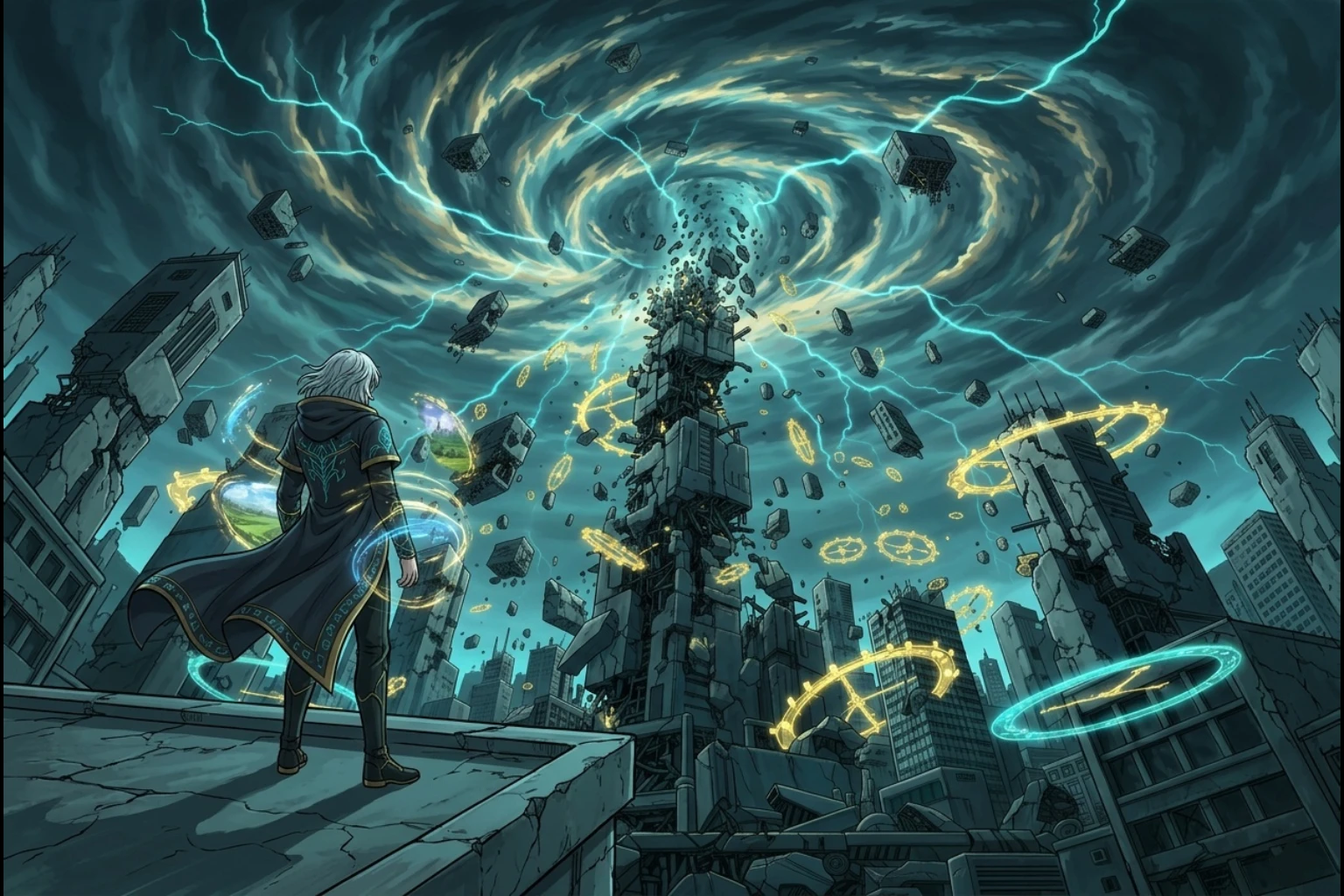
He had been here before.
He knew it the way he knew most things now — not as recollection, not as the vivid retrieval of stored experience, but as a residue. A quality in the air that his body recognized before his mind could form a question about it. The particular angle of the ruined skyline against the teal-dark sky. The way the cracked concrete beneath his boots had settled, the specific pattern of its fracture lines, the depth of the weathering in the gaps. These things pressed against something in him that was older than memory and harder to remove.
He had stood on this rooftop before.
He did not know when. He did not know why he had left, or what had happened after, or whether whatever he had come here to do the first time had been done. The notches on his bracer offered no guidance — they recorded expenditure, not location, and the interior of the bracer was filled edge to edge with marks whose individual meanings had long since departed.
The city below was not in the process of falling.
It had already fallen.
The buildings that remained were shells — facades without interiors, their windows long since empty, their structural cores compromised by whatever event had hollowed them out and left the exteriors standing as a kind of notation, a record that something had once been here that no longer was. The streets between them were buried under the accumulated debris of a collapse that had happened gradually enough to deposit its material in layers, the oldest deepest, the most recent still sharp-edged and pale where the weathering had not yet had time to work.
This had not happened recently.
This had happened, by his estimate, decades ago. Long enough for the ruins to develop their own ecology — the persistent plants that found purchase in broken concrete, the particular dustiness of stone that had been exposed to open air through many seasons. Long enough for the city's absence to become its own kind of presence, the empty space it had left behind now as established as the city itself had once been.
And yet the vortex above it was new.
It turned in the sky over the central tower with the fresh urgency of a system recently activated, its lightning arcing in the sharp bright way of energy that had not yet begun to dissipate into the surrounding atmosphere. The tower itself was mid-disintegration — its upper sections breaking apart in clean geometric fragments that the vortex drew upward in a slow continuous feed, piece by piece, floor by floor, the structure being consumed from the top down with methodical patience.
The tower was not ruins.
The tower was new.
Someone had built it here, in this already-dead city, recently, specifically to feed the vortex. Had constructed it as a conduit, a fuel source, something designed to be consumed in a way that powered the chronological disturbance above it. The gear-rings drifting through the air around it were not debris from the Mechanism — they were components, purpose-built, designed to interface with the vortex's rotation, to keep it stable as it fed, to prevent it from expanding beyond the boundaries of this location.
Whoever had built the tower had not wanted the vortex to spread.
They had wanted it contained.
Here.
Above this specific ruined city.
Kael looked down at the sphere in his hand.
He had found it at the rooftop's edge when he arrived, sitting in the precise center of a cleared space where the concrete had been swept clean of debris in a careful circle — left for him, he understood immediately, placed with the deliberateness of something intended to be found by a specific person at a specific time. It was small enough to hold in one palm, its surface cool and smooth, its interior visible as depth rather than reflection — green fields under an open sky, the image clear and still and impossibly detailed for something contained in a space this small.
He had not opened it.
He was not certain he should.
The rings deployed around his wrist, reading the sphere without touching it, and the data they returned was unlike anything the rings had returned before. The sphere was not a spatial anomaly. It was not a fracture or a contained reality or a compressed world waiting for release. It was chronological — a bubble of preserved time, a specific moment extracted from the substrate and enclosed, protected from the reversal and the decay and the accumulated damage of everything that had happened to this city since the moment the bubble contained.
A memory.
Not his — the sphere's origin was external, its preservation deliberate, its contents belonging to someone or something that had decided this particular moment was worth keeping when everything else here was lost. But the rings returned one additional reading that Kael sat with for a long moment before he accepted what it meant.
The moment inside the sphere had originally belonged to him.
He had been here before, and he had taken something from this city — a memory, a specific experience, a fragment of the past that his work had shown him — and he had enclosed it in this sphere and left it here because he had known, on that previous visit, that the cost of what came next would take it from him. He had known what he was about to spend. He had preserved what he could not afford to lose before he spent it.
He had left himself a message.
The vortex turned above the tower. Another floor dissolved into fragments and rose into the spiral. The gear-rings drifted in their slow containment orbits, keeping the disturbance bounded, patient and precise.
Kael opened the sphere.
The memory did not arrive as image or sound. It arrived as understanding — the same quality of complete and sourceless knowledge that the wound beneath the previous city had given him, but warmer, more specific, shaped by a particular experience rather than ancient substrate. It filled the spaces where it had originally lived, slotting back into the architecture of his interior with the ease of something returning to a place it had been made for.
He stood very still and let it settle.
The memory was of this city. Not as ruins — as itself, alive, its streets full of the ordinary motion of people who did not know they were living in something that would not last. He had been here on a different assignment, something minor, a small fracture in a residential district that had taken an afternoon to close. He remembered the afternoon. He remembered the specific quality of the light at that latitude in that season. He remembered a woman who had watched him work from across the street, not with fear or confusion but with the calm recognition of someone who had seen strange things before and had made her peace with them. He remembered that she had nodded at him when he finished, a small acknowledgment, one professional to another, and that he had nodded back.
He remembered her name.
Maren.
And he remembered what she had told him, standing across that street in the afternoon light of a city that would be ruins within the decade — told him quietly, as if sharing information she had been waiting to share with the right person for a long time.
She had known about the wounds.
Not the fractures, not the surface disturbances that his work addressed. The deep wounds. The deliberate lesions in the chronological substrate, planted before the cities above them were built, maintained across the full span of those cities' existences, designed to be triggered at the right moment by someone with the patience to wait for it. She had been tracking them. Had found eleven locations where the substrate bore the same signature — the same quality of deliberate wounding, the same evidence of external maintenance, the same geometric precision in the placement.
Eleven locations.
He had closed one beneath the city that had nearly been unwound.
He was standing above a second.
Nine remained.
The memory finished settling and Kael stood in the silence of its completion, feeling the weight of what had been returned to him — not just the information, but the context around it, the understanding of how the eleven wounds related to each other, the pattern of their placement across the substrate, the logic of whoever had made them.
They were not independent events.
They were a sequence.
Each wound, when triggered, fed something into the chronological substrate — not extracting sequence the way the vortex above him was extracting the tower, but depositing something, adding a specific charge to the deep substrate that accumulated with each triggered wound, building toward a threshold that the remaining nine would complete if they were not addressed.
He did not know what the threshold produced.
Maren had not known either.
She had known only that the pattern was deliberate and the destination was specific and that whoever had designed it had been working toward it for longer than any living person could have managed alone.
The tower shuddered.
Its lower sections were beginning to destabilize, the vortex having consumed enough of the structure that what remained could no longer support its own weight against the chronological pressure of the spiral above. When it fell, the vortex would lose its fuel source and its containment simultaneously — the gear-rings orphaned, the disturbance no longer bounded, free to expand across the ruined city and into the substrate beneath it in whatever direction the accumulated charge sought.
He had perhaps ten minutes.
Kael closed his hand around the now-empty sphere — its contents returned, its purpose complete, its surface already going dull as the preservation that had maintained it expired — and looked at the tower.
He could not save the tower. It was too far into its disintegration, the consumed sections unrecoverable, the structural integrity below the vortex's reach already compromised beyond correction. What he could do was close the vortex before the tower's collapse released it — sever the connection between the spiral and the substrate beneath the city, seal the second wound before its triggered charge finished depositing into the deep sequence, prevent this location from contributing its portion to whatever the eleven-wound pattern was building toward.
He would spend more of himself.
He knew that.
He accepted it the way he accepted the weather — as a condition of the work, present and real and not worth the energy of resistance.
Kael stepped off the rooftop.
Not falling — stepping, between one second and the next, into the interval that placed him at the tower's base without the intervening distance. The rings fired to full extension as he landed, their glyphs running the sequences he had used beneath the previous city, already calibrated for deep substrate work, already oriented toward the wound he knew was there.
The tower groaned above him.
He went down.
The substrate here was different from the previous city's — older, its layers more compressed, the record of its history denser in a way that slowed his descent and required more precision to navigate without disturbing the sequence around him. The barriers were present — fewer than before, but deeper, set closer to the wound itself as if whoever had placed them had learned from the previous correction and adjusted accordingly.
They knew he had healed the last one.
They had made this one harder to reach.
He cut through the first barrier.
Paid the price.
Cut through the second.
Paid again.
Reached the wound.
It was the same — the same deliberate lesion, the same quality of careful maintenance, the same evidence of external tending across the full span of the city's existence. But it was already partially triggered, the charge it had been designed to deposit already moving upward through the substrate in a slow column, drawn toward the deep accumulation that the first wound had begun.
He could not simply heal it.
He had to interrupt the charge first — catch it mid-transit, hold it in place, prevent it from completing its deposit while simultaneously closing the wound so that no further charge could follow. Two operations, concurrent, each one requiring the full attention that the other also required.
He had done harder things.
He could not remember any of them specifically.
He did both.
The charge resisted interruption with a vigor that the wound itself did not — it was active, energized, further along in its process than the wound that had generated it, and holding it required a sustained output from the rings that he felt as heat rather than the usual pressure, a warmth in his wrists that moved up his arms and settled in his chest and did not fade even as he held the interruption steady and worked the wound's edges toward closure with what remained of his attention.
The wound closed.
The charge, held and now severed from its source, dispersed — not into the substrate, not completing its deposit, but outward into the surrounding sequence where it dissolved into the ordinary chronological noise of a location with a long and complicated history.
Kael surfaced.
The tower fell.
He was already clear of it, already back on the rooftop, watching the structure come down in the way that structures come down when they have been emptied from the top — the remaining sections pancaking inward and downward, the collapse tidy in the way that engineered disintegration is tidy, nothing scattering further than it needed to. The vortex above lost its connection to the conduit and began to unwind, the spiral slowing, the lightning discharging in diminishing arcs as the energy that had been sustaining it dissipated into the teal-dark sky.
The gear-rings drifted free.
Spun slowly.
Stilled.
The sky emptied.
Kael stood on the rooftop with the dead sphere in his hand and looked at the settled ruins of the city and thought about Maren, whose name he now remembered, whose face he now remembered, whose careful nod across a sunlit street he now remembered, and who had lived in this city when it was alive and therefore had not lived in it when it was not.
He did not know what had happened to her.
He suspected the wound had happened to her.
He closed his hand around the sphere and held it for a moment longer than was necessary, and then set it back down in the center of the cleared circle on the rooftop, because it was empty now and he had no use for it and it seemed wrong to take it with him when it belonged here, in the place where it had waited for him, in the city where the afternoon light had once fallen at a particular angle across a street where a woman had understood what he was without needing to be told.
Nine wounds remained.
He stepped back into the Null Zone and oriented himself toward the pattern — the eleven-point geometry of it spread across the substrate like a constellation, each wound a star, the shape they made together legible now in a way it had not been before the memory returned.
He could see what they were pointing at.
He wished he couldn't.
He moved toward the next one anyway, because that was the only direction available to him, and because somewhere in the substrate a charge was accumulating that could not be allowed to complete, and because a woman he had once met on a sunlit afternoon had trusted him with what she knew, and that trust had survived everything he had lost, and he intended to honor it for as long as he could remember that he should.
Which, he understood, might not be long.
He moved faster.


.png)
.png)
.png)