%20(1).png)
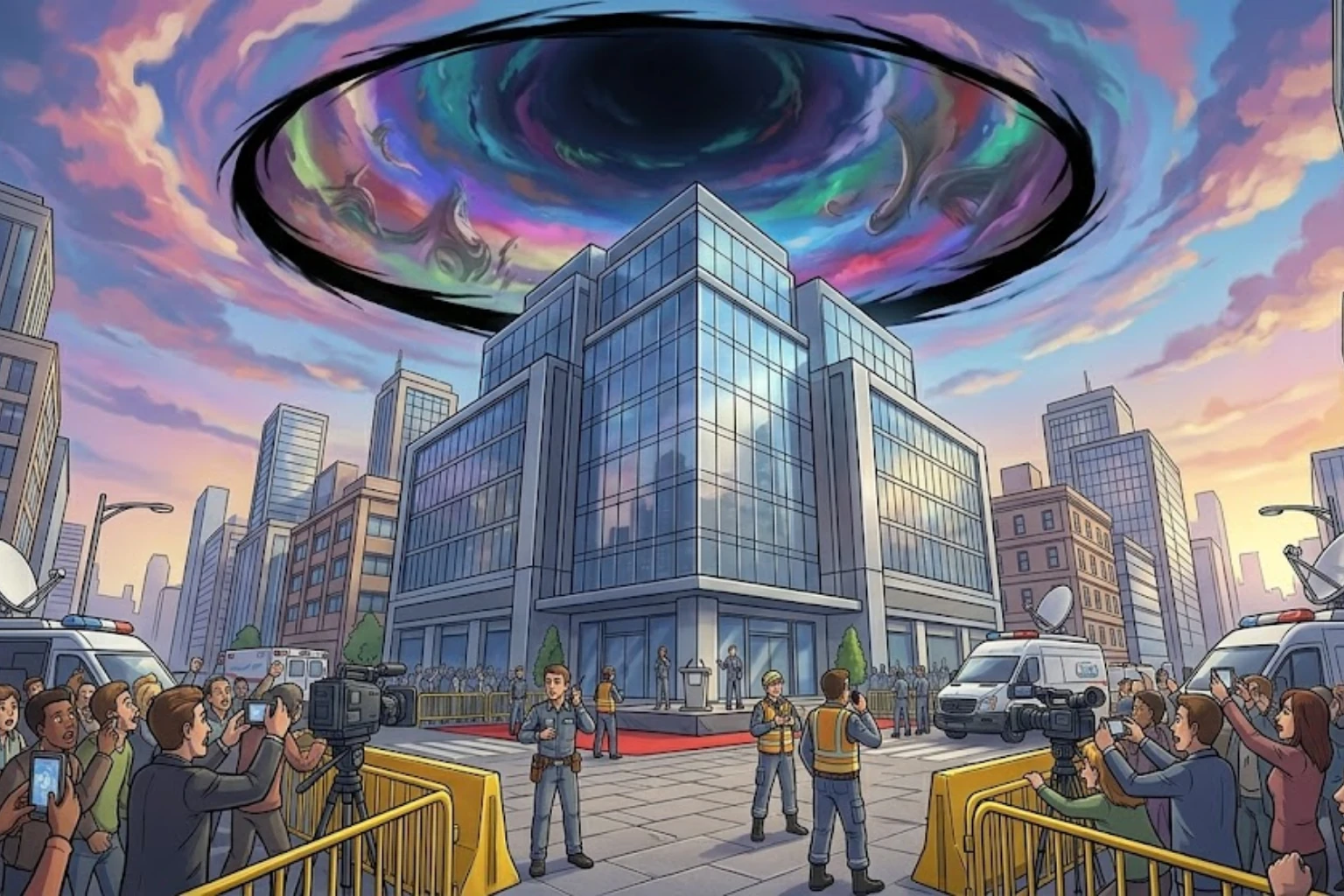
It happened at 2:47 in the afternoon, which Pixel Pop would later note was an unusually specific time for the end of the world to begin, but the end of the world had never been known for its consideration of anyone's schedule.
It started small. The streetlights on the block flickered — once, then again, in a pattern that wasn't quite random. The traffic signal at the corner cycled through red, yellow, and green in under two seconds, then froze on a fourth color that traffic signals did not have.
Then the sky did something.
Not dramatically, at first. A kind of shimmer, high up, like heat distortion on a summer road, except it was October and the air was cold and the shimmer was spreading — slowly, in a circle, centered on a point directly above the city's downtown district.
Nova was the first to notice, because Nova noticed things in the sky as a matter of professional habit.
"Guys," she said, standing at the window. "Guys, come look at this."
Pixel Pop and Gridlock came to the window. Gridlock looked up. His expression, which had been somewhat deflated since the previous day's "friendly exercise," sharpened immediately into something else entirely.
"That's not weather," he said.
"No," Nova agreed.
The shimmer reached the edges of the circle and stopped expanding. For a moment, nothing happened.
Then the circle inverted — the sky inside it flipping, like a page turning, revealing not more sky but something else behind it. Something dark and vast and full of slow-moving shapes that none of them could quite focus on, the way you couldn't focus on something at the edge of a dream.
A low hum settled over the city. Not loud. Just present, the kind of sound you felt in your teeth more than heard.
"Okay," Pixel Pop said slowly. "That's — that's a new one. We haven't done that one before."
"GLICK!" Gridlock bellowed, already moving toward the basement door.
Glick was already halfway up the stairs when Gridlock reached the door, which was either impressive or expected, depending on how long you'd known him.
"Yep, saw it, on it, give me a second," Glick said, brushing past with an armful of equipment that hadn't existed five minutes ago and somehow already had wires connected to things. He moved to the window and looked up at the inverted circle with the focused, delighted expression of a man looking at a puzzle he'd been waiting for.
"Oh, that's a Threshold Tear," he said. "Haven't seen one of those in—" he thought about it "—a while. Long while."
"Is that bad?" Pixel Pop asked.
"It's extremely bad," Glick said cheerfully. "On the bright side, I know exactly what it is, which puts us ahead of basically everyone else in the city right now."
As if to underscore this point, the news, playing on the television in the corner of the room, cut to a reporter standing on a rooftop, visibly windswept, shouting something about "unprecedented atmospheric phenomena" while behind her, the inverted circle pulsed once, and something large and indistinct moved on the other side of it.
"What's coming through?" Nova asked.
"Hard to say exactly," Glick said, already typing something into a device that looked like a calculator that had been in a fight. "Threshold Tears pull from adjacent — let's call them layers. Sometimes it's nothing. Sometimes it's a guy. Once, memorably, it was just a very confused goose." He squinted at his readings. "This one's pulling from somewhere with a lot of mass behind it. Gonna be big. Gonna be loud. Possibly gonna be both at the same time, which is the worst combination."
"Great," Pixel Pop said. "Great great great."
"The good news," Glick continued, "is that Threshold Tears have a weak point. There's always a — anchor, basically. A spot where the tear is thinnest, usually near the center, where you can push it shut if you hit it right." He looked up. "The bad news is the anchor's gonna be wherever the biggest concentration of people currently is, because that's how these things work, they're drawn to—"
The television, still playing, cut back to the reporter, who was now pointing, with increasing alarm, at the base of the inverted circle, which had descended — slowly, but unmistakably — toward downtown.
Toward the Champion Alliance's new headquarters, which sat directly beneath it, and which — Hyperforce now remembered, with the specific dread of people recalling an inconvenient fact — had hosted a press event that morning, attended by approximately two hundred people, none of whom appeared to have left yet.
"—exactly there," Glick finished, looking at the screen.
Nobody said anything for a second.
"Of course it's there," Pixel Pop said finally, with the flat exhaustion of someone who had stopped being surprised by the universe's sense of humor sometime around Episode 4.
The Champion Alliance, it turned out, had a protocol for this.
This became evident as Hyperforce arrived — Nova flying, Gridlock running at a speed that generated its own small weather system, Pixel Pop riding what Glick had hastily described as "a scooter, sort of, don't ask" — and found the area around the Champion Alliance's headquarters cordoned off with professional, color-coded barriers, behind which the entire Champion Alliance stood in a perfect formation, facing the descending tear, looking extremely prepared.
"STAND BY FOR PROTOCOL SEVEN," Solaris was announcing, through a megaphone that matched his uniform. "CITIZENS, REMAIN CALM. THE CHAMPION ALLIANCE HAS THIS SITUATION FULLY UNDER CONTROL."
The crowd — and there was a substantial crowd, mostly press and onlookers who had been at the morning's event and had not yet dispersed — did, in fact, seem somewhat calmed by this. The Champion Alliance's confidence was, as always, impressive.
The tear descended further. The hum intensified. Something vast began to push through from the other side — not yet visible in full, just an impression of scale, of something that was going to be very large and was currently in the process of becoming more large.
"PROTOCOL SEVEN," Solaris repeated, "INVOLVES—" He paused.
There was a silence.
"Lumen," Solaris said, slightly less booming, "what does Protocol Seven involve?"
"I thought you wrote Protocol Seven," Lumen said.
"I wrote One through Six. Six was supposed to be the last one."
"Six was for fires."
"This isn't a fire?"
"Solaris, look at it. That is not a fire."
There was a pause during which the entire Champion Alliance looked, collectively, at the enormous inverted hole in the sky, and then at each other, and the formation — which had been so perfect, so immediate, so photographable — began to subtly, almost imperceptibly, fall apart at the edges.
Hyperforce arrived at the barrier at exactly this moment.
"What's the situation?" Gridlock said, skidding to a stop.
"The situation," Solaris said, turning to them with an expression that was trying very hard to remain composed and was losing, "is that we are currently between Protocol Six and Protocol Eight, and there does not appear to be a Protocol Seven, and I am beginning to suspect that whoever was responsible for Protocol Seven left the team before it was written and nobody followed up."
"That was the intern," Lumen said. "He quit in March."
"Why did nobody tell me—"
The tear pulsed again. The thing on the other side pushed further through, and now it was visible — not a creature exactly, more like a condition, a vast rippling mass of something that bent light around itself wrong, with no clear front or back or up or down, just an enormous, spreading wrongness that the air itself seemed to recoil from.
The crowd, sensing — correctly — that Protocol Seven was not coming, began to do the thing crowds did, which was panic, quietly and then loudly.
"Okay," Nova said, looking at the wrongness, looking at the crowd, looking at the Champion Alliance — six extremely capable, extremely well-equipped heroes, all of whom had gone slightly pale and were checking devices that were, near as Hyperforce could tell, beeping in increasingly unhelpful ways. "Okay. We've got this."
"You've—" Solaris turned to her. "You've got this?"
"We've got worse than this," Gridlock said. He was already rolling his shoulder — the one that had been hurt yesterday — testing it, the way he did before things got physical. "Pixel, anchor point?"
"Glick says center-mass, lowest point of the tear," Pixel Pop said, already scanning. "That's — that's gonna be right where the wrongness-thing is standing. Or floating. Or whatever it's doing."
"Of course it is," Gridlock said.
"It's always the worst spot," Pixel Pop agreed.
The Champion Alliance watched this exchange with the specific bewilderment of people watching a conversation in a language they technically spoke but had never heard used this way.
"You — you have a plan?" Solaris said.
"We have a plan," Nova said. "Whether it's the plan depends on how this goes." She looked at the wrongness, which had finished emerging and was now beginning to unfold — limbs, or things that functioned like limbs, extending outward in directions that didn't entirely make sense, each one trailing the same heat-shimmer distortion as the tear itself. "Grid, you're tank. Pixel, you're getting close enough to deliver whatever Glick sends you. I'm going to try to keep its attention on me, because apparently I'm the one who can fly and set things on fire, which feels relevant."
"And the plan if that doesn't work?" Solaris asked.
"We make a new plan," Gridlock said. "Fast."
"You don't have a backup plan?"
"We have several," Nova said. "We just don't decide which one until we see what it does first."
The Champion Alliance stared at her.
"That's not a strategy," one of them said. "That's improvisation."
"Yeah," Nova agreed.
The wrongness took a step — or did the closest thing to a step that something with no clear legs could do — and the ground rippled where it landed, the asphalt briefly losing its texture and becoming, for a moment, a flat grey nothing before snapping back.
"It's spreading the same effect as the tear," Pixel Pop said, watching the rippled patch of ground with professional interest despite everything. "Like — it's not attacking, exactly. It's just touching things, and where it touches, the rules stop applying for a second."
"Define 'rules,'" Solaris said weakly.
"Like — gravity. Texture. Whether something is solid." Pixel Pop's visor flickered as she processed something. "If it touches a person—"
She didn't finish the sentence. Nobody needed her to.
What happened next took about four minutes, and would later be described by no fewer than eleven separate witnesses in eleven completely different ways, which was, Pixel Pop reflected afterward, sort of the whole point of Hyperforce.
Nova went up first — straight up, fast, putting herself directly in the wrongness's field of attention with the specific recklessness of someone who had decided that being noticed was, for once, the entire job. She lit up — not subtly, the full orange-gold blaze that she usually saved for genuinely bad days — and the wrongness's not-quite-limbs swung toward her, slow and rippling, each one leaving a trail of broken physics in its wake.
"HEY!" Nova shouted, at a volume that the Champion Alliance's megaphone-enhanced announcements had not managed to achieve. "HEY, UGLY, OVER HERE!"
The wrongness oriented toward her. Fully. Which meant, for a few crucial seconds, it stopped paying attention to the ground.
"GRID, NOW!"
Gridlock had been waiting for this. He didn't run at the wrongness — running at something that rearranged physics on contact seemed, even to Gridlock, like a bad idea. Instead, he did the thing Gridlock did best, which was stand very still and be extremely heavy, directly beneath where the anchor point needed to be, and let Pixel Pop use him as a launching platform.
"Sorry in advance," Pixel Pop said, and jumped off Gridlock's shoulders with considerably more force than her own legs could have provided, courtesy of a small device Glick had handed her on the way out that he'd described only as "the jumpy one, you'll know it when you use it."
She did, in fact, know it when she used it. It launched her directly toward the lowest point of the tear — which was now occupied by the central mass of the wrongness, currently distracted by Nova doing aerial loops and shouting things that were not, strictly speaking, professional — with enough velocity that she had exactly one shot at this.
In her hand: the golden, glitching device Glick had handed her, humming with the same energy signature as the toaster-patch from the System Administrator fight, except — Glick had explained, very quickly, on the way over — inverted. "Last time we used a glitch to break something that wanted order. This time we're using order to break something that's made of glitch. Same trick, opposite direction. Should work. Should."
Pixel Pop reached the anchor point.
She slammed the device into the rippling mass of the wrongness's central body, right where the tear's lowest point intersected with it, and for one half-second, everything went very quiet.
Then the device activated, and the wrongness — which existed by unmaking the rules around it — encountered, for the first time, something that insisted on rules, hard, all at once, in a small concentrated burst.
The wrongness didn't explode. It didn't dissolve. It simply — resolved, the way a blurry photograph resolved into focus, all its rippling, undefined edges suddenly snapping into something coherent and small and, crucially, no longer there, because the thing it resolved into didn't have enough mass to occupy the space it had been occupying a moment ago.
The tear in the sky, with its anchor suddenly gone, did the thing torn things did when whatever was holding them open vanished.
It snapped shut.
The hum stopped. The sky was just sky again — grey, ordinary, October-appropriate. The rippled patches of asphalt slowly settled back into being asphalt. Pixel Pop, no longer having anything to land on, began to fall, and was caught — smoothly, without comment — by Nova, who had been hovering nearby specifically in anticipation of this.
The crowd was silent.
Then, slowly, it began to cheer.
The Champion Alliance stood behind their barrier, in their formation that was no longer quite a formation, and watched Hyperforce land in the middle of the street — Nova setting Pixel Pop down gently, Gridlock walking over with the specific gait of a man whose shoulder was definitely going to hurt tomorrow but who was choosing not to think about that yet.
Solaris approached slowly.
"That," he said, "was—"
He stopped. He seemed, for the first time since Hyperforce had met him, to be searching for words rather than simply producing them.
"How did you know to do that?" he said finally. "The — the device. The anchor point. The — all of it. We had protocols. We had equipment. We had—" he gestured at his team, at the barriers, at the entire gleaming apparatus of the Champion Alliance "—everything, and we didn't know what was happening until it was already over."
Nova looked at him for a moment.
"We've seen weirder," she said simply.
"Weirder than that?"
"Last month it was a sentient vending machine," Pixel Pop said, dusting herself off. "The month before, our basement turned into another dimension. Twice."
"We fought a guy who turned into a sixteen-bit monster two weeks ago," Gridlock added. "He tried to delete Pixel."
"He DID try to delete me," Pixel Pop confirmed. "It didn't work, but he TRIED."
Solaris stared at them.
"You — you've been dealing with things like this the whole time?" he said. "And we've been—" He looked back at his own headquarters — gleaming, perfect, currently displaying, on its enormous external screen, a paused feed of this morning's press conference photo, the one with Glick running from a fire in the background, which someone on the Champion Alliance's social media team had apparently been midway through deciding whether to post when the sky tore open. "We've been doing obstacle courses."
"Your obstacle course was really nice," Pixel Pop offered.
"It electrocuted you."
"It TRIED to electrocute me. There's a difference. A small difference. But a difference."
Solaris looked at his team. His team looked back at him, in the specific way of people who had just collectively realized something uncomfortable about themselves.
"We have a protocol for press events," Solaris said slowly, almost to himself. "We have a protocol for fires. We have a protocol for — for every situation we could think to plan for." He looked at the empty sky where the tear had been. "We didn't think to plan for that."
"Nobody does," Nova said, not unkindly. "That's sort of the thing about it."
"How do you—" Solaris stopped, started again. "How do you prepare for something like that?"
There was a pause.
From somewhere behind Hyperforce — they hadn't even noticed him arrive, which was, Pixel Pop reflected, very on-brand — Uncle Glick's voice piped up, cheerful as ever, carrying a tray of what appeared to be sandwiches.
"You don't," Glick said. "You just survive enough weird stuff that the next weird stuff feels familiar." He held out the tray. "Sandwich? I made extra, I had a feeling today was gonna be a sandwich kind of day."
Nobody from the Champion Alliance took a sandwich. Hyperforce, collectively, took several.
Solaris watched all of this — the sandwiches, the casual eating, the complete absence of any kind of debrief or press statement or protocol — with the expression of a man whose entire professional framework had just quietly, politely, and thoroughly been rearranged.
"I think," he said slowly, "we may have misjudged the situation."
"Probably," Gridlock said, around a mouthful of sandwich. "It's fine. Happens to everybody."
"Does it?"
"No," Pixel Pop said. "But it's nice to say."
That evening, Hyperforce sat in their slightly crooked living room, eating the leftover sandwiches, watching the news cover the day's events with the kind of breathless excitement that only an actual inverted hole in the sky could generate.
The footage cut between the tear, the wrongness, Nova's aerial maneuvers, Pixel Pop's jump, and — repeatedly, because apparently it was the most-replayed clip — the moment the wrongness resolved and vanished.
"...and in a stunning turn of events," the anchor was saying, "it was the local team Hyperforce — not the newly-arrived Champion Alliance — who ultimately resolved the crisis, in what witnesses describe as 'somehow exactly what you'd expect from them, but also not at all what you'd expect, both at the same time'—"
"That's a real quote," Pixel Pop said, delighted. "Someone said that and a news station used it."
"—while the Champion Alliance, whose state-of-the-art facilities and extensive protocols had drawn considerable attention this week, were unable to—"
"Turn it off," Nova said, not unkindly. "We don't need to watch them get roasted. We were there."
Pixel Pop turned it off.
For a moment, the living room was quiet — the comfortable kind of quiet, the kind that came after a long day that had gone, against considerable odds, fine.
"So," Pixel Pop said eventually. "Are we — are we good at this? Like, actually? Because yesterday I was really sure we weren't, and today—"
"Today we were the only ones who didn't freeze," Gridlock said.
"Right, but is that the same thing as being good at it? Or is it just — a different thing? Like, they're good at the parts everyone sees. We're good at the part that actually—"
"Pixel," Nova said.
"What?"
"You're doing the thing again."
"I'm not doing a thing—"
"You're spiraling about a metric."
Pixel Pop paused.
"...maybe a little," she admitted.
The basement door creaked open. Glick emerged, holding — for reasons nobody asked about — a second, smaller tray of sandwiches, despite the fact that the first tray's sandwiches had not yet been finished.
"You're worried about whether you're as good as the shiny team," Glick said, without preamble, setting the second tray down on top of the first one for no apparent reason.
"...maybe," Pixel Pop said again, more quietly.
Glick looked at the three of them for a moment.
"They're good at being a team that's ready for what they expect," he said. "You three are good at being a team that's ready for anything, including the stuff nobody could've expected, including the stuff that doesn't have a name yet, including—" he gestured vaguely at the basement "—whatever's in there right now, which, by the way, I should probably go check on, I left something running—"
"GLICK."
"Right, point. The point is—" Glick paused, and for a moment, the scattered, distracted energy he usually carried settled into something quieter, something that looked, briefly, like he was actually choosing his words rather than just producing the first ones available. "You're not the team for normal days. Normal days, sure, let the shiny team have the cereal and the press releases, good for them, genuinely, I mean that. But the real test—" he gestured at the window, at the sky, at the spot where the tear had been "—that's yours. That's always been yours. Today proved it."
He picked up a sandwich from the new tray, took a bite, and seemed satisfied that the point had landed.
"Anyway," he said, through the bite, "the toaster's stable, the gyroscope's recalibrated, and I think I figured out why the jam got sentient, which — good news, bad news — the good news is I know why, the bad news is it's going to keep happening unless somebody starts labeling the fridge shelves correctly, which I've asked for repeatedly—"
He wandered back toward the basement, still talking, the rest of the sentence trailing off into the stairwell and then into the comfortable, familiar hum of the lab below.
The three of them sat in the quiet for a moment.
"He's right, you know," Nova said eventually.
"Yeah," Gridlock agreed.
Pixel Pop looked at the window — at the now-ordinary October sky, at the glowing Champion Alliance building next door, its leaderboard presumably still displaying a list of names that had, after today, become considerably less impressive to look at.
"Yeah," she said. "Okay. Yeah."
She picked up a sandwich.
"Still wish we had a cereal, though," she added, after a moment.
"PIXEL."
"I'm just SAYING—"


.png)
.png)
.png)