%20(1).png)
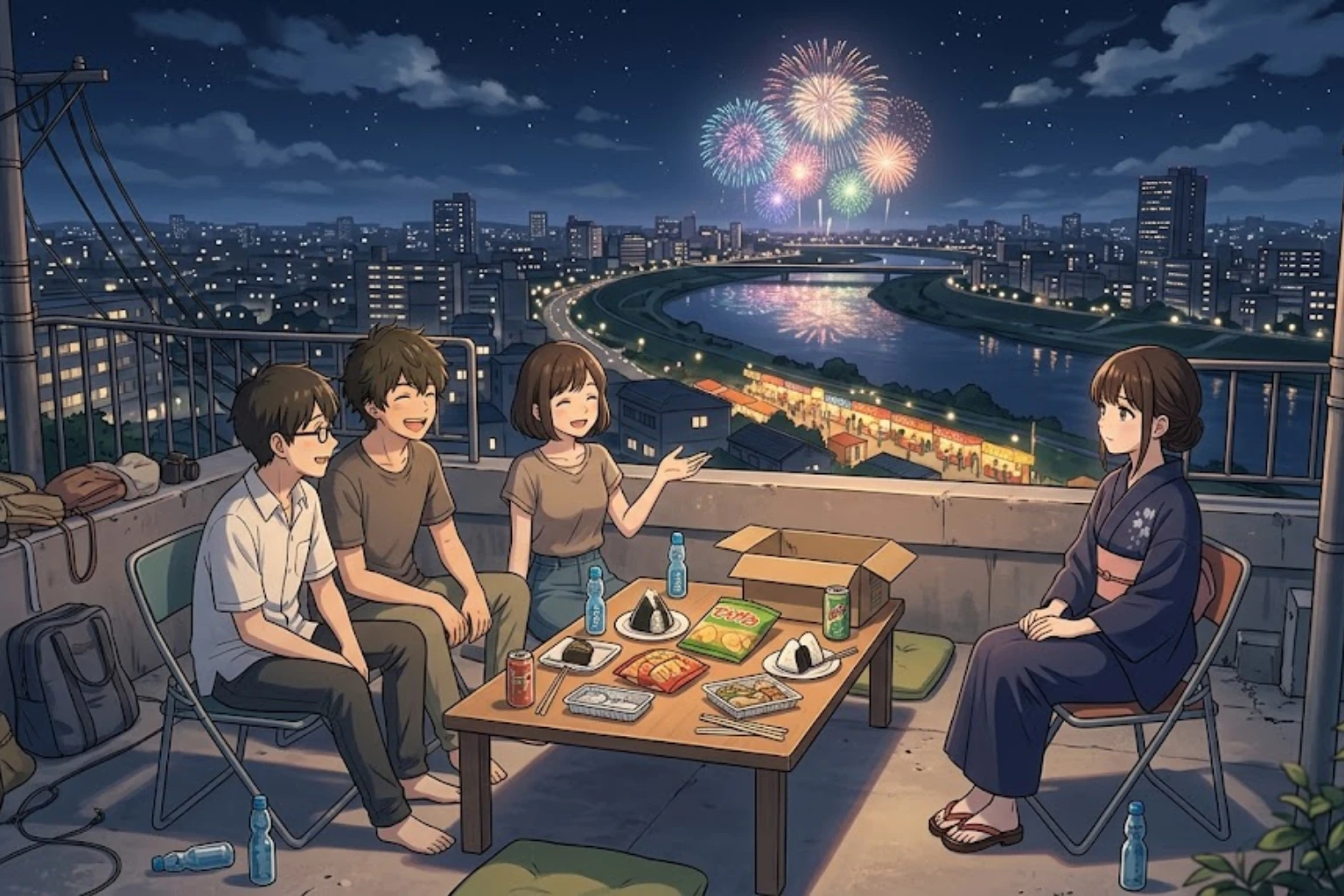
The festival was sold out.
Not the fireworks themselves — you couldn't sell out fireworks, they happened whether you had a ticket or not — but the riverside viewing area had gone to a lottery system two years ago, and none of them had won, which was how the four of them ended up standing in Haru's kitchen at seven thirty on a Saturday night in late July, staring at the lottery results on Yua's phone with the specific flat disappointment of people who had genuinely expected, this year, to finally get lucky.
"We should have known," Riku said. "We never win anything."
"I won a keychain at the summer market once," Haru offered.
"That doesn't count. Nobody entered that raffle."
"I entered it."
"You were the only one who entered it. That's not winning, that's just claiming."
Yua was still scrolling, as if the results might change if she refreshed hard enough, and then she stopped scrolling entirely and looked up with the particular expression she got right before one of her ideas arrived fully formed, which everyone in the room had learned to recognize and, more importantly, to trust.
"The roof," she said.
"What roof," Saki said.
"This roof. Haru's roof. It faces southwest, doesn't it? Toward the river?"
Haru considered this like it was a genuinely novel piece of information about a building he had lived in his entire life. "I mean — yeah. I've literally never been up there for anything, though."
"Your uncle manages the building."
"That doesn't mean I have keys to the roof, Yua."
"Ask him."
"It's seven thirty."
"The fireworks start at nine. You have an hour and a half. Ask him."
There was a brief pause in which Haru weighed the indignity of asking his uncle for a favor on short notice against the alternative, which was spending the evening pretending he wasn't disappointed about the lottery, and the indignity lost.
He called his uncle, who picked up on the second ring, listened to the request with what sounded like genuine amusement, and said yes with the specific resigned affection of a man who had been saying yes to Haru since he was seven years old and had apparently made peace with never stopping.
"He said yes," Haru reported, hanging up. "He also said if anyone falls off, that's on us, not the building."
"Nobody's going to fall off," Yua said. "There's a wall."
"He wanted it on record."
"Noted and recorded," Riku said. "Now can we go buy food, or are we doing this on principle alone?"
The convenience store two blocks over became, over the next twenty minutes, the site of a small and increasingly serious operation. Yua moved through it with a shopping list she had apparently composed mentally on the walk over, directing traffic — onigiri, two kinds, because nobody could agree on flavor and it was easier to just get both; edamame, still in the pods, because Yua had opinions about pod-to-bean ratio that she intended to exercise; a bag of ramune, four cans, one each; cold udon from the refrigerated section; a container of pudding, because Yua wanted pudding and was not interested in debate on the matter.
"We don't need four spoons," Haru said, holding up the pudding. "We can get one big one and share."
"Get the pudding with four spoons already in the package, Haru."
"That's not a real thing that exists."
It was, in fact, a real thing that existed, located two shelves over, and Yua retrieved it with the quiet triumph of someone who had known she was right and had simply been waiting for the opportunity to demonstrate it. Riku, meanwhile, had wandered off toward the snack aisle and returned holding a bag of chips he'd selected entirely on the strength of its packaging design, a habit the other three had stopped questioning years ago on the grounds that his hit rate was, against all reasonable odds, extremely high.
"You always do this," Saki said, eyeing the bag.
"It's a good bag."
"That's not a flavor."
"The flavor's on the bag too. I read it. It's fine."
They also picked up a bag of ice candy on the way to the register, mostly because it was July and thirty-one degrees even after sunset and the idea of anything cold felt non-negotiable, a decision that would prove, within the hour, to have been more optimistic than practical given the heat still radiating up off the rooftop concrete.
Getting everything upstairs took two trips and involved a genuinely undignified amount of struggling with a folding chair that had gotten wedged sideways in the stairwell door, courtesy of Riku, who insisted the chair had done it on purpose. The roof itself, when they finally emerged onto it, was exactly what Haru had promised and nothing more — flat, practical, cluttered with ventilation units and a pair of water tanks that hummed faintly in the background, the kind of space that had clearly never once been designed with anyone's evening in mind. But it faced southwest, out over a run of lower buildings toward the glass towers near the river, and the city spread out below them in the warm dark, orange and white and restlessly alive, and none of them said anything for a moment, just took it in.
"Okay," Haru admitted. "This might actually be good."
"It's better than the riverside," Yua said, already unfolding chairs.
"You don't know that yet."
"I know it already. You'll agree with me in an hour."
They arranged the convenience store food along the low wall that ran the roof's perimeter, spreading it out the way you could only really do with konbini food — everything opened at once, containers fanned across the concrete, the specific joy of eating across four or five different things simultaneously rather than committing to just one. This, Yua had argued back in Haru's kitchen, was the entire reason the riverside would never have worked as well; you couldn't spread out like this standing in a crowd holding a single bag. It required a surface. It required chairs. It required, specifically, this roof.
Riku connected his phone to a small Bluetooth speaker and put on something low and unhurried, more atmosphere than actual listening, and by the time they'd pulled the mismatched folding chairs into a loose semicircle and cracked open their ramune, the city below had settled into its full summer evening hum — traffic, distant voices, somewhere far off the tinny echo of festival announcements carrying up from the riverside they'd chosen not to fight their way into.
"This is better than the riverside," Haru said again, this time without qualification.
"I said that already."
"You were right."
"I know."
Riku peeled open the edamame, and Saki tucked her feet up under herself in her folding chair with the practiced ease of someone who had spent years making impractical furniture work through sheer force of habit, and looked out at the spread of the city with an expression Riku had seen on her before — quiet and receiving, like she was trying to hold the whole view somewhere safe before she had to put it down.
"You've been quiet," he said, not quite a question.
"I'm always quiet before fireworks," Saki said. "Building anticipation."
"That's not a real thing."
"It's a very real thing. I invented it just now, but it's real."
Nobody said anything for a while after that, and it wasn't the silence of people who had run out of things to say but the other kind, the kind that only exists between people comfortable enough to let a quiet stretch out without feeling obligated to fill it.
"Has anyone heard from your uncle again," Riku asked eventually, mostly just to have something to say.
"He texted to remind me the roof access code resets at midnight," Haru said. "Which is his way of telling us to be gone by then without actually telling us to be gone by then."
"Diplomatic."
"He's had practice."
Somewhere below, a distant announcement crackled over a loudspeaker, too far away to make out clearly, and Yua checked the time on her phone with the focus of someone counting down to something important.
"Twenty minutes," she said.
"You've had that job offer confirmed since spring," Haru said to Saki, apparently continuing a thought none of the rest of them had heard the start of. "Have you actually started packing yet, or are you still doing the thing where you say you'll start next week."
"I bought boxes," Saki said.
"That's not packing. That's buying boxes."
"It's the first step of packing."
"You've been on the first step since June."
"I'm building momentum."
"You're stalling."
"I prefer 'building momentum.'"
Yua laughed and passed the chips around, and the conversation drifted for a while into the ordinary logistics that had apparently been circling the group for months now without ever quite landing — Saki's apartment hunt, the three places she'd looked at online before finding one that actually had decent light in the mornings, the running joke that she would inevitably show up back in the old neighborhood within a month claiming she'd forgotten something crucial that could only be retrieved in person.
"You'll be back for the ramen place within two weeks," Riku said. "I'd put money on it."
"There's ramen in Osaka."
"Not that ramen."
"That's fair," Saki admitted. "That's actually a fair point."
The first firework arrived not as a sound but as something felt — a low concussive thud that landed somewhere in the sternum a half-second before the ear caught up to it, and then the sky over the southwest horizon bloomed open, red-gold, petals of light spreading wide and soft-edged before fading at the outer rim while the next one was already rising beneath it.
"Oh," Saki said quietly, to nobody in particular.
That was, Riku thought, exactly the correct response. The fireworks from the roof had a quality the crowded riverside would never have offered them — the distance made everything slower somehow, more deliberate, each burst given the space to fully open and fade before the next one demanded attention. No announcer shouting over a speaker system. No jostling for a sightline. Just the sky doing what it was doing, unhurried, and four people in mismatched chairs watching it happen.
Riku turned the music down without anyone needing to ask him to.
Haru passed the onigiri around, and Yua ate her edamame with the focused efficiency of someone who had strong opinions about extraction technique and was achieving excellent results, and Saki accepted an onigiri without looking away from the sky, her hand finding it by feel alone.
"Tuna mayo," Haru said, by way of identification.
"Perfect," she said, still watching the sky.
A green burst opened above the skyline, brighter than the ones before it, and its reflection appeared for a moment in the glass faces of the office towers to the west — fractured, multiplied, a dozen small versions of the same bloom scattered across a dozen different windows, flaring and gone almost before anyone could point at it.
"I didn't know you could see the reflection in the buildings," Riku said.
"I didn't either," Haru said.
"That might be the best part."
"Better than the actual fireworks?"
Riku considered the question with more seriousness than it probably required. "Different. The actual fireworks are the fireworks. The reflections are — I don't know. The city watching the fireworks."
Yua pointed at him with an edamame pod, delighted. "That's the most Riku sentence you've ever said in your entire life."
"I stand by it completely."
"I'm not saying it's wrong. I'm saying it's very you."
The pace of the show picked up gradually, launches beginning to overlap, the sky filling with two and sometimes three separate blooms competing for attention at once, and it was somewhere around there, without any particular setup, that Saki said, quiet but clear enough to cut through the noise: "I got the apartment. Officially. They confirmed it this week."
The others didn't turn away from the sky immediately, but something in the rhythm of the evening shifted, a small recalibration.
"Third floor," she went on. "There's a konbini two minutes away. I move the first week of September."
They had known this was coming — had known since spring, since the job offer and the two distracted weeks that followed it, when Saki had walked around looking like someone running a large and complicated calculation in the back of her mind. But there was a difference between a known possibility and a confirmed date, and the confirmation landed with its own particular weight, different from the shape it had taken as something merely likely.
"That's good," Haru said, and it was audible, the way he said it, that he genuinely meant it. "Third floor's good. No elevator drama."
"There's an elevator."
"Even better."
"Essential," Yua added. "Genuinely non-negotiable, a konbini two minutes away."
"That's what I said when I saw the listing," Saki said. "I think I picked the apartment for the konbini and the light in the mornings was a secondary consideration."
"Reasonable priorities."
A pause opened up after that, not uncomfortable, just present, while another burst climbed and opened somewhere off to the left, gold this time, trailing thin streamers of light on its way down.
"I keep thinking about how I'll have to find new versions of everything," Saki said, eyes still on the sky. "A new konbini. A new place to watch fireworks from, probably, since I doubt Osaka has a rooftop with this exact view just sitting around waiting for me." She was quiet for a beat. "A new everything, basically."
"You're good at that," Riku said.
She glanced over at him.
"Finding the good version of things," he said. "You found this roof."
"That was Yua's idea, not mine."
"You said yes immediately," Yua said. "With actual enthusiasm. That counts for something."
Above them, a white firework opened into a nearly perfect circle, held at its full width for a beat longer than the ones before it, and then began its slow unraveling, the outer edge dissolving first, trailing gently downward like something being unwound rather than extinguished.
Saki watched it all the way down before she spoke again.
"I'm not worried about Osaka," she said. "I actually think I'm going to like it there. It's not that." She stopped, tried again, more precisely this time. "It's this specific thing. This exact night, this roof, you three, this exact configuration of everything. You can't pack that into a box and bring it with you."
Nobody argued with that, because it was true, and arguing with something true would have been its own kind of disrespect to how she'd said it.
"You can come back for the lottery next year," Haru offered instead. "We'll probably lose again."
"And end up right back on this roof," Riku said.
"With the same food," Yua said.
"Worse chairs, probably," Haru said. "These are already borderline structurally unsound."
"Mine's fine," Yua said, mildly offended on the chair's behalf.
"Yours has a wobble."
"I've adapted to the wobble. We have an understanding now."
Saki laughed, sudden and real, the kind of laugh that arrives before you've had time to decide whether to allow it, and because she laughed, the rest of them did too — the particular contagious mechanics of a friend group comfortable enough that one person's genuine amusement becomes everyone's immediate reflex.
They talked a while longer between bursts, the conversation drifting easily between the practical and the ordinary — whether Osaka's summers were actually worse than here or just differently humid, whether Saki would keep the same phone plan or switch, whether anyone could realistically commit to visiting within the first month or whether that promise, like most first-month promises, would quietly slide to month three. Nobody made speeches. Nobody cried. It was mostly jokes with something more serious sitting underneath them, which seemed, to all four of them without anyone saying so, like the more honest way to handle it than saying everything directly.
Then the pace of the show shifted again, launches coming faster now, barely a breath between one bloom and the next, and they all felt it before anyone announced it — the unmistakable gathering momentum of an ending building toward itself.
The finale arrived the way finales always did, escalating past any single firework being worth tracking individually, the sky filling gold and red and silver and green in overlapping waves, the concussive thuds arriving close enough together that they stopped registering as separate sounds and became something closer to weather, a continuous rolling pressure against the summer air.
Conversation stopped on its own, without anyone deciding it should. You couldn't really talk through a finale. It wasn't built for talking. The forgotten ice candy had gone fully liquid in its bag by now, and the ramune cans sat empty on the low wall, and the four of them simply sat and watched with their whole attention, because that was what a finale like this one asked of you and it seemed rude, somehow, to give it anything less.
Haru thought, watching the sky fill and fill again: I want to remember exactly this.
Yua thought, tracking a burst as it fractured across a dozen office windows at once: the reflections really are the best part, and nobody's ever going to believe me about that except these three.
Riku thought, glancing sideways at Saki's face lit gold and then red and then gold again: I'm going to miss her. Just that, plain and unadorned, no plan attached to it, nothing more complicated than the simple fact of it.
Saki thought, looking out at the city she'd grown up in, spread beneath a sky doing its absolute best, at her three friends in their mismatched chairs with the convenience store wreckage between them and the day's heat still rising faintly off the concrete: I'm going to carry this one with me. Not the fireworks specifically. This. All of it, together.
The finale closed on one last enormous white bloom, wider than anything that had come before it, holding at its full spread for what felt like several seconds longer than physics should have allowed before it finally, gently, let go.
Then the sky was just the sky again — dark, ordinary, scattered with stars that had been there the entire time, quietly waiting behind all that light for their turn to be visible again.
Nobody spoke right away. The quiet after a finale always had its own particular texture, a kind of static hum where the fireworks had been.
"Okay," Riku finally said. "That was better than the riverside."
"I said that an hour ago."
"We all said it eventually."
"I said it first," Yua said, entirely without contest in her voice, simply stating a fact for the record.
"Credit where it's due," Haru said, raising his ramune can toward her in acknowledgment, only to discover it was empty and lower it again with mild disappointment.
They didn't move to leave right away. The show was over, but the night clearly wasn't finished with them yet, and nobody seemed in any hurry to be the one who suggested packing up. Yua dug the pudding container out from where it had migrated beneath a chair and distributed the four spoons, and they finished it in comfortable silence, passing the container along the low wall. The ice candy had gone entirely liquid, and Haru drank the last of his straight from the bag with a lack of dignity nobody bothered commenting on, mostly because they were all a little too tired and a little too full and a little too content to summon the energy.
Saki stood eventually and walked to the roof's edge, looking southwest toward the river, where the finale's smoke still hung in a long pale line above the rooftops, lit faintly from below by the scattered streetlights.
"Same roof next year?" she said, without turning around.
"You'll be in Osaka," Riku pointed out.
"Osaka has trains," she said. "I checked already. Two hours forty minutes on the shinkansen. If I leave by five, I'm here by seven thirty. Easily in time."
A short pause followed while everyone did the mental arithmetic and arrived, separately, at the same conclusion.
"Same roof," Haru said. "Same konbini run beforehand. I'll enter the lottery again next year specifically so we can lose it again."
"Lose it together," Yua said, with great solemnity, as though pronouncing something binding.
"It's basically a tradition now," Riku said. "You genuinely cannot break a two-year tradition. There are rules about this."
"Are there," Saki said.
"I just made them up. But they're rules now."
She turned around and looked at the three of them properly — Haru leaning back in his chair with his arms folded and his face still tilted up toward the emptied sky as though checking it hadn't changed its mind, Yua investigating the last smear of pudding at the bottom of the container with the spoon, entirely unbothered by the indignity of it, Riku with his elbows on his knees, watching her with an expression she couldn't quite name and didn't try very hard to.
She picked up her ramune can. Empty, same as everyone else's.
She held it up anyway.
"Next summer," she said.
They raised their own cans to meet hers, four empty cans catching what was left of the streetlight in a small, slightly absurd toast.
"Next summer," they said, more or less together, Yua half a beat ahead as usual.
The smoke drifted slowly eastward, thinning as it went, and the city hummed on below them, warm and continuous, indifferent in the specific way cities always were and beloved despite it, or maybe partly because of it.
They stayed on the roof a while longer than any of them would have predicted, gathering wrappers with the unhurried pace of people in no rush to end something good, until Haru's uncle finally texted a gentle reminder about the midnight access code, later than any of them had actually expected him to hold out. They folded the chairs, gathered the last of the convenience store debris into one overstuffed bag, and made their way back toward the stairwell door and the fluorescent, ordinary light waiting on the other side of it.
Saki was the last one off the roof.
She lingered at the door for a moment, one hand on the frame, and looked back once more at the southwest sky — dark now, unremarkable, just the sky again, no trace left of everything it had done less than an hour before except the faint lingering smell of smoke still caught somewhere in the warm night air.
Then she stepped through the door and let it close gently behind her.


.png)
.png)
.png)