%20(1).png)
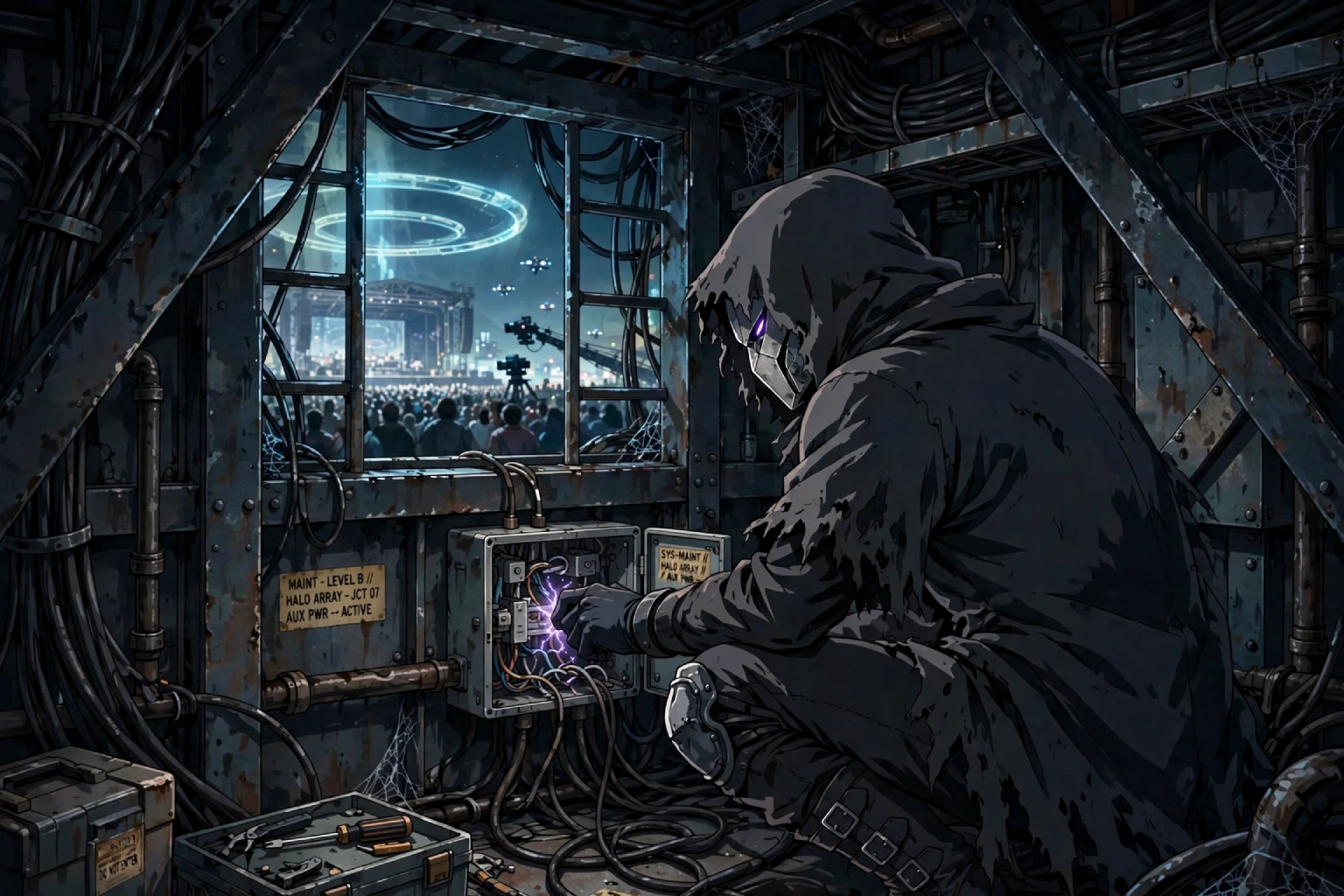
The briefing happened in a rented office eleven floors above a street that never quite went quiet, in a building whose name Ferro had already forgotten by the time he sat down.
Colston had chosen the location herself, she said, because it belonged to nobody who mattered, rented for the week under a shell name and stripped of anything that could tie it back to her actual employer. She had good instincts for that kind of thing. Ferro respected good instincts wherever he found them.
"You've seen the press material," she said, sliding a tablet across the table toward him. "Everyone has. Orvantis's been building this for six months. Billboards, sponsored segments, a countdown clock on their homepage. Tonight they unveil something called the Halo Array in front of ten thousand people and every camera crew in the city."
"I've seen it." Ferro didn't touch the tablet. "A hologram you can walk around without glasses. Big enough for a stadium. If it works the way they're claiming, it replaces every screen in every living room within five years."
"If it works," Colston said, "is the whole reason we're having this conversation."
"You want it to not work."
"I want it to work first." She said it carefully, like she'd rehearsed the distinction, which she probably had. "That's the part people get wrong when they hire someone like you. It's not enough for the thing to fail. A prototype that quietly breaks before the demonstration starts is a footnote. Orvantis apologizes, reschedules, fixes whatever went wrong, and tries again in six weeks with better security and a smaller, friendlier crowd. Nobody remembers that. It doesn't cost them anything they can't recover."
"But a prototype that works," Ferro said, following the thread, "in front of everyone. Cameras rolling. Every outlet already writing the breathless headline. And then it comes apart."
"Then they can't walk it back. They can't call it a delay. They can't control the story, because the story already happened in front of ten thousand witnesses and a hundred livestreams. That's the only version of this that's worth what we're paying you." She leaned back. "My employer doesn't need Orvantis's technology to fail. They need the world to have already believed in it once."
Ferro considered that, turning it over the way he turned over most jobs, looking for the seam where it might cause him trouble later. "So I don't touch anything until the machine's already running."
"Correct. Let it start. Let it impress everyone. Then you go in."
"And how long do I have once it starts?"
"These things don't run long. It's a demonstration, not a broadcast. Ten minutes, maybe fifteen if they're feeling confident. You won't get longer than that before the presenter starts wrapping it up and the lights come back on regardless of what you've done."
"That's a narrow window to break something I haven't seen the inside of."
"You've never needed a wide one." Colston said it like a compliment, though her expression stayed businesslike. "We have partial architecture. Whatever our people could get out of contractors who worked adjacent to the core system. It's not complete—Orvantis's kept the actual projection core sealed tighter than anything else in that building, tighter than their patents, tighter than their own board reports. But you've worked with less."
"I have." He finally picked up the tablet, scrolling once through the files. Power schematics, rough. A partial map of the plaza's structural conduits. Nothing that looked like the guts of the machine itself. "You understand I can't promise what I'll find once I'm actually inside it."
"I understand you're the best at finding out," Colston said. "That's what we're paying for."
"One more thing," Ferro said, setting the tablet down. "If this fails in a way that looks like an accident, you don't get what you paid for either. You said it yourself. You want them embarrassed, not unlucky. That changes how I do it."
"I'm not asking you to make a statement," Colston said. "I'm asking you to make it fail where the cameras are pointed. What it looks like when it happens is your decision, not mine."
"Good," Ferro said. "I'd rather it be mine."
He arrived at the Meridian Plaza a little over two hours before the scheduled start, well ahead of the crowds, while the tiers were still mostly empty and the stage crew were running final checks under a scatter of work lights. He did not walk in through any gate. He came around the back of the structure, along a service road where two catering trucks sat with their engines idling and a man in a reflective vest was arguing quietly with someone on a headset about where a generator cable was supposed to run.
Ferro watched that argument for nearly a full minute before he moved, not because it mattered to him, but because arguments like that told him things. They told him which parts of the plaza's power distribution were still being improvised this close to showtime, which told him where redundant, poorly documented connections were likely to exist, the kind of connections nobody thought to secure because nobody expected anyone to look for them.
He found the maintenance door behind the east tier exactly where the partial schematics said it would be, a plain gray service entrance with a keypad that had clearly been installed years before anyone imagined tonight's event.
He didn't bother trying the four-digit combination Colston's people had guessed at. He pressed two fingers flat against the plate beside the keypad instead, let the lattice in his forearm read the current running through the lock's solenoid, and eased it open the way he might ease open a door he already had the key to, without forcing anything, without hurrying.
Inside, the understructure of the east tier ran back into darkness, a lattice of steel supports and cable trays that smelled of old rain and hot dust from the work lights somewhere above. He moved through it slowly, not because he needed to, but because a job like this rewarded patience in the setup the same way it would reward patience later, inside the machine itself. He traced the run of cable trays with his eyes and with his hands, letting his fingers rest briefly against conduits as he passed, reading the current in each one the way another man might read labels.
He found the crawlspace he wanted roughly forty minutes later, a narrow channel bolted beneath the tier flooring with a gap in the structure above the stage wide enough to see through but too narrow for anyone below to notice a shape moving in the dark above them. He settled into it methodically, the way a sniper settles into a position he intends to hold for hours, checking the angle, checking the sightline, making sure nothing about his silhouette would catch stray light from the stage rigs once they came up.
Beside him, bolted into the crawlspace itself, was a junction box he'd identified from the schematics as a maintenance feed, a low-priority channel that reported power telemetry and lighting cycles back to whatever technical team Orvantis had stationed backstage. It wasn't much. It was, he judged, exactly the kind of door nobody thought to lock carefully, because nobody expected it to lead anywhere worth going.
He opened its panel with a small tool from an inside pocket, exposing a cluster of leads, and did not connect to them yet. There was no reason to announce himself to the system an hour and a half before it even woke up. Instead he sat with his back against a steel support, coat gathered around him, watching thin bars of gold light begin to fall across the empty stage below as the rigging crew brought the first color washes up for a sound check, and he waited the way he always waited, unhurried, listening to the plaza slowly fill with sound.
The crowd arrived the way crowds always arrived for something people had been promised would matter, in loose streams at first and then in a thickening tide, filling the lower tiers, then the upper ones, spreading across the plaza floor until there was barely a gap of pavement left uncovered. Ferro watched it build from above, through the narrow gap in the structure, feeling the tier itself begin to hum faintly under the weight and motion of thousands of bodies settling into place.
A band worked through an instrumental set near one side of the stage, nothing demanding, guitar and low percussion and a synth pad that filled the waiting without competing with it. Strings of soft amber light hung along the tier edges, giving the whole bowl a warm, expectant glow that had nothing to do with the display everyone had actually come to see.
Camera drones drifted in slow patterns overhead, their running lights blinking red and white, gathering footage of the crowd's anticipation that would run tomorrow regardless of what happened tonight. Somewhere near the stage, a cluster of reporters stood with handheld mics, doing live cut-ins for evening broadcasts, their voices carrying up faintly on the breeze whenever the band paused between songs.
"—expectations here are enormous," one of them was saying, close enough for Ferro to make out clearly. "Orvantis's stock is up eleven percent just this week on anticipation alone. If tonight goes the way the company's promising, we could be looking at the first real successor to the television screen in almost a century."
Below the crawlspace, closer to the stage itself, a woman in a silver jacket checked something on a handheld device and spoke briefly to a man wearing a headset, the kind of small unremarkable exchange that happens before every large production. Ferro recognized her from the press material Colston had shown him: Renata Oyelaran, Orvantis's head of product, the face the company had chosen to put in front of this exact moment. She looked calm in the way people look calm when they've rehearsed calm as thoroughly as everything else.
He let his attention drift down to the thick bundle of cabling running from the rear of the stage into a floor hatch, the artery that would, somewhere beneath the concrete, connect to whatever the Halo Array actually was. He did not touch it yet. There was no reason to. The machine was still asleep, and waking it early would cost him everything Colston was paying for.
By the time Oyelaran walked out to the front of the stage carrying a wireless mic, the crowd numbered easily in the thousands, and the low murmur of ten thousand private conversations had built into something that felt, from above, almost like a held breath.
"Good evening," she said, and her voice rolled out across the plaza through speakers stacked along the tier edges, warm and confident and clearly enjoying the moment. "My name is Renata Oyelaran, and I have the extremely unfair privilege of being the first person outside this company to show you what we've built."
A ripple of laughter went through the crowd.
"Six years ago," she went on, "Orvantis showed the world a prototype that could render a hologram the size of a coffee cup, in a lab, under controlled light, for about ninety seconds before it overheated. Some of you were kind enough to write about that. Some of you were less kind." More laughter, a little louder, someone near the front shouting something good-natured that didn't quite carry. "Tonight we are not showing you a coffee cup."
She let that sit for a moment, timing it the way a good performer times anything, letting the silence stretch just past comfortable before she broke it herself.
"We're going to turn off the lights now," she said. "All of them. I need you to trust me that this is supposed to happen."
A low murmur went through the plaza, thousands of people glancing at each other in the amber glow, some of them laughing nervously, a few phones already rising into the air in anticipation of whatever was coming. The band's instrumental set faded into a single held chord and stopped there, suspended, waiting.
Then the lights began to die.
They went in sequence, tier by tier, amber fading to violet fading to nothing, starting at the far end of the plaza and sweeping inward like a tide going out, until the only illumination left anywhere in the bowl came from the blinking lamps on the drones overhead and the pale scattered glow of phone screens held up in the dark. For a moment, genuinely, there was nothing. No stage lighting. No work lamps. Just the sound of ten thousand people breathing in the dark together, the kind of silence that has weight to it, that presses against the ears.
Ferro, watching from his crawlspace, felt the particular stillness that always came over a crowd right before something happened that they would talk about for years. He had felt it before, at other jobs, in other cities, and it never stopped being useful to him, because a crowd that quiet was a crowd that wouldn't notice a shadow moving thirty feet above their heads.
For several long seconds, nothing happened at all.
Then, in the exact center of that darkness, a single point of light appeared.
It was small, no larger than a struck match, hanging in open air with no visible source, no beam falling from above, no projector surface anyone in the crowd could point to. It held there, trembling faintly, and then began, slowly, to widen, gaining edges, gaining the faint suggestion of depth, spreading outward like frost forming on glass until the point had become a shape, and the shape had resolved, unmistakably, into the outline of a human figure standing in the middle of the empty stage.
The crowd's collective breath broke into sound all at once, a wave of gasps rolling outward from the front rows to the back, scattered applause breaking out before anyone had fully decided to applaud, at least one very loud "no way" from somewhere in the lower tiers that got a laugh even in the middle of everything else.
The figure was rendered in soft suspended light, translucent enough that the drones' running lamps showed faintly through its edges, solid enough in its outline that it held together with a crispness that felt wrong for something with no physical surface at all. It raised one arm, slowly, deliberately, clearly a rehearsed gesture built into the demonstration rather than anything spontaneous. Ten thousand people watched a hand made of pure light open its fingers against the dark.
"Ladies and gentlemen," Oyelaran said, and her voice cracked slightly, not from the microphone but from something that sounded like real, unrehearsed feeling breaking through the script, "that is being rendered in open air. No glasses. No headset. Visible from every single seat in this plaza at the same time. This is the Halo Array."
The applause this time was not scattered. It rolled through the whole bowl at once, thousands of hands, a sound that had weight and shape of its own, and somewhere in the middle of it Ferro heard a woman near the front crying, actually crying, the kind of overwhelmed reaction that happens maybe once at any given public event and that camera operators spend their whole careers hoping to catch on tape. One of the news crews nearby had gone live without announcing it, the reporter simply holding her mic toward the stage and letting the crowd's reaction speak for itself.
The demonstration built carefully from there, each segment more ambitious than the last, each clearly rehearsed within an inch of its life and clearly worth every hour that had gone into it. The glowing figure dissolved and reformed into a horse at full gallop, running in place above the stage, its mane catching motion-blur that had no business looking that convincing without pixels to smear it, hooves striking at nothing and throwing up light instead of dust.
The horse gave way to a recreation of some decades-old boxing match, two fighters trading blows in three-dimensional space while the plaza's roar climbed into something closer to a continuous wave, people ducking and flinching in their seats as a punch seemed to travel directly over their heads.
"It looked right at me," Ferro heard a child's voice shout somewhere below, too loud, delighted past the point of caring who heard. "Mom, it looked right at me!"
He let it all run. He let the crowd fall further in love with it, let the media crews get their footage of the boxing match and the running horse and the crying woman near the front, because Colston hadn't hired him to prevent people from being impressed.
She had hired him to let them be impressed completely, so that whatever came after would cost Orvantis everything this moment was currently buying them. He found, somewhat to his own private amusement, that watching the crowd's reaction was not entirely unlike watching a mark fall for a long con. The pleasure was different, but the shape of it, the slow building of belief before the turn, felt familiar.
When the light resolved into a slow rotating globe, continents picked out in soft blue-green fire hanging fifteen feet above the stage, Oyelaran's voice took on a different quality, quieter, more intimate despite the speakers carrying it to every seat.
"Imagine this in your living room," she said. "Not a screen on a wall. The game, in your room, life-size. A concert, standing in the space where your furniture usually is. We built this because we believe entertainment shouldn't live behind glass anymore."
The applause came again, warm and sustained, and Ferro judged, listening to the shape of it, that the machine had shown enough of itself now. He reached for the junction box bolted into the crawlspace beside him and opened its panel.
The maintenance feed running through the junction box was a thin channel, built for reporting power draw and lighting cycles rather than carrying anything resembling the Halo Array's core traffic, but Ferro had learned years ago that thin channels were often the only doors left unlocked. He unspooled a cable from the port at his wrist, fitted it into the box's exposed interface, and let his lattice reach into the current the way another person might reach a hand into still water, feeling for temperature and depth before committing to anything deeper.
For a moment there was only the ordinary hum of the plaza's auxiliary systems, lighting cycles ticking over, audio compression data flowing toward the speaker stacks, nothing that told him where the actual machine lived. He let his attention narrow, filtering out the noise the way he'd trained himself to filter out noise in a hundred other systems, until he found a thread of traffic that didn't belong to lighting or sound at all, a thread running deeper, toward something the maintenance feed wasn't supposed to be able to see.
It took him just under two minutes of patient searching, following that thread through what felt, in the language his modifications gave him, like walking a corridor lined with identical doors and touching each handle in turn, before he found what he wanted: a data trunk line running from an equipment vault somewhere beneath the plaza up through the stage floor, carrying command traffic labeled, in the fragment of documentation Colston's people had scraped together, as projection core.
He reached for it, intending something simple and direct, a corruption pattern injected into the trunk's timing signal that would desynchronize the array's emitters and collapse the image into flickering static in front of every camera in the plaza. It was the kind of move that should have worked in under thirty seconds against almost anything he'd dealt with before, the kind of move that had ended a dozen other jobs cleanly.
The moment his signal touched the trunk line, something in the system noticed him.
It was not the crude resistance of a firewall, the kind of wall he could simply push through with persistence. It felt, through the lattice, like a sudden cold attentiveness spreading through the data around him, something that recognized the shape of his signal as wrong before he'd even finished delivering it. Before he could complete the corruption pattern, the trunk line went silent under his hand. The command traffic he'd been reading simply stopped arriving through that path and reappeared, a heartbeat later, somewhere else entirely, rerouted through physical wiring his signal hadn't touched at all.
Ferro sat motionless in the dark, absorbing the absence where the connection had been.
"Interesting," he said quietly, to no one.
He tried again from a different junction two tiers over, reaching the trunk line through what should have been an unmonitored secondary path, one that hadn't appeared connected to anything he'd already touched. He held contact for perhaps four seconds, long enough to confirm he had genuine access, before the same cold attentiveness found him and the traffic rerouted a second time, the new path closing behind it as smoothly as the first, as though the system had simply grown a third route the instant the second one became unsafe.
Above him, muffled through the tier structure, the crowd roared again at something new happening on stage. He didn't look. He was doing the math that mattered more right now, and the math told him that whatever he was fighting understood him better than he understood it, which was not a sentence he was accustomed to having to think about a first-generation prototype.
This was not what Colston had described, and to her credit, it wasn't a lie she'd told him. She believed she was paying him to break a fragile prototype, the kind of first-of-its-kind system that failed if you looked at it the wrong way. What he was finding instead behaved like something built by engineers who had assumed someone exactly like him would come looking, and had spent real effort making sure that person wouldn't find an easy way in.
He thought of what she'd said about Orvantis keeping the core locked down tighter than anything else in the building. He understood now that this hadn't been paranoia about competitors stealing schematics. It had been something closer to respect for what they'd actually built, a respect nobody outside the company had been given the chance to earn secondhand.
He pulled the cable back a moment, flexing his fingers, feeling the faint residual current-tingle that always came with a hard push against a system that pushed back just as hard.
Below, the presenter's voice carried up through the gap, introducing a segment about interactivity, about the display responding to gesture and motion, the crowd's excitement climbing another register in response. He didn't have time to admire the engineering properly, not yet. The demonstration was moving into its next phase, and he needed a different kind of attack. He needed it soon.
He tried a different point of entry, abandoning the trunk line for the emitters themselves, the physical units embedded somewhere beneath the stage that actually produced the light. If the system could reroute command traffic around him at the network level, perhaps a local, physical disruption at a single emitter would be too embedded, too close to the hardware, to simply route around the way the trunk line had.
He found the emitter housing's power conduit by feel, tracing it through the stage's substructure to a narrow copper vein whose particular resonance told him it was carrying live current rather than idle wiring, the vibration under his fingers distinct from anything nearby. He touched it and pushed a destabilizing pulse into what he judged to be the emitter's focusing coil, the component responsible for keeping the projected light coherent instead of scattering into visible noise.
For three full seconds it worked beautifully. Through the gap in the structure he watched one of the shapes overhead, a glowing school of fish the crowd had been delightedly waving their hands through, stutter at its edges, fraying briefly into static, the fish's outline breaking apart like a badly tuned television. A ragged gasp went up from the nearest section of the crowd, somewhere between alarm and excitement, several people half-rising from their seats.
Then the stutter smoothed itself back into coherence, and the fish reformed whole and clean, swimming on exactly as though nothing had happened, and the crowd's gasp turned into an appreciative laugh, as though they'd all just watched a magician recover gracefully from a deliberate near-miss built into the act. Somewhere below, a voice shouted "do it again!" and several people laughed along with it.
Ferro felt, through the conduit, something adjust around the damage he'd caused. The emitter he'd disrupted had gone quiet without failing outright, its function picked up seamlessly by two neighboring units whose output increased just enough to cover the gap he'd made, the compensation arriving so smoothly that it left almost no trace in the data beyond a brief spike in two power signatures he wouldn't have thought to watch if he hadn't been looking for exactly that.
The system hadn't repaired his damage. It had simply absorbed it, distributed the cost across its own redundancy, and the image had never actually broken in any way the crowd would remember as anything but part of the show.
He sat back against the crawlspace's steel support, the copper vein still faintly humming under two fingers, and allowed himself one long breath that was equal parts frustration and something close to admiration.
"You built redundancy into a prototype," he murmured. "Nobody builds real redundancy into a prototype. Prototypes are supposed to be fragile. That's the whole point of a prototype."
But this one wasn't fragile. He thought back through the two failures, turning them over with the same patience he'd used to find the crawlspace two hours earlier. The trunk had rerouted around him. The emitter had shifted its load to its neighbors. Both responses pointed to the same underlying design.
The system wasn't one fortress with one gate he needed to break down. It was a colony, a mesh of individually replaceable parts, each one watching its neighbors and ready to take over when something failed. Less like a machine defending itself than an immune system, distributed and patient and indifferent to which particular part survived as long as the whole continued functioning. You couldn't kill something like that by attacking one part. You had to make it attack itself.
Below him, the presenter's voice shifted register, rising into the particular warmth that meant a show was entering its final act. "We're going to bring someone up from the audience," she announced, and the crowd's roar climbed in anticipation, thousands of hands going up at once, people shouting to be picked, the kind of unfiltered enthusiasm that told Ferro this demonstration was about to reach whatever moment Orvantis had built the whole evening around. He recognized the shape of that announcement from a hundred other events he'd half-watched in his life. It meant the centerpiece was close, and close behind it, the end.
The volunteer meant the demonstration was entering its final act. Ferro needed to be inside the system before it ended.
He stopped trying to break the mesh from outside its logic and started trying to understand how its parts recognized each other in the first place. If the emitters treated each other as trusted neighbors reporting status, there had to be some handshake, some pattern of traffic that told one node another was legitimate rather than hostile. He went looking for it the way he'd learned to find anything in an unfamiliar system: not by attacking, but by listening, patient and quiet, letting the mesh's own chatter teach him its language before he tried to speak it back.
He let his lattice sit passively against the conduit, no longer pushing, simply reading, the way a man might sit outside a locked room listening to muffled voices long enough to learn the cadence of a conversation without understanding a single word of it yet. Traffic moved past him in small, regular pulses, node to node, each pulse carrying a short preamble before whatever status information followed. He isolated one of those preambles and held it in his attention, comparing it against a second, then a third, watching for what repeated and what changed.
The pattern did not reveal itself quickly. Ferro remained motionless against the junction box, comparing one sequence against another while the demonstration continued above him. He found the pattern eventually in the repetition: a short cryptographic handshake each node exchanged with its neighbors before accepting a status report from them, simple enough in structure, once he'd seen it clearly, that he could build a convincing forgery from the fragments he'd already intercepted.
He built it carefully, piece by piece, testing the shape of it against the traffic he'd already logged before committing to anything live. When he was satisfied, he let his lattice construct the forged handshake and offered it to the nearest node, holding his breath in the particular way that had nothing to do with his lungs and everything to do with attention narrowed down to a single thread of possibility.
The node accepted him.
For the first time since he'd touched the trunk line, he was inside the mesh rather than outside it, a quiet unremarkable presence among dozens of others, unnoticed because he had finally stopped behaving like something that needed noticing. He could feel, distantly, the traffic of the whole system moving around him now, node reporting to node, status flowing in a steady unbothered rhythm that had no idea he'd just forged his way into the family.
He did not celebrate. He understood, even as the access settled around him, that it wouldn't last forever. Somewhere behind this first handshake sat a deeper verification layer he could sense the way a person senses a second door standing behind the first one they've just opened, something that would eventually check his forged credentials against a pattern he hadn't been able to fake. He had a window. He didn't know exactly how wide it was. He intended to use every second of it.
"—and if you'll just reach out your hand," Oyelaran was saying somewhere above him, her voice bright with the particular energy of a presenter watching her demonstration land exactly as rehearsed, "the array will respond to you directly. No controller. No gloves. Just motion."
The crowd's roar spiked again, and Ferro understood without needing to see it that someone had been pulled up from the audience, a volunteer standing on the stage now with one hand extended toward a shape of light that was, at that exact moment, reaching back to meet it. Applause rolled through the plaza in a long wave, someone near the front shouting the volunteer's name, whatever it was, over and over.
He let the sound wash past him without letting it distract him. He was moving through the mesh now, node by node, studying the shape of its own compensation logic, the very redundancy that had defeated him twice already. Each node, he found as he traced the pattern further, carried a simple governing instinct built somewhere deep in its firmware: when it detected a failing neighbor, it increased its own output to cover the gap, scaling its contribution upward in rough proportion to how much of the array appeared to be missing. It was an elegant answer to small, isolated failures.
A single emitter dying, a short in one conduit, a cable clipped by an overeager technician during setup. The mesh had never been designed, he suspected, to survive every node believing every other node had failed at once, because no engineer building a demonstration array had ever planned for an attacker who could reach the mesh from inside and simply tell it that.
He thought, briefly, of Colston, of what she wanted, of the difference between a stutter the crowd would forgive as part of the show and the kind of failure nobody walks back the next morning. Not a flicker. Not the momentary static of the fish reforming a moment later. Something the mesh itself would be forced to cause, using its own logic, at a scale it had never been tested against, something loud enough and wrong enough that no spokesperson standing in front of a podium tomorrow could call it anything other than what it was.
He began constructing the report carefully, aware even as he worked that the deeper verification layer he'd sensed earlier might catch him before he finished, aware that the volunteer on stage above him was at this exact moment becoming the single most photographed person in the plaza, hand pressed flat against a shape of light that the whole world was about to watch collapse. He built a single false status report, one that claimed total failure across the entire array simultaneously, timed to arrive at every node in the mesh within the same fraction of a second, delivered through the same forged handshake that had let him in in the first place.
He held it a moment longer than he needed to, not from hesitation, but from the habit of a professional who checked his work once more before releasing it, and then he pushed it.
The mesh did exactly what its engineers had built it to do.
Every node, believing every neighbor catastrophically gone in the same instant, attempted simultaneously to compensate for a total loss by driving its own output as high as its hardware would physically allow, each one racing to cover a gap that did not exist anywhere except in the lie Ferro had just told them all at once.
Above him, the light did not flicker. It surged.
The soft suspended glow the crowd had spent fifteen minutes falling in love with tore upward into something raw and colorless and far too bright, a column of light climbing off the stage like it was trying to escape its own machine rather than perform for it. For one half-second it was still recognizably the volunteer's outstretched hand and the shape of light reaching to meet it, both blown out into featureless white, and then even that distinction vanished into a single blinding pillar rising into the dark sky above the plaza.
Oyelaran's voice cut off mid-word. A half-second later the plaza's sound system, fed a feedback spike riding the same shared channel that had carried the array's command traffic, screamed once through every speaker at once and went dead, the sudden silence after it almost more shocking than the sound had been.
For three full seconds the entire bowl of the Meridian Plaza was lit brighter than daylight by a column of uncontrolled light tearing up off the stage, every phone camera in the crowd overexposing into featureless white, every drone's onboard feed blowing out into glare so total that the footage, when it surfaced online within the hour, would show nothing at all for those three seconds except a wall of light and the panicked motion of bodies silhouetted against it.
Then, just as suddenly, it collapsed.
The emitters that had driven themselves past their limits failed not gracefully but completely, all at once, a cascade rather than a shutdown, and the stage went dark and faintly smoking in a way that required no technical explanation for ten thousand people to understand that something had gone catastrophically, publicly, irreversibly wrong. The volunteer who had been standing with her hand raised toward the light a moment before stumbled backward off the edge of the stage, caught by someone in the front row, more startled than hurt, her face still lit by the afterimage burned into everyone's vision.
Someone screamed, not from pain but from the particular startled reflex of a crowd watching spectacle turn unexpectedly real. It set off others, a ripple of alarmed shouting spreading outward through the tiers, people rising from their seats, some already moving toward the exits, others frozen with their phones still raised, recording the confusion because recording had become reflexive before they'd had time to decide whether it was safe.
The house lights stuttered back on a beat later, tripped by some panicked emergency circuit, revealing Oyelaran standing frozen at center stage, one hand still half-raised where she'd been gesturing toward the volunteer a moment before, staring at a smoking housing where a horse and a rotating Earth and a delighted volunteer's outstretched hand had all been standing a few seconds earlier. A member of the stage crew ran past her toward the smoking equipment with a fire extinguisher already raised, though there was, in the end, nothing left burning to put out, only the acrid smell of overloaded components drifting out across the front rows.
The reporters who had been doing live cut-ins near the stage had not stopped recording. One of them, the same woman Ferro had overheard earlier talking about Orvantis's stock price, was already speaking rapidly into her microphone, her voice pitched somewhere between professional composure and genuine shock, describing what she'd just watched to viewers who were, in that same moment, watching it themselves on a dozen different livestreams.
Ferro was already moving before the house lights finished stabilizing. He pulled the cable free from the junction box, coiled it with the economy of long habit, and closed the panel behind him, leaving no trace beyond a length of copper that had briefly carried more current than it was rated for, indistinguishable from a hundred other minor faults a full investigation would eventually find and mostly fail to explain. He was three meters down the crawlspace toward the maintenance ladder before the first stage crew member reached the smoking emitter housing, moving without hurry, because hurry was the thing that got people noticed.
Behind and above him, muffled through the tier structure, he heard the crowd's roar curdling from awe into confusion into something closer to a low continuous murmur of disbelief, punctuated by shouted questions nobody on stage was in any position to answer. Somewhere in that noise, Oyelaran's voice, no longer amplified by a dead sound system, was shouting something at her crew that didn't carry clearly enough to make out.
He came down the service ladder into an alley behind the east tier, unhurried, a man in a black coat walking away from a building where nobody was yet looking for anyone at all. Overhead, camera drones that had lost their intended subject swept wildly across the panicking crowd instead, gathering exactly the kind of footage that would run on every channel before sunrise, alongside words like malfunction and investigation and, within a day, almost certainly, lawsuit. A security guard jogged past the mouth of the alley toward the plaza's main gate, radio crackling at his shoulder, and did not so much as glance in Ferro's direction.
By the time he reached the street two blocks away, the first clips were already surfacing online, shaky phone footage of a blinding column of light and a dead sound system and a crowd scrambling for the exits, captions forming in real time underneath them, the story writing itself faster than anyone at Orvantis would be able to control it.
Colston found him nearly two hours later, in a parking structure four blocks from the plaza, her heels loud against the concrete as she crossed to the van where he sat with the side door already open, a cracked tablet propped against his knee showing a muted feed of some anchor gesturing at a freeze-frame of collapsing light.
"It's everywhere," she said, not quite breathless but close to it. "Every network, every feed. Someone's already calling it a fire hazard. There's a city safety commissioner on record saying they want an inspection before Orvantis's allowed to test anything like it again."
"That was the assignment," Ferro said, without looking up.
"I thought it would flicker. Stutter. Fail quietly enough that people would argue about whether it even counted as a failure." She gestured at the tablet, at the frozen image of the column mid-collapse plastered across some journalist's rushed screenshot. "That looked like the stage caught fire."
"You wanted it embarrassing," he said. "You didn't want it forgettable. There's a difference, and it doesn't come cheap."
She studied him for a long moment, something in her posture shifting from alarm toward a colder, calmer satisfaction. "It fought you," she said. It wasn't quite a question.
"It fought me harder than your information suggested it would." He closed the tablet and set it aside. "Whatever your people paid for that architecture, it was incomplete. Not a lie. Just incomplete. Nobody who sold it to you actually understood what Orvantis built. I found that out before the demonstration would have ended on its own, whether I'd finished or not."
"Does that change the price?"
"No." He stood, and the black coat settled around him the way it always did, dark and unremarkable, already half a shadow against the parking structure's poor light. "It changes what I think of whoever underestimated that machine badly enough to nearly cost me the job. That's not my problem to solve. My problem was finishing it."
"And?"
"I finished it."
He walked off across the dim concrete without waiting to see whether she had anything else to say, already turning the shape of the mesh over in his mind, thinking about forged handshakes and distributed trust and how easily a system built to survive almost anything could be turned, for just long enough, into the very thing that undid it.


.png)
.png)
.png)