%20(1).png)
I walked home.
Forty minutes in the rain, which was either a bad decision or the only decision I was capable of making at midnight with a packet of stolen documents sitting against my ribs. The Shita district at that hour was the version of the city that didn't perform for anyone — no foot traffic, no commerce, just the infrastructure running on its own logic, the drainage and the wiring and the occasional vehicle moving through the wet streets with the purposeful anonymity of things that had somewhere to be and weren't interested in being noticed getting there.
I took the long route. Not the scenic long route — the long route that went past the noodle stand on Akemi Street that stayed open until two and had a mirror behind the counter that gave a reasonable view of the street behind you if you stopped to check the menu. The menu hadn't changed in three years. I knew it by heart. I stood there for ninety seconds pretending to read it and watched the street behind me in the mirror.
Nobody.
Not nobody meaning the street was empty. Nobody meaning there was no one whose movement pattern matched mine across the last six blocks, no one who stopped when I stopped or turned when I turned or maintained the specific inconsistent spacing of a professional tail. Amateurs were easier to spot because they stayed too close. Professionals were harder because they handed off and kept distance, but the handoff left seams if you watched for them, and I watched for them for the full ninety seconds and didn't see any.
I went home.
My apartment was on the third floor of a building on Mitsuse Street that had been built for a purpose other than residential and then converted when that purpose became impractical, which meant the ceilings were higher than they needed to be and the walls were thicker than standard and the locks on the front door were good because whoever had done the conversion had understood that thick walls and good locks were the same category of thinking. I'd added a second lock myself, a deadbolt with a non-standard key profile that I'd had cut by a locksmith in the Higashi ward who didn't write down what he made. The door opened, both locks, no sign of interference.
I went in.
The apartment was dark and smelled like coffee grounds and the particular staleness of a space that belonged to someone who didn't spend much time in it. I didn't turn the lights on. I moved to the table by the window — the one that faced the street, with the angle that let me see the building entrance from above — and stood there for a while watching the street below. Rain. Pavement. The lamp post at the corner throwing light in an oval shape that the rain disturbed and then restored, over and over.
Nobody on the street.
I took the packet out of my coat and set it on the table and looked at it.
The wax seal stared back at me, which was the kind of thinking I needed to stop. Wax seals didn't stare. They were compressed wax with a stamp impression. The proprietary mark in it was information — someone's authentication mark, the kind of thing that would mean something to the people who used it and nothing to everyone else — but it wasn't looking at me. It was sitting on a table. I was the one deciding how to feel about it.
I went to bed. Coat off, shoes by the door, the packet on the table where I could see it from the couch if I couldn't sleep. In my line of work you learned early that sleeping on a decision didn't change the decision, it just made you more rested for whatever the decision cost. I'd made this one at midnight in a café booth and I'd been awake for seventeen hours and what the situation required now was not further deliberation.
I slept. Didn't dream, or didn't remember dreaming, which was the same thing for practical purposes.
Morning came in through the window at the angle it always came in at this time of year — low and grey, the rain continuing in a lighter register than the night before, the city outside resuming its daytime frequencies. I made coffee on the two-burner stove, the same way I made it every morning, and stood at the window drinking it and watching the street below return to operation.
The packet was still on the table.
I hadn't opened it.
I wasn't going to open it yet. Not because I wasn't curious — I was, in the specific professional way of wanting to understand what I'd agreed to hold before I needed to act on it. But Sayuri Shiranami had not told me to open it. She had told me to protect it, to go to ground with it if something moved before she made contact, and to not try to understand it on my own timeline. That was a client instruction, and I had a policy about client instructions: follow them until you have a concrete reason not to, because clients who give specific instructions usually have specific reasons and telling them apart from clients who give specific instructions because they're paranoid required more information than I had at zero hours into a job.
I had other work. The Yabata skip-trace had been on my desk for a week, and skip-traces didn't pay attention to your other caseload when they decided to go stale.
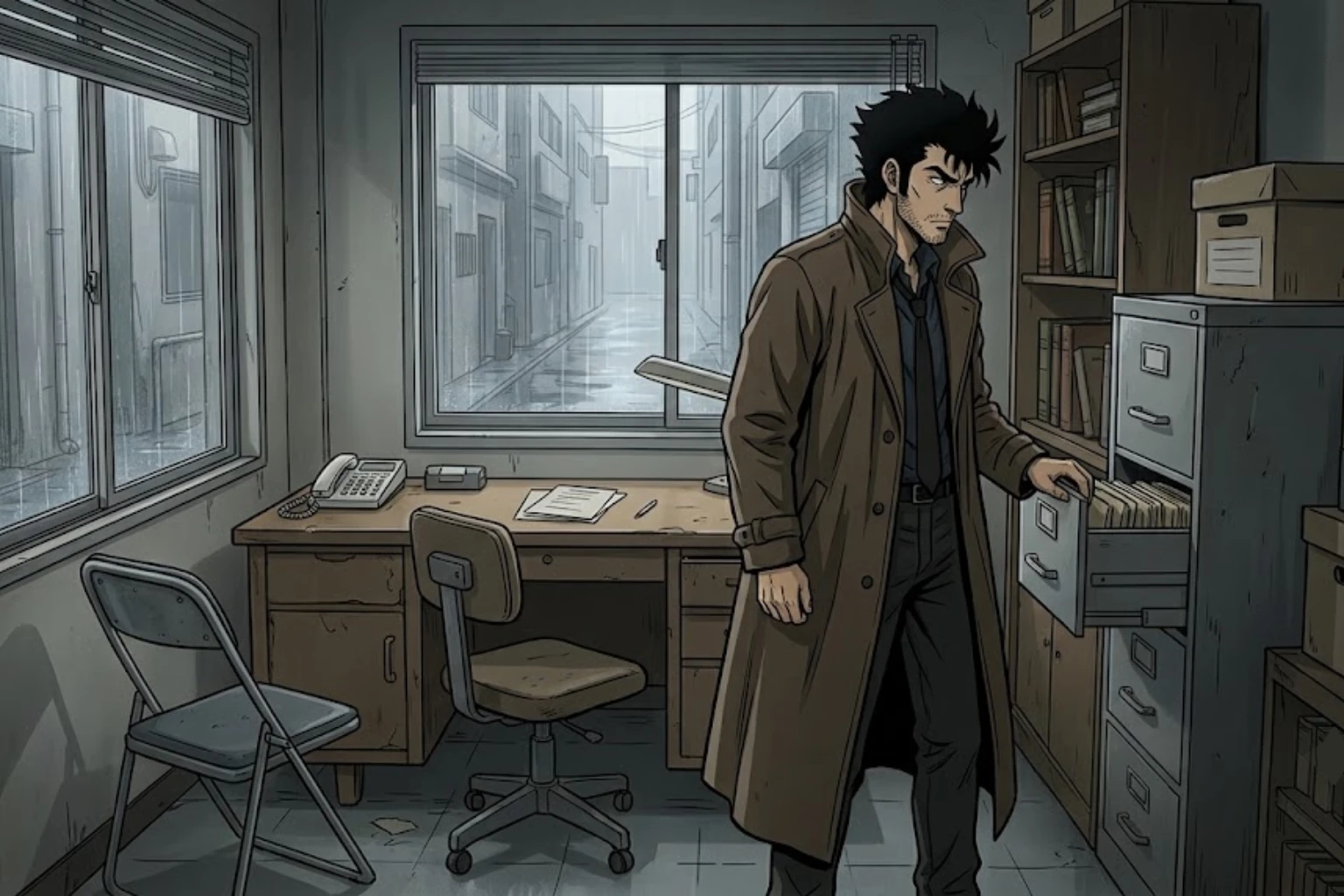
The office was twelve minutes from the apartment on foot. A room on the second floor of a building on Kosho Street, above a notary's office that kept regular hours and generated the kind of foot traffic on the stairs that made my own foot traffic unremarkable. The building's owner knew I was there, knew what I did, and had a practical arrangement with me about the rent that suited both of us and that neither of us would have benefited from examining too closely. The office had a desk, two chairs, a filing cabinet with a lock, a window that faced the alley, and a telephone. Nothing on the walls. I'd learned early that things on walls became things that visitors commented on, and I didn't want visitors to have anything to comment on.
I went in at seven-fifteen, which was earlier than my usual start and earlier than anyone would expect me to arrive, which was part of why I did it.
I knew something was wrong before I touched the filing cabinet.
Not from anything visible. Not from anything broken or disturbed or obviously moved. The room looked exactly as I'd left it — the desk clear, the two chairs at their usual angles, the window latch in the position I left it in, the filing cabinet with the lock engaged. Everything was where everything should be.
That was the problem.
I had a system for leaving the office. Not a complicated one, not the spy-novel level of hairs across doorframes and strategically placed threads — just a set of small positional details I maintained consistently and noticed if they changed, the way anyone who worked alone in a space developed habits about it. The chair on the near side of the desk sat slightly angled right — not far, maybe five degrees, from where someone sitting across the desk would naturally push it when they stood. It was two degrees left of where I'd left it. The filing cabinet's lock was engaged but the key-side face was rotated a quarter-turn clockwise from the position I locked it in, which was a consequence of the lock's mechanism — it took a specific motion to engage it fully, and I always engaged it the same way, and someone else had engaged it differently.
Small things. The kind of small things that were invisible if you didn't know what you were looking at.
I stood in the doorway for a moment without going in.
Then I went in, left the door open behind me, and went through the room.
The desk drawer: closed. Everything inside it was in order — the pens, the loose change, the notepad I used for case notes. But the notepad was face-up when I left it face-down, and the pen on top of it was the wrong pen, which meant someone had looked at the notepad, replaced it, and put the pen back in the wrong orientation. The notepad was blank — I didn't keep sensitive information there, I kept sensitive information in my head until it needed to be written down somewhere that wasn't findable, which was not the desk drawer — but someone had checked it anyway.
The filing cabinet: I unlocked it with my key and went through the files. Three active cases, including the Yabata skip-trace. The Yabata file had been looked at — not disturbed, not copied as far as I could tell, but removed from the cabinet and replaced, which I knew because the crease in the bottom left corner of the folder was facing the wrong way. Whoever had done this had looked through the Yabata file and then put it back.
Yabata was a routine skip-trace. A creditor looking for a man who owed money and had stopped returning calls. No connection to anything Sayuri Shiranami had described. The search wasn't about Yabata.
The search was about me. About what I was working on, who I was working for, what I had and where I kept it.
I stood in the middle of the office and thought about the timeline.
The meeting at Kuroame had been midnight. I'd walked home — forty minutes, plus the ninety-second stop at the noodle stand. Call it one in the morning before I was in the apartment. The search had been done between midnight and seven-fifteen, which was a window of six hours and fifteen minutes. I'd seen no tail on the walk home.
Which meant either the search had been done before the meeting — someone already watching my office, already anticipating the connection — or the tail had been good enough that my check at the noodle stand hadn't caught them, and they'd gone straight to the office while I went home.
Neither option was comfortable. Both options told me the same thing: whoever Sayuri Shiranami was frightened of was already aware of me, and they were operating at a level that found a grey-market investigator in the Shita district without particular difficulty.
I sat down in my desk chair and looked at the room.
The packet was not here. The packet was in the apartment, in the inner pocket of my other coat, hung on the back of the bathroom door. I had not brought it to the office, which had been a decision I'd made out of habit — you didn't bring new case materials to the office on the first morning because the office was a known location, addressable, findable by anyone who looked — and which now turned out to have been the right decision for better reasons than I'd had for making it.
I needed to think about the packet's location. The apartment was one floor up from a ground-level entry with no doorman, which was a liability. The office was a known professional address, which was a different liability. I had a third option — a storage locker in the Tenma district that I used for things I didn't want at either location — but the Tenma locker required a trip across two district lines, which was exposure.
I put that problem in the holding area of my thinking and moved to the more immediate one.
The search had been professional. That meant I wasn't dealing with street-level operators or casual criminal enterprise. Street-level operators broke things, took things, left evidence of themselves because they weren't thinking about the second-order consequences of the search itself. Professionals left things exactly as they found them, or tried to, and the only reason I could tell the difference was that I looked for it. Most people didn't look for it. Most people weren't supposed to look for it.
I was supposed to look for it. And I had, and I'd found it, and that told whoever had done this something about me that they'd now have to account for.
I picked up the telephone.
The person I called went by Miki, which was not her name. She ran a small information brokerage out of the Shita district that operated on the principle that information about who was doing what in the district was itself a commodity, and she had been careful and smart enough over a long career to be still operating when plenty of her competition was not. I had a professional relationship with her that consisted mostly of me paying for things she knew and occasionally giving her things I knew in return, and neither of us pretended it was anything other than what it was.
She picked up on the third ring.
"Murphy," she said. Not a greeting. An acknowledgment.
"I need a professional read on a search profile," I said. "Someone went through my office last night. Clean job. What's the market look like for that kind of work in the district right now?"
A pause. Miki's pauses were informative — short ones meant she was thinking, long ones meant she was deciding how much to say.
This one was long.
"What kind of timeline?" she asked.
"Midnight to seven this morning."
"What did they take?"
"Nothing."
Another pause. "Assessment job," she said. "Not a retrieval. Someone wanted to know what you have."
"Yes."
"How clean?"
"Clean enough that I almost didn't see it."
The pause this time was the longest yet. "Murphy," she said, and her voice had shifted to the register she used when she was being careful. "I'm going to tell you something and I'm going to tell you it doesn't cost you anything because I'm not adding to whatever you've already stepped in. Are you listening?"
"Yes."
"There's been a specific type of work moving through the district in the last two months. Quiet. High-end. The profile is assessment, surveillance, records access — not muscle, not collection, not the usual commercial pattern. Someone is building a picture of something. Or someone." She stopped. "I don't know who they're working for. I've tried to find out and the chain disappears fast, which means either the client is very careful or the operators are, or both." Another stop. "If your search fits that profile, you should understand what kind of attention you're dealing with."
"I understand it better now than I did before I called," I said.
"Good. Because I can't help you with this one, Murphy. Not won't — can't. Some things I don't touch."
The line didn't go dead — she didn't hang up dramatically. She just said: "Good luck," in the flat way of someone who meant it as a statement of fact rather than a wish, and the call was over.
I sat with the phone for a moment after she hung up.
Two months. Whatever Sayuri Shiranami had set in motion when she left the organization — whatever copies she'd made, whatever they contained — the response had been running for two months in the Shita district, building a picture of something or someone. She'd said she'd been managing for four months. The math suggested that whoever she'd taken the documents from had been looking for her for about half that time, and that their looking had expanded to include the people she might reach out to.
Which would include the Nakashima channel. Which would include me, as of last night.
I put the phone down, picked up the Yabata file, and pretended to read it for ten minutes in case anyone was watching through the alley window. Then I stood, put my coat on, locked the filing cabinet, and left the office.
The Yabata skip-trace led me to a mahjong parlor in the lower Shita district called the Green Sleeve, which was where Yabata Doshin apparently spent his Tuesday and Thursday mornings. I'd traced him there through three steps that had taken the better part of the week — a forwarding address at a convenience store that led to a gym locker that led to a regular food delivery order and the address it went to and the parlor around the corner from the address. It was routine work, the kind that required patience rather than inspiration, and I did it the same way I'd done a hundred others.
I also did it because I needed to be visible doing normal work.
If someone was watching me — and someone was, or had been, based on the office search — then spending the morning on a routine skip-trace in a public location established a pattern that was harder to read malicious intent into than spending the morning sitting in my apartment staring at a packet I hadn't opened. The packet was in the apartment. I was at the Green Sleeve, drinking tea at a table near the door, watching the mahjong tables for a face that matched the photograph the creditor had given me.
Yabata showed up at nine-forty. Shorter than the photograph suggested, which photographs of heavy men often were. He sat down at the second table from the left, ordered something from the passing attendant, and settled in with the comfort of a man in a familiar routine.
I watched him for twenty minutes. Confirmed the face, noted the associates at the table — three regulars by the look of the interactions, nobody I recognized — and left before he could notice me noticing him. The report to the creditor would be filed this afternoon. The case would be closed. The payment would be in the envelope under the door of the office by end of week, because the creditor was reliable about payment if not about timelines.
It was eleven in the morning and I had done a complete piece of work and I felt none of the satisfaction that completing work was supposed to generate, because the office had been searched and Miki had told me she couldn't help me and the packet was in the apartment and the woman who'd given it to me had said she'd find me and hadn't said when.
I walked back through the Shita district toward the apartment and paid attention to the street the way I'd paid attention to it the night before and the night before that, which was the way I always paid attention to it. The Shita district had a texture to it that rewarded attention — a rhythm of who was where at what time, who moved with purpose and who was just there, the regular against the irregular, the expected against the one that didn't fit.
The man outside the tobacco shop on Mitsuse Street didn't fit.
Not dramatically. Not obviously. He was standing in the partial shelter of the shop's awning reading a folded newspaper, which was ordinary enough, and he was dressed in the clothes of someone who worked in an office somewhere nearby, which was ordinary enough, and he was approximately the right age and type for someone who stopped at a tobacco shop in the morning before heading somewhere else. All of it was ordinary.
Except I'd seen him twenty minutes ago. Not at the tobacco shop — at the end of the block near the entrance to the Green Sleeve. He'd been walking in the opposite direction, east, with the walk of a man who knew where he was going. He was now west, standing still, reading a newspaper.
I didn't alter my pace or my direction. I walked past the tobacco shop at the same pace I'd been walking, past the man with the newspaper, close enough to note the newspaper — it was today's, which meant he'd bought it this morning, which was either genuine or a prop, and either way was interesting. I turned the corner onto my street, went to the building entrance, and went in.
Third floor. I went to the window that faced the street — not the one the packet was near, the other one — and looked down at the corner.
He was gone.
Not in the middle of the block, not visible in either direction. In the thirty seconds between me passing him and getting to the window he had moved out of sightline, which he could have done by going into the tobacco shop or around the corner or into any of the building entries between the corner and where I could see.
Could have been nothing. Man standing at a shop, reads his paper, moves on.
Could have been a tail who'd made me at the café entrance and pulled off the moment I turned.
The problem with professional surveillance was the same as the problem with the professional search: you couldn't always tell the difference between it and coincidence, because it was designed to look like coincidence, and the only way to distinguish them was to accumulate enough data points until the pattern was undeniable. Right now I had one data point, which was not enough for a pattern and was enough for a concern.
I went to the bathroom door and took the packet from the coat pocket and held it for a moment.
Eight sheets, maybe. The weight of records that weren't supposed to exist, documents copied in a hurry from a filing system that operated in the margins of official record-keeping. People erased. An organization whose authentication mark I didn't recognize. A woman who'd been inside it for two years and had spent four months since then learning how to stay ahead of the people looking for her.
And now a searched office and a man outside a tobacco shop who might or might not have been following me.
I sat on the edge of the bed with the packet in my hands and thought about what Sayuri Shiranami had told me and what she hadn't told me and what the sequence of things she was releasing information in was designed to protect.
She'd told me people were missing. She'd told me she had records that proved they'd existed. She'd told me three people had stopped being findable in the last eighteen months — one with copies, two looking for the first. She had not told me the organization's name, not told me the nature of the filing system, not told me what the records were records of. She'd told me all the things that conveyed the shape and seriousness of the job without telling me anything that would be operationally dangerous if I said the wrong thing to the wrong person.
That was a carefully constructed information boundary. The kind you built when you'd thought hard about what happened if things went wrong.
I respected it. I also knew that I was now operating in a situation where things were already moving without her having told me they were going to move this fast, and the question was whether the information sequence she'd established was still the right one or whether the situation had overtaken it.
She'd said she'd find me. She'd said when the time was right. I had no way to reach her — the card in my pocket had a number for a burner that was already cycled, and the drop service on the back required leaving a message and waiting. I couldn't move toward her. I had to wait.
I didn't like waiting. Waiting was what you did when you had no other option, and I was in the early stages of determining whether I had other options.
I put the packet back in the coat. Put the coat on the bathroom door. Went to the kitchen and made another coffee and drank it standing at the window that faced the street, watching the corner where the man with the newspaper had been standing.
The rain came back in the early afternoon, heavier than the morning, the city returning to the state it seemed to prefer for this particular week. The street below went wet and reflective and the ordinary business of Mitsuse Street continued in the ordinary way of a street that had not been told it was part of anything.
It wasn't the street that was part of it. I was the part of it.
And the packet was on the bathroom door.
And somewhere in the city, Sayuri Shiranami was managing her exposure and waiting for the time to be right, and the people she'd taken the documents from were running a long-term surveillance operation in the Shita district that Miki wouldn't touch, and a professional had been through my office in the six hours between midnight and seven in the morning and left it looking exactly right.
That was the shape of the first day.
I poured the rest of the coffee down the drain and went out to file the Yabata report.
You kept working. That was the rule. When everything else was uncertain, the work you could complete was the work you completed, and the pending things you couldn't resolve stayed pending until they resolved themselves or until the information arrived that let you resolve them. I'd been in worse positions than this one. I'd been in positions where the information never arrived and the thing resolved itself at high speed in a direction I hadn't anticipated, and I'd been in positions where the waiting produced exactly the piece the situation needed at exactly the moment it became necessary.
You didn't know which kind you were in until you were through it.
I filed the Yabata report, collected the acknowledgment, and walked back to the apartment in the rain.
The coat with the packet was where I'd left it. The window facing the street showed nothing of note. The street below was wet and ordinary.
I made a list of what I knew, which was short.
Then I made a list of what I could find out without the packet and without Sayuri Shiranami's next contact, which was longer.
The authentication mark on the wax seal. The pattern of high-end surveillance work in the Shita district over the last two months. The three people who had stopped being findable. Not their names — I didn't have those. But the shape of a disappearance was findable, if you knew where to look, and I knew where to look.
I picked up the phone.
Not Miki. Someone else. The district had a network of people who knew things, and most of them were reachable if you had the right currency, and I had, over nine years, accumulated enough of the right currency in the right places to make calls that other people couldn't make.
I started making them.
The rain came down outside the window and the city did what the city did, which was continue being the city regardless of what any individual in it was doing, and I worked through the afternoon with a list and a telephone and the patience of someone who understood that the first day of a case was almost never the day anything broke open.
It was the day you started building the picture.
The picture, so far, looked like this: someone careful, someone resourced, someone who had been operating in the margins of official record-keeping long enough to develop the habit of thoroughness. An organization that deleted people from records rather than from life, which was a specific kind of threat — not violence as the primary tool, but erasure, which was harder to prove and harder to fight and in some ways harder to survive. People who had found me inside twelve hours of my taking the job, which meant either their network was very good or Sayuri Shiranami's security had a leak, and since she was still alive and operational, the former was more likely than the latter.
By six in the evening I had three more data points and no conclusions, which was normal for day one.
I ate something, couldn't have told you what. Checked the coat. Checked the locks.
Went to sleep earlier than usual, because the first day had been long and the second day was going to require the kind of attention that only came from adequate sleep, and the packet would still be there in the morning and whatever was coming would come whether or not I was rested for it.
The rain kept on outside.
The city kept its secrets the way it always kept its secrets — not by hiding them, but by making them part of the texture, indistinguishable from everything else. You didn't find things in this city by looking for secrets. You found them by learning to read the texture until the things that didn't fit showed themselves.
The search in the office didn't fit.
The man at the tobacco shop didn't fit.
The rest was texture, and I was still learning to read it.


.png)
.png)
.png)