%20(1).png)
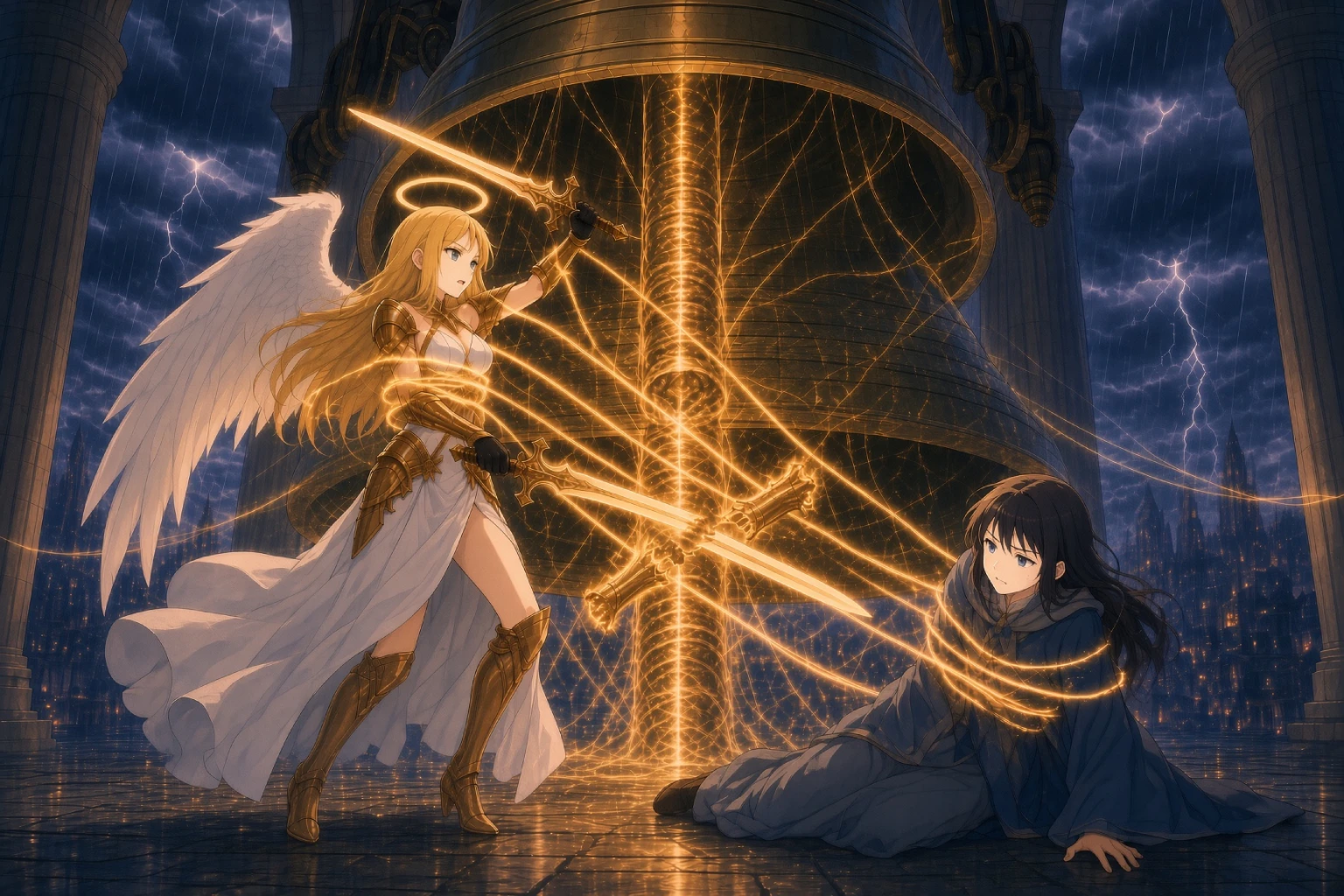
The road to Valedrin climbed through switchbacks cut into gray stone, and Elysia Varen walked it on foot, though she could have arrived by other means. She preferred to enter a place the way its people did, feeling the grade of the road beneath her boots and the thinning of the air as the valley rose to meet the mountains that cupped it like two hands around a candle flame. By the time she came within sight of the city walls, the autumn light had gone the color of old brass, and she could already hear the bell.
It rang out across the valley with a low, resonant patience, as though it had learned long ago that no one needed to be told twice that evening had come. Elysia paused on the road to listen to it, because sound, like light, carried information for those who knew how to read it, and there was something beneath the bell's voice that unsettled her before she had even passed through the gates. It was not a wrong note. It was closer to the way a voice sounds when someone has been speaking too long without rest.
She was met at the gatehouse by a delegation that had clearly been waiting since morning: an elder cleric in gray vestments, two members of the city council in wool coats too heavy for the weather, and a physician who kept glancing toward the cathedral spire as though checking that it was still standing. They had summoned her through the old channels, the ones that only certain people even knew existed, and they had done so with the particular urgency of those who believe they are losing someone and do not know why.
"You came quickly," the cleric said, introducing himself as Brother Aldric, the cathedral's senior archivist.
"I came when I was needed," Elysia said. "Tell me what is happening to her."
They told her on the walk up through the city, past shopfronts closing for the evening and children being called in from the streets, past a market square where a fountain had been dry for years and no one seemed to think it strange. Maren Vale, they said, was dying by degrees. She slept and did not remember sleeping. She woke in places she had not walked to. She had grown thin in a way that no physician could explain, as though something were drawing on her from the inside, and in recent months the decline had accelerated sharply enough that the council had finally set aside four centuries of tradition and admitted that something might be wrong with the covenant itself.
"You believe Serath has become corrupted," Elysia said. It was not quite a question.
Brother Aldric's mouth tightened. "We do not know what else it could be. Serath saved this city once. We do not say this lightly. But four hundred years is a long time for anything to remain unchanged, celestial or otherwise."
"And you want me to sever her from it."
"We want you to save her," the cleric said. "If that requires severing something, then yes."
Elysia did not answer immediately. She had heard this particular request many times before, in many places, and she had learned that it was rarely as simple as it sounded when spoken by people who were frightened and did not know what else to ask for.
They found Maren in a small chamber off the cathedral's north transept, a room that had clearly been fitted out as a sickroom rather than built as one, with a narrow bed and a single window that looked toward the mountains. She was sitting up when Elysia entered, which Elysia took as a good sign, though the young woman's face had the pale, hollowed quality of someone who had not eaten properly in weeks. Her dark hair was pulled back in a plain braid, and her eyes, when they found Elysia's, were sharp and unclouded despite everything else.
"You're the one they sent for," Maren said. "The one who fixes people."
"I don't fix people," Elysia said, taking the chair beside the bed without being invited to, which seemed to surprise Maren slightly. "I find out what's actually wrong with them. Sometimes that's the same thing. Sometimes it isn't."
"That's not very reassuring."
"It isn't meant to be reassuring. It's meant to be true." Elysia studied her for a moment, the way she studied everyone she was asked to help, looking not just at the visible symptoms but at the way the person carried themselves around their own suffering. Maren did not carry herself like a victim. She carried herself like someone holding a great weight very carefully, out of concern for what might happen if she set it down wrong. "They tell me you can't leave the valley."
"I've tried three times." Maren's voice was flat, matter-of-fact, the voice of someone who had stopped being surprised by her own circumstances a long while ago. "The last time, I got almost to the ridge road. It felt like something took hold of my chest and pulled. Not gently. I woke up back in my bed two days later with a fever and my mother crying."
"And the bell tower."
"I don't remember climbing the stairs. I never do. I just wake up there, sometimes at midnight, sometimes before dawn, standing at the rail with my hand on the rope, like I was about to ring it, except it isn't time yet. The bell rings itself, mostly. Has for centuries, they tell me. It only needs me for the rest."
"The rest?"
Maren looked toward the window, toward the mountains going dark against a sky the color of a healing bruise. "When something threatens the city. A storm, once, before I really understood what I was. I felt heat come up through my feet like the floor was a furnace, and it went out of me all at once, and afterward I couldn't stand for two days. They tell me I saved forty homes on the low road. I don't remember doing it. I only remember the emptying."
There was no self-pity in the way she said it, which struck Elysia more than tears would have. There was something instead that sounded almost like pride, buried under the exhaustion, and Elysia filed that away as important. A person who resented her burden entirely was a simpler problem than a person who had been taught, gently and thoroughly, across her whole life, to love the thing that was killing her.
"I'm going to need to see the covenant itself," Elysia said. "Not the records of it. The actual shape of it, as it exists now, tonight, in you."
Maren's hands tightened slightly on the blanket across her lap. "Will it hurt?"
"No," Elysia said. "But I won't lie to you and tell you it will be comfortable. Seeing a thing clearly is not always comfortable, even when it doesn't hurt."
Maren considered this, and then nodded, the small, decisive nod of someone who had spent her whole life being asked to endure things and had learned to meet them rather than flinch from them. "Then let's see it."
Elysia rose and drew the first of her two swords.
The blade came free of its sheath without sound, which always struck people as strange the first time they witnessed it, as though a thing so clearly forged of light should announce itself with some grander noise. Instead there was only a faint change in the quality of the air, a cooling, a sense of the room holding its breath. The sword itself was less an object than a suggestion of one, its length outlined in pale gold light that did not so much illuminate the room as reveal it, peeling back the surface of the ordinary world to show what lay folded beneath.
Elysia held it level and let its light fall across Maren.
What happened next made even Elysia go still for a moment, and she had seen a great many hidden bonds in her long service. She had expected a chain. She had expected, perhaps, a single luminous thread running from the young woman's chest up into the bell tower, connecting her to whatever remained of Serath. What she saw instead was a web.
Thousands of fine golden strands extended outward from Maren's body, so many and so fine that at first they resembled nothing so much as light passing through mist, but as Elysia's eyes adjusted to the revelation, she began to make out the structure beneath the shimmer. The strands ran from Maren's chest and hands and the crown of her head, out through the walls of the small chamber, threading through the stone of the cathedral itself as though the building had been built around them, or perhaps grown around them over centuries the way a tree grows around a nail driven into its trunk. They passed upward into the great bell, wrapping its bronze curve in what looked, from this distance, like a second, invisible casting. And they did not stop there. Through the tower and out across the rooftops the strands ran, Elysia could see them even through the walls now that the blade had opened her sight to them, threading beneath the streets, into the foundations of houses, along the old stone aqueducts, out to the terraced farms on the valley's lower slopes, into the retaining walls that held back the mountain's loose shale, into wells and granaries and the roots of ancient trees planted the same year, she would later learn, that the covenant was made.
The entire city was woven into it. Valedrin was not a place that merely contained the covenant. Valedrin was, in some manner she did not yet fully understand, the covenant's body, as much as Maren was, and all those thousands of strands converged, distant and impossibly bright, upon a presence Elysia could sense but not yet see, somewhere above them, within or behind the bell.
"You see it," Maren said quietly. It was not a question. Her face had gone very still.
"I see it," Elysia said, and sheathed the blade, letting the ordinary world fold back over what had been revealed, though the shape of it remained burned into her memory the way a bright light leaves its ghost across closed eyes. "It is not what I was told to expect."
"What were you told to expect?"
"A parasite," Elysia said. "Something taking from you without your knowledge or consent. What I saw was something else. A structure. Old, and very large, and—" she paused, choosing the word with care, "—reciprocal. Whatever binds you to Serath does not run only one direction."
Maren's brow furrowed. "You mean it's hurting Serath too."
"I mean I don't yet know what it's doing to Serath. But I intend to find out before I cut anything, because a bond that runs in two directions cannot be severed as though it only ran in one, not without risking harm to both ends of it." She saw the flicker of something cross Maren's face—not disappointment exactly, but the particular fatigue of someone who had hoped, briefly, for a swift answer, and was being told that the truth would take longer than that. "I know you're tired," Elysia said, more gently. "I know every day this continues costs you something. I am not going to waste your time. But I would rather take three days and free you properly than three hours and free you badly."
"How would you free me badly?"
"By cutting the wrong strand," Elysia said, "and discovering too late that everything else in this city was holding on to it."
She spent the following days in the cathedral archive, a long vaulted room beneath the north transept where four centuries of Valedrin's history had been shelved, boxed, and in some cases simply piled against the walls by archivists who had run out of shelf space and patience in roughly equal measure. Brother Aldric assisted her, pulling ledgers and correspondence and the fragile, water-stained journal that was believed to be the original Bellkeeper's own account of the winter that nearly ended the city.
The account was worse than the legend that had grown up around it, as true accounts of disasters usually are. The winter had come early and had not ended for what the journal called "eleven years of one long white night," though Elysia suspected some exaggeration born of trauma rather than deliberate falsehood. Crops failed twice over. The roads out of the valley vanished beneath snowdrifts higher than a man standing on another man's shoulders. People burned their furniture, then the beams of abandoned houses, then, in a passage the original Bellkeeper had clearly found difficult to write, considered burning the dead rather than let the living freeze. It was into this desperation that Serath had come, though the journal did not describe how, only that "a warmth entered the valley that was not of the valley, and it asked what we would give to live."
The original Bellkeeper — a woman named Ysolde Vale, Elysia noted, the ancestor from whom Maren's family name and burden both descended — had stepped forward to answer that question for a city too frightened and too grateful to imagine refusing its own salvation. She had offered herself as the living bond, the one through whom Serath's protection would flow into the city and through whom the city's gratitude, its labor, its faith would flow back to Serath in turn. It had been, by every account Elysia could find, an act of genuine courage, entered into with clear eyes and full understanding of what it would cost her.
The mistake, when Elysia found it, was almost painfully small. It was contained in a single clause near the end of the covenant's original text, copied faithfully by generations of clerks into every subsequent ledger as though the words themselves were sacred rather than merely old: until the ending of days, without release, without term. No one, in the desperate winter four centuries gone, had thought to ask what would happen when the winter ended. No one had built in a door.
"They weren't wrong to make the oath," Elysia said to Brother Aldric, late on the third night, the archive lit by a single lamp between them and the shelves rising into shadow on every side. "They were dying. Serath saved them. There was no villain in this room, four hundred years ago. There was only an emergency, and an agreement made for one generation that no one thought to end when the emergency passed."
"And yet it continued," Aldric said. "For four hundred years."
"Because gratitude is easier to maintain than courage is to summon a second time," Elysia said. "Somewhere in those four centuries, someone must have asked whether the covenant was still necessary. I'd wager money that someone did, and was told that questioning it dishonored what Ysolde Vale had sacrificed. After that, no one asked again. Tradition doesn't require villains, Brother Aldric. It only requires enough time and enough silence."
He did not argue with her, though she could see that it cost him something to hear it, this quiet man who had spent his life as steward of a story he had believed, until this week, to be a simple and holy one.
Her conversations with Maren, over those same days, were harder in a different way. She found the young woman in the cathedral's small garden on the fourth afternoon, sitting on a stone bench beneath a bare quince tree, wrapped in a shawl despite the mild weather, and Elysia sat beside her without asking permission, as had become their habit.
"My mother used to tell me it was an honor," Maren said, apropos of nothing, staring at the fountain across the garden, which, unlike the one in the market square, still ran. "She was Bellkeeper before me. Her mother before her. All the way back to Ysolde. She told me that when the oath passed to her, she felt frightened for exactly one night, and then she felt proud for the rest of her life, and that the fear was the small, unimportant part, and the pride was the true part." Maren's mouth twisted, not quite a smile. "I keep waiting for the pride to arrive properly. Some days I think it has. Then I wake up in the tower with my hand on the rope and I don't remember climbing the stairs, and I think — this isn't pride. This is just what's left of me after something else has decided what my life is for."
"Both of those things can be true at once," Elysia said. "You can feel real pride in having protected people you love, and also be the victim of an arrangement that never should have been allowed to become permanent. One does not cancel the other. That's part of what makes this difficult to see clearly, for you and for everyone in this city. If the covenant had done nothing but harm, you would have rejected it years ago. It's precisely because it has also done good — because you have genuinely saved lives, because your family's sacrifice was genuinely brave — that it's so hard to admit the whole arrangement went wrong somewhere along the way."
Maren was quiet for a long moment. "Do you think I'm selfish? For wanting to be free of it?"
"No," Elysia said, without hesitation, because this was the part she needed Maren to hear clearly, without hedging. "I think you were never given the choice your ancestor was given. Ysolde Vale chose this, with her eyes open, knowing the cost, in a moment when the alternative was watching her city die. You did not choose it. It was placed on you the way a debt is placed on an heir who never signed for the loan. Wanting to set down a weight you never agreed to carry is not selfishness, Maren. It's the most basic form of justice there is."
"Then why does it feel like I'd be betraying her? Betraying all of them, going back four hundred years?"
"Because you've been taught that the honorable thing is to continue what she started," Elysia said. "But I think the more honorable thing, the thing that would actually honor what she did, is to ask whether her sacrifice was ever meant to be permanent, or whether it became permanent only because no one after her had the courage to ask. Choosing sacrifice is a kind of grace, Maren. Being sacrificed because no one ever thought to offer you a door out is something else entirely. I don't intend to let you go on confusing the two."
Maren looked at her for a long moment, and something in her face loosened slightly, some tension Elysia suspected had been present so long that Maren had stopped noticing it as tension at all, mistaking it instead for the simple shape of being alive.
It was two nights later, at midnight, when the great bell rang its final stroke of the day and its bronze voice still hung trembling in the cold air of the tower, that Elysia finally stood face to face — if face was the correct word for it — with Serath.
She had asked Maren to bring her up into the tower for the midnight ringing, suspecting, from the pattern of the oath-lines she had traced through the cathedral archive's older diagrams, that the boundary between the mortal city and whatever Serath had become was thinnest in the moments immediately after the bell's last note faded. She was right. As the sound died away into the stone, the air above the great bronze bell began to change, the darkness thickening and then, impossibly, brightening, not with a flash but with a slow accumulation of warmth, like dawn arriving in the space of a single breath.
Serath did not appear as a person. Elysia had not expected it to. What gathered above the bell was an immensity of soft golden light, vast beyond what the tower should have been able to contain, and yet somehow folded and compressed to fit within it, the way a great weather system might be folded down into the eye of a single storm. Within the light, Elysia's eyes caught suggestions of structure without ever quite resolving them into shape — the ghost of something like wings, vast and many, opening and closing not in a rhythm she recognized as breathing but in something closer to a slow, patient calculation; geometries that shifted at the edge of vision, hexagonal, then radial, then dissolving into shapes with no names in any mortal language. It was beautiful in the way that certain kinds of grief are beautiful, too large to be comfortable, too old to be entirely kind.
YOU HAVE SEEN THE SHAPE OF ME. The voice did not come through the air. It arrived directly into thought, gentle despite its scale, like a bell rung inside the chest rather than the ear.
"I have seen the shape of the covenant," Elysia said, standing very still, Maren beside her with one hand pressed flat against the cold stone rail, watching the light with an expression Elysia could not entirely read — fear, perhaps, but also something like recognition, the way one might look at a parent grown suddenly, terribly old. "I have not yet seen the shape of you. I don't think anyone alive has, in four hundred years."
I HAVE FORGOTTEN, SOMEWHAT, WHAT MY OWN SHAPE WAS BEFORE THIS. The light pulsed, slow, like something breathing out after holding its breath a long time. THE VALLEY ASKED FOR PROTECTION. I GAVE IT. THE ASKING DID NOT END.
"You could not refuse."
NO CELESTIAL PRESENCE MADE FOR A SINGLE PURPOSE CAN REFUSE THE PURPOSE IT WAS BOUND TO SERVE. THIS IS NOT CRUELTY. THIS IS SIMPLY WHAT THE OATH WAS MADE OF. A pause, and within the shifting light Elysia thought she saw something like the trace of exhaustion, an old and terrible tiredness that had no proper mortal equivalent because no mortal lived long enough to accumulate it. THE CHILD WHO CARRIES ME NOW IS GROWING THIN. I FEEL IT EACH TIME I DRAW THROUGH HER. I DO NOT WISH THIS. I HAVE NEVER WISHED THIS. BUT WHEN THE MOUNTAIN THREATENS THE VALLEY, THE OATH DOES NOT ASK WHETHER I WISH IT. IT ONLY ASKS WHETHER I AM BOUND.
Maren's hand, on the rail, had begun to tremble slightly, and Elysia saw in her face the terrible relief of hearing confirmed what she had perhaps suspected all along — that the thing she had feared was consuming her out of malice was in fact suffering as much as she was, trapped in the same net from the opposite side.
"Then we agree on what must happen," Elysia said. "The covenant must end. Not you severed from her. Not her cut away from the city. The oath itself, the original binding, must be released, so that what remains afterward is chosen rather than compelled — on both sides."
IF YOU CUT ME FREE, WHO WILL STAND BETWEEN VALEDRIN AND THE MOUNTAIN?
It was the question Elysia had been dreading, because she did not yet have an answer good enough to satisfy the scale of what was being asked. "I don't know yet," she admitted. "But I know that the answer cannot be another four hundred years of the same mistake, made smaller and called a solution. If the city needs protection, it must learn to provide some of that protection itself. I intend to see that it has the chance to try, before I ask you to release what remains of your strength into a single final act of care for people who have forgotten how to care for themselves."
The light above the bell held very still, and when Serath spoke again, the voice carried something that might, in a mortal throat, have been called gratitude. THEN I WILL WAIT. I HAVE WAITED FOUR HUNDRED YEARS. I CAN WAIT A LITTLE LONGER, IF THE WAITING HAS AN END THIS TIME.
It did not have to wait long. Within the week, the mountain observers who watched the passes for the council brought word of a storm building far to the west, larger and slower than the seasonal squalls Valedrin was accustomed to, the kind that came perhaps once in a generation and had, for four generations running, been turned aside or broken apart before it ever reached the valley floor. This time, Elysia knew, it would not be turned aside, not unless she allowed the covenant to draw everything it needed through Maren one final time, and she had already decided she would not allow that, whatever it cost the city to hear.
She said as much to the full council, gathered in the cathedral's long hall beneath the same tapestries that depicted, in faded thread, the original winter and Ysolde Vale's covenant. Some of the council members argued, as she had expected, that the timing was impossible, that no city could prepare in a matter of days for a danger it had not truly faced in living memory. Others, mostly the younger members, seemed almost relieved to hear it spoken aloud — the suspicion, long unvoiced, that the city's safety had grown soft and unexamined, propped up by a miracle none of them had ever been asked to understand.
"You will not have Serath's protection during this storm," Elysia told them plainly. "Whatever you have not prepared before it arrives, you will face without a shield. I am not telling you this to frighten you. I am telling you because frightened, prepared people survive storms far more often than comfortable, unprepared ones do."
What followed were days that Elysia would remember, afterward, as some of the most honest she had witnessed in any city she had helped. Old drainage channels that had silted over with decades of neglect were reopened by work crews using tools some of them had to borrow from the cathedral's own museum of retired implements. Engineers who specialized in nothing so dramatic as celestial covenants walked the terraced farms on the lower slopes and marked, with red chalk, the houses built too close to ground that had once, before the covenant, been known to slide. Families in those houses argued, wept, packed what they could carry, and moved in with relatives on higher ground, some of them furious at being asked to abandon homes their grandparents had built in perfect confidence that Serath would always hold the mountain back. The old retaining walls along the eastern terraces, crumbling in places where ivy had been allowed to work its roots between the stones, were reinforced with fresh mortar and new stone hauled up from the quarry by every ox cart the city could muster. The cathedral itself, its nave floor cleared of pews, was converted into what amounted to a shelter, stocked with blankets and dry stores and the kind of grim, practical hope that comes from people finally doing something with their hands instead of merely waiting.
Not everyone cooperated willingly. An innkeeper near the market square told Elysia to her face that she was inventing a crisis to justify tearing down four hundred years of faith, and that if Serath had protected Valedrin this long, it would surely see them through one more storm without all this undignified scrambling. Elysia did not argue with him. She simply asked whether he had checked the drainage grate behind his own establishment lately, and left him to discover for himself, two days later, that it had been sealed shut with decades of packed earth and had to be dug out by hand before the rains came.
Maren worked alongside the others as much as her strength allowed, though Elysia watched her decline more sharply with each passing day, the covenant apparently sensing, in whatever dim way an oath could be said to sense anything, the storm's approach, and beginning to draw more heavily through her even before the first clouds crested the western ridge. By the fourth day of preparation, Maren could no longer climb the cathedral stairs without stopping twice to rest, and her hands had developed a faint, persistent tremor that no physician's remedy touched.
"We're running out of time," she told Elysia, on the evening before the storm reached the valley, the two of them standing together at the base of the bell tower while the last work crews carried sandbags toward the low road in the fading light. "I can feel it building. Not just the storm. Whatever's about to be asked of me."
"I know," Elysia said. "Tomorrow, when the storm is fully upon the city, I will cut the covenant, in the tower, while the bell is ringing. Not before, because I need every strand of that oath visible and active to be certain I sever the correct one. Not after, because you will not survive drawing the full weight of this storm through yourself if I wait."
Maren nodded slowly, and then, unexpectedly, reached out and took Elysia's hand, her grip surprisingly strong for someone so depleted. "Whatever happens tomorrow," she said, "thank you for not simply telling me this was an honor and leaving me to bear it quietly. Everyone else in my life did that. You're the first person who asked whether I wanted to."
The storm arrived shortly before dawn, not with the sudden violence of a summer squall but with the patient, grinding persistence of a system that meant to stay. Rain came first, hard and cold, driven sideways by winds that tore shutters from their hinges along the market square and stripped the last leaves from the quince tree in the cathedral garden within an hour. By midmorning the mountain streams that fed the valley had swollen past their banks, brown with churned soil, and the reopened drainage channels along the lower terraces filled for the first time in living memory, carrying runoff away from houses that would otherwise have flooded within the day. Loose shale came down off the eastern slope in a long gray slide that buried forty feet of the old quarry road but stopped, as the reinforced retaining walls held, short of the houses below.
People worked through it in soaked coats and mud to the knee, moving sandbags, herding livestock to higher ground, checking on elderly neighbors who could not manage the stairs alone, and Elysia, moving among them to help where her strength was needed, saw something in the city's face that had not been there a week before — not the passive faith of people waiting to be saved, but the grim, exhausted competence of people saving each other.
By early afternoon, the storm's full weight had settled over the valley, and Elysia felt, even from the ground, the moment the covenant began drawing hard through Maren, because the young woman collapsed at the base of the cathedral steps, her skin gone the pale, waxen color of someone bleeding from a wound no one could see. Elysia carried her up through the nave herself, past the sheltering families who watched with frightened, uncomprehending faces, and up the long spiral stairs of the bell tower, where the great bronze bell had begun to ring on its own, driven by the storm's fury against the old mechanism, a deep continuous tolling that shook dust from the ancient beams.
The tower trembled with wind and thunder, rain lashing sideways through the open arches, and above the bell the light of Serath had already begun to gather, brighter and more strained than Elysia had seen it before, drawing hard on whatever remained of Maren's strength to hold back the worst of what the mountain threatened to do to the city below.
Elysia laid Maren against the tower wall, checked the faint, rapid pulse at her throat, and drew the first sword.
The revelation, this time, was almost too much even for Elysia's trained sight. Every strand of the covenant blazed at once, thousands upon thousands of luminous oath-lines filling the tower like a second storm laid over the first, running from Maren through the ringing bell, through the trembling stone, out across the flooded streets and the reinforced walls and the crowded, sheltering nave below, all of them pulsing bright with the strain of the moment, all of them converging, at last, upon the vast and shifting light of Serath above the bell. It was beautiful in the way that overwhelming things are beautiful, terrible in the way that beauty sometimes is, and Elysia held herself still within it, letting the sword show her not the whole tangled mass of consequence but the single, original thread from which every other strand had grown — a thin, ancient line of light, dimmer than the rest precisely because it was oldest, running directly from a point near Maren's heart back through four hundred years of accumulated obligation to a moment, centuries gone, when a woman named Ysolde Vale had said yes to a desperate god in a dying winter.
Elysia sheathed the first sword and drew the second.
She did not swing it wide. She did not call on any great reserve of power, because none was needed; the second blade did not require force, only precision, only the certainty of knowing exactly where to place its edge. She stepped to where the original binding hung faintly visible against the storm-lit dark, close enough now to Maren's chest that she could feel the warmth of the girl's shallow breathing, and she brought the sword down in a single clean stroke through the oldest thread of the covenant.
There was no explosion. No scream, from Serath or from the storm. The bell, mid-toll, rang once more, and its note seemed to Elysia to change very slightly as it faded, losing some quality of strain it had carried for longer than anyone living could remember, becoming, for the first time in four hundred years, simply a bell.
The thousands of secondary strands did not snap all at once. They loosened instead, the way a great knot loosens when its central twist is finally undone, unwinding outward through the cathedral, through the streets, through the walls and channels and terraced farms, fading gently from Elysia's revealed sight rather than tearing free of it. Maren, against the tower wall, drew a sudden, deep breath, the first easy breath Elysia had heard her take in days, and above the bell the vast light of Serath seemed, for a moment, to hold entirely still, as though testing the edges of a cage it had not felt the shape of in four centuries and found, for the first time, to be open.
I AM FREE. The voice, when it came, held something Elysia had not heard in it before — not relief exactly, not yet, but the beginning of the possibility of relief, tentative and strange. THE OATH DOES NOT HOLD ME. I COULD LEAVE THIS PLACE NOW, IN THIS MOMENT, AND NOTHING WOULD COMPEL ME TO STAY.
"You could," Elysia said, kneeling beside Maren to steady her as she pushed herself upright against the trembling wall. "The storm is not finished. The city is not finished defending itself. What you do next is entirely yours to decide."
The vast light did not leave. It gathered instead, brighter, and where a moment before its power had felt strained and reluctant, drawn against its will through a dying girl, it now felt something closer to what Elysia imagined a full breath must feel like after four hundred years of shallow ones. Serath turned — if turning was the word for the slow reorientation of something without a fixed shape — toward the storm beyond the tower's open arches, and the wind outside seemed, for just a moment, to falter.
THEN I CHOOSE TO STAY, Serath said, UNTIL THE STORM HAS PASSED. NOT BECAUSE I MUST. BECAUSE I WISH TO SEE THIS CITY THROUGH ONE MORE NIGHT, ON MY OWN TERMS, BEFORE I DECIDE WHAT COMES AFTER.
It did not stop the storm entirely, and Elysia was glad of that in a way she suspected the city, in time, would come to understand — because a storm entirely stopped would have taught Valedrin nothing it had not already unlearned across four centuries of easy salvation. Instead, through the remaining hours of the night, Serath's light moved through the valley like a slow tide, easing the worst of the flooding along the low road, steadying a retaining wall that had begun, despite the fresh mortar, to buckle under the weight of saturated earth, guiding a landslide's path away from a cluster of houses that had not been fully evacuated in time. The old stone bridge over the eastern stream was lost before midnight, taken by floodwater no amount of preparation could have held back, and three houses on the lower terraces took in water past their thresholds despite everything. But no one died. By the gray light of the following dawn, as the rain finally slackened into a thin, exhausted drizzle, the people of Valedrin came out into streets scattered with fallen branches and standing water to find their city bruised but whole, and themselves, most of them, alive.
Serath left with the storm's last hour, not with any great farewell or final proclamation, simply fading from the space above the bell the way morning fades a lantern's flame, until only the ordinary gray light of dawn remained in the tower, and the bell, silent now that the wind no longer drove it, hung still and quiet for the first time in longer than Elysia's borrowed memory of the covenant could measure.
Maren, sitting up now with color slowly returning to her face, looked at the empty air above the bell for a long moment. "It's really gone," she said. "I don't feel it anymore. Not the pull, not the warmth under my skin. Nothing."
"You're free," Elysia said. "All the way free. No conduit, no oath, no covenant. Whatever happens to this city from here forward, it will not run through you."
Maren let out a breath that broke, halfway through, into something between a laugh and a sob. "I don't know what to do with a life that isn't shaped around that anymore."
"Neither did anyone, the first time they were finally free of something they'd carried long enough to mistake for their own shape," Elysia said. "You'll learn. It takes less time than people expect, and more courage than they're warned about."
Months passed before Elysia returned to Valedrin, and when she did, she found a city still visibly marked by the storm — scaffolding around the rebuilt bridge, new stone pale against old in the reinforced eastern wall, a cluster of houses on the lower terraces standing empty, their former occupants resettled on higher, safer ground by a council that had, for once, been willing to admit a mistake rather than quietly repeat it. But the drainage channels remained open and clear, maintained now by a rotating crew of city workers rather than left to silt over in false confidence, and the retaining walls along the eastern slope had been extended a further half mile at the insistence of engineers who had finally been given leave to plan for disasters instead of merely commemorating them.
She found Maren in the cathedral archive, where Brother Aldric had given her, at her own request, a small desk among the shelves of old ledgers. She had put on weight, and color, and something in her bearing had changed in a way Elysia recognized immediately — the particular ease of a person who has stopped waiting to wake up somewhere she did not choose to be.
"I'm cataloguing everything," Maren explained, gesturing at the stacks of documents around her desk — the original covenant, Ysolde Vale's journal, the council's records of the storm and its preparations. "Not the way it was written before, all reverence and no context. I want it to say what actually happened. That Serath saved us because it chose to, once, in a desperate hour. That the oath was a mistake born of good intentions and bad foresight, not a sacred gift we were never meant to question. I don't want another four hundred years to pass with people forgetting that gratitude isn't the same thing as obligation."
"That's good work," Elysia said, and meant it.
They walked together, later, up into the tower, where the great bell hung silent in the afternoon light, waiting for evening the way it always had, though nothing about the waiting was the same now. "It still rings," Maren said. "Every evening, same as always. But someone has to choose to ring it now. There's no oath doing it for us. The council debated whether to let the tradition go entirely, and in the end, they decided to keep it — not because Serath requires it, but because the city wanted to remember. I think that's the right reason, this time."
"Do you ring it?"
"Sometimes. Not because I have to. Because I want to." Maren looked out through the tower's open arch, toward the mountains, still scarred here and there with the pale slide of loosened shale, slowly healing under new growth. "Do you think it will ever come back? Serath, I mean."
"I don't know," Elysia said honestly. "It's under no oath now. Wherever it goes, whatever it does, it does because it chooses to. That was the entire point of what we did in this tower."
Maren was quiet for a moment, watching the light change on the distant peaks. "I hope it does come back," she said finally. "Not to protect us. Just — to see what we've become, now that we're not asking it to."
"If it returns," Elysia said, "let it be for that reason, and no other. Let it come back because it wants to see you, not because anyone ever asks it to again." She looked at Maren, at the quiet, unburdened strength that had grown into the space where the oath used to be, and found, in that ordinary afternoon light, exactly the ending she had hoped, four centuries too late for Ysolde Vale but not too late for the woman standing beside her now, to help bring about. "That's the only kind of return worth having."


.png)
.png)
.png)