%20(1).png)
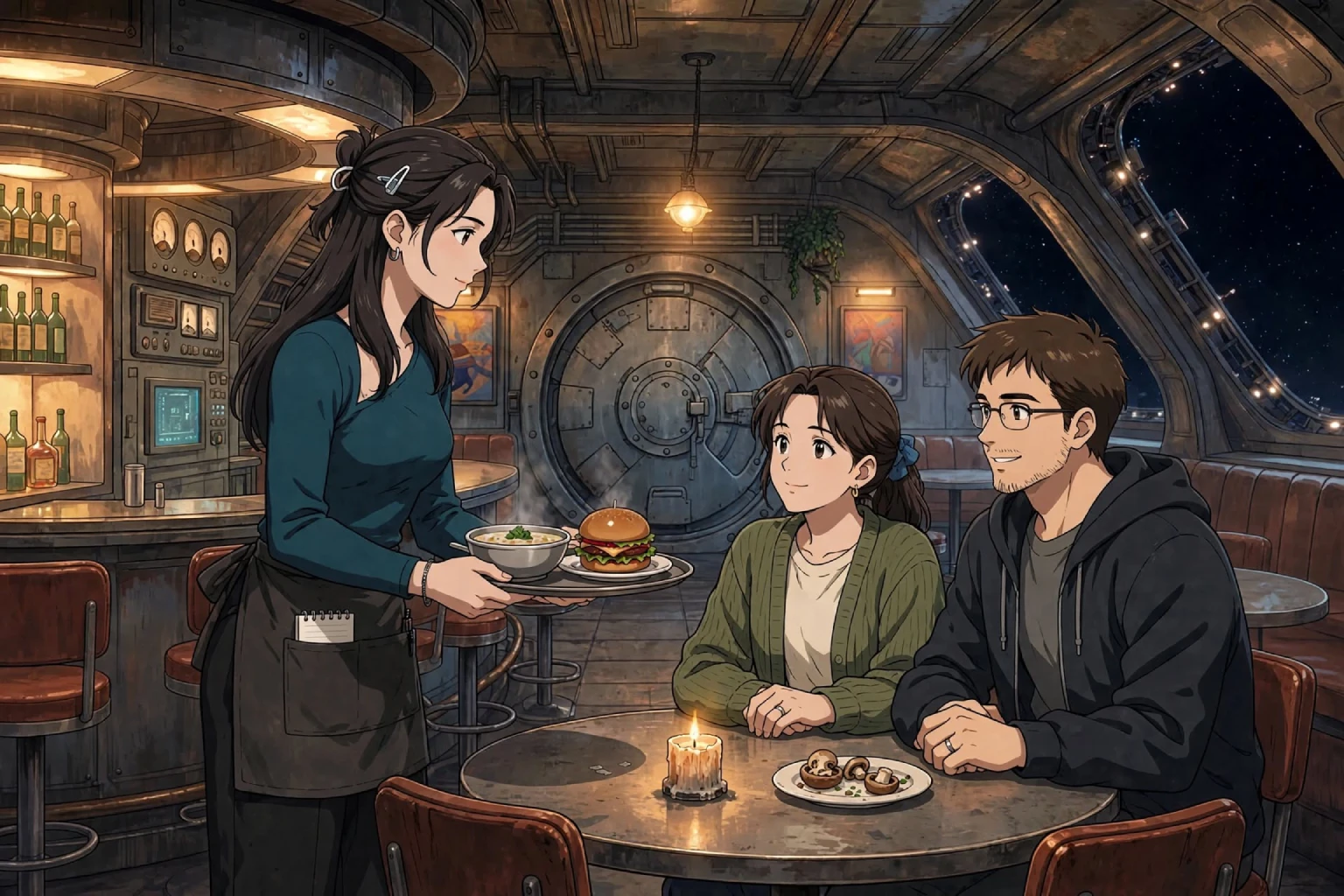
The ship was called the *Marigold*, which Sena thought was a nice name for something that spent most of its life hauling freight, and it had put in for a routine refuel and crew changeover a little after the dinner hour started, which meant its two passengers had a few hours to spend somewhere that wasn't a cramped berth before they were back aboard for the next leg of the run.
They came in together, the way people did when they'd traveled enough distance as a pair that walking side by side had become an unconscious habit rather than a decision, and stood just inside the door for a moment taking in the restaurant with the mild, curious attention of people who hadn't been sure, until they saw it, whether there'd be anywhere decent to eat at all.
"This is it?" the woman asked, not unkindly, glancing at the man beside her.
"This is what the berth listing said. 'Restaurant on site.' I didn't get more specific than that." He looked around, taking in the mismatched chairs, the counter with its faint permanent gleam of a thousand wipe-downs, the curved windows along the far wall that framed a slice of docking ring and a wedge of dark beyond it. "Looks fine to me."
"I wasn't complaining. I was asking if this was it."
"It's it," he confirmed, and they found a booth near the windows, dropping a single shared bag onto the bench beside them with the particular carefulness of people who'd packed for a long trip and had learned exactly how much could fit where.
Dani got to them first, because Dani generally got to new faces first, menus already in hand. "Welcome in. You're off the *Marigold*?"
"That's us," the man said. "I'm Corwin. This is Maren."
"Dani. Kitchen's good tonight, for what it's worth, though I say that most nights, so take it with whatever grain of salt you want." She set the menus down. "You've got a few hours before the ship's ready again, if the manifest I saw is right. Plenty of time, no rush."
"That's the first plenty of time we've had all week," Maren said, opening her menu with the unhurried pleasure of someone who intended to actually read it rather than just glance at the first thing that looked edible. "We'll take it."
Dani went to get water and give them a minute, and it was Sena, passing with a rag in hand on her way to wipe down an emptied table, who caught the tail end of a conversation that hadn't been meant for her, the way overheard things at a counter-height restaurant so often weren't.
"I told you we'd make it in time," Corwin was saying, low, mostly to Maren.
"You told me that three ports ago too, and we missed the connection by forty minutes."
"That one wasn't my fault. That one was the depot's fault for posting the wrong gate."
"I'm not assigning blame. I'm just establishing a pattern."
"There's no pattern. This is a completely different situation." He glanced toward the window, at the docking ring beyond it, and something in his shoulders eased slightly. "We made it. We've got the whole evening. This is the good one."
"This is the good one," Maren agreed, and reached across the table to take his hand for a moment, not with any particular flourish, just the easy, unremarkable gesture of two people who did this often enough that it barely registered as a gesture at all.
Sena kept moving, because it wasn't her business to linger over a private moment, but she filed the phrase away without quite meaning to. *This is the good one.* People said things like that about all kinds of evenings, and it usually meant something, even when they didn't say what.
Dani came back with waters and the offer of drink recommendations, which Corwin waved off good-naturedly in favor of "whatever's cheapest and doesn't taste like regret," a request Dani relayed to Stirling with visible amusement.
"He said cheap and not-regret-flavored," she reported, sliding onto the stool across from the bar. "I think that's a request for the house lager."
"A reasonable interpretation," Stirling said, already reaching for glasses, "though I would point out that 'cheap' and 'not unpleasant' are not mutually exclusive categories, and I intend to serve something that satisfies both without insulting either."
"It's beer, Stirling."
"Beer poured with care is a different experience than beer poured without it," Stirling said, with the same total sincerity he brought to everything, and set to work with an attentiveness that suggested he considered this instruction less a limitation than a small, interesting puzzle.
Back at the booth, Maren and Corwin had settled into the particular comfortable quiet of two people deciding what to order, occasionally reading a line off the menu aloud to the other for consultation.
"They've got a mushroom thing," Maren said. "Some kind of stuffed mushroom appetizer."
"Get it. We're splitting it either way, might as well pick the thing you actually want."
"We are not splitting everything tonight."
"We split everything every night. Why would tonight be different."
"Because it's supposed to be nice," Maren said, and there was something in the way she said it, light but deliberate, that made Corwin look up from his own menu.
"It is nice. Look at this place. There's a window. There's a docking ring out there with actual stars behind it, which is more scenery than we've had in two weeks of hauler transit. This is nice."
"I know it's nice. I meant—" She stopped, waved a hand slightly, the gesture of someone deciding a thought wasn't worth finishing out loud, and went back to the menu instead. "Never mind. Get the mushrooms. I'll get something we're not splitting, so you don't feel deprived."
"I never feel deprived. I like sharing food. It means I get to try twice as many things."
"That's a very generous way of saying you like eating half of my dinner."
"It's the same thing," Corwin said, entirely unbothered, and when Dani came back to take the order a few minutes later, they'd settled on the stuffed mushrooms to start, a bowl of the chowder for Maren, and the burger for Corwin, ordered with the specific, practiced efficiency of people who'd learned, over a long trip on a modest budget, exactly how to get a satisfying meal without overordering.
It was Sena who put it together, a little while later, not from any one thing they said but from the accumulation of several small things — the way they'd priced out the menu before ordering, quietly, without making a production of it; the way Maren had asked, almost as an aside, whether the chowder came with bread or if that was extra; the way neither of them had so much as glanced at the more expensive plates further down the page.
It wasn't unusual, exactly. Plenty of travelers on the route watched their spending. But there was something in the careful, contented way they were doing it, the sense that this wasn't a source of anxiety so much as a simple fact of the trip, that made Sena pay closer attention than she might have otherwise.
She got her confirmation a few minutes later, delivering the water refill herself instead of sending Nari, mostly out of the ordinary hospitality instinct that made her check on new tables at least once before the food arrived.
"How's the evening treating you so far?"
"Better than expected," Corwin said. "We weren't sure there'd be anywhere decent to eat on this leg of the trip. Most of the stops so far have been vending machines and whatever we packed."
"Rough way to travel."
"It's fine, honestly. We planned for it." Maren glanced at Corwin, and something passed between them, a small private exchange that Sena recognized as the kind couples had when deciding, without quite deciding out loud, whether to share more of a story than a stranger technically needed. "We've been saving for this trip a long time. Figured we'd rather spend the money on the destination than on food along the way."
"Where's the destination?"
"Calder Station, eventually. There's supposed to be an actual view of the ring nebula from the observation deck there. We've wanted to see it since before we got married." Corwin said this with the easy pride of someone who'd been planning something for years and had finally gotten close enough to touch it. "This was supposed to be our honeymoon trip. Took us four years to actually afford it."
"Four and a half," Maren corrected.
"Four and a half. We got married young and broke, and figured we'd do the honeymoon properly once we had something to spend on it, instead of doing something small and disappointing right away."
"It wasn't going to be disappointing," Maren said. "It just would've been a weekend at his cousin's cabin instead of the ring nebula."
"His cousin's cabin has a leak in the roof."
"It's still a nice cabin."
"It's a cabin with a leak in the roof, Maren."
"I'm just saying it wasn't going to be nothing," Maren said, to Sena now, with the faint, good-natured exasperation of someone re-litigating an old argument for an audience of one. "We would've had a fine time either way. But this way we get the nebula, so."
"So tonight's part of the trip," Sena said. "The honeymoon trip."
“This route was the cheaper way to make the trip work,” Corwin said. “More stops, more layovers, but that’s how we ended up here.” He grinned, glancing around the restaurant with what looked like genuine appreciation rather than resignation. “Not that I'm complaining. This is exactly the kind of place I'd want to stumble into on a trip like this. Feels lived-in. Feels real.”
"We were going to call tonight our nice dinner, actually," Maren admitted, a little sheepishly, like this was slightly more sentiment than she'd meant to volunteer to a waitress she'd known for ten minutes. "We budgeted for one actual sit-down dinner on the whole trip, somewhere in the middle, before we get to Calder and spend everything on the observation deck tickets. Tonight's it."
"This is the nice dinner," Corwin confirmed, with no trace of irony or disappointment in it at all, just plain, uncomplicated contentment. "We picked well. Look at the window. That's a real view."
Sena looked at the window herself, at the ordinary slice of docking ring and dark beyond it that she saw every night of her working life and had stopped particularly noticing years ago, and then looked back at the two of them, sitting close together in a booth they'd chosen specifically for that unremarkable view, and understood, in the plain, uncomplicated way you sometimes understood things at work, that whatever the Cosmic Bar and Grill did for the next hour and a half needed to be done well.
"I'll go check on your food," she said, and did not say anything else about it, because there was nothing to say yet, only something to do.
She found Dani first, at the pass, waiting on the mushroom appetizer.
"That table," Sena said, low, nodding back toward the booth without pointing. "Table by the window. That's their honeymoon dinner. Whole trip's budgeted around one nice sit-down meal, and this is it."
Dani's whole face lit up like someone had flipped a switch. "Their honeymoon dinner. Here. Tonight."
"Dani—"
"We have to do something. We have to do *something*, Sena, this is—" She was already reaching for a stack of napkins like she intended to fold them into something ambitious. "What if we did a whole thing, like a little card, or moved them to the corner booth with the better view, or—"
"We are not moving them," Sena said. "They picked that booth. They like that booth. If we move them, it stops being their dinner and starts being ours."
"Okay, but what if we—"
"Small," Sena said, firmer now, though still gentle about it, the way you talked someone down who meant well but was about to overcorrect. "Whatever we do, it stays small. They didn't come in here looking for a production. They came in looking for a nice meal on a budget, and they already think this is that. Our job is to make it a little better without making it into something it isn't. If we turn this into a whole event, we're not doing it for them anymore. We're doing it for us."
Dani deflated slightly, though not all the way. "Small," she repeated, testing the word like she wasn't sure she believed in it yet. "Okay. Small. What counts as small?"
"I don't know yet. Let me think about it while their food's cooking." Sena glanced toward the kitchen. "Does Chef know?"
"Chef's about to know," Dani said, and went to tell him, because some things moved faster through the kitchen than through any official channel, and this, given who was cooking, seemed like exactly the sort of news that deserved to move fast.
Chef received the information the way he received most information, without any visible change in his expression, working the mushrooms off the flattop with the same unhurried economy he brought to every plate.
"Honeymoon dinner," he repeated, once Dani had finished. "The whole trip's honeymoon, or just tonight?"
"Just tonight, I think. They're saving the big stuff for wherever they're actually headed. Tonight's the one dinner they budgeted for."
Chef considered this while he finished plating the mushrooms, setting them just so, an adjustment so small Dani almost missed it happening. "Their order's fine as it is," he said. "Chowder, burger, mushrooms. Nothing wrong with any of it. Just means I do it a little better than usual."
"What does a little better look like?"
"Means the burger gets the good bun instead of the standard one, and it means I don't rush the chowder even if we get busy, and it means when the mushrooms come out, they come out looking like somebody cared how they looked instead of just how they tasted." He slid the plate onto the pass. "Doesn't mean I put a flag on the plate and make an announcement. Means I do my job the way I'd want it done for me, if it were my one nice dinner on a long trip."
"That's very poetic for you, Chef."
"It's not poetic. It's just cooking," Chef said, and went back to the grill, though Sol, working beside him, caught the faint, deliberate care with which he checked the burger a second time before it went up, longer than the order strictly required, and said nothing about it either, because some things about Chef were better left uncommented on if you wanted him to keep doing them.
Sol, for her part, took the news with considerably less ceremony and considerably more practicality. "So we're doing something nice for the honeymoon table," she said, mostly to herself, already moving toward the dessert case. "Fine. I'll do something with the pie. We've got that good batch of berries in, the ones I was saving for tomorrow's special. I can do a slice with the berries instead of the usual syrup, no charge on the upgrade. Doesn't need explaining. Just comes out better than the regular slice."
"You don't want to make a thing of it?" Dani asked.
"Making a thing of it is the opposite of what you want when it's somebody's one nice meal on a trip," Sol said, without looking up from the berries. "You want it to feel like the place is just good, not like the place noticed you and decided to perform about it. Nobody wants to feel like a charity case at their own honeymoon dinner."
"That's exactly what I keep telling Dani," Sena said, arriving in time to catch the tail end of it.
"I wasn't suggesting a charity case," Dani protested. "I was suggesting warmth."
"Warmth that doesn't announce itself," Sol said. "That's the trick. Anybody can make a fuss. Takes more care to make somebody feel special without them clocking exactly how you did it."
Stirling, meanwhile, had taken the news with the gravity of a man receiving a commission rather than a service request, and had already begun rearranging bottles at the bar with the focused intensity of someone approaching a genuinely important problem.
"A honeymoon table," he said, to Dani, who had delivered the information along with the beer order and was now watching him process it with visible fascination. "This changes the beverage service considerably."
"He just wanted the cheap lager, Stirling. Don't overcomplicate it."
"I have no intention of overcomplicating it. I intend to *appropriately complicate* it, which is a different matter entirely." He set two glasses on the bar and studied them for a moment like they were about to become something significant. "I will still serve the lager, as requested, because a man's stated preference deserves respect even on a special occasion. But I intend to accompany it with something small. A complimentary pour. Nothing so grand as to draw attention, but enough to mark the evening as distinct from an ordinary one."
"What are you thinking?"
"Something warm in color. Not overly sweet. I am thinking of calling it 'The Long Way Round,' given what I understand of their route." He considered this, turning a bottle over in his hand. "Understated. A gesture rather than a declaration. I believe that is the correct register for this occasion."
"That's actually really nice, Stirling."
"I am capable of nice," Stirling said, with the faint, wounded dignity of someone who felt this observation ought to have gone without saying, and set to work on both drinks with the same careful ceremony he brought to everything, though this time with an added attentiveness that made even pouring a house lager look, for a moment, like something worth watching.
It was Ivo, clearing a nearby table, who caught the tail end of the plan as it moved through the kitchen and found himself with an idea of his own, small enough that he almost didn't mention it, and mentioned it to Nari instead of announcing it to the room.
"You know the candle Sol keeps for birthdays? The stub one, behind the register?"
"The one that's basically down to nothing at this point? Yeah."
"I was thinking, for the honeymoon table. Not the whole birthday thing, obviously. Just — a candle on the table. Small. Doesn't need to say anything about it, doesn't need a whole moment. Just makes the table look a little nicer than the others for a couple hours." He shrugged, a little self-conscious about it now that he'd said it out loud. "Might be a stupid idea."
"It's not a stupid idea," Nari said. "Go ask Sena."
Sena, when Ivo found her, considered it for a moment and then nodded, the same small, definite nod she gave when something met her particular standard for tasteful rather than showy. "Do it quiet. Don't make a thing of setting it down. Just put it there like it was always going to be there."
Ivo did exactly that a few minutes later, setting a squat little candle in a chipped glass holder on the honeymoon table's corner while clearing a used glass from the surface, timed so casually that Maren and Corwin, deep in conversation about whether the *Marigold*'s captain was going to make her connection window on the next leg, barely registered it happening until the small flame was already flickering steadily between them.
"Did that just appear?" Maren asked, a beat later, looking down at it.
"I think it just appeared," Corwin said. "Nice touch."
"Very subtle appearance. Almost like it materialized."
"Maybe the restaurant's haunted. Friendly ghost, does candles."
"That would explain the ambiance," Maren said, and they went back to their conversation without either of them making more of it than that, which suited Ivo, watching from the counter with quiet satisfaction, exactly fine.
The food came out not long after — Sena carrying the tray herself rather than sending it with Nari, because some deliveries, she'd decided without quite articulating it to herself, were worth doing personally. She set the chowder in front of Maren and the burger in front of Corwin, the mushrooms already half-eaten between them, the candle flickering low and steady at the table's edge, the window behind them full of dark and the faint scattered lights of the docking ring, and for a moment, setting the plates down, she had the distinct, uncomplicated sense of a scene that had arranged itself without anyone forcing it — two people leaning slightly toward each other across a battered table, a small flame between them, an ordinary window doing an extraordinary job of looking like something worth remembering.
"This looks great," Corwin said, already reaching for the burger. "Seriously, this is exactly what I wanted."
"Chef does a good burger," Sena said. "Enjoy. Flag me down if you need anything."
She stepped back toward the counter rather than lingering, because the whole point, she'd told Dani, was to make the evening better without making it about the staff, and there was something almost proprietary about hovering over a table once the food was down. From a few steps away, though, she allowed herself a moment to watch, the way she sometimes did with tables she'd taken a particular liking to, and saw Corwin take his first bite of the burger and go quiet in the specific way of someone genuinely surprised by how good something was.
"Okay," he said, once he'd swallowed. "This might be a better burger than the one from that place in the market district back home."
"You say that about every burger you like."
"I say it because it's usually true. This one's up there, though. This one's genuinely up there." He gestured at it with what remained in his hand. "Try the chowder-adjacent bite of my burger. Trade me."
"That's not a thing. There's no chowder-adjacent bite."
"There could be, if you gave me some chowder."
"You have your own food."
"I like your food more. I always like your food more. It's a pattern."
"You just told me twenty minutes ago there was no pattern."
"That was about missed connections. This is a completely different, unrelated pattern about food," Corwin said, entirely unbothered by the inconsistency, and Maren, laughing despite herself, slid her bowl an inch toward him anyway, because four and a half years of marriage had apparently taught her that resistance on this particular front was not worth the effort.
They ate slowly, the way people did when they had nowhere pressing to be for the first time in what sounded like a long stretch of travel, trading bites and small observations about the trip so far — a delayed shuttle a few stops back that had turned, by their account, into an unexpectedly good evening once they'd stopped being annoyed about it; a market on some previous stop where Corwin had nearly bought a truly ugly ceramic bird as a souvenir before Maren talked him out of it; a running disagreement about whether the observation deck at Calder Station would be as impressive as the pictures made it look, Corwin convinced it would exceed expectations, Maren more cautiously optimistic on the grounds that pictures always oversold things.
"I just don't want you disappointed," she said. "You've been building this up for four years. If it's just a window and some lights, I don't want that to wreck the whole trip for you."
"It's not going to wreck the trip. Even if the nebula's a letdown, I'll still have gotten the whole trip out of it. The stops. The delays. This dinner." He gestured at the table between them, the candle, the half-eaten mushrooms, the window full of ordinary dark. "This is already a good trip, Maren. The nebula's just the last stop on a good trip. It doesn't have to be the whole point."
"That's a very reasonable way to think about it."
"I have my moments."
"You have maybe one moment a week, and this was apparently it," Maren said, but she was smiling when she said it, and reached over to steal a mushroom off his side of the plate without asking, which he allowed without comment, because this too, evidently, was part of the long-established pattern.
Sena, passing on her way to check on another table, caught this exchange without meaning to and felt something settle in her chest that she didn't examine too closely, the particular satisfaction of watching two people be genuinely, unremarkably happy in a place she helped run. She didn't linger. She kept moving, checked on the regulars at the counter, refilled a water glass two tables over, and let the honeymoon table have its evening without further interruption, the small ordinary hum of the restaurant continuing around them the way it did every night, which was, she thought, exactly the point.
Stirling delivered the beer and its quiet companion pour a little later, setting both glasses down with more ceremony than the gesture strictly required but less than he clearly wanted to give it.
"Compliments of the house," he said, indicating the smaller glass, its contents a warm amber color he'd clearly spent some thought on. "I have taken the liberty of preparing something to accompany your evening. I call it 'The Long Way Round,' in recognition of your route."
Corwin picked it up, examining it with interest. "What's in it?"
"That would spoil the experience of discovering it," Stirling said, with total sincerity, and left it at that, retreating back toward the bar before either of them could press further, though Maren caught Sena's eye a moment later with an expression somewhere between amusement and genuine touched surprise.
"Is he always like that?"
"Always," Sena confirmed. "You get used to it. It grows on you."
"It's already growing on me," Maren said, taking a careful sip of the drink and looking pleasantly surprised by it, and Corwin, following suit, made a small approving noise around his own glass that suggested Stirling's instincts, whatever they'd been, had landed exactly where he'd intended.
The evening went on in that unhurried way, the restaurant filling and thinning around them with its ordinary evening traffic, a couple of regulars at the counter arguing amiably about something on the news feed, Ivo and Nari moving through their usual rounds, the low hum of Chef and Sol working the kitchen in the particular wordless coordination of people who'd cooked together long enough not to need much conversation about it.
Maren and Corwin talked their way through the rest of dinner without any particular hurry, circling back at one point to an old story about their wedding — small, apparently, and thrown together on short notice, with a borrowed venue and a cake that had partially collapsed before the reception even started, a detail that made Maren laugh so hard retelling it that she had to set down her spoon.
"It just tipped over," she said. "Right there on the table. In front of everyone."
"In front of my grandmother specifically," Corwin said. "Who has never let me forget it."
"She still brings it up?"
"Every single family gathering. Doesn't matter the occasion. Somebody mentions cake, she mentions the collapse."
"It wasn't even a big cake."
"It was a modest cake that had one job," Corwin said, "and it failed spectacularly at that job, in front of forty people, four years ago, and I will apparently be discussing it for the rest of my natural life."
"I thought it was funny," Maren said. "I still think it's funny."
"It was the best part of the wedding, honestly. Everybody remembers the cake falling over. Nobody remembers the vows, which, frankly, I don't blame them, because I stumbled over half of mine."
"You did not stumble over half of them."
"I forgot the part about better or worse. I just skipped straight to the ring."
"You did skip it," Maren said, delighted at the memory rather than bothered by it, "and I had to whisper it to you in front of everyone, and you just said it back like nothing had happened."
"I recovered smoothly."
"You did not recover smoothly. You recovered *loudly*, and slightly off the beat of the officiant."
"Recovering at all counts as smooth, under the circumstances," Corwin said, entirely unrepentant, and Maren, laughing again, reached across the table to take his hand the same easy way she had earlier, and this time didn't let go of it right away, the two of them sitting there in the candlelight with the window full of stars behind them, in no apparent hurry to finish the moment.
By the time Sol came by with the pie, they'd slowed down considerably, the plates mostly cleared, the conversation settled into a comfortable, unhurried quiet punctuated by small remarks about nothing in particular. Sol set the slice down between them without announcement, the berries dark and glossy against the crust, and said only, "On the house, tonight," before turning to go, in a tone that discouraged follow-up questions.
"We didn't order pie," Maren said, to her retreating back.
"Kitchen's discretion," Sol said, over her shoulder, and kept walking, because she had never been one to linger over a gesture once she'd made it.
Corwin looked at the pie, then at Maren, then picked up a fork with the satisfied air of a man who considered unexpected dessert to be one of life's more reliable pleasures. "I like this place."
"I like this place too," Maren said, and they split the slice the way they split everything, without any particular ceremony about it, though Maren noticed, taking her first bite, the specific care that had gone into it — the berries clearly fresh, clearly meant for something better than the regular rotation — and glanced toward the kitchen for a moment like she half suspected there was more intention behind the free dessert than the kitchen's discretion implied, before deciding, evidently, not to examine it too closely and simply enjoying it instead.
They lingered afterward, the way people did at the end of a meal they weren't in a hurry to leave, finishing the last of their drinks, the candle burned down another visible notch, until Corwin finally checked the time on his communicator and sighed with the particular reluctance of someone whose good evening was, regrettably, subject to a departure schedule.
"We should probably get back before the *Marigold* leaves without us."
"That would be a genuinely terrible way to end the honeymoon story."
"It would make for a great story eventually. Terrible tonight, great in retrospect."
"Everything's great in retrospect with you," Maren said, but she was already reaching for the shared bag, and they gathered themselves the unhurried way people did after a meal that had gone exactly the way they'd wanted, no rush in it even at the end.
Sena came by to settle the bill, and Maren checked the total twice before looking up. The dessert and the small drinks Stirling had brought over weren’t on it.
“You didn’t charge us for the pie.”
“That one was ours,” Sena said.
Maren studied her for a moment longer, the look of someone who suspected there was more to it than that but had decided, generously, not to make the staff explain themselves out of a kindness they'd clearly rather leave unremarked. "Well. Thank you. This was — " She glanced back at the booth they'd just left, the candle still burning low at its corner, the window still full of the same ordinary dark that had somehow managed to look, for the last hour and a half, like exactly the view they'd been hoping for. "This was a really good dinner. Exactly what we wanted."
"That's the best thing anybody says to us around here," Sena said, and meant it plainly, without dressing it up any further.
Corwin shook her hand on the way out, an old-fashioned gesture that seemed to suit him, and Ivo, catching them near the door on his way past with an armful of dishes, got a genuine, warm thanks of his own for the candle, which he accepted with a slightly embarrassed shrug and no further explanation of how it had come to be there.
"Good luck with the nebula," he said. "Hope it looks as good as the pictures."
"Even if it doesn't," Corwin said, "we've already had a pretty good trip out of it," and with that they were through the door and gone, back toward the berth corridor and the waiting *Marigold*, the two of them walking close together the way they had coming in, unhurried, comfortable, in no particular need of anything further from the evening than what they'd already gotten out of it.
The restaurant settled back into its ordinary rhythm once they'd gone, Dani clearing the last of the table with visible, barely contained satisfaction.
"That went well," she said, to Sena, setting the empty glasses on her tray. "That went really well. And I kept it small. I want that on the record. I kept it small."
"You kept it small," Sena agreed. "Good job."
"I wanted to do the banner thing so badly."
"I know you did."
"I didn't do it, though."
"You didn't do it," Sena said, "and that's exactly why it worked," and Dani, considering this, decided it was a fair enough trade, and carried the tray back toward the kitchen with the particular satisfaction of someone who had, for once, successfully resisted her own better instincts in favor of somebody else's better evening.
Ivo, blowing out the stub of the candle where it still sat on the counter waiting to be tucked back behind the register, found himself thinking, not for the first time this month, about how little it sometimes took to make an ordinary evening into somebody's good one — a candle, a slice of pie, a beer poured with more care than it strictly needed. He didn't say any of that out loud, mostly because he wasn't sure how to say it without sounding like he was making more of it than it was, and instead just carried the candle back to its spot behind the register, ready for whichever birthday or borrowed occasion needed it next, and went back to clearing tables, the restaurant settling, around him, back into its familiar, unremarkable, entirely ordinary evening quiet.


.png)
.png)
.png)