%20(1).png)
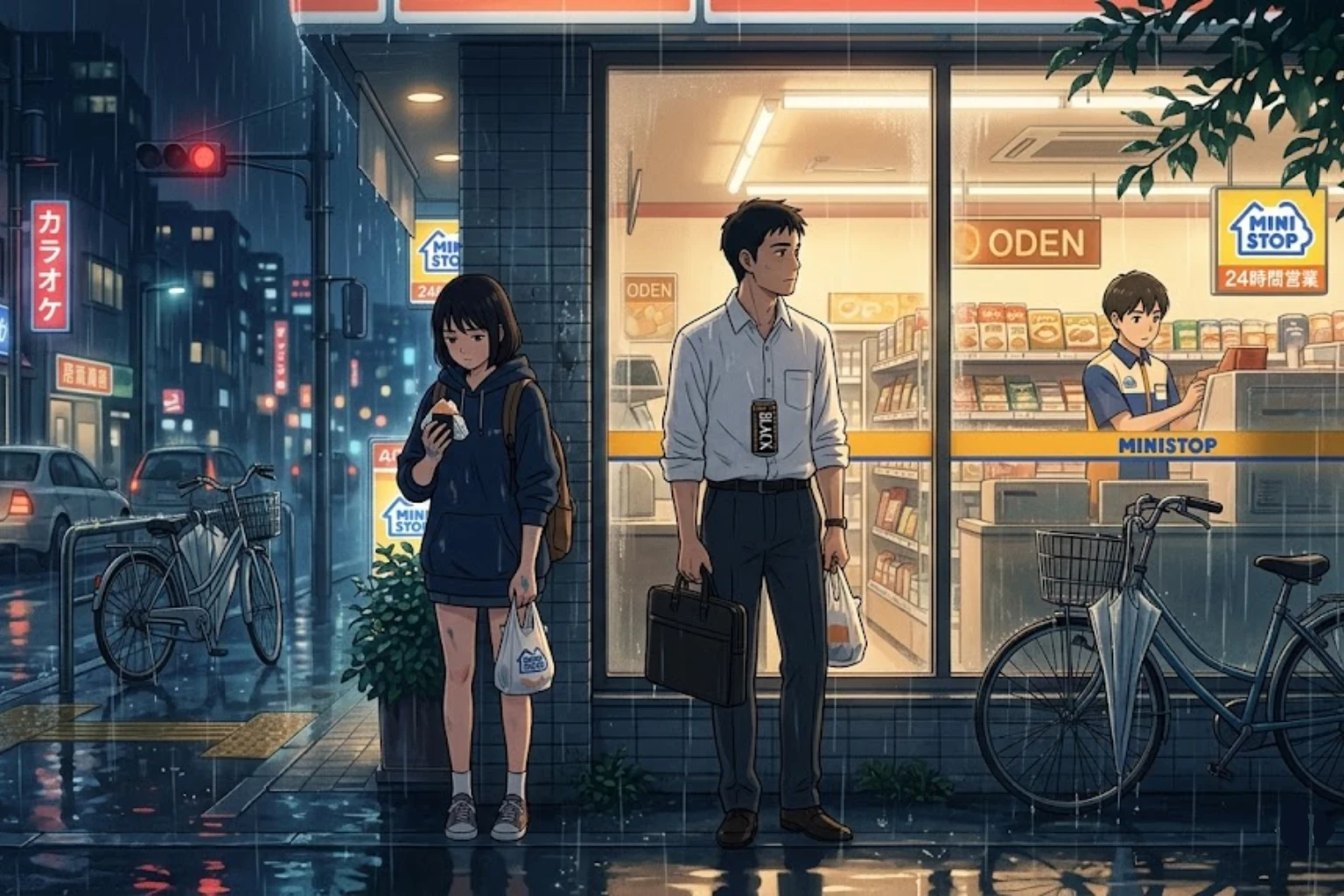
The rain arrived without warning, which was the only thing it had in common with most of the things that had happened to Yuna today.
She had been two minutes from her apartment — close enough that she had looked at the sky earlier and made the calculation that she didn't need an umbrella, a calculation that the sky had apparently found amusing. Then the first drops came down. The first drops became the second drops, and the second drops became a quantity of drops that no longer had a useful individual identity and was simply rain — serious and committed. It was the kind of rain that had decided it was going to be here for a while and had made arrangements accordingly.
She ran.
The nearest shelter was the awning of the convenience store on the corner — a narrow strip of roof perhaps four feet deep that covered the entrance and approximately nothing else. She made it under it with her bag held over her head, which had protected her bag and not her at all. She stood there catching her breath, watching the rain come down in the yellow light of the store's signage.
Already under the awning: a man she didn't know.
He was perhaps mid-twenties, in a work shirt with the collar open and the sleeves rolled to the elbow, holding a convenience store bag in one hand and his phone in the other. He was looking at the rain with the expression of someone who had done the same mental calculation she had and reached the same incorrect conclusion.
They looked at each other.
"Hi," Yuna said.
"Hi," he said.
The awning was very small.
They redistributed themselves without discussing it, each taking a side, a foot of space between them, facing the rain. It was the mutual understanding of two people who had not chosen this situation and were going to manage it with reasonable dignity.
The rain showed no interest in cooperating.
For a while, neither of them said anything. Yuna checked her phone, mostly for something to do with her hands. The man beside her did the same, in the specific way people check their phones when they are not actually expecting anything on them.
A car went by, throwing up a sheet of water from the gutter. Somewhere down the street a dog was barking at the rain itself, as if personally offended by it.
"This wasn't in the forecast," Yuna said, eventually, because the silence had gone on long enough that saying nothing was starting to feel like its own kind of statement.
"It was," the man said. "Ten percent chance. After eleven."
"That's not a forecast. That's a dare."
He almost smiled at that — she caught the corner of it before he turned back to the street. "I looked at ten percent and thought, that's basically zero."
"Same. I did the same math."
"How'd that work out."
"Badly," she said. "Clearly."
He held up his own bag, slightly, as if in solidarity. "I had the same thought at the store. I looked out the window, saw it was clear, and told myself three blocks was nothing."
"How far are you now?"
"Three blocks. Unchanged." This time the almost-smile made it all the way. "The rain moved faster than I did."
Yuna checked her phone again. Eleven forty-seven. The weather app, consulted too late, now showed a solid band of rain sitting directly over the neighborhood with the settled confidence of something that had paid for its time and intended to use it.
"App says an hour," she said. "Minimum."
He exhaled through his nose — not quite a sigh, not quite a laugh. "Of course."
"Were you going far?"
"Three blocks," he said again, then caught himself. "Sorry. I said that. Late dinner." He lifted the bag a little higher, as if it were evidence.
She looked at the bag with open curiosity, since it was, at the moment, the most interesting object available to look at. "What did you get?"
He glanced at her — briefly, with the mild surprise of someone who hadn't expected the conversation to go in this direction. "Onigiri. Katsu curry cup noodles. Canned coffee."
"The canned coffee at this hour is going to keep you up."
"I have a report due at six."
"Ah," she said. "Then it's medicinal."
"Exactly."
That landed somewhere close to a real laugh, on both sides, small and involuntary, and after that the silence that returned was a slightly different silence than the one before — a little less like two strangers, a little more like two people who had agreed, without saying so, that this could be tolerable.
She leaned against the wall beside the door and looked at the rain running off the awning edge in a thin, continuous curtain. Inside the store, visible through the glass, the night employee — a teenager who looked like he would rather be anywhere else, which was fair — was restocking the drinks refrigerator with the mechanical efficiency of someone operating on autopilot. A middle-aged man came in out of the rain, bought a single can of something, and left again without appearing to register that it was raining at all.
"Do you come here a lot?" Yuna asked. "This store."
"Most nights, lately," he said. "It's between the office and my apartment. Convenient, hence the name, I assume."
"That's very on brand for them."
"I like to think they named the whole category after this one."
"Bold claim."
"I have no evidence. I choose to believe it anyway."
She smiled at that, looking back out at the rain rather than at him, which felt like the right amount of eye contact for two strangers under four feet of shared roof.
"How far is your place?" he asked.
"Two minutes. Which is the worst possible distance to get caught in this."
"Why worst?"
"Because it's too close to justify waiting an hour, and too far to just make a run for it without arriving looking like I fell in a river." She gestured at herself, at her damp shoulders, at the general dampness that had already been achieved despite two minutes of exposure. "This is already most of the way to river."
"You could still make it."
"I could. I'm choosing not to, on principle."
"What principle."
"The principle that I already tried to outsmart the weather once tonight and lost. I'm not doing it twice in one evening."
He nodded slowly, as if this were a genuinely sound piece of risk assessment. "That's fair. I respect that."
They stood a while longer. The rain did not lighten. A couple went by on the far side of the street, sharing one umbrella badly, both of them half-soaked and laughing about it in the specific way people laugh when the alternative is being annoyed. Sota watched a taxi go past without stopping, its light off, and Yuna watched him watch it — the brief flicker of a man considering his options and finding none of them good, then settling back into the wall.
"I'm Yuna," she said. She wasn't entirely sure why she said it just then. The rain, probably. The hour. The particular social pressure of sharing four feet of roof with a stranger for going on ten minutes.
He looked at her. Seemed to decide something.
"Sota," he said.
"Nice to meet you, Sota. Under the circumstances."
"Nice to meet you too. I'd shake your hand, but—" he lifted the bag in one hand and the phone in the other, demonstrating the general impracticality of the gesture.
"I'll take the intention," she said.
The next several minutes were awkward in the specific way of two people who had exchanged names and were now technically acquainted and weren't sure what to do with that information. Yuna checked her phone twice, for no particular reason. Sota checked the rain, also for no particular reason, since it had not meaningfully changed since the last time he'd checked it.
He opened his bag, eventually, and took out one of the onigiri, unwrapping it with the practiced, slightly resigned efficiency of someone who had eaten a great many meals standing up in inconvenient locations.
Yuna watched this without meaning to. Her stomach, which had been quiet through most of the evening, chose this exact moment to remind her, with some editorial firmness, that it had not been fed since lunch and considered that an oversight requiring correction.
She looked away, toward the street, in the hope that looking away would also make the sound stop. It did not.
"Sorry," she said, under her breath, mostly to herself.
Sota glanced over. "What?"
"Nothing. My stomach has opinions."
That got an actual laugh out of him, short and surprised. "When did you last eat?"
"Lunch. It's been —" she checked her phone, as if the exact number would help. "A while."
He looked at the second onigiri still in the bag, then at her, and seemed to arrive at a decision with the same deliberate economy he'd used on the taxi.
"Do you want the other one?" he said, holding it out.
She looked at him, and then at the onigiri — tuna mayo, still wrapped. There was the specific hesitation of someone raised not to take things from strangers, weighed against the specific persuasion of someone who had not eaten in eight hours.
"That's your dinner," she said.
"I bought two out of habit. I'll only eat one — the noodles are the actual dinner, this was just something for the walk."
"You're sure."
"I'm sure. Also you're clearly suffering, and I have a working conscience."
She took it. "Thank you. Genuinely."
"Don't mention it. Least I can do for someone who's stuck under here because of me and my terrible weather judgment."
"Your judgment was independently terrible. I brought my own."
"We can share the blame, then. Equally."
"Deal."
They ate standing up, more or less side by side, in the slightly less awkward silence of people sharing food. It was a different quality of silence than the one before it, the kind that comes with a small act of generosity already lodged between two people, quietly changing the terms.
"This is good," Yuna said, after a moment. "Thank you. Actually."
"Don't thank the giver, thank the convenience store. I take no credit for tuna mayo. That's a group effort across an entire industry."
"Fine. Thank you, industry."
"They'll never know, but I'm sure they appreciate it."
The rain had settled into a steady rhythm on the awning above them, unbothered by the small conversation happening beneath it. Somewhere down the street, a delivery scooter went by with its rider hunched against the wet, engine whining faintly before it faded around the corner.
"Report on what?" she asked, once they'd both mostly finished eating.
"Supply chain logistics." He said it with the flat affect of someone who had been staring at the same document for too many hours and had lost the capacity to have feelings about it one way or the other. "You?"
"Graphic design student," she said. "Second year."
He glanced at her hand — at the faint gray-blue smudge of paint along the side of her palm that she had not fully scrubbed off — and then at the tote bag over her shoulder, where the edge of a sketchbook was visible above the zipper.
"The paint gave it away," he said.
She looked at her own hand, mildly betrayed by it. "I keep meaning to get that off. It never quite comes off in one wash."
"What were you working on? Before the rain ambushed you."
"A poster project." She peeled the wrapper further down and took another bite before continuing. "We have to design a campaign for something that doesn't exist yet. An imaginary product, a fake event, whatever we want, as long as we can justify the concept."
"What did you pick?"
"A fake film festival. Small, local, the kind that would run for one weekend in a neighborhood like this one." She gestured vaguely at the street, at the wet pavement and the yellow signage and the general ordinariness of everything around them. "I liked the idea of designing something for a place instead of a product. Posters, a schedule, little flyers you'd see stapled to a telephone pole."
"That sounds like a good concept."
"The concept's fine. The execution is the problem." She said it plainly, without much self-pity, the way you describe a fact you've made peace with even if you don't like it. "I've been working on it for three weeks and I keep starting over."
"What's going wrong, exactly?"
She considered how to answer that in a way that wasn't just complaining. "I know exactly what I want the final poster to look like. I can see it — the layout, the colors, the type, how the whole thing should feel when someone looks at it for two seconds walking past. It's completely clear in my head."
"But."
"But every time I actually make it, it's — flatter. Less alive than what I was imagining. Like I'm tracing a memory of the good version instead of building it directly." She shrugged, a little helplessly. "So I scrap it and start again, hoping the next attempt closes the gap. Sometimes it does, a little. Mostly it doesn't."
Sota was quiet for a moment, turning that over. "Is it a skill problem? Like, technical things you haven't learned yet. Or something else."
"Some of both, probably. My professor says a lot of it is just experience — that the gap between what you can see and what you can actually make closes over time, the more you practice. That eventually your hands catch up to your head." She paused. "I believe her. It doesn't make it less frustrating to be stuck in the gap right now."
"That happens a lot? The gap thing."
"Every project, honestly. Different size gap depending on how ambitious I get, but it's always there." She glanced at him. "Does that happen with logistics? Or is it more — solvable. Like, you know the answer exists and you just have to find it."
He laughed under his breath, but it wasn't quite a happy sound. "There's a version of that. Most of it's solvable, technically. That's actually the problem."
"How is solvable a problem?"
"Because solvable isn't the same as satisfying." He turned the empty onigiri wrapper over in his hands, not really looking at it. "I'm good at my job. I can tell you that honestly, it's not modesty. I'm good at finding the inefficiency in a shipping route or a warehouse layout and fixing it. It's just — it was never the thing I wanted to be good at."
"What did you want to be good at?"
"Urban planning," he said. "Not the version people usually picture — zoning maps and traffic studies, though that's part of it. I mean the kind that actually thinks about how a neighborhood works for the people living in it. Whether a street is walkable. Whether there's a bench where an old woman can actually sit and rest between the market and her building. Whether a kid can get from home to school without crossing four lanes of traffic that nobody designed with them in mind." He said this with more energy than he'd shown all evening, and seemed to notice it himself, and dialed back slightly. "Sorry. I don't usually get going on that."
"No, keep going. I asked."
He glanced at her, checking that she meant it, and seemed satisfied that she did. "The human part of it, basically. Not just moving things efficiently from one point to another, but thinking about what it's like to actually live somewhere. That's what I studied. That's what I wanted to do."
"What happened?"
"I interned at a planning firm the summer before I graduated. Small place, good work — we did a project on a neighborhood that kept losing foot traffic to a strip mall outside town. We tried to figure out what would actually bring people back to the local shops instead of just telling them to." He paused. "I was good at it. They told me so, more than once. When I graduated, I asked about a position."
"And?"
"They didn't have one. Not that year. Budget, hiring freeze, the usual reasons that are true and also don't help." He exhaled. "The logistics company had a position. So I took it."
"How long ago was that?"
"Two years, this spring."
Yuna let that sit for a moment, watching the rain, aware that the conversation had drifted somewhere quieter than either of them had probably planned when they said hi to each other twenty minutes ago.
"Do you like it?" she asked. "The logistics job. Not the plan — the actual thing you do every day."
He considered this with genuine seriousness, which she appreciated — he didn't deflect, or perform contentment, or give the automatic answer people give when they've decided in advance not to complain.
"Parts of it," he said. "I like solving the actual puzzles. There's something satisfying about looking at a mess of numbers and routes and finding the version that works better. I'm good at it, which helps — it's easier to tolerate something you're competent at." He turned the can of coffee in his hand, not yet opened. "But being good at something and wanting to do something are —" he paused, looking for the right way to finish it.
"Different lists," Yuna said.
He looked at her.
"Yeah," he said, slowly, as if trying the phrase on and finding it fit. "Different lists. That's exactly it."
Behind them, through the glass, the teenage employee had finished with the drinks refrigerator and moved on to the snack aisle, straightening bags of chips with the same detached, autopilot energy he'd shown all night. A couple ran past on the far pavement sharing one umbrella inadequately, laughing about it, disappearing around the corner into the wet dark.
Sota cracked open the can of coffee, finally, the small hiss of it swallowed by the sound of the rain. He took a sip, made a face that suggested it tasted exactly as medicinal as advertised, and held it out toward her, almost as an afterthought.
"I only have the one," he said. "But you're welcome to it, if you want."
She touched the can briefly — not quite taking it, more acknowledging the offer — and shook her head. "Thank you. I'll pass. I don't think I could survive canned coffee at midnight."
"Wise. I won't survive it either, probably, but I have a report and no other options."
"Different lists," she said, "of who has to suffer tonight."
"Very true. I'm at the top of mine."
She smiled, and for a moment neither of them said anything, the rain filling the space where a next line might have gone, and it didn't feel empty. It felt, if anything, like the kind of silence that only exists once two people have actually said something real to each other.
"Can I ask you something?" Yuna said, eventually.
"You've been asking me things for twenty minutes."
"A different kind of thing."
He looked at her, mildly wary but not unwilling. "Go ahead."
"Do you think you'll go back to it? The urban planning."
He didn't answer right away. He looked out at the rain, at the wet street doubled in reflection under the streetlights, and seemed to actually weigh the question rather than reach for whatever answer came easiest.
"I think about it," he said, finally. "There are evenings — after a good day at the current job, when something actually clicked, some route or warehouse plan came together better than I expected — where I think, maybe this is fine. Maybe this is just what working life is. You find the thing you're competent at, you do it well, you build a life around it, and the other thing stays a nice idea you had once."
"And other evenings?"
"Evenings like this one." He held up the can slightly, a small, tired gesture. "Writing a report at midnight for a job that's fine, about numbers that matter to a company and not especially to me, and I think — I'm twenty-six. If not now, when."
"When what?"
"When do I stop waiting for the right time to try again." He said it quietly, without any performance in it, which made it land harder than if he'd said it as a declaration. "There's always a version of not yet. Not yet, I need to save more. Not yet, the timing's bad. Not yet, maybe next year there'll be an opening. At some point not yet just becomes never, and you don't notice the exact day it happened."
Yuna didn't say anything immediately. She was thinking about her own three weeks of restarted posters, the pile of discarded drafts on her desk at home, the particular ache of almost.
"That's probably more than you were asking," Sota said, after the silence had gone on a beat too long, a little embarrassed now, like he'd said more than the conversation had asked of him.
"No," she said. "It's exactly what I was asking."
He glanced at her — surprised, she thought, to have been taken seriously rather than politely deflected. Then he looked back out at the street, at the rain that was, she noticed now, coming down a little less insistently than it had been ten minutes ago.
"The gap closes," she said, half to him and half to herself. "That's what my professor says. Between what you can see and what you can actually make." She paused, turning the idea over. "I wonder if it applies to other things too. Not just posters."
"Maybe," Sota said.
"Maybe you get better at closing the distance between the life you can picture and the one you're actually building. The same way I'm supposed to get better at closing the distance between the poster in my head and the one on the page."
"That's a nicer way of putting it than I would've come up with."
"I had help. I'm quoting my professor."
"Still. It's a good line to borrow."
They stood there for a while without saying much else, the kind of quiet that didn't need filling. The rain had visibly thinned — not stopped, but reconsidering itself, the drops spacing out, the sound on the awning softening from a steady drumming to something more like scattered applause winding down.
Yuna checked her phone. Twelve nineteen.
"It's letting up," she said.
He looked at the rain, tilting his head slightly to judge it. "A little. Not gone."
"Give it five more minutes."
"Five more minutes," he agreed.
Neither of them said anything for those five minutes, exactly, though it wasn't an uncomfortable silence. It was more the kind two people share when a conversation has already gone somewhere real, and there's a mutual, unspoken decision to just sit with that for a moment rather than immediately fill it with something smaller. The city hummed its midnight hum around the edges of the quiet, and the convenience store light fell yellow and warm across the wet pavement. Somewhere down the street a cat crossed unhurried between two parked cars, entirely unbothered by the weather either of them had spent the last half hour discussing.
The rain stopped at twelve twenty-four.
Not all at once — it tapered the way things end when they have somewhere else to be. The drops spaced further and further apart until they simply weren't arriving anymore, leaving behind only the quieter sound of water running off gutters and awnings and finding its way to drains.
They both looked out at the street. Wet and shining and empty, the streetlights doubled in the puddles, the whole block rinsed clean and briefly still.
"Clear," Sota said.
"Clear," Yuna agreed.
Neither of them moved right away.
"Well," he said, eventually, with the small, slightly reluctant energy of someone acknowledging that a thing has to end even though he isn't quite ready for it to. "I should get this report started before I fall asleep standing up."
"And I should get home before the next round of rain the app is definitely lying about."
"Probably wise."
She picked up her tote, adjusted it on her shoulder. He picked up his convenience store bag, the noodles and the empty coffee can rattling faintly inside it.
They stepped out from under the awning onto the wet pavement together, and the air smelled the way air smells after rain — clean, faintly electric, the city briefly rinsed of whatever it had been carrying before.
"Which way?" he asked.
She pointed left.
He pointed right.
Of course.
"Good luck with the report," she said.
"Good luck with the poster." He paused, and something crossed his face — the particular hesitation of someone deciding whether a thing is worth saying and then deciding it is. "The gap closes."
She looked at him.
"You said your professor said it first," he said, with a small, almost apologetic gesture, as if handing something back. "I'm just returning it."
She smiled. "Yeah," she said. "It does."
He nodded once, the kind of nod that serves as both goodbye and thank you, and turned right. She turned left. They walked away from the convenience store in opposite directions down the washed and quiet street, and neither of them looked back. That was the right thing to do, and also a thing that required a small, specific effort that both of them made without acknowledging it, even to themselves.
Yuna walked the two minutes to her apartment with the rain-smell still in the air and the paint still faint on her hand. The empty onigiri wrapper was still folded in her coat pocket, where she'd tucked it out of habit rather than throw it in the street.
She got home. Unlocked the door. Turned on the light.
She set her bag down, hung her damp coat over the back of a chair, and sat down at her desk. The poster project was waiting exactly as she'd left it three hours earlier — the half-finished layout on the screen, the stack of discarded drafts beside the monitor. There was the small, familiar weight of a thing not yet resembling what she could see so clearly in her head.
She looked at it for a long time.
Then she picked up her pen, and started again.


.png)
.png)
.png)