%20(1).png)
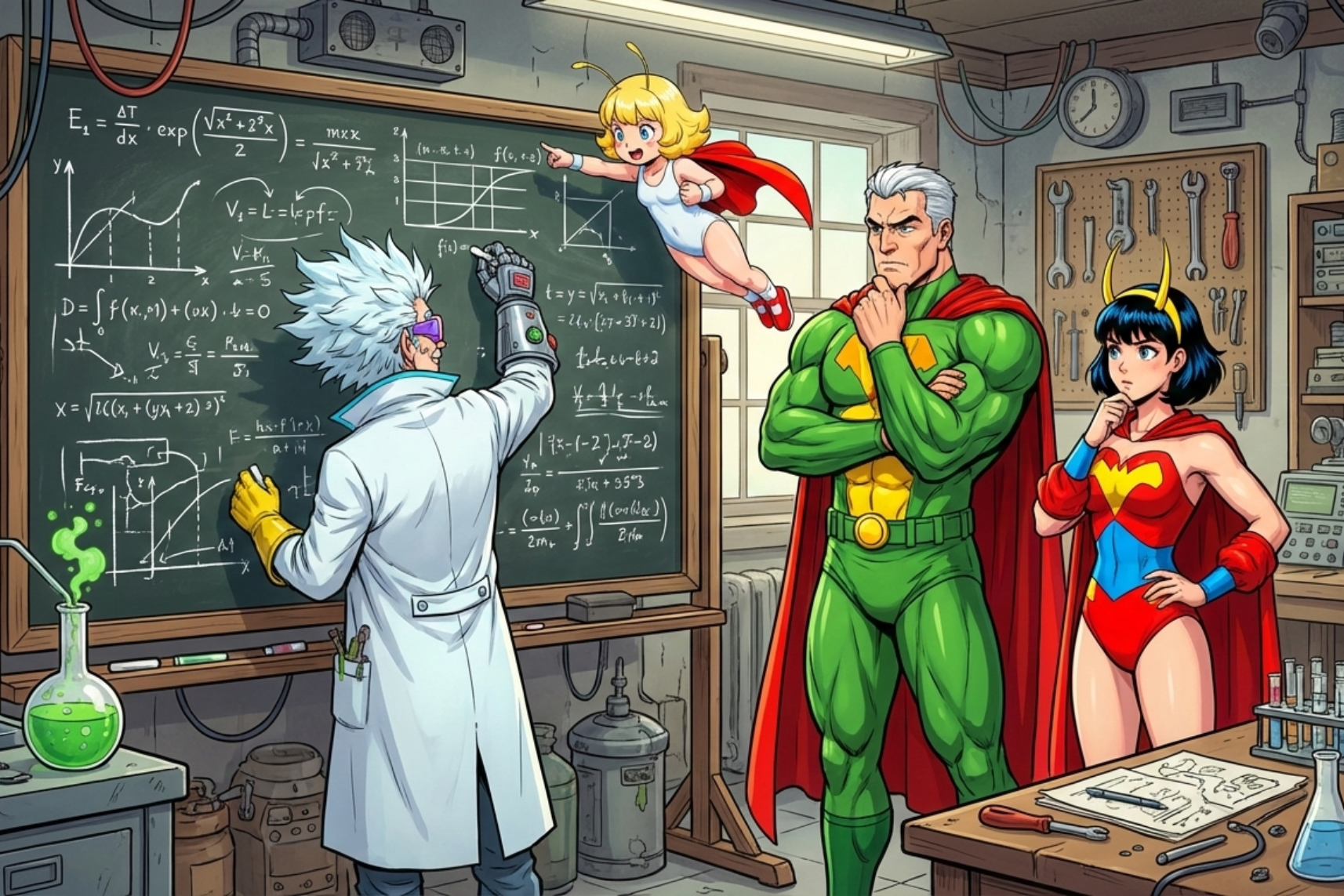
The basement stairs ended where the basement used to be.
Captain Gridlock knew the space by muscle memory alone. He’d carried weights down these steps. Stored old equipment. Filed away things that didn’t belong anywhere else. The smell had always been dust and cardboard and neglect.
None of that survived the last six seconds.
Light hummed. Not overhead bulbs—something deeper, brighter, threaded through the walls themselves. Copper pipes had multiplied, branching like veins. Cables snaked across the ceiling, disappearing into vents that definitely hadn’t existed yesterday. The concrete floor was gone, replaced by steel plates etched with symbols Gridlock didn’t recognize but instinctively disliked.
The room stretched too far. It shouldn’t have been possible. Their base sat on a normal foundation. Normal lot. Normal square footage. Gridlock had seen the blueprints. He’d signed off on structural reinforcement after the last incident with the collapsed training platform and the angry ceiling fan.
This wasn’t expansion. This was replacement.
Pixel Pop hovered off the last step, pointing at everything at once. “This is new. This is all new. This is criminally new.”
Crimson Nova stayed still, eyes scanning, already cataloging exits that no longer lined up with where exits were supposed to be. “The house didn’t expand,” she said slowly. “The space did.”
Gridlock exhaled through his nose. “That’s worse.”
The air smelled like hot metal and ozone, like the atmosphere had been microwaved and left out to cool. Somewhere deep in the lab, something crackled with electricity, followed by a sound like a metal animal coughing.
Pixel Pop drifted closer to a thick glass tube along the wall. Something blue swirled inside it like mist trapped in water. It pressed faintly against the glass, then retreated.
Pixel Pop pointed at it, whispering like it might hear her. “That thing is alive.”
Crimson Nova’s gaze didn’t move. “Everything in here is alive.”
Gridlock stepped forward. The floor responded. Not with sound, but with movement. A subtle shift, like the plates adjusted themselves beneath his boots, almost as if they were measuring his weight and deciding whether they approved of it.
He stopped instantly.
Pixel Pop froze mid-hover. “Did the floor just… flex?”
Gridlock stared down. “Yes.”
Crimson Nova frowned. “That’s not a floor. That’s a system.”
Gridlock lifted his foot carefully and set it down again. The floor didn’t move this time. It simply pulsed once—faint lines of light traveling under the steel like veins beneath skin.
Gridlock’s jaw clenched. “This is a trap.”
Pixel Pop shook her head. “This is a science fair from hell.”
At the center of the room stood Uncle Glick.
He had his back to them, lab coat flapping slightly as he scribbled equations across a massive chalkboard that had replaced the old shelving unit. Numbers curled into symbols. Symbols folded into shapes. Shapes looped back into numbers that erased themselves mid-line.
The chalkboard itself looked wrong. Not physically wrong. Existentially wrong. Like it was older than the house. Older than the neighborhood. Older than the planet.
Glick hummed cheerfully as he worked.
Pixel Pop whispered, “Why is the chalkboard… bleeding?”
“Not bleeding,” Glick said without turning. “Phase residue. Perfectly normal.”
“It’s glowing.”
“Only on Thursdays.”
Gridlock took a step forward. The floor shifted under his boot again—subtle, like something adjusting to his weight. He stopped immediately.
“This wasn’t here yesterday,” he said.
Glick nodded. “Correct.”
Crimson Nova blinked. “You admit that?”
“Of course,” Glick said, tapping the chalkboard with satisfaction. “Yesterday it was somewhere else.”
Pixel Pop spun in place. “WHERE.”
Glick finally turned around.
He looked pleased. Not guilty. Not startled. Pleased, like someone whose guests had finally noticed the decorations.
“Oh, don’t worry,” he said. “It’s still your basement. Mostly. It just intersects with three other spatial frames now.”
Gridlock crossed his arms. “You broke our house.”
“I improved it,” Glick replied. “Substantially.”
Crimson Nova’s voice was calm, but there was an edge underneath it. “Explain what you did. In a way that doesn’t sound like you’re confessing to a cosmic felony.”
Glick smiled. “Oh, it’s absolutely a cosmic felony.”
Pixel Pop gasped. “You can’t just say that!”
Glick shrugged. “I can. I did. Watch.” He cleared his throat politely. “I committed a cosmic felony.”
Gridlock’s eyes narrowed. “You’re enjoying this.”
“Oh yes,” Glick said. “I haven’t had company in weeks.”
Crimson Nova stared at him. “You’ve been here for weeks?”
Glick waved a hand. “Time is relative. Also irrelevant. Also occasionally delicious.”
Pixel Pop blinked. “What does that even mean.”
Glick ignored her and swept his arm wide. “To your left is a temporal stabilizer. It keeps the Intersect from collapsing. Mostly.”
Pixel Pop blinked. “Mostly?”
Glick nodded. “Sometimes it collapses a little, but that’s normal. It rebuilds itself. Like a confident wound.”
Crimson Nova’s expression did not change, but her voice became sharper. “That’s not reassuring.”
“To your right,” Glick continued, “is a weather engine.”
Gridlock snapped his head toward it. A massive machine sat in the corner, covered in coils and vents and pipes that pulsed with faint blue energy. It hummed ominously like a sleeping monster.
Gridlock pointed. “Why is there a weather engine in our basement?”
Glick shrugged. “Because the sky is inefficient.”
Pixel Pop floated closer, staring at the machine. “That thing could absolutely create a tornado.”
Glick smiled. “Yes.”
Crimson Nova’s eyes narrowed. “Why would you want that.”
Glick’s smile widened. “For testing.”
Gridlock stepped forward. “You’re going to explain. Now. Why you’re here, what you did to our base, and what that door is.”
He pointed toward the far wall.
A massive steel door sat embedded into it, covered in warning signs. Some were in English. Some were in symbols. One was literally a skull wearing sunglasses. The largest sign read: DO NOT OPEN THIS DOOR. SERIOUSLY. LAST WARNING. THIS IS NOT A JOKE. (IT IS KIND OF A JOKE.)
Pixel Pop stared at it. “That door is… aggressively suspicious.”
Crimson Nova nodded slowly. “It’s not even trying to look safe.”
Glick clasped his hands behind his back and smiled like a proud homeowner. “That door is my favorite.”
Gridlock’s voice dropped. “You are not opening it.”
Glick looked offended. “Of course I’m not opening it.”
Pixel Pop exhaled in relief.
Glick continued. “I’m only going to show you what’s behind it.”
Gridlock’s eyes widened. “That’s the same thing.”
Glick walked toward the door.
Crimson Nova stepped in front of him immediately. “No.”
Gridlock moved beside her. “Absolutely not.”
Pixel Pop floated between them, arms spread dramatically. “I am invoking the emergency rule that says no doors with skulls get opened before lunch.”
Glick blinked. “You have rules?”
Gridlock growled. “We do now.”
Glick sighed. “Fine. No door. Not yet. Then we’ll start with something simpler.”
Crimson Nova watched him carefully. “Simpler than a forbidden door?”
Glick nodded. “Yes. Fractured reality.”
Pixel Pop’s eyes widened. “That is not simpler.”
Glick began writing again, chalk scratching across the board in fast, confident strokes. Symbols appeared that looked like math and magic had collided and refused to apologize.
“Your basement used to exist in one coordinate. One dimension. One predictable spatial frame,” he said. “But that’s boring. Boring spaces invite boredom. Boredom invites entropy.”
Gridlock frowned. “What.”
Glick turned around. “Entropy is the enemy.”
Crimson Nova folded her arms. “So you decided to fight entropy by turning our basement into an interdimensional laboratory.”
“Yes,” Glick said.
Gridlock stared. “You’re insane.”
Glick smiled brightly. “Thank you.”
Pixel Pop pointed at the chalkboard. “What is that equation.”
Glick glanced. “Oh, that’s the Chronoton Misalignment Curve.”
Crimson Nova’s eyes sharpened. “Chronoton.”
Gridlock frowned. “Is that even a real thing?”
Glick shrugged. “Not here.”
Pixel Pop whispered, “That’s worse.”
Glick tapped the chalkboard with the chalk. “Chronotons are particles of time. Not time itself—time is a liar—but the pressure that holds it in place.”
Crimson Nova stared. “Time pressure.”
Glick nodded. “Exactly. Like water pressure. Except if it bursts, you don’t get wet.”
Pixel Pop leaned forward. “What happens.”
Glick smiled slowly. “You get rewritten.”
Gridlock’s entire body stiffened.
Crimson Nova’s voice lowered. “Rewritten how.”
Glick gestured vaguely. “Sometimes you become a version of yourself that never existed. Sometimes you become furniture. Sometimes you become the idea of a song someone almost remembered.”
Pixel Pop floated backward. “NOPE.”
Gridlock stepped forward, fists clenched. “Why are you here.”
Glick paused. For the first time, his smile softened. Not vanished. Just quieted.
“I’m here because the Intersect chose you,” he said.
Crimson Nova’s eyes narrowed. “Chose us.”
Glick nodded. “This base. This house. This team. You are a fixed point. A rare one.”
Gridlock’s voice was low. “We didn’t ask to be.”
“No,” Glick admitted. “Fixed points never do.”
Pixel Pop stared at him. “So you’re saying the universe picked our basement?”
Glick smiled. “Yes.”
Gridlock growled. “That’s stupid.”
Glick shrugged. “The universe is often stupid. But it’s also persistent.”
Crimson Nova stepped forward. “What happens if we shut it down.”
Glick blinked. “Shut what down.”
“This,” Gridlock snapped, gesturing at the lab. “All of it.”
Glick stared at him for a long moment, as if considering whether Gridlock was joking. Then he laughed. Not a normal laugh. A tired laugh. A laugh that sounded like someone who’d tried that before.
“Oh,” he said softly. “You can’t shut it down.”
Pixel Pop whispered, “Why not.”
Glick pointed to the floor. The etched lines pulsed again. Slowly. Like a heartbeat.
“Because it’s not a machine,” he said. “It’s an intersection. It’s an event. A phenomenon. You can’t turn off a thunderstorm by yelling at the sky.”
Gridlock’s jaw tightened.
Crimson Nova’s voice became colder. “Then why did you build it.”
Glick shook his head. “I didn’t build it.”
Pixel Pop blinked. “Then why is it here.”
Glick exhaled. “It followed me.”
Silence.
Even the lab hum seemed quieter.
Gridlock stared. “You brought this here.”
Glick shook his head again. “No. It found me. I’ve been running from it for years.”
Crimson Nova’s eyes narrowed. “Running from what.”
Glick looked at the sealed door again. His smile returned, but this time it was thin.
“From what’s behind that door.”
Pixel Pop screamed. “NO.”
Gridlock stepped forward. “What’s behind it.”
Glick didn’t answer immediately. Instead, he walked toward a small table near the chalkboard. On it sat a cloth covering a single object.
He lifted the cloth carefully.
Underneath was a device. Metallic. Strange. Small enough to fit on a wrist, shaped like a bracelet fused with a compass. It glowed faintly with blue-white light, pulsing like it had its own heartbeat.
Gridlock stared. “What is that.”
Glick’s voice softened. “That is the Relic.”
Crimson Nova’s eyes widened slightly. “The Relic.”
Pixel Pop leaned forward slowly, her fear temporarily replaced by curiosity. “What does it do.”
Glick looked at them. “It listens.”
Gridlock frowned. “To what.”
Glick tapped the Relic lightly. “To the things that exist between stations.”
Pixel Pop’s voice dropped. “Between stations?”
Glick nodded. “When you hear static on a radio, you think it’s nothing. You think it’s emptiness. But emptiness isn’t silent.”
Crimson Nova whispered, “It’s full.”
Glick smiled at her, pleased. “Exactly.”
Gridlock stared at the Relic. “And you have it.”
Glick nodded. “No. It has me.”
Pixel Pop stared at the glowing device. “Why does it feel like it’s staring back.”
Glick shrugged. “Because it is.”
Gridlock’s voice became sharp. “Why are you in our basement.”
Glick looked up. “For protection,” he said.
Crimson Nova’s eyes narrowed. “Protection from what.”
Glick gestured vaguely at everything. “From the moment the universe remembers where I am.”
Gridlock’s fists clenched. “You’re hiding.”
Glick nodded. “Yes.”
Pixel Pop whispered, “In our house.”
Glick smiled faintly. “Yes.”
Crimson Nova stepped forward. “Why choose us.”
Glick’s eyes flicked to Gridlock, then to Pixel Pop, then to Crimson Nova. “Because you’re heroes,” he said simply. “And because you already live in a house full of secrets.”
Gridlock stared. “That’s not an answer.”
Glick’s smile widened slightly. “It’s the only answer I have.”
A sudden metallic clank echoed from the far wall.
All three of them froze.
Pixel Pop’s voice came out small. “What was that.”
Glick’s expression changed instantly. Not panic. Not fear. Focus.
He turned his head slowly toward the sealed door.
Another sound followed.
A scratch.
Soft. Deliberate. Like a fingernail dragging against metal.
Crimson Nova’s voice dropped. “Something is inside.”
Gridlock stepped forward. “What is it.”
Glick swallowed. “Something I promised I would never let out,” he said quietly.
Pixel Pop whispered, “You promised that to who.”
Glick’s eyes didn’t leave the door. “To the universe,” he said.
The door rattled once. Harder. The warning signs vibrated. The skull-with-sunglasses sticker peeled slightly at the corner, as if even it wanted to leave.
Pixel Pop grabbed Gridlock’s arm. “We need to go upstairs.”
Gridlock didn’t move.
Crimson Nova’s voice was calm, but tight. “Glick. Tell us what’s behind the door.”
Glick exhaled slowly, then smiled again. Not cheerful. Not proud. A smile like a man who knew he’d already lost.
“That is where the other basement is,” he said.
Gridlock stared. “What.”
Glick pointed at the door. “This basement intersects three spatial frames,” he said. “But the fourth one is hungry.”
The Relic on the table pulsed brighter. Once. Twice.
Then the lab lights flickered.
The hum deepened.
And from somewhere deep in the pipes overhead, a voice crackled through the system like radio static. Not a voice spoken through speakers. A voice spoken through reality.
It whispered a single word.
A name.
“Glick…”
Pixel Pop froze.
Crimson Nova’s eyes widened.
Gridlock stepped forward, fists clenched, jaw locked.
Glick whispered, almost annoyed, “Oh no.”
The voice came again, louder this time.
“Uncle…”
The door shuddered.
Then, very softly, a knock.
Polite.
Three taps.
As if whatever was inside wanted permission.
Gridlock stared at it, then at Glick, then back at the door.
His voice was low.
“…Welcome to Hyperforce,” he muttered.
Pixel Pop whispered, “We are absolutely doomed.”
Crimson Nova nodded once. “Yes.”
Glick clapped his hands together suddenly, forcing cheer into his tone like a man trying to laugh at the end of the world.
“Wonderful!” he said. “Now. Who wants to see the toaster fly through time?”
Pixel Pop screamed.
Gridlock shouted, “NO.”
Crimson Nova stepped backward.
And the door tapped again.
This time…
harder.


.png)
.png)
.png)