%20(1).png)
The train to the coast took ninety minutes and they were loud for all of it.
This was partly Daiki's fault. He had arrived at the station with a bag that clinked when he walked, which Mei immediately identified as containing an unreasonable quantity of canned drinks for eight in the morning. That led to a debate about reasonable quantities, which occupied the first three stations. By the fourth it had evolved into a broader argument about preparedness that Ren tried to moderate and Sora derailed entirely.
She reached into her own bag and produced a full watermelon.
"You brought a watermelon on the train," Hana said.
"It's a beach trip," Sora said.
"It's a whole watermelon."
"Beach trips require watermelons. This is established science."
"You can't even cut it. We don't have a knife."
Sora reached back into the bag and produced a knife in a plastic sheath, with the calm expression of someone who had anticipated the objection days in advance.
Hana stared at her. "You're terrifying."
"I'm prepared," Sora said. "There's a difference."
Kenji, cap pulled low, arms folded, eyes closed in the posture of a man attempting to sleep through the next ninety minutes, said without opening them: "She's both."
Ren was wedged between the window and Daiki's clinking bag. He looked up from his phone. "How many cans did you actually bring?"
Daiki considered whether honesty was the right call here.
"Enough," he said.
"That's not a number."
"It's a philosophy."
"Daiki."
"Twelve," Daiki admitted. "But two are for the train."
Mei had been reading since the first station, with the focused calm of someone who had made peace with this group's particular chaos long ago. She turned a page without looking up. "You'll finish all twelve before we get back on the bus."
"That's not—" Daiki started.
"Four on the train. Four at the beach before noon. Four on the way back." She turned another page. "I know how you work."
Daiki opened his mouth, then closed it again.
"She's not wrong," Kenji said, still without opening his eyes.
"Nobody asked you," Daiki said.
"I'm just an observer here."
"You're an observer with opinions."
"That's most observers."
Ren laughed, which made his shoulder brush the window, which reminded him he still hadn't put on sunscreen. It was a fact he noted and immediately set aside, because the train was loud and the morning was young and there would be time later. Sora had brought a small speaker too, and after some negotiation — Daiki wanted something upbeat, Mei wanted something she could read to, Ren had no opinion and said so twice — they settled on something quiet enough not to bother the rest of the car and just present enough to give the ninety minutes a rhythm.
"Last year we didn't even make it out of the city before Daiki finished his first can," Hana said.
"That was a different trip," Daiki said. "Different rules applied."
"There were no rules. You just drink fast when you're nervous."
"I wasn't nervous."
"You'd known us for two weeks."
"I was building relationships."
"With canned coffee."
"It's a bonding tool."
Mei glanced up from her book just long enough to add, "It worked, though," and went back to reading before Daiki could decide whether that counted as an insult or a compliment.
The train moved south through the last of the city and into the flat coastal plain, and the light through the windows changed from the grey filtered light of buildings to something wider and more honest. Sora set the watermelon carefully between her feet and looked out the window with the quiet satisfaction of someone whose plan was already coming together.
The beach was good.
Not a famous beach — a local one, an hour past the tourist stops, reached by a bus that ran twice an hour and was driven by a man who had clearly done this route long enough to stop announcing stops and simply slow down meaningfully at each one. They were the youngest people on the bus by about thirty years. They got off at the last stop, onto a narrow road through wind-shaped pines, and came out onto a beach that was maybe half the size of the resort beaches down the coast, with exactly four other people on it at ten thirty in the morning.
"Perfect," Ren said.
"It's small," Daiki said.
"That's why it's perfect."
"Where do we put everything?"
"Anywhere. It's empty."
"I like to establish a base," Daiki said. "A defensible position."
"It's a beach, Daiki. Not a military campaign."
"All good beach days require strategy."
Mei walked past both of them without comment and put her bag down in the middle of the sand. "Here," she said. "This is where we are."
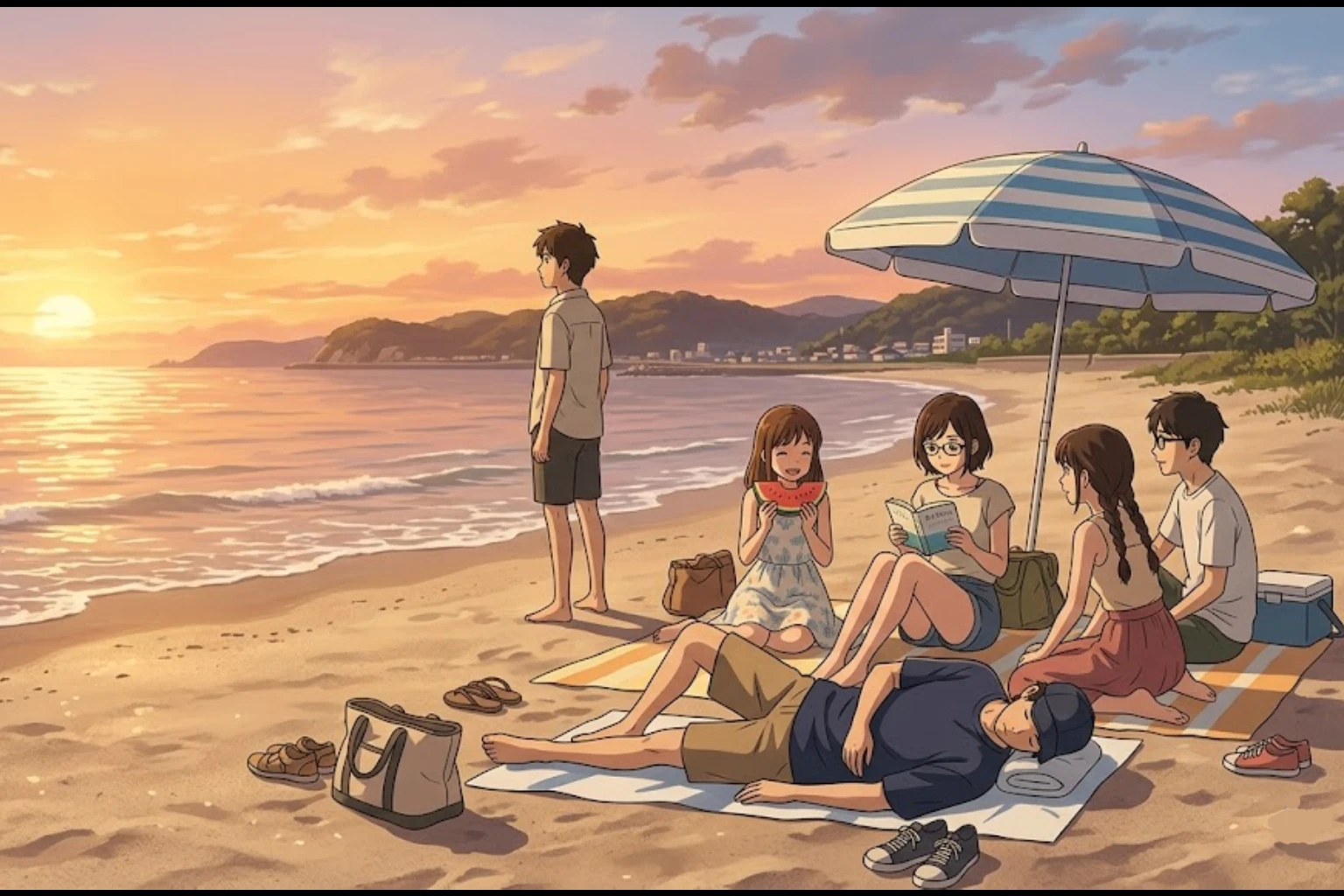
Nobody argued with that. They set up around her with the easy efficiency of a group that had spent a whole summer learning each other's rhythms. Towels went down in a loose row. Bags got arranged by size, a system nobody had agreed on but everyone somehow followed. The umbrella that Mei had insisted on bringing, and that everyone had complained about carrying to the bus stop, was now being quietly appreciated by all six of them without a single person admitting it out loud.
"I want it on the record," Daiki said, angling the umbrella slightly, "that I complained about this umbrella for forty minutes."
"Noted," Mei said.
"And that I was wrong."
"Also noted."
Sora tucked the watermelon into the shade beneath it, patting it once like she was settling a small animal. Daiki cracked open his first can at ten forty-three, which Mei noted aloud for the record, prompting a groan from Daiki that everyone chose to ignore.
The sea had the color it only got at the very end of summer — deeper blue than July, cooler-looking at the edges, the light on it more gold than white. It looked like it knew the season was ending and had dressed for the occasion.
Kenji went in first.
He stood at the waterline with his shoes off, jeans rolled, cap turned backward, which he always did at the beach for no reason he could explain and none he felt like explaining. He looked at the water with the expression he got sometimes when he forgot to maintain his usual mild, ironic distance from things.
Hana came and stood beside him.
"You're going in?" she said.
"Thinking about it."
"The water's cold."
"I know."
"You're going in anyway."
"Probably."
She looked out at the sea. "I'll time you."
"Time me doing what."
"How long before you come back out."
He looked at her sideways. "That's not a bet I'm taking."
She laughed and went back up the beach, leaving him standing there another moment with the cold water running over his feet, looking at the horizon where the sea met the sky in a line so clean it looked drawn with a ruler.
He walked in to his knees. Stopped. The cold worked its way up through him with the cheerful indifference cold water always had.
"Keep going," Daiki called from the towels.
"I will."
"You've been standing there thirty seconds."
"I'm adjusting."
"To what."
"The temperature."
"It's not that cold."
"Come find out."
Daiki did not come find out. He opened a second can instead, which was its own kind of answer, and Mei silently updated her count in her head without saying anything.
Kenji went in the rest of the way quickly, before he could reconsider, the cold hitting him fully and then receding into something manageable, the way it always did once you stopped hesitating. He surfaced, pushed his hair back, and floated on his back looking up at the sky, which was wide and blue and thoroughly late-summer. He thought about nothing in particular, which was rare enough that he noticed it happening and tried to hold on to it a little longer.
Sora came in next, wading rather than committing all at once, complaining the entire way about the temperature while continuing forward regardless. Ren followed a few minutes later, testing the water with one foot like it might change its mind about being cold if given the chance. Daiki eventually joined them too, loudly, insisting he'd simply been waiting for the "optimal moment," a claim nobody bothered disputing.
"This is the optimal moment?" Sora asked. "Two hours in?"
"Strategic patience."
"You were scared of the cold."
"Strategic patience that happened to also avoid the cold."
Once everyone was in, the swimming stopped being a private negotiation with the temperature and turned into something looser and louder. Sora started it, splashing Daiki without warning the moment he got within range, which he took as a declaration of war and answered accordingly. Within a minute the whole group had drifted into a ragged, disorganized water fight that had no rules and no clear teams and ended, as these things always did, with everyone wetter than the ocean alone could have managed.
"Truce," Ren called eventually, hands up, hair flat against his forehead. "Truce. I have a sunburn."
"You started it," Sora said.
"I didn't start anything, I was floating peacefully."
"You splashed me first."
"That was self-defense."
"Against what?"
"The general atmosphere of threat."
Daiki, for his part, had gone quiet and strategic, treading water a few feet off, and used the lull to launch an ambush on Kenji that ended with Kenji fully submerged and surfacing with an expression of profound, silent betrayal.
"You've made an enemy," Kenji said, wiping water from his eyes.
"I've made a legend," Daiki said.
"You've made a mistake."
He didn't retaliate immediately. He waited a full two minutes, long enough for Daiki to relax, floating on his back with his eyes closed and a satisfied look on his face, before pulling him under by the ankle with the calm efficiency of someone who had been planning it the entire time.
"That's not fair," Daiki said, spluttering.
"You had it coming."
"I had a two-minute head start on forgetting."
"That's on you."
Mei stayed out of most of it, swimming a slow, competent lap parallel to the shore, occasionally rolling her eyes at whatever was happening behind her without ever quite looking. When Sora tried to draft her into the fight by splashing her directly, Mei simply looked at her, unbothered, water running down her face, and said, "I will remember this," in a tone that made Sora immediately apologize.
"That was scarier than the actual splash," Ren said.
"She's got a memory like a filing cabinet," Daiki said. "Never start something with Mei you're not prepared to lose in October."
"October?"
"She holds grudges on a semester schedule."
"That's not true," Mei said, already swimming away.
"It's completely true," Daiki said. "Ask me how I know."
They played a loose, improvised game of catch with a ball Ren had brought and nearly forgotten in his bag, standing in a rough circle in water up to their waists, the rules amended constantly and agreed to by nobody, mostly involving trying to make the catch as difficult as possible for whoever was least paying attention. Kenji dropped it twice in a row and blamed the sun. Hana caught everything thrown at her without visible effort, which Daiki found personally offensive.
"How are you doing that," he said, after she plucked a bad throw out of the air one-handed like it was nothing.
"Doing what?"
"Catching. Effortlessly. It's rude."
"I played on a team in middle school."
"What sport?"
"Volleyball."
"That explains it and I resent it."
Eventually the group thinned back toward the shore in twos and threes, tired in the pleasant, sun-warmed way that came from being in salt water too long, and collapsed loosely onto towels to dry off, the conversation slowing to match the new pace of things.
"I'm never getting up again," Ren announced, flat on his back, arm shading his eyes.
"You have to get up eventually," Hana said.
"Do I, though."
"You'll get sand in places you don't want sand."
"I already have sand in places I don't want sand. I've made peace with it."
Sora, sitting cross-legged and wringing out her hair, reached into her bag and produced a bag of rice crackers, passing them around without being asked, which had become such a fixture of group outings that nobody thanked her for it anymore, only made room. Mei accepted a handful and ate them while reading, somehow managing not to get a single crumb on the page.
"How do you do that," Daiki said, watching her.
"Do what?"
"Eat and read at the same time without disaster."
"Practice."
"I've tried it. I always ruin the book."
"You eat like you're being timed."
"I eat with conviction."
"That's a generous way to describe it."
Ren sat up slightly to take a handful of crackers, wincing as the movement pulled at his shoulders, and Hana reached over without comment and passed him the bottle of aloe gel she'd apparently packed for exactly this situation, the same way she packed for most situations involving Ren.
"You brought aloe."
"I always bring aloe. You always need aloe."
"That's fair," he said, and let her put some on the worst of it, hissing once at the cold of it and then going quiet with relief.
"I told you about the sunscreen," Mei said, not looking up from her book.
"You did."
"I'm not going to say I told you so."
"You just did, though."
"That was a factual statement. The told-you-so was implied."
"That's worse."
Daiki, meanwhile, had wandered a short distance off to inspect a sandcastle two small children had abandoned nearby, and returned announcing that he intended to improve it. Nobody asked him to. He spent almost twenty minutes on it anyway, building an elaborate second tier with a moat that immediately collapsed the moment he tried to fill it with water, taking half the structure down with it.
"Engineering failure," Kenji observed from a safe distance.
"It's a design flaw in the sand, not in my plan."
"Sure."
"The sand here has structural issues. I want that noted."
"Noted," Mei said, without looking up, and Daiki gave up on the castle entirely, wandering back to the towels with the particular dejection of a man defeated by an inanimate beach.
It was around then that the gulls started circling with real intent, drawn by the rice crackers, and Sora had to wave the bag away twice before giving up and stuffing it back into her bag entirely, muttering something about seagulls having no respect for personal property.
"They're just hungry," Ren said.
"They're opportunists."
"Same thing, from a certain angle."
"Not the same thing at all."
Daiki's third can came open somewhere in the middle of all this, without ceremony, and Mei, still reading, said, "Three," without looking up, prompting a groan that had by now become so routine it barely registered as a complaint anymore, just a piece of the day's rhythm, like the waves.
Hana swam out properly not long after — not the tentative knee-deep consideration Kenji had started with, but the committed, purposeful stroke of someone who'd grown up near water and understood it as a natural element rather than a cold obstacle to be negotiated with. She went out past where the waves broke and floated there, the shore a comfortable distance away, the sounds of the beach carrying faintly across the water: Daiki's voice, a child shrieking with delight, the dog barking at something only the dog found significant.
From out here the group looked small and bright against the sand. Mei's red swimsuit. Sora's umbrella. The white of Ren's borrowed shirt. She could see Kenji sitting at the edge of things, looking at the water, though from this distance she couldn't read his expression at all.
She floated on her back and looked at the sky for a while.
She had known these five people for exactly one year. A year ago she hadn't known any of them — she'd arrived at university orientation alone, nervous in a way she hadn't admitted to anyone at the time, carrying the specific anxiety of someone who was good at most things and wasn't sure yet whether she was good at this particular thing: starting over somewhere new, among strangers. Then, through the ordinary mechanics of seating charts and shared classes and the gravitational pull of people who made you laugh at the right moments, there had been five of them. Then six.
A year had passed, and here she was, floating in the sea at the tail end of it, not entirely sure she could explain to anyone who hadn't lived it exactly how that had happened.
She turned over and swam back in.
By the time she reached the shallows, Ren had migrated to sit under the umbrella properly, Sora's spare shirt draped over his shoulders even though he wasn't yet burnt enough to need it, "as a preventative measure," he explained, unconvincingly. Daiki had found a second wind and was attempting to teach Kenji some kind of hand-clapping game he claimed to have learned from a cousin, which Kenji was failing at with visible lack of effort.
"You're not even trying," Daiki said.
"I'm trying exactly as hard as this deserves."
"That's zero effort."
"Precisely calibrated."
Hana toweled off and dropped onto the sand next to Mei, who finally set her book down, spine up, marking her place with one finger.
"Good book?" Hana asked.
"It's fine. I've read better."
"Then why are you still reading it?"
"I want to see how it ends. Even mediocre things deserve that."
"That's a very generous philosophy."
"It's the only way I get through some of these," Mei said, and picked the book back up, though she didn't open it right away, letting it rest closed on her knee while she watched the water instead.
Sora cut the watermelon at two o'clock exactly.
This was an event, not because watermelon was complicated, but because Sora approached it with the focused ceremony of someone who believed doing ordinary things properly was itself a form of respect. She had carried the thing an hour and a half on a train specifically for this moment, and she intended to do it right.
She cut it into six equal pieces with a precision that Daiki called impressive and Mei called exactly expected.
"You practiced," Kenji said.
"I cut a lot of watermelons."
"That's not a normal sentence to be able to say."
"My family has a garden. We grow them." She handed him a piece. "Eat it."
He ate it. It was excellent — cold from sitting in the shade, deep red, the specific kind that only showed up at peak summer and tasted like the concentrated idea of the season itself. Everyone went quiet for a moment after the first bite, the involuntary silence food sometimes earned.
"Sora," Ren said.
"Yes."
"I'm sorry I said the watermelon was excessive."
"You didn't say that."
"I thought it very loudly on the train."
"I know," she said. "I forgive you."
"How did you know?"
"You have a very loud thinking face."
"That's Kenji's whole thing," Daiki said, mouth full. "You're stealing his brand."
"I contain multitudes," Ren said, and reached for a second piece before Sora could ration him.
"There's a seed contest," Daiki announced, halfway through his own piece, seeds already lined up in a small damp row on the towel beside him.
"There is not a seed contest," Mei said.
"There is now. I'm inventing it. Furthest spit wins."
"We're not spitting watermelon seeds at a public beach."
"It's a beach. It's designed for exactly this kind of thing."
"It's designed for swimming and lying down. Nothing about it says 'seed spitting arena.'"
Daiki, undeterred, spat a seed a genuinely unimpressive distance and looked immensely satisfied regardless. "Beat that."
Ren, despite himself, took the bait, sat up carefully to protect his shoulders, and spat a seed that traveled marginally farther, prompting Daiki to insist the wind had helped him and demand a rematch under fairer conditions. Sora refused to participate on principle, citing the sanctity of the watermelon she'd personally transported across two train lines and a bus. Kenji participated exactly once, with visible reluctance, produced a distance so unremarkable that Daiki declared him disqualified from ever trying again, and Kenji accepted this ruling without complaint, clearly relieved to be let off the hook.
Mei won, in the end, without appearing to try, which everyone agreed was somehow the most infuriating possible outcome.
"You didn't even look like you were aiming," Daiki said.
"I wasn't."
"That's worse than if you'd tried."
"I contain multitudes too," she said, echoing Ren, and went back to her book while Daiki sat in stunned, seedy silence beside her.
They sat in a loose circle on the towels, eating watermelon, while the beach did its early-afternoon thing around them — families beginning their slow packing-up, children conducting one final urgent negotiation with the tide, the dog achieving what looked like total satisfaction and submitting to the leash with only minor protest.
"Card game," Daiki announced, once the watermelon rinds had been collected. "I brought cards."
"Of course you did," Mei said.
"I invented one. It's good. You'll like it."
"Did you invent it on the train?"
"I've been developing it for months."
"You've been developing it since ten forty-three this morning," Ren said, "when you finished your first can and got bored."
"The timeline is irrelevant. The game stands on its own merits."
Mei set her book face-down and sat up properly. "Explain it."
Daiki explained it, at length, with hand gestures. The rules involved suits, a point system that changed depending on how many cards were left in a pile Daiki called "the reserve," and a clause, introduced roughly four minutes into the explanation, that allowed the current dealer to redraw once per round "for balance."
"You're the dealer," Mei said.
"For this round, yes."
"And you added that rule just now."
"It's always been part of the game."
"You said 'reserve' for the first time thirty seconds ago."
"The terminology is still settling."
They played anyway. By the third hand, Daiki had introduced two more rules, both of which benefited Daiki specifically, and Mei had begun quietly tracking every card played with the kind of attention she usually reserved for actual coursework. By the fifth hand, she won, cleanly, in a way that made none of Daiki's amendments matter at all.
"How," Daiki said.
"You kept changing the rules to protect your hand," Mei said, laying her cards down. "Which meant every rule told me something about your hand."
Daiki stared at his cards like they'd personally betrayed him. "You beat my game with my own game."
"I beat your game with math."
"That feels worse, somehow."
"It should."
Sora, watching from her towel, said, "I could have told you this would happen."
"You could have told me before I lost."
"You wouldn't have listened."
"...No," Daiki admitted. "Probably not."
He demanded a rematch immediately, insisting the first game had simply been a "calibration round" and didn't count toward any real record, a claim nobody accepted but everyone humored anyway. The second game went worse for him than the first — Mei won again, faster this time, and even Ren, who had been half paying attention while nursing his shoulder, managed to beat Daiki into third place, which Daiki took harder than losing to Mei at all.
"Ren beat me," he said, staring at the sand like it owed him an explanation.
"I was barely trying," Ren said, not unkindly.
"That's worse."
"It's really not."
"It's categorically worse. Losing to effort I understand. Losing to Ren accidentally winning is a crisis."
"I'm going to choose to feel good about that," Ren said, and lay back down, careful of his shoulders, wearing the smug, sun-warmed satisfaction of a man who had won something without meaning to and intended to enjoy it fully regardless.
Sora dealt one more round, mostly to be polite, and Daiki lost that one too, though by then he had stopped pretending to be surprised and had moved into a kind of philosophical acceptance, muttering something about the house always winning, even though there was no house, only Mei, sitting there with the same calm unbothered expression she'd worn through all three games, already reaching for her book again.
Ren fell asleep somewhere in the fourth hand, which was either brave given the sunburn or simply inevitable given Ren, and nobody woke him. Sora went back to reading. Hana and Kenji got up and walked the length of the beach and back, not talking much at first, stopping now and then to look at shells they mostly didn't keep.
Hana crouched near the waterline and picked something up — green, smooth, worn down to a soft opacity by however many years in the water. She held it up to the light.
"Keep it," Kenji said.
"I always keep them." She turned it over once. "I have a jar."
"How many pieces?"
"A lot. I've been collecting since I was little." She slipped it into her pocket. "My mother thinks it's strange."
"It's not strange."
"She thinks anything you can't display properly is strange."
"You can display sea glass."
"That's exactly what I told her." She looked back at the water. "She's coming around. Slowly."
He looked at her profile for a second — the easy, unselfconscious way she moved along the sand, the way she stopped for things that interested her without worrying whether stopping was inconvenient for anyone. He'd noticed this about her early in the year, in the first few weeks, and it had seemed worth paying attention to then. It still did.
He didn't say anything about it. It sat there quietly as they turned and walked back toward the others.
Back at the towels, Daiki had recovered enough dignity to open his fourth can, right on schedule, and held it up toward Mei without being asked, like a man reporting for inspection.
"Four," he said.
"Four," she agreed, not even looking up this time.
"You don't even have to check anymore."
"I trust the pattern."
"That's almost a compliment."
"It's an observation."
"I'll take it as a compliment."
"You would."
The afternoon had thinned out further by then — the families with small children mostly gone, the older couples down the beach packing their umbrella with the unhurried efficiency of people who'd done this exact thing a thousand times before. The light had started, very slowly, to change, though nobody had said anything about it yet. It was still the kind of bright that made you squint, but it had lost the flat, hard quality of noon and taken on something a little more forgiving.
Halfway back, a gull made a sudden, confident run at Ren's abandoned watermelon rind, and Sora yelled something that startled it off before it committed fully, which woke Ren, who sat up in a panic convinced something worse had happened, checked his shoulders reflexively, and then lay back down once informed the actual crisis was bird-related.
"I thought I was on fire," he said.
"You're always slightly on fire," Daiki said. "That's just your shoulders now."
"That's not comforting."
"It wasn't meant to be comforting. It was meant to be accurate."
The sun started going down around five.
Not dramatically — gradually, the light changing quality before the sun itself moved noticeably. The gold deepened. Shadows on the sand lengthened and softened. The sea shifted from blue toward something warmer and harder to name. The beach had emptied steadily through the late afternoon, until it held only a scattering of distant figures and the six of them, their towels a small island of color on pale sand.
Ren woke from his nap and immediately checked his shoulders.
"Don't," Sora said.
"How bad."
"Don't."
"Sora."
"Eight," she said. "Maybe eight and a half."
He lay back down without further comment.
Hana closed her book for good this time. Daiki, uncharacteristically quiet for the past hour, sat with his knees drawn up, looking at the water with an expression that wasn't his usual forward-moving cheerfulness — something slower, more considered. Mei noticed and said nothing, because Daiki worked through things at his own pace, and pushing never helped him get there faster.
Kenji stood and walked down to the water's edge.
Mei followed after a moment, and that was how the two of them ended up there together as the sunset began — standing at the waterline with the rest of the group behind them, the sea turning gold in front of them.
"Kenji," Mei said.
"Yeah."
"Are you okay?"
He looked at the sea. "Yeah. Why?"
"You've got a face."
"I always have a face."
"A different face. A thinking face."
He was quiet a moment. The waves came in and went out in the same patient rhythm they'd kept long before either of them existed, and would keep long after.
"I keep trying to remember it while it's still happening," he said. "I can't tell if that helps or makes it worse."
Mei looked out at the water. "I think it's just what you do," she said, "when you know something's ending."
"Does it help?"
"No," she said honestly. "But it feels right anyway."
He nodded slowly, and neither of them said anything else for a while, because nothing else needed saying.
Behind them, Hana had set her book down completely. Daiki had stopped watching the water and started watching the sky instead. Sora sat with her arms around her knees. Ren had pushed himself up, sunburn and all, and turned to face west along with everyone else.
The sun touched the horizon — not quite down yet, just approaching, the light going deeply gold across the water and the sand and the six of them at the end of the summer that had belonged to them.
Nobody said look, or come here, or the sunset. Nobody needed to. They were already all looking.
The six of them sat loosely arranged on the sand, the way they always arranged themselves without planning, through a whole year's accumulated habit of being around each other. They watched the sun go down over the sea — not because it was the expected thing to do at a beach, but because the day had been quietly building toward this the whole time, and the light was doing something that asked for attention. They were eighteen years old at the end of a summer that was ending whether or not they were ready.
The sun touched the water.
Sora thought: I want us to do this every year until we're old.
Ren thought: I should have put on the sunscreen. Also — this. Definitely this.
Hana touched the sea glass in her pocket and thought about jars, and collections, and the specific kind of thing you kept because it was too good to leave behind.
Daiki thought, with the plain honesty that surfaced sometimes when he stopped performing cheerfulness and just let himself feel something: I love these people.
Mei didn't think anything in particular words. She just felt it — the weight and the warmth of being exactly here, with exactly these people, at exactly this moment. It was a moment that wouldn't come again in precisely this shape, and was, for that reason, worth every bit of attention she had left to give it.
Kenji watched the light on the water and, finally, stopped trying to memorize it. He just let it happen.
The sun went down. The sky above it turned pink, then orange, then a deep, complicated color without a simple name. The sea held the light a while longer after the sun had gone, giving it back slowly, the way good things sometimes do.
Then Daiki said, very quietly, "Same beach next year."
Because he said it quietly, and because the light was what it was, it landed differently than it would have at noon — not quite a plan, not quite a comfort, but something true and chosen. A small flag, planted in the future, by six people who genuinely intended to find their way back to it.
"Same beach," Sora said.
"Same watermelon," Hana said.
"Same sunscreen situation," Ren said.
"Different outcome," Kenji said.
Mei said nothing. She was already smiling.
The bus back was quieter than the train out had been — the specific quiet of people full of sun and salt and a day well spent, leaning against windows and each other. The bags were lighter now. The watermelon rind had been disposed of properly, by Sora, who insisted on it. Daiki's twelve cans had come down to two, which he was saving for the train with a discipline nobody had expected and everyone privately respected.
The driver slowed meaningfully at each stop, same as before.
They got off at the station as the last of the light left the sky completely, and stood on the platform a moment in the warm evening air. Salt still on their skin. Sand still in Hana's hair. Ren's shoulders a color that would require careful management for several days.
Hana's train came first. She hugged Sora, then Mei, then Ren carefully around the shoulders, avoiding the worst of the sunburn, then Daiki. Then Kenji — and that hug lasted half a second longer than the others, which nobody mentioned and everyone quietly registered.
"Same beach," she said, at the door of the train.
"Same beach," they said back.
The doors closed.
Then Sora and Ren boarded the same line, Ren already asleep against the window before the train had fully cleared the station. Then Mei, who waved once from the platform as her train pulled away, small and clear in the last of the evening light.
Kenji and Daiki were left last, standing on the platform with their bags and their sunburns and the specific lightness of a day that had turned out to be everything it was supposed to be.
"Good day," Daiki said.
"Good day," Kenji said.
Their train came. They got on. The doors closed behind them.
Outside the window, the station slid away and the city rose up around the tracks. The summer was still there for a few more days yet — in the warm night air coming through the gap at the top of the window, in the salt smell that would take a proper wash to get out of everything. It was in the watermelon Sora had carried an hour and a half on a train and cut with a knife she'd brought specifically for the purpose. It was in the sea glass sitting quietly in Hana's pocket on a different train, moving in a different direction, through the same warm night.
Kenji leaned his head against the window and closed his eyes.
He kept the day somewhere safe.


.png)
.png)
.png)