%20(1).png)
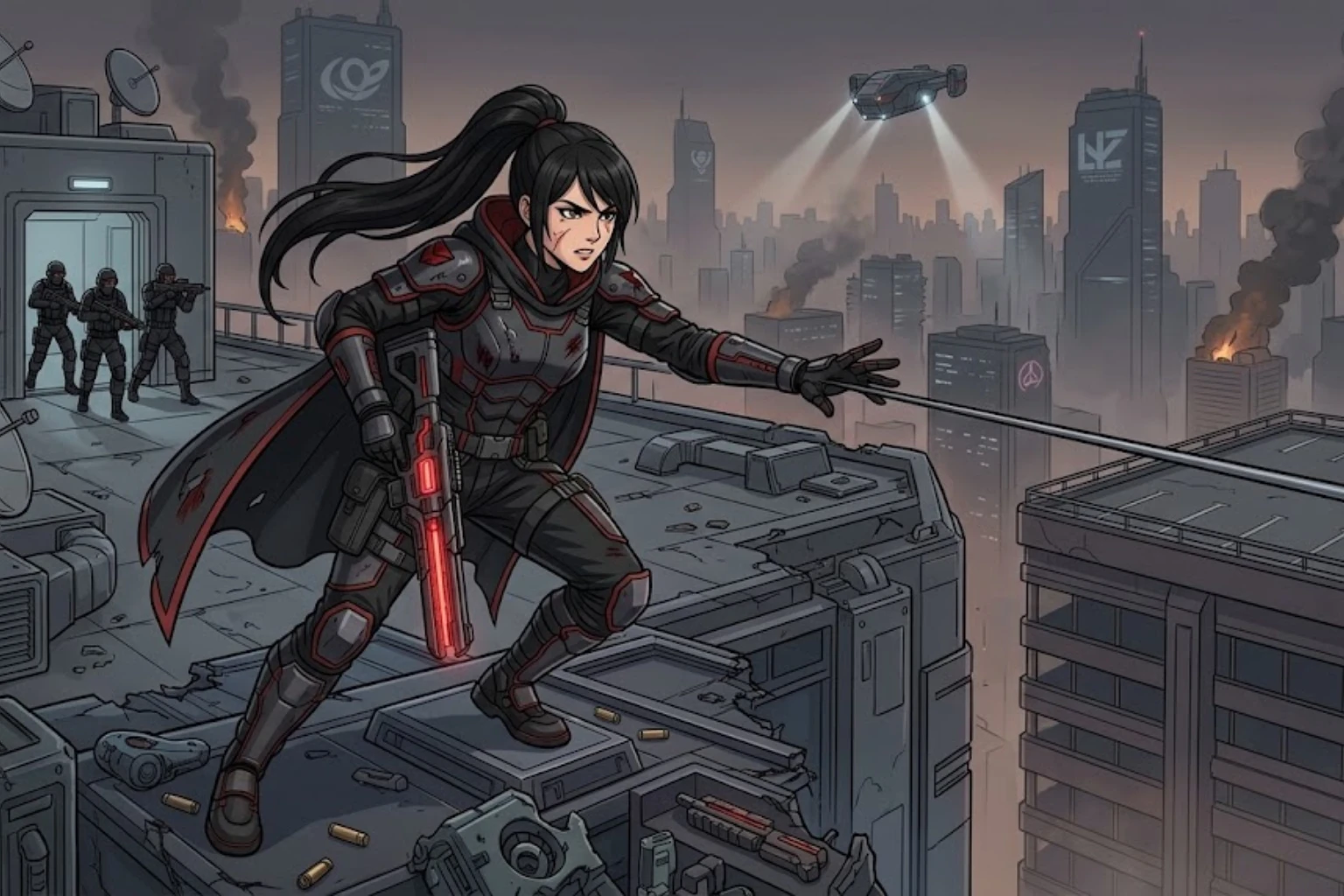
Rei Takahashi had walked into forty-one jobs she could still remember clearly enough to count, and every single one of them had started the same way: with her assuming it would go wrong, because assuming otherwise was how people ended up as somebody else's cautionary story.
She stood in the shadow of an HVAC unit on the roof of the parking structure across from Ashgrove Tower, forty stories of black glass and cold light rising into a sky already choked with smoke from somewhere three districts over, and ran the numbers one more time.
Sixty-two rounds in the rifle, four spare magazines, the shotgun holstered along her thigh with a full tube and six more shells looped into her belt, the smoke charges she hadn't used in three jobs and kept meaning to replace, the grapple line coiled at her hip that had saved her life exactly twice and nearly killed her once when the anchor point had been softer than advertised.
Three exits. That was the rule, and she'd built three before she'd even confirmed the contract: the service elevator shaft down to the sub-level parking, the maintenance stairwell on the building's east face that fed out onto a loading dock nobody bothered to guard properly, and the roof, if the first two closed and she had no better option than a straight drop onto a lower building's terrace and a prayer that the terrace held.
"You reading me clean?" she said, low, into the comm bead tucked behind her ear.
"Clean as it gets through this much interference," came the reply, a voice she'd worked with on six jobs now and trusted about as far as she trusted anyone in this line of work, which was to say not very far but further than most. Denver Kade ran contracts out of a converted shipping container three sectors from here, and he had never once, in six jobs, lied to her about anything that mattered.
That she was even considering the possibility now said more about tonight than it did about him. "Ashgrove's internal security cycles on a forty-minute rotation on the executive floors, thirty on the R&D levels below that. You've got a window starting in six minutes that should hold for eleven."
"Should."
"Should is the best anyone's giving you tonight, Rei."
"Copy." She checked the rifle's charge indicator one more time, more out of habit than doubt, and started moving.
She'd learned the three-exit rule the hard way, two years back, on a job in a converted refinery where she'd walked in with exactly one plan and one way out, and the one way out had collapsed under a support strut she hadn't accounted for, leaving her to improvise an escape through a ventilation duct with a bullet still lodged in her shoulder and a very reasonable suspicion she wasn't going to make it.
She had made it, barely, and the lesson had cost her enough blood that it stuck: never trust a single plan, never trust a client's floor plans without walking the building herself first if she could manage it, and never, under any circumstance, let a job feel routine just because the pitch sounded simple. Boring jobs killed more contractors than dangerous ones did, mostly because boring jobs were the ones people stopped being careful about.
Ashgrove Tower didn't look like a place that needed that kind of caution from the outside — clean black glass, a logo lit up in cold blue near the crown, the specific bland respectability corporations liked to project even when, as she happened to know from tonight's contract, they were running weapons tests on people too poor to have lawyers. She'd walked the building's public lobby twice in the past week, memorized the guard rotation from a coffee shop across the street, and confirmed three separate ways out before she'd ever agreed to Kade's number. That was the whole discipline. Preparation instead of luck. It had kept her alive through forty-one jobs, and she saw no reason tonight would be the one that finally broke the pattern.
The job itself had sounded almost boring when Kade first pitched it to her three days ago, which should have been the first flag if she was being honest with herself in hindsight — a data extraction, no bloodshed required if she did it clean, retrieve a research core from a locked vault on the thirty-first floor and get it to a buyer whose name Kade hadn't given her and she hadn't asked for, because names weren't her business and payment was.
The core held something called the Cassandra Array, a targeting and surveillance system Ashgrove Dynamics had apparently been testing on live subjects in a district poor enough that nobody with a badge had come asking questions, and whoever wanted it out badly enough to pay her rate either wanted to expose it or wanted to steal it for themselves.
She hadn't asked which. She'd learned a long time ago that the moral shape of a job usually mattered less than whether the client paid on time, though she kept her own private ledger of lines she didn't cross regardless of what the client wanted, and testing weapons on people who couldn't fight back sat close enough to one of those lines that she'd taken the job partly out of an itch she wasn't going to examine too closely.
The maintenance stairwell got her to the thirty-first floor without incident, eleven minutes exactly, the security rotation holding just long enough for her to slip through a service door propped by a technician too lazy to let it lock behind him, and the vault itself turned out to be less of a fight than the corridor leading to it.
Two guards held the static post outside the vault door, close enough that she could hear them talking before she could see them clearly around the corner, one of them complaining in the low, bored monotone of a man who'd worked this exact shift too many times to find it interesting anymore.
"— told him the sensor array on level thirty needs recalibrating, and he just says file a ticket, like that's going to matter to anybody before next quarter — "
"You always complain about the same thing."
"Because it's always the same problem."
She used the gap in their attention to plant a distraction charge two hallways down, a soft thump and a flicker of simulated arc-fault light that had both guards moving away from their post at a jog within four seconds, professional enough to investigate but not curious enough to call it in as anything more than a maintenance fault, which told her something useful about how tightly this building's security actually ran when nobody expected trouble. She slipped past their empty post and reached the vault door with time to spare.
The lock took her hacking rig four minutes longer than she'd planned for, a corporate-grade encryption layer stacked on top of a physical bolt mechanism that clearly hadn't been designed with a casual thief in mind, and she spent those four minutes with her back against the wall beside the door, rifle across her knees, counting the guards' footsteps as they eventually wandered back toward their post none the wiser.
"You're cutting it close," Kade said, quiet, as the rig finally chewed through the last encryption layer with a soft, satisfied chime.
"Close is still on time."
"Close is close."
The vault beyond the door was smaller than she'd expected, a single climate-controlled chamber holding a dozen secured cases and one active terminal, and the data core sat exactly where the contract had said it would, small and matte black in its cradle, no larger than her palm once she'd pried the case free and pocketed it.
She pocketed the core and started back the way she'd come with the specific, cautious satisfaction of a job that was, for once, going almost exactly according to plan.
That satisfaction lasted until the stairwell door she'd come through refused to open.
"Kade," she said, quiet, testing the handle a second time in case it was mechanical rather than intentional. "Door's locked. Not jammed, locked. Somebody flagged this exit."
There was a pause on the line longer than she liked. "Give me a second, I'm pulling the building's security feed."
"You had the building's security feed an hour ago."
"I had the *rotation schedule* an hour ago. The live feed's a different access point and it's not answering the way it should."
She didn't wait for him to finish explaining. She was already moving toward the second exit, the service elevator shaft two corridors over, rifle up, the specific cold clarity settling into her that had kept her alive through every job that had ever gone sideways — not panic, never panic, just the narrowing of the world down to the next three seconds and the three seconds after that.
The service elevator shaft was also sealed, the access panel dark where it should have been glowing green, and that was the second data point, and two data points in this line of work was never a coincidence.
"Talk to me," she said. "Right now."
"I've got it," Kade said, and his voice had changed, gone tight in a way she'd heard from him exactly once before, on a job that had ended with both of them nearly dead in a drainage culvert. "Rei, listen to me carefully. I'm reading internal comms traffic on a channel that shouldn't exist for a routine security response. It's not corporate security procedure. It's a designated response team, already staged, already moving to your floor."
"Define designated response team."
"Cleanup. That's the classification on the channel. Cleanup team, target confirmed, authorization from — " A pause, the sound of him scrolling through something fast. "Authorization from the executive office directly. Rei, this isn't rival corporate security responding to a break-in. This is Ashgrove's own people, and they were staged before you ever went through that vault door."
She stood very still for a second in the corridor, the weight of the data core in her pocket suddenly feeling less like payment and more like the thing that had gotten her killed, and ran the timeline back through her head with the same cold precision she used for everything else. A boring job. An easy vault. A client whose name she'd never asked for. A security rotation Kade had somehow gotten hold of with suspicious ease.
"They knew I was coming," she said. "Before I ever got here."
"Looks that way."
"And the buyer."
"I don't know," Kade said, and for once she believed the uncertainty in his voice completely, because it matched the cold feeling settling into her own gut. "Either there was never a buyer and this whole contract was built to get you into this building with a stolen core in your pocket so they could kill you and call it corporate security doing its job — or the buyer's real and somebody inside Ashgrove found out about the leak and decided the cheapest fix was making sure the thief never left the building instead of chasing down whoever hired her."
"Either way I'm the loose end."
"Either way you're the loose end."
Down the corridor behind her, she heard the specific rhythmic thud of coordinated boots moving with purpose rather than the shuffling patrol pace of ordinary security, and she didn't wait for confirmation of anything else. She turned and ran, back toward the stairwell door that had refused to open, because a locked door in this line of work was rarely as locked as it looked from the wrong side of a rifle.
Three rounds into the lock mechanism at close range solved the door's opinion on the matter, and she was through it and moving down the stairwell two steps at a time when the first shots came from above her, cutting through the space she'd been standing in half a second earlier, close enough that she felt the heat of one round pass near her shoulder before it buried itself in the stairwell wall.
"They're on me," she said, breathless, taking the next flight in a controlled slide down the handrail rather than the steps. "Stairwell, coming down fast, at least four, maybe more staged below."
"Sub-level exit's your best option, the loading dock's still showing clear on what feed I've got left."
"What feed you've got left doesn't sound reassuring."
"It's what I've got."
The stairwell narrowed as it descended, concrete and steel and the flat industrial smell of a space nobody was ever meant to spend time in, and every flight brought its own small negotiation between speed and cover — take the steps at a full sprint and risk a clean shot up an open sightline, or hug the inside wall where the switchbacks gave at least a beat of blind corner between her and whoever was closing from above. She split the difference the way she always did, moving fast through the exposed stretches and slowing just long enough at each landing to check the angle before committing to the next flight, a rhythm that had kept people alive in stairwells for as long as buildings had had them.
She hit the next landing hard, rolled through it rather than stopping, and came up firing a burst back up the stairwell at the two shapes descending after her, catching one across the shoulder plating hard enough to spin him into the railing while the second ducked back out of sight behind the stairwell's central column. Not a kill. She hadn't expected one at this angle, hadn't wanted one particularly — corporate security in this city rotated through enough companies that today's designated response team might be tomorrow's rival contract, and burning bridges she didn't need to burn wasn't good practice even mid-firefight. But it bought her four seconds, and four seconds was enough to clear the next flight entirely.
A round sparked off the railing an inch from her hand two flights further down, close enough that she felt the sting of a metal fragment across her knuckles, and she didn't stop to check the damage, just adjusted her grip on the rifle and kept moving, counting flights instead of floors because floors told her where she was and flights told her how much further she had left, and right now the second number mattered more than the first.
"Twenty-second floor," she reported, mostly to keep Kade oriented rather than because she expected it to change anything. "Still four behind me, maybe closing."
"They know the building better than you do, Rei, watch for a cutoff team using the interior elevators to get ahead of your position."
"Copy." She filed the warning away and kept moving, and two flights later the warning proved out — a door on the landing ahead of her cracked open a hand's width before she reached it, a rifle barrel easing through the gap, and she put a round through the door itself at hip height before whoever was behind it had finished bringing the weapon to bear, a wet grunt and the sound of a body sliding down the far side confirming the shot had landed somewhere useful.
A stray transmission bled through her comm bead somewhere around the fifteenth floor, cross-talk from the response team's own channel that Kade's intercept was apparently wide enough to catch even without full decryption, and she caught two full seconds of it clean before the signal dropped away again.
"— confirm elimination before extraction, priority stands, do not let the contractor reach the ground floor with the payload — "
"Copy elimination priority, contractor's armed and mobile, requesting additional—"
The rest dissolved into static, but she'd heard enough. Elimination priority. Not capture, not recovery of stolen goods with the contractor detained for questioning, which was the sort of order she might have expected from a corporation more interested in covering its losses than covering its crimes. They wanted her dead specifically, and they wanted it badly enough to say so plainly on an internal channel instead of dressing it up in the kind of bloodless corporate language that usually cushioned orders like this one.
"You get that?" she asked Kade, breathing hard, taking the next flight two steps at a time.
"I got it. Rei, that's not standard security doctrine, that's—"
"That's somebody who wants a body, not a recovery. I heard it the same as you did." She didn't slow down to feel anything about it, because feeling things mid-firefight was a luxury she'd trained herself out of a long time ago, and filed the fact away instead, next to everything else she was collecting tonight that she intended to make expensive later.
By the tenth floor her legs had started to burn with the specific deep ache of a body running past what it wanted to give, her breath coming in short controlled pulls through her nose because breathing through her mouth this hard would have carried further down the shaft than she wanted, and she reloaded on the move, dropping a spent magazine and seating a fresh one without breaking stride, a motion drilled into her hands so many times over so many years that it happened faster than conscious thought could keep up with. Behind her, the pursuit had thinned from four voices calling positions to three, then held steady there, close enough that she could hear boots on the stairs two flights back whenever the gunfire paused long enough to let the sound through.
The sub-level parking garage, when she finally reached it, was exactly as dark and exactly as full of blind corners as every parking garage she'd ever fought her way through, and she'd barely cleared the stairwell door into it before the first vehicle's headlights swung across the space, illuminating three more figures already fanning out into a search pattern that told her, with total clarity, that whoever was running this operation had anticipated every exit she'd mapped out before she'd ever mapped them.
"Kade, loading dock's not clear, there's a full team already staged down here."
"Copy — Rei, I'm reading a support unit inbound too, aerial, I don't know what kind yet but it's fast and it's close."
"Wonderful."
She dropped low behind a support pillar as the nearest team member swept his weapon across the space where she'd just been standing, and did the math the way she always did the math, fast and unemotional, the way she'd trained herself to do it back when doing it any other way had nearly gotten her killed. Three exits, all three compromised. That left the fourth option, the one she never counted as a real exit because counting on it meant something had already gone badly wrong: straight up, through whatever stood in her way, and out the roof.
The garage gave her exactly one advantage the stairwell hadn't, which was space to move sideways instead of only up or down, and she used it, breaking from the pillar in a low crouch and cutting between two parked service vehicles as the nearest team member's rounds chewed through the concrete where she'd been a half-second earlier. A second shooter had circled wide along the garage's far wall, trying to pin her between two angles the way a decent team always tried to, and she caught the movement in the reflection off a windshield just in time to drop flat behind an engine block as rounds sparked across the vehicle's hood above her.
"Two on me directly, one wide left trying to flank," she said, voice tight but even. "This isn't security response training, Kade. This is somebody who's done this before."
"Copy. Get moving, that aerial unit's closing faster than I like."
She came up firing, three short bursts that put down one team member and forced the other two into cover, and used the four-second gap that bought her to sprint for the elevator shaft's maintenance ladder, the same shaft whose panel had denied her earlier from the thirty-first floor but whose service ladder ran the entire height of the building for exactly this kind of emergency, the kind nobody liked to think about when they designed a building but everybody eventually needed.
The flanking shooter reached the ladder access half a second behind her, close enough that she felt rather than heard the round that missed her shoulder by a hand's width as she hauled the access door shut and threw the manual bolt, buying herself a few seconds of solid steel between her back and everything on the other side of it.
The climb back up thirty-one floors of ladder rungs with a rifle slung across her back and a team of professionals shooting at the shaft doors below her every time she paused long enough for them to get a bead was, without question, one of the worst ten minutes of her professional life,, and she counted at least four separate points during it where a round came close enough to the ladder itself that she felt the vibration through her hands rather than just hearing the impact.
Her palms had gone slick with sweat by the tenth floor, forcing her to grip harder than the rungs strictly required, and twice a boot slipped half a rung before catching, the kind of small failure that would have meant a very long fall if it had gone even slightly worse. Below her, muffled through the shaft doors on each landing, she could hear the team splitting up, some peeling off to search level by level in case she abandoned the ladder early, others apparently committing to a straight pursuit up whatever stairwell ran parallel to the shaft.
"They're pulling more units," Kade said, voice climbing now despite his best effort to sound calm. "Rei, whatever this is, it's bigger than a routine security response, they're pulling from at least two other floors."
"They want me confirmed dead badly enough to burn resources on it."
"Looks that way."
"That's actually useful information," she said, mostly to herself, filing it away the way she filed away everything useful in the middle of a fight, for later, if there was a later.
Her shoulders had started to shake with the effort by the time she cleared the twenty-fifth floor marker painted on the shaft wall, arms and legs working in a rhythm that had gone entirely automatic somewhere around floor fifteen, thought reduced to the next rung and the one after that, and the last six floors passed in something close to a blur of strain and noise, gunfire echoing up the shaft from below at increasingly irregular intervals as whoever was still pursuing her on foot began to lose ground against the sheer physical cost of a vertical chase.
The roof access door gave easier than the stairwell had, mostly because whoever had locked down her exits had apparently assumed nobody in their right mind would try to escape a forty-story building by going up instead of down, and she came out onto the open roof into a wind that smelled like smoke and rain and the specific electric tension of a storm that hadn't decided yet whether it was actually going to arrive.
The rooftop stretched wide and mostly empty in front of her, service units and antenna clusters breaking up the open space into a rough maze of cover, and she took stock of it in the half-second she had before the next problem arrived, already mapping which structures would hold up against sustained fire and which were just sheet metal pretending otherwise.
The support unit Kade had warned her about arrived at almost the exact same moment she did, a matte-gray aerial transport banking low over the rooftop's edge with a spotlight sweeping the surface, engine noise rising from a distant hum to something that vibrated in her back teeth as it closed the distance. She didn't wait to find out whether it was armed for suppression or armed for something worse.
She put two rounds through the cockpit glass on the near side, not enough to bring it down but enough to make the pilot bank hard away in a reflexive dodge, buying her the three seconds she needed to sprint for the roof's far edge where the parking structure she'd started this whole job on stood close enough, four stories lower, that the grapple line at her hip had a real shot at reaching it.
Behind her, the roof access door she'd come through shuddered under the impact of a shoulder against it, and then again, harder, the lock she'd bypassed on the way in clearly not built to hold against someone determined to force it a second time. She didn't look back to check how close they'd gotten. Looking back cost time she didn't have, and the sound alone told her enough — boots on concrete, close, closing.
She reached the roof's edge with the aerial transport already swinging back around for a second pass, and fired the grapple without slowing down, the line catching solid on a structural beam across the gap with a jolt she felt travel up through her wrist and shoulder, one clean anchor point in a night that hadn't given her many. The stairwell door behind her burst open the same instant the line went taut, and she was already committing her weight to it, stepping off the edge of a forty-story building with rounds cutting through the air where she'd been standing a heartbeat earlier, the ground and the gap and the parking structure's rooftop all tilting sideways in her vision as the line carried her out over open air.
For one long half-second the swing felt clean, controlled, the exact kind of exit she'd practiced a hundred times in less dangerous circumstances, and then something caught her across the outer thigh hard enough to spin her mid-swing and turn a controlled descent into something closer to a barely-controlled crash, the line jerking violently in her grip as her body's angle changed and the parking structure's edge came up faster and less forgivingly than it was supposed to.
She hit the parking structure's roof hard, rolled through the impact on instinct rather than plan, the rifle torn loose from her grip somewhere in the tumble and skittering away across the concrete out of reach, and came up on one knee with her leg screaming loud enough that she had to grit her teeth against the sound she wanted to make instead. For a moment the whole world narrowed down to the pain radiating up from her thigh and the ringing in her ears from the impact, and she forced herself through it the same way she forced herself through everything else that threatened to slow her down mid-job — acknowledge it, file it, keep moving.
"Rei — Rei, talk to me, I lost visual — "
"I'm hit." She forced herself upright, weight on the good leg, checking the wound with a hand that came away slicked dark in the dim light — deep, ugly, not immediately fatal if she stopped the bleeding soon, which was its own small mercy in a night that hadn't offered many. "Grazed. Bad graze. I'm still moving."
"The aerial unit's re-acquiring, they'll have you in visual range in under a minute."
"Then I've got under a minute."
She pulled a compression bandage from her thigh pouch with hands that were shaking more than she liked to admit, the adrenaline finally starting to thin enough to let the pain through in full, and wrapped it tight enough to slow the bleeding without slowing her down further, cinching the strap with her teeth when her fingers fumbled the buckle on the first attempt. She left the rifle where it had fallen, no time and no free hand to retrieve it, and pulled the shotgun from its holster instead, six shells left in the tube and six more on her belt, which would have to be enough because it was what she had.
The parking structure's stairwell down to street level was clear, for now, and she took it at a limping run that cost her more than she wanted to spend, every impact against her injured leg sending a fresh wave of pain up through her hip that she filed away with the same cold discipline she filed away everything else that wasn't immediately useful.
She kept one hand braced against the stairwell wall on the turns, using the concrete to catch herself when her leg threatened to buckle under the uneven rhythm of a run that had stopped being a run somewhere around the fourth flight and become something closer to a controlled fall down a series of steps. Behind and above her, the aerial unit's spotlight swept the structure's roof, found nothing, and began a slow, methodical descent toward street level instead, the pilot apparently deciding a ground search was worth the time it cost.
"I need an extraction point," she said, hitting the ground floor, moving now through a service alley that ran behind the structure and out toward the wider grid of the district beyond it. "Something they haven't already got covered."
"Working on it — Rei, there's a transit line two blocks east, freight route, mostly automated, if you can get aboard a car before the next scheduled stop you're out of their immediate search radius in under ninety seconds."
"Copy."
The two blocks felt considerably longer than two blocks with a wounded leg and a corporate cleanup team somewhere behind her recalculating its search pattern, the alley narrow enough that every parked vehicle and stacked crate became a fresh decision about whether it hid a body or just shadow, her leg dragging slightly by the second block despite everything she'd done to keep weight off it, breath coming ragged in a way she didn't like the sound of.
The aerial unit's engine noise rose again somewhere behind her, closer than she wanted, sweeping a search pattern across rooftops rather than street level for now, which bought her exactly the margin she needed and not a second more.
She made the freight line with maybe twenty seconds to spare, hauling herself up onto the open service platform of a slow-moving automated car with an effort that cost her the last reserve of strength she'd been running on since the rooftop, arms shaking with the strain of pulling her own weight up over the platform's edge while her injured leg contributed nothing useful to the effort at all, and lay there for a moment against the cold metal decking, breathing hard, watching the tower recede behind her through a gap in the car's siding, its upper floors still lit with the restless movement of search teams that had, for now, lost their target.
"You still with me?" Kade asked, after a stretch of silence long enough that she suspected he'd started to worry it meant something worse than exhaustion.
"Still with you." She pulled the data core out of her jacket pocket, turning it over once in the dim light, the small matte cylinder that had nearly gotten her killed for a payment she now strongly suspected she'd never been meant to collect. "Kade. I want everything you can pull on that authorization channel. The one that called this a cleanup response instead of a security breach."
"I've got a partial recording. Command traffic, not full identification, but enough to establish the authorization came from inside the executive office, not just building security improvising."
"Send it to me. All of it."
"What are you planning?"
"I'm planning on making sure the people who decided I was cheaper to kill than pay find out exactly how wrong that math was."
She spent the next six hours in a safehouse two districts over that Kade kept stocked for exactly this kind of night, cleaning and re-dressing the wound in her leg with hands that had finally stopped shaking, and reviewing the recording he'd pulled with the same methodical patience she brought to everything else in her line of work. It wasn't much — a designated channel, a confirmation code, a voice she didn't recognize authorizing "asset neutralization, contractor Takahashi, priority one" in a tone as flat and unbothered as someone approving an expense report — but it was enough, combined with the data core itself, to constitute a problem considerably larger than the one Ashgrove Dynamics thought they'd solved by trying to erase her.
The message she had Kade forward to Ashgrove's executive office two days later was short, and she'd made him read it back to her twice before he sent it, mostly because she wanted to be sure the wording carried exactly the right amount of professional detachment and exactly none of the anger she still felt about a rooftop, a support unit, and a leg that was going to ache for weeks.
*You hired me to retrieve the Cassandra Array. I retrieved it. You then authorized my elimination rather than my payment, on a recorded channel I now hold a copy of, along with the original stolen research. I am prepared to deliver both — the data and the recording — to whichever of your competitors offers the better price, along with a public account of Ashgrove's testing program and its response to a contractor who did the job it hired her for.
Alternatively, you can pay the original contract rate, plus a penalty for the attempt on my life that I consider extremely reasonable given the alternative, and this entire matter disappears along with the copies. You have forty-eight hours. I don't negotiate downward, and I don't extend deadlines. Ask around. That part of my reputation, at least, has always been accurate.*
The payment arrived in thirty-one hours, considerably faster than she'd asked for, routed through three shell accounts before it landed somewhere she could actually access it, and it came in at exactly double the original contract rate without her having to ask for the penalty a second time.
"They folded fast," Kade said, when he confirmed the transfer had cleared. "Faster than I expected, honestly."
"They ran their own numbers." Rei sat on the edge of the safehouse's narrow bed, testing weight on the injured leg with the careful, incremental patience of someone rebuilding trust with her own body one step at a time, the bandage beneath her pant leg still bulky enough to change how she walked. "Cost of paying me what they owed against the cost of a rival corporation getting the Cassandra Array's data and the recording of an executive ordering a hit on a contractor, for free, with a story attached that makes them look both criminal and incompetent. I was always the cheaper option. They just needed a forty-eight hour deadline to remember that."
"You think they'll try again? Once the immediate threat's off the table?"
"Maybe. Probably, eventually, once enough time passes that they think I've stopped paying attention." She rolled her shoulder, testing that too, the ache from the rooftop fall settling into something duller and more manageable than it had been the night before. "But not soon. And not carelessly. I made this expensive enough that the next person who suggests killing me instead of paying me is going to have to explain, in a meeting, exactly how that math worked out the last time."
"That's not exactly safety, Rei."
"It's not supposed to be safety." She reached for the rifle propped against the wall beside the bed, checking the charge indicator out of habit even though she had no immediate reason to, because the habit itself was the point, the same cold discipline that had gotten her off that rooftop and back onto this bed instead of into a body bag in Ashgrove's sub-level parking garage. "It's supposed to be a rumor. The right kind, this time. Not the one where I'm cheap to erase. The one where erasing me costs more than anyone's willing to spend twice."
Kade was quiet for a moment on the other end of the line, and when he spoke again there was something almost careful in it, the tone of a man asking a question he wasn't entirely sure he wanted answered. "For what it's worth. You could've sold the data straight to the highest bidder the second you had it and skipped the whole message. Would've been simpler. Probably safer, even."
"Probably."
"So why the message first."
She considered the question longer than she expected to, turning the data core over once more where it sat on the nightstand beside her, small and unremarkable for something that had nearly ended her. "Because the job was never really about the data. Somebody's running tests on people who can't afford lawyers, and a company decided the cleanest way to keep that quiet was killing the contractor who did exactly what they hired her to do.
If I just sell it and disappear, that's a business transaction. If I make them pay double, in the open, on a channel they know I could burn them with — that's a lesson. Companies remember lessons longer than they remember contracts." She shrugged, wincing slightly at the pull in her shoulder. "Doesn't fix what they already did to whoever they tested that array on. But it makes the next contractor they try this on a little more expensive to erase too. That's worth something, even if it's not everything."
"That's a very careful way of saying you've got a line you don't cross."
"I've got several. I just don't advertise them. Advertised lines are the first thing a smart client learns to work around."
Kade didn't have anything to say to that, or didn't try to find something. The line went quiet for a while, the two of them sitting on opposite ends of a connection that had survived one more job neither of them had planned on surviving quite this badly.
Outside the safehouse window, the district's smoke-hazed sky finally let go of the storm it had been threatening all week. Rain came down steady and unhurried over a city that had already started forgetting one more contractor's near-death by the time the next headline arrived to replace it.
That suited Rei Takahashi fine. In her line of work, being forgotten was usually a great deal safer than being remembered for the wrong reason.


.png)
.png)
.png)