%20(1).png)
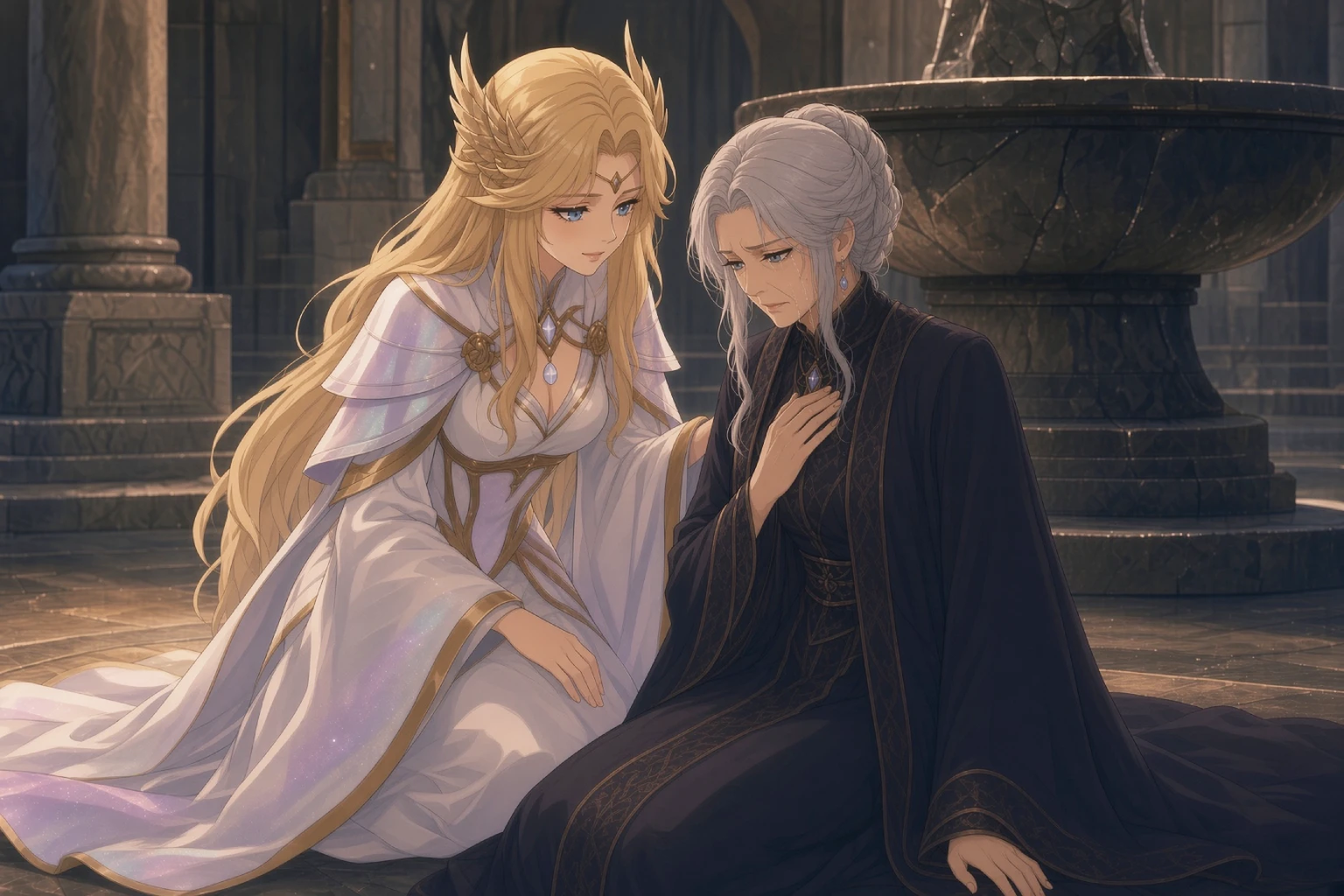
Aurethiel Luminary came to the kingdom of Caelmoor on a morning so clear and mild that the farmers had already begun singing in the fields, and the merchants of Aurvale were laughing over their scales, and not one dog barked in anger anywhere within the city walls. She walked the road from the eastern hills in the shape of a woman wrapped in pale gold, her presence soft enough that shepherds mistook her for a traveler, and no one thought to ask why the light seemed to gather gently around her feet rather than cast a shadow.
She had come because she had felt something from very far away: not a cry of pain, which she knew well and answered often, but its absence where pain should have been. A silence in a place that should have held sound.
Thirty years, the shepherds told her, without a single uprising. Thirty years without an assassination, without a feud that lasted more than a season, without a war. The old wounds of Caelmoor's civil war, they said, had healed clean, like a scar so faint you had to know where to look for it.
Aurethiel walked among them and smiled and asked small questions, and the answers she received were warm and unremarkable. A woman told her, without bitterness, that her husband had died two winters past, and that she missed him, of course, but that grief passed quickly here, as it always did. A boy told her that he had argued with his brother that morning over a broken fishing rod, and that by midday they were friends again, as they always were.
As they always were.
It was the always that troubled her. Grief did not behave that way. Anger did not resolve on a schedule. She had walked among enough mortal hearts across enough ages to know that sorrow left ridges, that fury needed to be spoken and answered and sometimes shouted before it could rest, that reconciliation without friction was not reconciliation at all, only agreement dressed in its clothes.
Beneath the golden fields of Caelmoor, beneath the laughing markets and the well-tended roads, she felt something old and heavy and full, like a cellar packed floor to ceiling with things no one had looked at in a long time.
She followed the feeling toward the capital.
Queen Isolde received her in a hall paneled in pale wood, with high windows that let in more light than any throne room Aurethiel had seen in any kingdom, mortal or otherwise. The queen was perhaps sixty years of age, silver-haired, upright, her face carved with the specific calm of someone who has decided, long ago, that calm is a duty.
"They told me a being of light was walking the eastern road," Isolde said, rising from her chair without ceremony, which surprised Aurethiel more than the light-filled hall had. "I hoped you were coming to us. We have needed help for some time, though most of my kingdom does not know it."
"Tell me," Aurethiel said.
The queen's council stood near the walls, five men and women in robes of undyed linen, watching with the particular stillness of people trying very hard not to look nervous. It was the queen who spoke, and she spoke plainly, without the evasions Aurethiel so often met among rulers.
"After the war," Isolde said, "when my great-grandmother's grandmother sat where I sit now, this kingdom nearly tore itself apart. Brother against brother, city against city, for reasons that had stopped mattering before the fighting even ended. When it was finally over, the survivors built a place beneath this palace. They called it the Chamber of Concord. It was meant to be a mercy — a place where a person overwhelmed by grief or rage or the desire for vengeance could go, and lay that burden down, so that it would not curdle into another war."
"Voluntary," Aurethiel said.
"At first, yes. Entirely voluntary." Isolde's hands folded in front of her. "Over generations, it became... expected. A kindness offered before it was asked for. A physician's remedy administered before the patient complained of pain." She paused. "I do not think anyone decided this. I think it simply happened, the way a path becomes a road becomes the only way anyone remembers to walk."
"And now?"
"Now the Chamber is failing." One of the council members, a narrow man with tired eyes, stepped forward. "The stonework beneath the palace has begun to weep at the seams. The Wardens who tend it say it groans at night like something too full to hold its shape. If it breaks—"
"Everything it has been holding returns," Aurethiel said, not as a question.
"We do not know what that would do to the kingdom," Isolde said quietly. "Thirty years of grief and fury, all at once, in people who have forgotten how to carry such things. We fear it would be worse than the war that made the Chamber necessary in the first place." She looked at Aurethiel with something that was almost hope, and almost fear of that hope. "We ask you to repair it. Strengthen it. Whatever needs to be done. You are the only power we have heard of that might be equal to the task."
Aurethiel was quiet for a long moment. The light around her did not flare or dim; it simply held, steady as a held breath.
"I will go and see it," she said. "Before I decide what repair means."
The Warden who led her down was an old man named Ossian, whose family had tended the Chamber for four generations, and whose devotion to it was unmistakable and entirely sincere. He carried a lantern he did not need, out of habit, and he spoke of the Chamber the way another man might speak of an aging parent — with tenderness, and a certain protective anxiety.
"My grandmother's grandmother was one of the first to serve here," he said as they descended a stair cut directly into bedrock, "when the wounds of the war were still fresh enough to bleed. She used to say the Chamber was the kindest thing her generation ever built. A place to set down what could not be carried forward."
"And your family has served it since."
"Someone must," Ossian said. "It asks for careful hands. It asks for people who understand that what is stored here is not ours to judge."
The stair ended in a wide chamber of dark stone, its ceiling lost in shadow far above the reach of the lantern light. At its center stood a structure that Aurethiel had no ready word for — not quite a well, not quite an altar, a great basin of black stone sunk into the floor, its surface unmoving and yet somehow full, the way a held breath is full. Fine cracks ran along its outer rim like the crazing of old porcelain. From deep within it came a low pressure Aurethiel felt against her own light before she heard any sound at all — a sense of enormous weight, contained.
"It has never cracked before," Ossian said, and for the first time his composure faltered. "Not in four generations. I do not know what happens if it does."
Aurethiel knelt at the basin's edge and let her light fall upon its surface, not as a weapon or a tool, but the way she always offered her light — as an invitation for hidden things to be seen, rather than a demand that they show themselves. She did not force the Chamber open. She simply let it be looked at, fully, for what it was, and it answered her the way deep water answers a stone dropped into it: with rippling revelation.
The first thing she saw was a woman standing over a small grave, decades ago by the look of her dress, her face composed into careful grief, tears sliding down in an orderly, contained way that no true grief has ever managed. Beside her stood attendants in the pale robes Ossian's ancestors would have worn, murmuring words of comfort, and Aurethiel watched — because this was a memory held fast in the Chamber's substance, not a living thing, but true as any memory is true — watched the exact moment when something in the woman's chest was gently, invisibly, drawn away. The woman's shoulders eased. Her breath steadied. She thanked the attendants for their kindness, and walked from the grave upright, composed, and hollow in a place she would never again be able to name.
The scene dissolved and another rose in its place: two brothers, grown men, standing in a farmyard, one shouting about a debt owed and never repaid, about land promised and never given, about years of feeling like the lesser son — and even as he shouted, Aurethiel could see the fire in him thinning, cooling, the argument losing its heat before either brother had said the thing that mattered most. They stopped mid-sentence. They looked at each other, suddenly calm, suddenly unsure why they had been so upset. They embraced, both faces slightly puzzled, as if waking from a dream they could not quite recall. The resentment had not been resolved. It had been taken, mid-sentence, unfinished, and it sat now in the dark basin exactly as unfinished as the moment it left them.
Another: a merchant, betrayed by a partner who had quietly emptied their shared accounts and blamed the theft on a servant who lost his position for it. The merchant had suspected the truth. Aurethiel watched the suspicion rise in him, watched him begin to form the accusation in his mouth — and watched it drain away before he spoke it, leaving him only with a vague unease he mistook for indigestion, and a friendship with his betrayer that continued, warmly, for another twenty years, built on a foundation neither of them knew was hollow.
Another, smaller, and this one struck Aurethiel harder than the rest: a boy no older than seven, sitting on a doorstep in the rain, after his father had walked away down a long road and did not come back. The boy's small hands were fists. His face was red with something too large for his body, something he did not yet have words for, something that was trying, in its clumsy childish way, to become grief or fury or simply the first understanding that the world could take things from you without asking. And before the boy could finish becoming whatever he was becoming, before he could cry the whole cry or scream the whole scream, it was gently lifted from him, and he sat still, and blinked, and went inside for his supper, and grew up gentle and untroubled and never once understood why he found himself, at forty, unable to feel very much of anything when his own children left home.
Aurethiel remained kneeling at the basin's edge for a long while after the visions stopped rising, her light dimmed low and thoughtful, like a lamp turned down for reading.
"You see now why it is failing," Ossian said quietly, watching her. "There is a great deal to hold."
"I see why it is failing," Aurethiel agreed. "But I do not think you have understood what it is you have been holding."
"Grief. Rage. The things that break kingdoms."
"Love," she said. "Every one of those things you named was love, misshapen by circumstance into something painful. The grief was love with nowhere left to go. The rage in the boy on the doorstep was love, betrayed by abandonment, trying to find a shape. Even the brothers' resentment — that was love too, love that had curdled from being unspoken too long." She rose, and her light spread further through the chamber, touching every crack in the black stone. "You have not been storing poison here, Ossian. You have been storing pieces of people. And none of it was ever given freely, not really, not for a very long time. It was taken before it was asked for. A kindness that stopped waiting for consent is not a kindness anymore."
Ossian's face had gone pale. "The Chamber has kept the peace for thirty years. Longer than that, if you count all the generations before mine."
"It has kept the appearance of peace," Aurethiel said, not unkindly. "I do not say this to condemn what your ancestors built. They built it out of love for a broken kingdom, in the aftermath of a horror I can still feel the edges of in this stone. What they made was a true mercy, once, when it was offered and accepted freely, one grieving heart at a time. But mercy that becomes obligation stops being mercy. It becomes something else. A kingdom that has forgotten how to fully grieve has not been healed of grief. It has only been prevented from finishing it."
She asked to see the queen alone.
Isolde received her this time in a smaller room, without her council, a modest chamber with a single window overlooking a garden where late roses were beginning to drop their petals onto the stone path below. There was a portrait on the far wall, a young man perhaps nineteen years old, painted with the stiff formality court painters favored, but with eyes that some skilled hand had managed to make warm despite the stiffness of the rest.
"My son," Isolde said, following Aurethiel's gaze. "Prince Alden. He died of a fever eleven years ago, in the spring. It took him very quickly. Three days from the first cough to the end."
"I am sorry."
"It was terrible," Isolde said, and her voice was steady, almost puzzlingly so. "The worst days of my life. But the Chamber's Wardens came to me within the week, as is customary for those in mourning, and I accepted their offer, as my mother accepted it before me, and my grandmother before her. I remember the grief. I remember it was enormous. But I have not felt its full weight in eleven years, and I have been grateful for that mercy every day since." She turned from the portrait to look at Aurethiel directly. "You are going to tell me that this was wrong."
"I am going to tell you that it was not entirely yours to give away," Aurethiel said gently. "Not because you did anything wrong in accepting it. You were drowning, and someone offered you a shore, and you swam for it, as anyone would. But the grief you set down was never separate from the love that made it. It belonged to you because your love for your son belonged to you first. No one can take one without eventually taking a little of the other."
Isolde was silent for a long moment. When she spoke again, her voice had thinned. "Are you saying I do not properly love him? That I have not properly mourned him?"
"I am saying you have not been permitted to finish mourning him. There is a difference, and I think you already feel it, somewhere beneath the calm you have built."
The queen's composure, so carefully maintained through thirty years of ruling a kingdom that prided itself on its evenness, did not break, exactly. It simply grew tired, the way a held pose grows tired after too long.
"I have been at peace with his death for a decade," she said, more quietly now.
"Have you," Aurethiel said. It was not a challenge. It was, gently, an offer to look again.
The queen agreed, in the end, to let Aurethiel show her — not force upon her, but show her, so that she might choose. Aurethiel took her down into the Chamber herself, past Ossian's anxious protests that no monarch had gone below in living memory, and there, in the low light of the black basin, she called forth the fragment that had been Isolde's own, eleven years buried among a hundred thousand others and yet, to Aurethiel's discerning light, unmistakably hers — a mother's grief, folded and set aside before it had finished being felt.
She did not pour it back into the queen all at once. She let it rise, slowly, the way morning light rises over a hill, giving Isolde time at every stage to step back if she wished.
Isolde did not step back.
The grief came up through her like water finding a channel it had been dammed from for eleven years, and Aurethiel watched the queen's face change — not into wailing collapse, nothing so theatrical, but into something rawer and more human than anything Aurethiel had yet seen in this composed, orderly kingdom. Isolde's knees did not hold her. She sat down hard on the stone floor of the Chamber, both hands pressed to her chest as though checking that her heart was still where she had left it, and she made a sound that was not quite a sob and not quite a laugh, the sound of someone remembering all at once the exact size of something they had convinced themselves was small.
"Stop," she said. "Please. Stop, I can't—"
Aurethiel knelt beside her immediately and let the flow of returning grief slow, then still, holding the rest of it gently in reserve, unforced. "I have stopped," she said. "It is yours to take at whatever pace you can bear. I will not give you more than this unless you ask."
Isolde was weeping now, fully, the tears running without the careful composure of the woman Aurethiel had watched grieving at a grave three decades ago in a memory not her own but shaped just like it. "I remember him," she said, between breaths. "I remember all of it. The fever. His hands. I held his hands, they were so warm, I thought that meant he would be all right, fevers make you warm, I thought—" She stopped. Started again. "I have told that story a hundred times at a hundred remembrance days, exactly the same way, calm, composed, a lesson about acceptance. I did not know until just now that I had never once told it and felt it at the same time."
"You are feeling it now."
"It is enormous." Isolde's hands trembled against her chest. "I do not know how a person carries something this large."
"You already have," Aurethiel said. "You carried the love that made it. The grief is only the same weight, wearing a different name. You are not being asked to carry something new. You are only being asked, finally, to finish carrying what you never set down properly to begin with."
Isolde wept for a long time in the dim stone chamber, and Aurethiel did not try to comfort her out of it, did not soften the edges of it, did not tell her that this would pass quickly or that it would make her stronger or wiser. She simply stayed, a quiet warmth beside a grieving mother, until the worst of the first wave had passed and Isolde's breathing steadied into something exhausted but her own.
"I do not think I want the rest of it back all at once," Isolde said finally, wiping her face with the back of one hand, oddly steady again in a new way — not the old composure, but something more like the composure of a person who has just set down a very heavy pack and is deciding, slowly, how much of it to pick back up.
"No one has to take it back all at once," Aurethiel said. "Not you. Not anyone in this kingdom. That is not how I intend to do this."
She met with the council again the next day, and this time the queen sat among them, her eyes red-rimmed and unashamed of it, which unsettled several of her advisors more than any argument Aurethiel could have made.
"I am not going to seal the Chamber," Aurethiel told them. "It cannot hold much longer regardless of what I do, and even if it could, I would not choose to reinforce it. What is stored inside belongs to your people. It was taken, in most cases, before it was ever fully felt, and a kingdom cannot be called healed simply because its wounds have been hidden from itself."
"You would have us grieving and quarreling in the streets," said the narrow-eyed councilor from before, his voice sharp with real fear. "Thirty years of peace, undone."
"I would have you feeling what is already yours," Aurethiel said. "It will not come back as one storm. I intend to open the Chamber slowly, and let what is stored there return to each person to whom it belongs, a little at a time, as they are able to receive it. This will take longer than a season. It may take longer than a decade. Some of what is stored belongs to people long dead, and that portion I will hold, and let it fade in its own time, gently, since there is no one left to receive it."
"And the rest of us," Isolde said, "will simply have to learn to live with feeling things again."
"Yes," Aurethiel said. "I cannot promise you it will be comfortable. I can promise you it will be true. There is a difference between a kingdom where conflict has been resolved, and a kingdom where conflict has been quietly removed before anyone had the chance to resolve it. You have built the second kind, out of good intentions, over many generations, and I do not think any single person now living made that choice on purpose. But it is the choice that has been made, and it is failing, and I think — I think you already know that a peace which must be constantly maintained by taking pieces out of people is not the kind of peace that was hoped for, when your ancestors first built that Chamber to help one grieving heart at a time."
No one spoke for a long moment. Then Isolde rose from her seat, slowly, and looked at her council with an expression none of them, apparently, had seen on her in years.
"I lost my son eleven years ago," she said. "I have only just begun mourning him properly, yesterday, in that chamber. I do not regret it, though it was the hardest hour I have lived through in a decade. I would rather my kingdom be difficult and honest than easy and hollow. We will do as she says."
The unmaking of the Chamber, in the end, was not an unmaking at all, but a long and careful opening, tended by Aurethiel herself for as long as she remained in Caelmoor, and afterward by Ossian and the Wardens who came after him, taught a new discipline entirely unlike the one their family had practiced for four generations — not the gathering in of what people could not bear, but the patient, willing return of what had never truly been theirs to keep.
The kingdom did not fall apart, though for a time it did become messier than it had been in living memory.
Old grievances, released gradually and in fragments too small to overwhelm, surfaced in kitchens and marketplaces and council chambers. A judge who had presided for twenty years over disputes that always seemed to end in quick, amicable settlement found her court suddenly full of people who wanted, for the first time, to actually argue their cases to the end — who wanted, it seemed, simply to be heard fully before agreeing to anything, rather than agreeing quickly because some of the will to fight had quietly gone out of them before they ever reached her bench. She resigned within the year, not out of shame, but because she said, plainly, that she no longer knew how to be the kind of judge her kingdom now needed, and that someone younger should learn it fresh.
A pair of brothers, the same two Aurethiel had watched arguing over a debt in the Chamber's stored memory decades before, found their old resentment returning to them in slow pieces over the course of a year — not enough to destroy their friendship, but enough, finally, for the younger to say aloud what he had never said: that he had felt like the lesser son his whole life, that the old debt had never mattered as much as being believed. They argued badly for a week. They did not resolve it neatly. But by the following spring they had begun, awkwardly, actually speaking to each other about their father, about the farm, about things neither had mentioned in thirty years, and whatever came of it after that was theirs to build, no longer Aurethiel's business nor anyone else's.
The merchant who had never confronted his betraying partner remembered the theft in full, three months into the restoration, and this time he did speak the accusation aloud, in the middle of a crowded trading hall, and the friendship that had survived twenty hollow years did not survive the truth. Aurethiel felt no triumph in this. A false peace had ended, and something honest, if painful, had taken its place, and she did not know whether that was better or worse for the two men involved, only that it was theirs to live now, undistorted.
Not every restoration ended in reconciliation, and not every ending was peaceful, and Aurethiel made no attempt to guide these outcomes, no matter how much some in the court begged her to intervene, to soften, to guarantee that the returning grief and fury would resolve itself neatly, the way the Chamber had once promised. She would not choose for them. She could only make it possible for them to choose at all, which they had, in the smallest and largest matters, been quietly prevented from doing for longer than most of them had been alive.
The boy who had once sat weeping on a rain-soaked doorstep was, by now, a man of nearly fifty, with grown children of his own, and when his portion of that old unfinished fury finally returned to him — not the whole storm, but enough of it to matter — he wept for an entire afternoon in his own garden, alone, for the father who had left him, and afterward told his wife, haltingly, for the first time in their marriage, that he thought he had never really known how to love their children properly, because some part of him had never been allowed to finish being hurt enough to understand what love risked. It was not a happy conversation. It was, his wife told a neighbor afterward, the most honest conversation of their marriage.
Aurethiel stayed in Caelmoor the better part of two years, tending the slow opening of the Chamber, teaching Ossian and his successors the discernment required to release only what a person was ready to receive, no more, and to hold the rest in patient reserve. By the time she judged the kingdom steady enough to continue without her constant presence, the black basin beneath the palace had thinned to something closer to a quiet, dim pool than the swollen, cracking vessel she had first knelt beside, and its cracks had stopped spreading, because it was no longer full past bearing.
On the morning she chose to leave, she walked once more through the market square of Aurvale, the same square she had passed through on her arrival, when every dispute had seemed to dissolve before it could properly begin.
It did not seem that way any longer.
Near a fish stall, a woman and a man were arguing loudly enough that several passersby had slowed to listen, though none stopped entirely, which struck Aurethiel as its own kind of trust — a sign that the argument, whatever it was, did not need an audience or an intervention.
"You said the barrels would be here by dawn," the woman said, hands on her hips, her voice sharp with real frustration. "I have promised these fish to three houses already. Do you understand what it means for me if I cannot deliver?"
"I understand that my cart broke a wheel on the north road and I nearly lost the whole load in the ditch," the man shot back, equally sharp. "Would you rather I'd delivered you spoiled fish on time, or good fish a morning late?"
"I would rather you had sent word."
"I sent word the moment I could stand up straight!"
They went on like this for some time, voices rising and falling, neither backing down, neither raising a hand nor a threat, only the plain heat of two people who felt they had each been wronged and meant to be heard saying so. It did not resolve quickly. The man eventually threw up his hands and said something about how he could not work with someone who assumed the worst of him after eight years of honest dealing, and the woman, instead of matching his anger further, went quiet for a moment, and said, in a different voice, "Eight years. You're right. I know you wouldn't have delayed on purpose. I'm frightened about the houses, that's all, and I took it out on you."
"I should have sent word sooner," the man admitted, some of the heat going out of him too. "I was ashamed about the wheel."
They did not embrace. They did not resolve everything between them in a single breath. But they stood there a moment longer, both a little tired, both still a little frustrated, and began — haltingly — to discuss what could actually be done about the fish.
Beside Aurethiel, a young clerk from the palace, sent to see her off, watched the exchange with a slight frown.
"It didn't used to be like this," he said. "People used to settle things faster."
"They used to stop feeling things faster," Aurethiel said. "That is not the same as settling them."
The clerk considered this, watching the fishmonger and the merchant now crouched together over the surviving barrels, counting what could still be sold. "It looks like less peace than before."
"It is less quiet," Aurethiel agreed. "It is not less peace."
She said nothing further on the matter, because there was nothing further that needed saying, and because she had learned, across ages longer than this kingdom's whole history, that truth revealed and left to breathe did more lasting good than truth explained. She watched the two arguing merchants a moment longer, watched the woman laugh, briefly, despite herself, at something the man said, watched the tension between them ease not because it had been taken from either of them, but because they had, in their small and ordinary way, walked all the way through it together.
Then she turned from the square, and took the eastern road out of Aurvale, her light gathering softly around her feet as it had on the morning she arrived, leaving behind her a kingdom that was, by every old measure, less perfectly peaceful than it had been — and by every measure that mattered, considerably more alive.


.png)
.png)
.png)