%20(1).png)
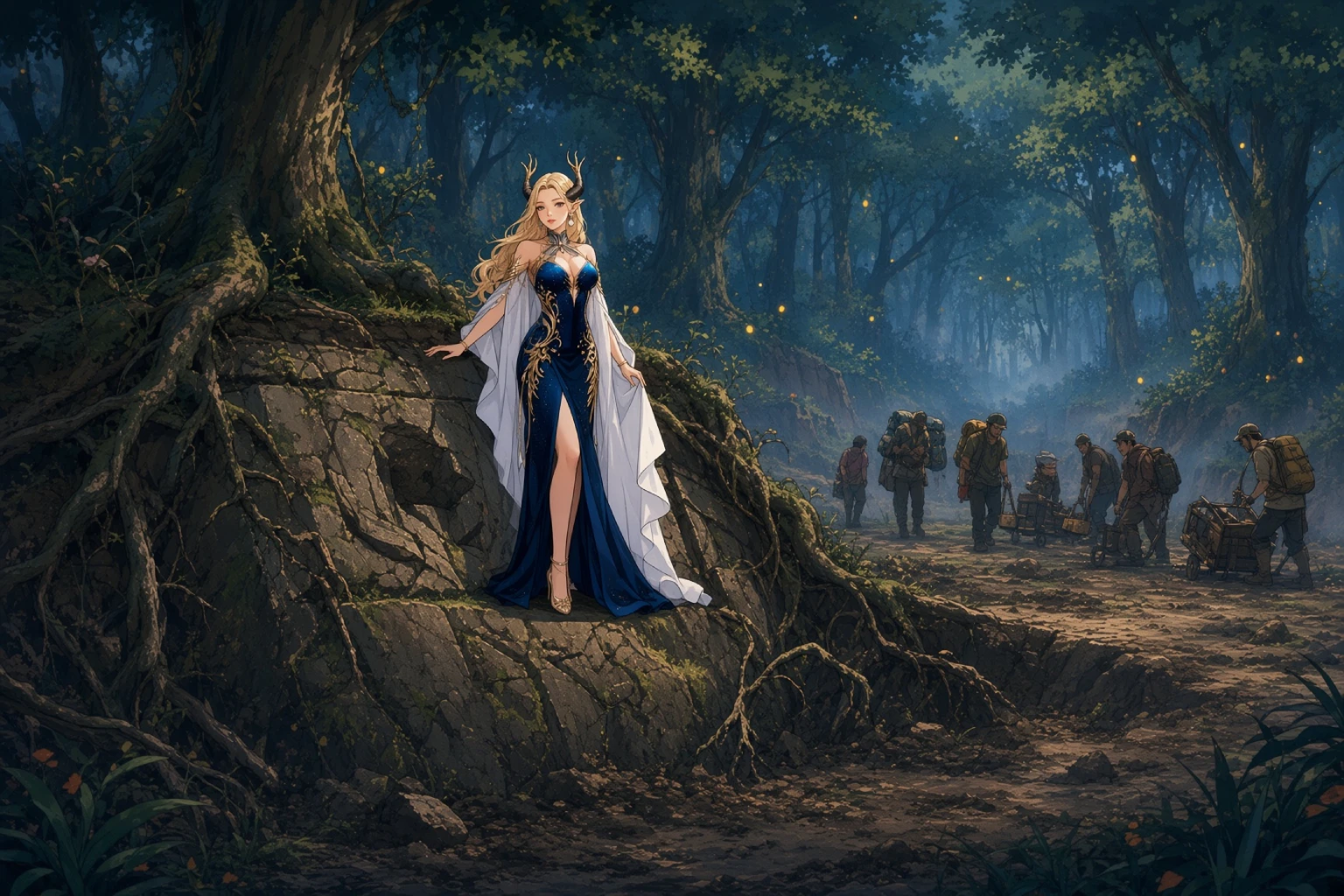
The wrongness reached her the way all wrongness did — not as a sound, but as an absence of one.
Aurenelle had been standing at the high ridge above the Duskmere Hollow for the better part of an hour, watching moonlight pool and drain between the branches of the old canopy the way water finds its level, when the birds three valleys over stopped singing all at once. Not frightened into silence — she knew that sound, the ragged stop-start panic of a hawk passing low, and this wasn't that. This was quieter. This was the particular, total stillness of a place that had simply stopped being listened to, the way a room goes quiet when everyone in it has already left.
She turned toward it before she understood why.
The forest did not speak in words, not even to her, not even after three centuries of walking its understory like it was the floor of her own house. It spoke in weight and light and the angle grass bent away from a footstep it didn't like. It spoke in the particular color moss turned when something beneath it had been disturbed, and in the way birds chose, collectively and without discussion, to relocate a season's nesting fifty yards to the north for no reason a human surveyor would ever find in the soil. Aurenelle had spent her long life learning that language the way a person learns their own mother's silences — not translated, exactly, but understood.
And three valleys east, past the Hollow, past the old growth that even the deer treated with a kind of formal caution, something had gone quiet that had no business going quiet at all.
She went to see for herself. That was always the first thing, the only thing, really — not knowing, but going. The forest did not hand her its secrets whole. It gave her threads, and she followed them, on foot, at whatever pace the land itself demanded of her, because a Guardian who trusted only what she was told instead of what she found underfoot was a Guardian who would eventually be wrong about something that mattered.
---
The ground told her first.
A half-mile out from the silence, she found the wheel ruts — two parallel grooves pressed deep into old leaf-mold that hadn't held a cart's weight in longer than the nearest village had existed, the earth compressed in a way that spoke of load, of repetition, of more than one trip. She crouched and laid two fingers against the disturbed soil, feeling for what the forest remembered of the passage — not magic, not exactly, just attention paid carefully enough that the land's memory became legible to her, the way an old woman might read a stranger's character from the state of their boots.
Heavy cargo. Recent — three days, perhaps four. Moving east to west, away from the old boundary line rather than toward it, which meant whatever had been carried had been carried out of the deep wood, not into it.
That detail sat wrong in her chest before she'd even let herself think the word for what it might mean.
She followed the ruts another mile, through a stand of birch gone strangely pale even for the season, their bark stripped of the faint luminescence that marked healthy wood this deep in the old growth, and came, finally, to the place the silence had started.
The pact-stone was gone.
Not broken. Not defaced. Gone — the low grassy mound where it had stood for longer than anyone but Aurenelle and perhaps two or three other living things could remember now bare and raw, a rectangular scar of pressed earth where the stone's base had sat undisturbed since before the nearest human settlement had a name. The moss that had grown in the stone's shadow for centuries lay wilting in a ring around the empty space, already browning at the edges, the way any old, patient thing withers when the thing it grew accustomed to is suddenly taken away.
Aurenelle stood at the edge of that bare scar for a long moment, and felt something in her chest settle into a stillness she recognized from experience as the specific quiet that came before her grace, unbidden, began to harden into something else.
The pact-stone was not decoration. It was not a boundary marker in the way a human fence was a boundary marker, a suggestion easily stepped over. It was a promise made physical — old ground and older agreement, the specific point at which the wild world and the world grown up around it had once, long ago, looked at each other honestly and decided where one would yield to the other and where it would not. Moving it did not erase the boundary. The boundary was older than the stone, older than the ground it sat on, woven into the land itself in a way no cart could carry off. But moving it meant someone believed the promise could be relocated to suit them. And believing that, Aurenelle had learned across three centuries of walking this line, was very often the first mistake that led to all the others.
She followed the ruts west.
---
The quarry came into view before the trees fully thinned, a raw open wound of pale stone cut into what had been, only a season ago by the forest's own reckoning, still deep and living wood — the old growth here felled in a rough semicircle, stumps still pale and weeping sap, the canopy that had once closed protectively overhead now open to a sky that felt, to Aurenelle's eye, faintly indecent in its exposure.
Men worked the quarry face in the gray hour before true dawn, torches guttering low, the sound of pick against stone a steady, thoughtless rhythm that had clearly been going on for days. She counted perhaps a dozen of them, dust-pale, moving with the particular tired efficiency of laborers working toward a deadline rather than a purpose. And near the quarry's edge, set upright again in fresh-turned earth as though its removal from its true home were a matter of simple relocation rather than violation, stood the pact-stone.
Someone had planted it here, deliberately, as a boundary marker for the new claim — using the old stone's authority, whatever they understood that authority to be, to lend legitimacy to ground it had never agreed to bless.
Aurenelle watched from the tree line for a long while before she moved, because watching, too, was part of the work. A Guardian who acted before she understood the shape of a violation risked becoming the kind of danger she existed to prevent.
She learned the shape of it slowly, from fragments of conversation carried across the still morning air. A man in a heavier coat than the laborers, directing rather than digging, was called Foreman by the others — Joric Hale, she gathered eventually, from someone shouting his name over the pick-sound to ask about timber supports. He moved through the site with the harried competence of a man responsible for a schedule he hadn't set and couldn't control, checking supports, checking the stone's new footing, glancing occasionally back toward the tree line with an unease he likely couldn't name even to himself, the particular animal wariness of someone standing somewhere his body understood before his mind did that he shouldn't be.
He was not, she judged, watching him direct a crew away from an unstable overhang with genuine care for their safety, a cruel man. He did not seem, from what she could read of him across that morning, a man who understood what he had helped move, or why the wood around the quarry's raw edge had gone the color of old ash where healthy trees should have stood green even this late in the season.
But he was not the only authority here.
A second man stood apart from the labor entirely, at a folding table set up near the pact-stone's new position, papers weighted against the breeze with a chunk of quarried granite, a ledger open before him. He wore a merchant's traveling coat, well-made and mud-spattered in a way that suggested he'd ridden hard to arrive here rather than walked, and he carried himself with the particular stillness of a man used to being obeyed by people who resented him for it. When Joric Hale approached the table with some question about the week's yield, the man answered without looking up from his ledger, and something in the economy of that gesture told Aurenelle more about him than an hour of watching the laborers would have.
She did not yet know his name. She would, before this was finished. But she understood, watching him mark figures into his book with the pact-stone standing sentinel over ground it had never agreed to sanctify, that he was the one she would eventually need to reckon with, and that Joric Hale, whatever his part in this, was not.
---
Her first response, when it came, was neither loud nor cruel, because it did not need to be either.
She did not go to the quarry that first night. She went, instead, to the path the wagons used to carry stone out toward the settlement beyond — a rough cart track cut through what had been, until recently, undisturbed forest, now packed hard by weeks of heavy traffic. She walked its length slowly in the deep dark, laying her palm flat against tree trunks at intervals, feeling for the places where the wood's own will still ran strong enough to answer if asked properly.
It answered.
By morning, the path had closed.
Not violently — no crushed wagons, no broken wheels, nothing that could be called an attack by even the most frightened laborer. The brambles simply grew where the track had been, overnight, in a thickness and speed that had no natural explanation a quarry worker could offer without sounding foolish to his own ears — thorned vines as thick as a man's wrist knotted across the cart path in a wall shoulder-high, growing not randomly but with the particular deliberate density of something meant to be understood rather than merely survived.
Pale light moved through them.
It was too early for sunlight to have reached that deeply beneath the canopy, yet a faint silver-gold glow traced the edges of the thorns and leaves, not bright enough to illuminate the road so much as mark it. The message required no translation: whatever had closed the path wanted those who found it to know that this was not ordinary growth.
Past the brambles, where the track had once run straight toward the settlement, that same impossible light appeared intermittently between the trees. Men followed it because it seemed to mark the way out. An hour later they found themselves standing again at the quarry's edge, though every man among them swore he had walked steadily west.
The trees had not moved. The road had not visibly turned. Yet every attempt to leave by that route ended exactly where it began.
It was not an attack. It was a warning: you are not permitted this way.
Aurenelle watched, from a distance respectful of her own restraint, as the message landed.
Joric Hale stood at the bramble wall the next morning with an expression she read easily enough even from fifty yards — not defiance, but a kind of dawning, uncomfortable understanding, the look of a practical man forced to consider a possibility his practicality had no framework for. He sent two men to clear the brambles with axes, and the axes, she noted with something that was not quite satisfaction but was adjacent to it, blunted themselves against wood that should have yielded easily, over and over, until the men gave up and reported that the thorns simply would not cut.
He did not send them again the next day. He called, instead, a halt to the quarrying — not permanently, she understood from the fragments of argument that carried to her across the stilled work site, but a pause, a chance to "let the surveyors reassess," the particular hedging language of a man who had felt something he couldn't name and wanted, very badly, an excuse to stop without admitting why.
For one full day, the wood held its breath, and so did she.
---
The second man broke the pause on the third morning.
Aurenelle heard the argument before she saw it, voices raised across the stilled quarry in the particular sharp cadence of two men who had already had this conversation more than once and were tired of pretending otherwise.
"—superstition dressed up as bad luck," the merchant was saying, standing now rather than seated at his table, ledger closed under one arm. "Brambles grow fast in wet seasons, Hale. Men get turned around in unfamiliar wood at dawn. None of that is a sign. None of that is anything but weather and poor sense of direction, and I did not ride four days to watch a work crew frighten itself into missing a delivery deadline over a hedge."
"You didn't see the axes," Joric said, and there was something careful in how he said it, a man choosing words he half-expected to be mocked for. "Wood doesn't blunt itself like that. Not natural wood."
"Then it's unnatural wood, and unnatural wood cuts the same as any other with a sharper blade and a stronger arm," the merchant said. "House Aldric has committed to this delivery. The consortium has committed, on my signature, to a schedule that does not include an indefinite pause because a work crew got lost walking in a circle." He set the ledger down, hard, on the table, a gesture meant to end the conversation rather than continue it. "We resume tomorrow. Full crew. If the path's overgrown, we cut a new one. If men are turned around, we mark the trail with rope and torches every twenty paces until even a frightened fool can follow it home. This delivery does not fail because of hedges and headaches."
Joric Hale was quiet for a long moment, and Aurenelle, watching from the tree line, saw in that silence the shape of a decision she recognized — the particular capitulation of a practical man who had gone as far as his conscience allowed and then, faced with a superior's flat refusal to hear him, let his conscience be overruled by his employment.
"Your name on the schedule," Joric said finally. "Your signature on the deadline. Not mine."
"My name has been on considerably harder ground than this," the merchant said, and something in the flatness of it, the particular practiced ease with which he dismissed a warning he had, Aurenelle understood watching him, actually understood far better than he was willing to admit aloud — told her everything she still needed to know.
She had watched him closely enough by now to read the shape of what he was. Not ignorant, as Joric Hale was ignorant, a man who felt a wrongness in his body before his mind caught up to naming it. This man — Cassian Merrow, she would learn his name eventually from the ledger he guarded so carefully, though the name mattered less to her than the choice — understood, at least in outline, exactly what kind of ground he stood on. She had seen it in the particular care with which he'd had the pact-stone re-erected rather than simply discarded, the instinctive respect of someone who knew old things carried old weight even when he chose to disregard what that weight demanded of him. He had felt the wood's first answer and decided, consciously, that his deadline mattered more than whatever had sent it.
That was the difference the forest itself had always cared about. Ignorance could be taught. Accidents could be forgiven, corrected, folded back into the pact without lasting harm. But a man who understood the warning and chose, deliberately, to press past it anyway had made his own weight fall on the wrong side of the old promise. The wood did not forget the difference, even when it chose, in its patience, to answer both kinds of trespass the same way at first.
It would not answer them the same way twice.
---
She let them cut the new path. She let them mark it with rope and torchlight, let the full crew return to the quarry face at dawn with the particular grim determination of men who had been told, by someone whose authority they could not safely refuse, that yesterday's fear had been foolishness. She let Cassian Merrow believe, for the better part of that day, that his flat refusal to be frightened had won.
The wood was patient in a way no human deadline could out-wait.
She went to the pact-stone itself that evening, alone, and knelt before it in the last violet light before true dark, laying both palms flat against its cold, familiar surface — the same stone, she was certain of it despite the raw new earth around its base, the same weight and grain her hands had known for longer than the settlement beyond the wood had existed to send its wagons this far. She could feel, beneath her palms, how wrong the ground beneath it sat now, the stone planted in soil that had never agreed to hold it, the old promise straining at an anchor point that no longer matched the shape it had been cut to fill.
"I am sorry it came to this," she said quietly, to the stone, to the wood around it, to the old promise itself, because some things deserved to be spoken aloud even when there was no one present who needed the words translated. "But you were not the only one who remembered what this ground was for."
And then, with the particular deliberate calm of a decision long since made and only now being carried out, she called the boundary home.
---
It began, to the men working the quarry face at first light, as nothing more than an unusual quiet — the birdsong that had returned tentatively over the past day's calm falling away again, all at once, the specific totality of silence Aurenelle herself had first noticed three valleys distant, now arriving here, at the source of the wrongness, to announce that the wood's patience had run its course.
Then the canopy began to close.
Not violently. Not with the crack and groan of falling timber, nothing that gave the men below cause to run for their lives, only the slow, deliberate thickening of branches overhead that had, until that morning, remained thinned and open above the cleared quarry ground — new growth threading between old limbs with a speed no laborer's eye could reconcile with anything they understood about trees, the pale open sky above the raw stone wound narrowing, hour by patient hour, into dappled half-light and then, by midday, into something closer to true forest shade, the specific cathedral dimness of old growth that had not stood open to direct sun in centuries and had decided, now, that it would not stand open any longer.
The paths went next.
Every route out of the quarry — the rope-marked trail Cassian Merrow had ordered cut, the older wagon track worn hard by weeks of traffic, even the narrow footpaths individual laborers had trodden for themselves between the work face and their camp — began, with the same unhurried, undeniable patience, to lead only back toward the pact-stone's raw and wrongly-planted earth. Men who set out at midday to fetch water from the nearby stream found themselves, an hour later, standing again at the quarry's edge, having walked in what every instinct in their body insisted had been a straight line the entire way. The rope markers Merrow had insisted upon still hung from their branches exactly where they'd been tied, and led, without a single knot disturbed, back to precisely where they'd started.
It was not a maze built to trap them. Aurenelle wanted, more than she wanted almost anything else in the execution of this reckoning, for that distinction to be understood by every frightened man now standing idle at the quarry face, torches guttering uselessly in daylight that no longer quite reached them. A maze was cruelty for its own sake. This was simply the wood insisting, with total and unbudgeable patience, that there was only one direction available to men who had entered where they should not have entered: back the way that mattered, back to the stone, back to the beginning of the wrong they had helped commit.
By late afternoon, even the light itself had begun to answer the boundary's call — not darkness, nothing so simple or so frightening as true dark descending at midday, but a strange, directionless quality to what light did filter down through the newly thickened canopy, shadows falling at angles that didn't quite match where the sun should have stood, so that a man's own sense of the hour, of which way was west and which way was home, slowly, patiently, stopped being reliable at all.
Joric Hale found her, in the end, though she had made no particular effort to be found and no particular effort to remain hidden either. He came upon her standing at the pact-stone's raw earth scar in the strange directionless light of late afternoon, and stopped a respectful distance away, his torch nearly useless in daylight that had gone soft and confusing rather than dark, his face carrying the specific exhausted clarity of a man who had spent the entire day walking in careful circles and had finally stopped fighting what his body had known from the very first morning.
"You're what the crew's been calling the wood's answer," he said. Not quite a question. "Since the first night. The brambles."
"I am the reason the brambles grew," Aurenelle said. "The wood answers on its own account. I only asked it to speak plainly, the first time, so that no one here could later claim they hadn't been warned."
Joric absorbed that in silence, his eyes moving to the pact-stone, then to the canopy overhead, close and dim now in a way it hadn't been that morning. "The men want to leave. All of them. I want to leave. I don't—" He stopped, started again, the words of a practical man reaching for a way to say something his practicality had never needed a vocabulary for before. "I don't think any of us understood what we were digging next to. I didn't order the stone moved. That was done before I was hired onto this. But I let the work continue anyway, once I saw it standing there, because the schedule mattered more to me than a feeling I couldn't explain to anyone who'd have listened."
"I know," Aurenelle said, and there was no cruelty in it, only the plain accounting of someone who had watched him carefully enough to already understand the shape of his part in this. "You are not who I came for."
Something in his shoulders eased, fractionally, at that — not relief exactly, but the specific loosening of a man given permission to stop bracing against a blow he'd half expected to fall on him personally.
"Then who," he said, though she suspected he already knew the answer, and only wanted to hear it said aloud by someone who could say it with certainty.
"The one who understood the warning," Aurenelle said, "and chose to disregard it anyway."
---
She found Cassian Merrow at his folding table, ledger open before him despite the failing, directionless light, his face set in the particular rigid composure of a man refusing, on principle, to admit that anything around him had gone wrong in a way his authority couldn't simply overrule. He looked up as she approached, and to his credit — she would allow him that much, later, in whatever accounting she kept of this — he did not flinch, did not startle, only closed his ledger with the same deliberate care he'd shown it all week and regarded her with the wary, calculating stillness of a man assessing a negotiation rather than a reckoning.
"You'd be the wood, then," he said. "Or whatever passes for it in a shape a man can talk to."
"I am the boundary's Guardian," Aurenelle said. "You knew that, before you asked. You knew it three days ago, when the brambles grew, and you chose to call it weather rather than warning because weather did not require you to explain a delayed delivery to whoever sits above you in House Aldric's ledgers."
Something flickered across his composure at that — not surprise, she noted, but the specific discomfort of a man being read more accurately than he'd prepared for.
"The consortium needs this stone," he said, and there was less command in it now than there had been that morning, arguing with Joric Hale across the quarry face. "The town beyond needs it more. There's a mill wall half-collapsed and a granary roof that won't survive another wet season without new foundation stone, and every quarry within three days' cart ride of Harrowgate that isn't sitting on someone's protected ground has already been picked clean. I did not choose to move that stone out of malice. I chose it because the alternative was telling a town of several hundred people that their granary collapses this winter because an old marker mattered more than their children eating."
Aurenelle considered that for a long moment, because it deserved to be considered. The worst violations of the old pacts rarely announced themselves as villainy. More often, they arrived dressed as necessity — the lesser of two griefs, a hard choice made by someone who believed, not entirely without reason, that they were choosing the more defensible harm.
"That may even be true," she said. "I have watched settlements starve rather than yield an inch of what they'd claimed, and I have watched others thrive for generations on land that never once crossed a boundary it had no right to cross. I do not doubt that Harrowgate needs stone. I doubt very much that Harrowgate needed *this* stone, from *this* ground, moved by a man who understood exactly what he was disturbing and chose, when the wood answered him plainly, to disregard the answer rather than seek another quarry face on honest ground." She let that settle before she continued. "There is quarriable stone half a day further south, past the old boundary rather than within it. Your surveyors would have found it, had you sent them looking instead of sending them here, where the ground was already claimed and the labor already cheaper for it."
Cassian Merrow's jaw tightened, the particular expression of a man confronted with a truth he had, somewhere beneath his ledger and his deadlines, already known and chosen not to examine too closely.
"The southern face would have cost three weeks longer to reach and twice the transport," he said. "I made a business decision."
"You made a decision," Aurenelle said. "Whether it was a business one or simply the easier one, only you can honestly say. But you were warned, plainly, in a language even a stranger to this wood could not mistake for coincidence, and you chose to press forward regardless of what that warning meant. That choice is yours to carry now. Not Joric Hale's. Not the laborers who blunted their axes against brambles and walked in patient circles all day believing they'd simply lost their way. Yours."
The light around them had gone strange and thick, the canopy overhead close enough now that true dusk seemed to have arrived hours early, and somewhere at the quarry's edge she could hear, faintly, the low murmur of frightened men discovering, over and over, that every path they attempted still led only back to this clearing.
"What happens," Cassian Merrow said, and for the first time since she'd begun watching him, three days past, there was something in his voice that had stopped being composed, "if I refuse to move the stone back."
"Then the wood will simply keep answering you," Aurenelle said, "for as long as it takes you to understand that this is not a negotiation you are capable of winning through patience alone, because the patience on this side of the table is considerably older than yours, and considerably less tired." She let the silence hold a moment, let him feel the full weight of the canopy's dimness, the directionless light, the specific totality of a quiet no bird had broken all day. "No one here will be harmed, Cassian Merrow. That was never the wood's intention, and it is not mine. But no one here will leave, either, walking any path that does not first pass back through an honest reckoning with what was taken. The boundary does not need to hurt you to hold you. It only needs to remember, patiently, exactly where it stands, for exactly as long as you refuse to remember it yourself."
---
It took him until true dark to yield, and Aurenelle judged, watching him finally give the order to his exhausted crew, that the hours between had cost him something real — not fear, exactly, though there was fear in it by the end, but the specific grinding erosion of a man watching every tool of his authority, his schedule, his ledger, his deadline, his flat assurance that difficulties could always be managed with enough will and enough men, fail against something that simply would not be managed at all.
The stone went back at midnight, by torchlight, twelve exhausted laborers and one foreman and one merchant who had, by the end, taken up a share of the physical labor himself, hauling the great weight of it back along a path that Aurenelle noted, with the particular quiet satisfaction of watching an old promise honor itself, opened cleanly and directly the moment the men turned toward the true boundary rather than away from it — no brambles, no confusion, no directionless light, only the ordinary honest dark of a forest at midnight, willing, now, to let them pass.
She walked behind them the whole way, unseen by most, though Joric Hale glanced back once, near the boundary's true edge, and found her there long enough to offer a single, tired nod that she returned in kind.
The stone settled into its old scar of earth as though it had never left — no ceremony needed, no words required beyond the simple physical fact of weight returning to the ground that had shaped itself, across centuries, to hold exactly that weight and no other. The withered moss around its base, Aurenelle noted, would take a full season to recover, perhaps longer, a small and lasting cost that no amount of restored stone could undo overnight. Some scars healed slowly even when the wrong that caused them had been set right. She had learned to let that be true without treating it as failure.
Cassian Merrow stood at the boundary's edge afterward, ledger nowhere in evidence, his mud-spattered traveling coat torn at one shoulder from the night's labor, and looked at Aurenelle with an expression she read, this time, as something closer to honest than anything she'd seen from him across the whole ordeal.
"The town still needs stone," he said. It was not quite an apology. She suspected it was as close as he had the vocabulary to offer.
"Then send your surveyors south, past the old boundary, to ground that never promised anyone anything," Aurenelle said. "The wood will not begrudge you what was never its to protect. It only ever begrudged you this."
He held her gaze a moment longer, and something in his composure — the careful, ledger-keeping certainty that had carried him through three days of warnings he'd chosen to call weather — settled, finally, into something quieter, something that looked, if she was generous in the reading of it, like the beginning of understanding rather than merely the ending of resistance.
"I'll remember this ground," he said.
"See that you do," Aurenelle said. "The wood remembers everything. It costs it nothing to wait for the rest of you to catch up."
---
She stood alone at the pact-stone long after the last torch had guttered out down the road toward Harrowgate, long after the sound of wagon wheels and tired voices had faded past the edge of what even her hearing could follow. The canopy above her had already begun, slowly, to loosen back toward its ordinary late-season thinness, the strange directionless light of the day's reckoning settling back into honest moonlight, silver and patient, falling in the same scattered coins across the forest floor it had fallen in for longer than any settlement beyond these trees had stood.
The birds would return by morning. They always did, once the wood had finished saying what it needed to say.
She laid her palm once more against the pact-stone's cold surface, feeling the rightness of its weight settled back into ground that had shaped itself, across centuries, to hold exactly this, and exactly nothing else. Somewhere beyond the tree line, in a town she had never once needed to visit to know its shape, families would wake in the morning to word that the quarry crew had returned empty-handed and shaken, and would tell each other stories, over the following seasons, about the wood that did not forgive the moving of old stones — stories that would grow stranger and more frightening in the retelling, the way all true warnings eventually did, until the specific patient reasoning of what had actually happened here faded beneath the simpler, more useful shape of a legend.
That was, Aurenelle had come to understand across three long centuries of walking this boundary alone, precisely how the old pacts survived at all. Not through memory kept honest and unchanging, but through fear kept useful — a blessing wearing the shape of a warning, passed down until the specific reasons for it no longer mattered half so much as the simple, enduring fact that the wilds remembered, and were never, in the end, truly alone in the remembering.
She turned from the stone and walked back into the deep wood, unhurried, the moonlight closing soft and silver behind her.


.png)
.png)
.png)