%20(1).png)
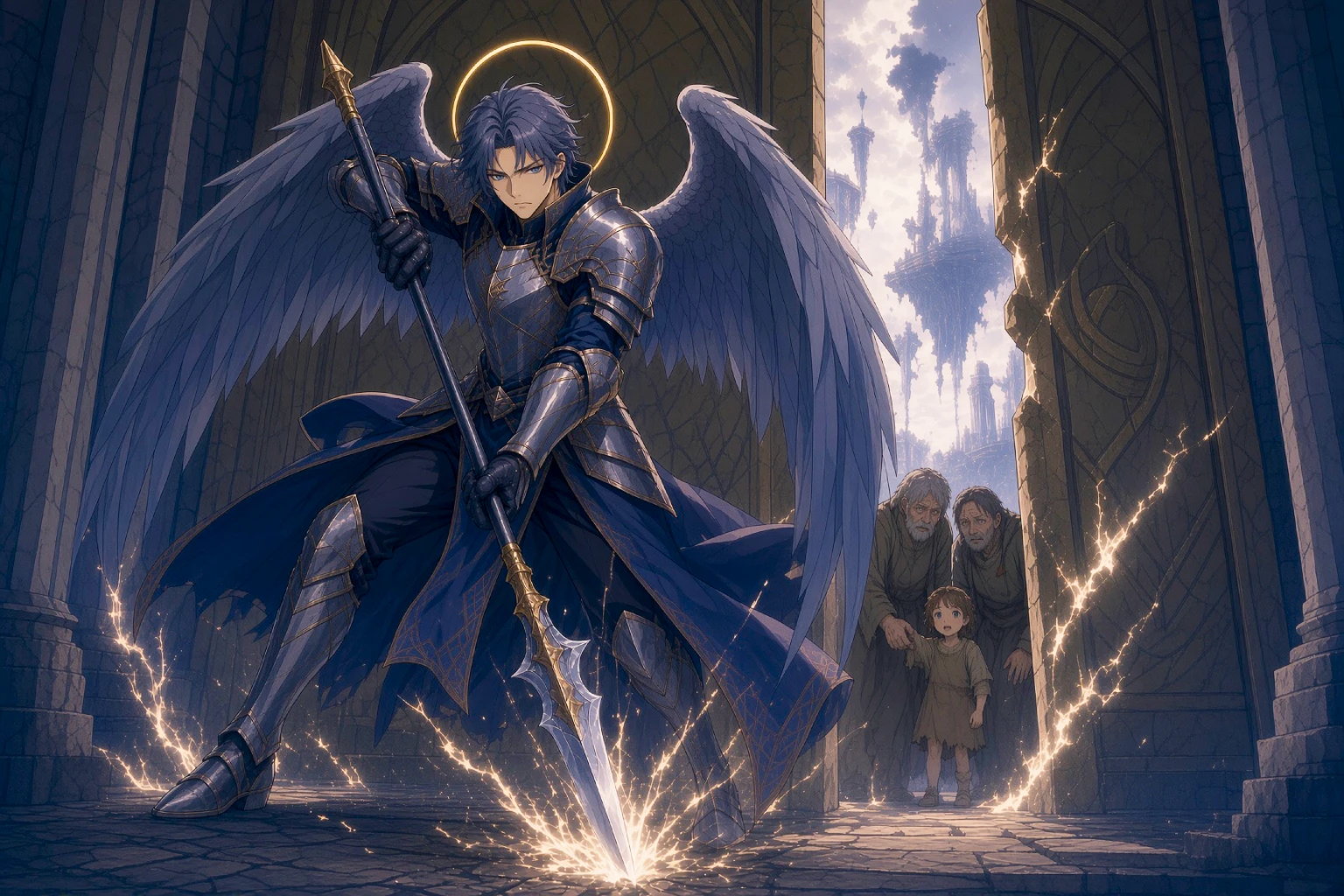
Auren Valec had learned, over the long stretch of centuries, that most thresholds announced themselves long before they were breached. A boundary did not fail suddenly. It thinned, first, in small and deniable ways—a draft where no draft should exist, a sound arriving a heartbeat before its cause, a shadow that fell at the wrong angle for the hour of day.
He had come to trust these small warnings more than any grand omen, because omens were for stories told after the fact, and his work was the quieter labor of noticing before the fact arrived at all.
The Last Door stood at the base of a long stone causeway, set into a cliff face that had been carved, not by wind or water, but by hands that no longer existed in any world Auren could name. It was vast—easily three times his height—and its surface was inscribed with celestial markings that pulsed faintly, like the slow breath of something sleeping rather than something dead. For most of his long vigil there had been nothing to guard against but the Door's own memory.
No traveler had approached from the far side in longer than he could easily reckon, and the healthy realm behind him, the one he had sworn to protect, had grown up around his post the way moss grows around a standing stone: aware of it, but untroubled by it.
He had walked the causeway every day for longer than most kingdoms lasted. He knew the particular way the light fell through the fracture-lines in the rock at dusk, and the exact pitch of the wind when it found its way through the old carvings. So when he heard the knock—three measured strikes against the far side of stone that had not moved in centuries—he did not startle.
He simply stopped walking, turned his head toward the Door, and waited, because a threshold that had been silent for that long did not knock without reason, and reasons deserved to be heard before they were answered.
The second set of knocks came a little raggedly, as though whoever made them had less strength than the first attempt required. Auren set his spear against his shoulder, its long shaft humming faintly with a note only he could hear, and walked the remaining distance of the causeway without hurrying. Hurry, in his experience, was rarely useful to a threshold, and never useful to the one who guarded it.
He placed his palm flat against the stone, feeling for what lay beyond—not sight, not sound, but the deeper pressure that told him whether a boundary was holding or straining. What he felt troubled him more than the knocking had. The realm beyond the Door was not merely quiet or sealed away.
It was frayed, the way a rope frays under years of weight, its fibers separating one by one until only a thin and uncertain core remains. He had known, in the abstract, that Ithern was dying. He had not expected to feel it pressing so thinly against his hand.
"I know someone stands there," came a voice from the other side, muffled by stone but clear enough in its intent. It was a woman's voice, worn but not frightened, the voice of someone accustomed to speaking plainly because there was no longer time for anything else. "I do not ask you to open this out of kindness. I ask you to listen first."
Auren considered the marks along the Door's edge, the old celestial script that had not shifted in his lifetime, and understood, without needing to be told, that something on the other side had changed enough to bring a stranger this close after centuries of silence. He drew his spear from his shoulder and planted its heel against the stone floor, not yet in the Door itself, but near enough that its presence would be felt on both sides—a small assurance, offered before words, that whoever spoke would not be ignored.
"I am listening," he said, and his voice carried through the ancient stone as easily as hers had. "Speak."
Her name, she told him, was Endra Voss, and she had been a physician in a city that no longer had a shape he would recognize even if he crossed to see it. She spoke through the Door for a long while before Auren agreed to open even a narrow seam of it, wide enough for sound and breath but not for passage, and in that seam he finally saw her face: lined, steady-eyed, marked by the particular exhaustion of someone who had spent every resource but hope and had learned to ration that too.
Behind her, through the seam, he glimpsed corridors of stone that did not sit quite right against one another, as though the architecture had been built by two different memories of the same city and neither had fully won. Distant light flickered in colors that had no place being in a sky, and somewhere far off he heard what might have been a bell, or might have been a voice shaped like a bell, ringing from a direction that seemed to shift each time it sounded.
"Ithern has been dying for longer than any of us have been alive," Endra said, before he could ask. "Not conquered. Not cursed. It simply began coming apart, the way old cloth comes apart at the seams no matter how carefully you've folded it. We do not ask you to save it. We are long past asking that of anyone, including ourselves."
"Then what do you ask?"
"Passage," she said, and there was no plea in the word, only fact. "Not for a nation. I would not insult you by pretending our whole world could be saved by walking through your door. I ask for twelve. Twelve people, chosen carefully, who carry what little can still be carried out of a dying place. That is all I ask you to consider."
Twelve. Auren turned the number over in his mind, feeling its smallness against everything Endra had not needed to describe for him to understand—the scale of what was ending behind her, the towers and rivers and generations that would never see this side of the Door no matter what he decided. Twelve felt less like a request and more like an admission of grief already accepted, and that, more than anything else she had said, told him how much thought had gone into asking for so little.
"I will not answer you today," Auren said, and watched her expression, gauging whether she would take that as refusal dressed in patience. She did not. She simply nodded, the way someone nods who has already survived worse waiting than this.
"I did not expect you to," she said. "But I would ask one thing while you consider. Come and see what is asking to cross. Do not decide from behind a door you have not opened."
It was, he thought, precisely the kind of request a careful person made, and he found he could not fault her for making it.
He told her he would return, and he did, though not before he had walked the length of the causeway twice more, feeling along every hairline fracture in the surrounding stone, testing whether the strain he had felt through his palm was isolated to the seam Endra had spoken through or ran deeper into the Door's whole structure. It ran deeper. The entire Door held the memory of two states—open and closed—and nothing between them, the way a held breath knows only holding and release and nothing resembling a slow exhale. It had never been built to allow anything partial. That fact settled into him with the particular weight of a problem that could not be solved by strength or by will alone, only by understanding.
When he opened the seam again, wide enough this time to allow his voice through clearly and to let a narrow column of light from his side spill onto the broken stones beyond, Endra was waiting exactly where he had left her, as though she had not moved in the hours between.
"Show me," Auren said. "Not tell me. Let me see what stands behind that door before I decide what I am willing to make cross it."
She looked at him for a long moment, weighing something he could not name, then nodded and stepped back to allow him a clearer view. What he saw was not chaos in the way he had imagined chaos might look—no fire, no monstrous shape, no army pressing at a gate. It was worse, in its way, because it was quiet. A street continued for perhaps thirty paces before the buildings along it simply lost their edges and dissolved into a soft, featureless light, as though someone had begun erasing a drawing and stopped partway.
Two towers that should have stood at a visible distance from one another passed through each other slowly, indifferent to their own impossibility, and separated again a moment later as if nothing had happened. Somewhere in the near distance, a woman's voice called a name, and a heartbeat later the same voice called it again from an entirely different direction, and Auren understood that he was not hearing an echo but two moments of time occupying the same instant.
"It has been like this for longer than the youngest of us can remember clearly," Endra said quietly. "We stopped asking why a long time ago. We learned instead which streets to avoid, which hours were safer than others, which sounds meant retreat. It is not an invasion, Warden. There is no enemy to defeat here. There is only less and less world, every season, until one day there will be none left to stand on."
Auren said nothing for a long while, watching the slow erasure continue in the distance the way one watches tide erode a shoreline—not swiftly enough to be called violence, and yet unmistakably a kind of ending. He thought of the healthy world at his back, its rivers running where they had always run, its seasons keeping their old, reliable order, and he understood with total clarity why the Door had been sealed in the first place. He also understood, watching Endra's steady, unflinching face, why sealing it could not be the whole of his answer.
"If I open this fully," he said at last, "even briefly, I do not believe your instability remains contained to your side. I believe it would begin to unravel what stands behind me as well."
"I know," Endra said. "I am not asking you to fling your gate wide. I told you—twelve. I ask you to find whatever narrower door exists between everything and nothing, if one exists at all. If it does not, then say so plainly, and I will carry that answer back to the people waiting behind me, and we will make what peace we can with it."
He looked at his spear, then—the long shaft that had never once needed more from him than the strength to plant it and the patience to hold it there—and understood, slowly and without triumph, that the plain answer she feared might not be the only one available to him.
He spent what would have been, on his side of the Door, the better part of two days studying the threshold's structure, tracing the celestial script with his fingertips, feeling for the places where the old inscriptions still held meaning and the places where centuries had worn them smooth. The Door itself, he confirmed again and again, understood only two states. It could stand as a wall or it could stand as an opening, and nothing in its ancient design accounted for the narrow, controlled seam he had been holding for Endra's sake, which was already, he suspected, costing the structure more than either of them yet realized.
But a spear was not a door. A spear could be planted, angled, held at a chosen depth, and it was to that difference that Auren finally turned his attention. His spear was not simply a weapon he carried; it was an instrument built for exactly this kind of impossible work, an anchor meant to fix a boundary's shape when the boundary itself no longer had the will or the structure to hold a shape on its own.
He had used it before to stop a widening fracture from spreading further, to hold a fraying seam steady while it healed on its own terms. He had never tried to use it to force an opening that the Door itself had never been built to allow, narrow enough to admit one person at a time and no wider, but he understood, turning the problem over through that long, careful study, that it might be possible.
It might also fail in ways he could not fully predict, and it would certainly cost him more than the simple exhaustion of holding a heavy door open by main strength. He had felt, even in maintaining the small seam for conversation, a faint disorientation creeping at the edges of his attention—a sense, gone as quickly as it arrived, that he stood a half-step to the left of where his body actually was. He recognized what that meant.
The dying realm did not merely threaten to spread instability through matter and structure. It threatened to spread it through anyone who stood too long with a foot in both worlds at once, blurring the very certainty of where, and who, they were.
He returned to the seam and found Endra waiting again, patient in the particular way of someone who had run out of any alternative to patience.
"I can open a passage," he told her, without preamble, because she had earned that plainness. "Not the Door as it was built to open. A narrower way, held by my spear rather than by the Door's own structure. Wide enough for one person at a time. I do not know how long I can hold it, and I do not know what it will cost to hold it, but I believe it is possible, and I believe it is safer than opening the Door as it stands."
Something in Endra's shoulders eased, though her face remained composed, unwilling to spend hope until hope had proven itself. "Twelve," she said again, as though testing whether the number still held between them.
"Twelve," Auren agreed. "Chosen with care, as you said. Bring them to the threshold. I will begin the moment you are ready, and I will not be able to stop and start again easily once I have begun. Choose well, Endra Voss, because I do not know if I will be able to offer this twice."
She held his gaze for a long moment, and something passed between them that was not quite gratitude, because gratitude implied a gift, and both of them understood this was closer to a wound accepted willingly by one side to spare the other a worse one.
"Is twelve truly enough to risk your whole world for?" she asked, quietly, not as a challenge exactly, but as though she needed to hear how he would answer it before she could let herself believe he meant to try. "I have asked myself the opposite question every day since I chose to come here. Whether twelve lives are worth what it might cost you to save them. I have never managed an answer I trusted. I do not expect you to have one either."
"I don't," Auren admitted. "I only have a door that was never built for this, and a spear that might be able to make something new of it. That will have to be enough for both of us."
The crossing began at an hour that meant nothing on either side of the Door, since time no longer moved reliably in Ithern and had never needed to move by any particular clock on Auren's side. He drove the spear's heel into the seam of the threshold itself, not through stone in the ordinary sense but into the deeper structure beneath it, the place where the Door's old binding still lived, and felt the shaft take hold the way a keel takes hold of water—resisting, then accepting, then answering to his hand as an extension of his intent.
The passage that opened was narrow, exactly as he had planned: a corridor of light no wider than a single person's shoulders, stretching from the threshold on his side to a point somewhere within the dissolving streets of Ithern. Endra came through first, as he had somehow known she would, refusing to send anyone ahead of her into a passage she had not tested with her own steps, and behind her the others began to come one at a time, each pausing at the threshold as though the crossing itself required a kind of permission that went beyond Auren's.
He felt the first strain almost immediately—not pain, precisely, but a wrongness in his sense of his own position, as though for half a heartbeat he stood not at the threshold but somewhere within the corridor itself, his hand still on the spear and yet somehow also watching his hand from a distance. He held his footing, and the sensation passed, and he told himself it was the price of holding two realms at a shared edge, nothing more.
The survivors who crossed were not what he might have imagined from tales of ending worlds—no soldiers, no desperate mobs. An old man carried a satchel of what looked like seed and root cuttings, wrapped with obvious care. A younger woman held a child's toy carved from pale wood, though no child accompanied her, and Auren did not ask what had become of the child it once belonged to.
A tall, silent man carried nothing at all but walked with the particular stiffness of someone bearing an invisible weight he had decided not to set down until he reached somewhere safe enough to do so. Each of them looked back once, at the threshold of their own dissolving world, and then did not look back again.
Behind them, through the narrowing seam of the passage, Auren could see Ithern continuing its slow unraveling, and the pressure of that unraveling began to lean against his hold the way wind leans against a held door. A section of street rippled and reformed as something subtly different, its cobblestones briefly translucent before settling back into solid shape. A voice called out from a building that, in the same instant, ceased to exist, the words arriving perfectly clear from a source that was no longer there to have spoken them.
Once, terribly, he watched one of the survivors waiting to cross flicker for the span of a breath into two overlapping versions of herself, standing in slightly different positions, before merging back into one, and she did not seem to notice it had happened at all.
The spear in his hands began to hum with a note that was not the low, steady tone he was used to, but something sharper, more effortful, as though the shaft itself strained to keep the shape he had asked of it. He felt the disorientation deepen with each crossing—a memory of a conversation he had not yet had arriving fully formed in his mind, complete with Endra's future voice saying words she had not yet spoken; the brief, vertiginous certainty that his own hand on the spear belonged to someone standing on the far side of the Door, watching him hold it from Ithern's collapsing streets rather than from his own solid ground.
He did not let go. He had held worse strains than this before, though never one that reached so directly into his sense of where and who he stood as, and he understood, gripping the spear more firmly, that discipline here meant something more exacting than simple endurance. It meant refusing to let the blurred edges of his perception convince him that the boundary itself had blurred, when in fact it was only his grip on it that trembled.
Nine had crossed. Then ten. He allowed himself, briefly, to believe the number would hold at twelve, that the corridor would close cleanly once the last of them had passed, and that this would be the whole of the cost.
It was the eleventh crossing when the shouting reached them from somewhere deep within Ithern's dissolving streets—not the calm, prepared voices of the chosen twelve, but something more ragged, carrying the particular pitch of people who had run farther and longer than they believed they could.
Through the passage, Auren saw a second group emerging from a side street that had not existed, by his understanding, an hour before: a dozen or more figures, some adult, some unmistakably children, stumbling toward the threshold with the specific desperation of those who had believed themselves already lost and had somehow found, against expectation, one more chance to try.
Endra, already through and standing at his side on the healthy ground of his own realm, went very still.
"They were reported gone," she said, and there was something raw beneath her composure now, the first crack he had seen in it. "A settlement deeper in, cut off months ago when the roads between us stopped agreeing to exist. We assumed them lost."
Auren looked at the corridor of light he held, felt the strain already gathered in the shaft of his spear, and understood immediately, without needing to calculate further, that the passage as he had built it could not sustain the additional weight of so many more crossings, not at the pace fear would demand of them, not with children among them who would not move with the same discipline as the twelve who had known, days in advance, exactly what was being asked of them.
He could close the passage now, honoring the calculation he had made, the twelve he had promised Endra, and by every reasonable measure of his duty that would be a defensible choice. He could also feel, standing there with the spear trembling faintly in his grip, that a defensible choice was not the same as a choice he could live with making, not when children were among those running toward a threshold that would close before they reached it.
There was one further thing the spear could do, though he had known it only in the way a man knows the shape of a debt he has never yet had to pay. He could not simply hold the boundary from outside its structure any longer. He could give part of himself into it—not his life, not in any manner that would end him, but a portion of the authority that made him what he was, the celestial charge that let him command a boundary's shape at all. Bound permanently into the Door's foundation, that portion of himself could strengthen the seam from within, allowing the narrow passage to hold longer, wider, steadier, for as long as it was needed. It would not return to him afterward.
Whatever he gave to the threshold in this moment would remain there, a permanent thinning of what he was, a door within himself that would never again close all the way.
He did not hesitate long, though the decision cost him something even in the making of it, a private grief at the edges of a duty he had carried whole for so long.
"Endra," he said, "tell them to run. Tell them the passage will hold."
He drove the spear deeper into the threshold's foundation than he had yet allowed it to go, past the surface binding and into the older structure beneath, and he opened something in himself that he had never opened before—not his strength, which was easily given, but his authority, the very thing that let a Warden's word mean something to a boundary at all. He felt it leave him not as pain but as absence, a silence opening where a note had always quietly sounded, and the passage widened, steadied, held.
The second group came through in a rush that would have overwhelmed the corridor as he had first built it. Children were passed hand to hand across the threshold by adults who had clearly rehearsed, in some desperate private moment, exactly this kind of crossing, though they could never have known it would be needed. Auren felt Ithern's instability surge against the strengthened boundary and, for the first time, felt it held—not without strain, not without the spear singing under a pressure that made his teeth ache, but held.
When the last child was through, pulled forward by a woman who did not stop running until she was several full strides onto solid, healthy ground, Auren allowed himself, finally, to draw the passage closed.
The seam narrowed slowly, not with violence but with the reluctant, effortful motion of something being asked to remember a shape it had briefly forgotten. Through the last sliver of light, Auren saw Ithern's streets continuing their quiet dissolution, indifferent now to whatever had just passed through them, and he understood that nothing he had done had saved that world, only carried a handful of its people out from beneath it before it finished closing over itself entirely.
Endra stood near him as the passage shrank to a hairline seam and then, at last, to nothing at all, leaving only the old, familiar stone of the Door, though Auren could feel, even without looking, that something in its structure had changed. A single thin line of light now ran through the center of the ancient carvings, faint but steady, marking the place where a portion of himself remained, folded permanently into the threshold's foundation.
"You did not have to give that," Endra said quietly, watching him rather than the Door, and he understood that she had recognized, in some way he had not explained to her, exactly what the second crossing had cost him.
"No," he agreed. "I chose to."
"Will it heal?"
"Some wounds to a Warden's authority heal," Auren said, after a moment spent considering how much truth the question deserved. "This one will not, not fully. This threshold will never answer to me quite as completely as it once did. It will remember that I gave part of myself to hold it, and it will always ask for a little more of me than it once did, in exchange."
Endra was quiet for a while, watching the line of light in the stone, and when she spoke again her voice had softened into something less like negotiation and more like grief allowed, at last, a little room to breathe. "We leave nothing behind us there but ruin," she said. "No records will survive that dissolution. No city, no archive, no monument. I have spent my whole life keeping records, Warden. It is a strange thing, to walk away from a world knowing that nothing of what I recorded will remain to be read."
"Something remains," Auren said, and he chose the words carefully, because he did not want to offer her a comfort that was not true. "Not in stone, and not in any archive that outlasts the world that made it. It remains in the language your people still speak, in the names they will give their children, in whatever songs the old man with the seeds still hums under his breath without noticing he does it. Ithern is ending. It is not vanishing without witness. Every person who crossed that threshold carries a piece of it forward, whether they intend to or not."
Endra looked at him for a long moment, and something in her exhausted, composed face eased slightly, not into happiness, which would have been too much to ask of that hour, but into something quieter and more sustainable—an acceptance that did not require forgetting what had been lost.
"Thank you," she said finally, "for finding a door that did not exist before you needed it to."
"Thank you," Auren answered, "for asking for twelve, when you could have asked for far more and been no less desperate in the asking."
She smiled at that, faintly, the first real softening he had seen in her whole bearing since she had first knocked. "I did consider it," she admitted. "Asking for more. I decided a Warden who might say yes to twelve was worth more, in the end, than a Warden pushed past what he could bear by a number too large to refuse gracefully. I am glad I was right to trust that."
They stood together a while longer at the base of the Door, saying little else, because there was little else that needed saying, and then Endra turned to gather the survivors who had crossed with her, the original twelve and the unexpected dozen more, all of them now standing on solid, unraveling-free ground for the first time in longer than most of them could say. Auren watched them go, carrying nothing of Ithern but what they had managed to bring in their hands and in their memory, and understood that this, imperfect and incomplete as it was, was the whole of what his choice had purchased: not a world saved, but a handful of its people spared the ending, and carried forward into whatever they would make of the ground beneath their new feet.
Years passed the way years pass around a threshold that no longer needs daily watching quite so closely, which is to say slowly, and then all at once. A settlement grew within sight of the causeway, not built at Auren's direction but simply because the ground was good and the survivors of Ithern, having crossed into a world that continued reliably from season to season, found they preferred to stay near enough to the Door to remember, on quiet evenings, exactly what it had cost to bring them through it. They did not build shrines to him.
They did not gather at the threshold to offer thanks or ask further favors. They simply lived, the way people live anywhere, planting what seeds the old man had carried, teaching children words in a language that had no other speakers left in the world it came from, and letting the Door stand, sealed and quiet, at the edge of their daily lives the way a mountain stands at the edge of a valley: present, respected, and mostly unremarked upon.
Auren returned to the causeway less often than he once had, since the threshold no longer required the same vigilance it once demanded, though he could feel, whenever he did walk its length, the faint, permanent absence where a portion of his authority had gone to strengthen the Door's foundation. It did not pain him exactly. It simply reminded him, each time, of a debt paid rather than a debt still owed, and he had learned, over the long years since, to accept that kind of reminder without resentment.
It was on one such visit, the light falling in the particular slant he had always associated with dusk at that place, that he found a child crouched at the base of the Door, tracing one small finger along the thin line of light still visible in the old celestial carvings. She could not have been more than seven or eight, dark-haired, dressed in the practical, undyed cloth the settlement favored, and she did not startle when his shadow fell across the stone beside her, only glanced up with the frank, unguarded curiosity children still permitted themselves before the world taught them otherwise.
"What's behind it?" she asked, nodding toward the Door itself, as though it were the most natural question in the world to put to a stranger who happened to be standing there.
"A place that ended," Auren said, because it was the truest and simplest answer he had, and he had long ago learned that children deserved truth offered plainly, without unnecessary weight added to it.
The girl considered that for a moment, still tracing the line of light with her fingertip. "Is that why it stays closed?"
Auren looked down at the Door, at the single thread of brightness running through otherwise dark and silent stone, and thought of Endra Voss, long since passed into whatever peace this side of the world had offered her, and of the seeds that had grown into orchards now old enough to shade the settlement's paths, and of the particular cost a threshold exacts from anyone who asks it to bend, even briefly, into something gentler than its nature.
"Some doors," he said finally, "stay closed because opening them, even a little, always costs something. Not always a bad thing. But never nothing."
The girl nodded slowly, as though the answer satisfied some quiet part of her that had not really expected a simpler one, and returned her attention to the faint line of light beneath her fingertip, tracing it back and forth as if she might, given enough patience, learn to read what it remembered.
Auren stood beside her a while longer, saying nothing further, watching the dusk settle fully over the causeway and the Door and the small, living world that had grown up around both, and found that he did not need to explain any more of it than he already had. Some things, he had come to understand, were carried forward not by explanation but by the simple, ongoing fact of people continuing to live near them, tracing their fingers over what remained, and asking their questions plainly, the way questions about endings are always best asked.


.png)
.png)
.png)