%20(1).png)
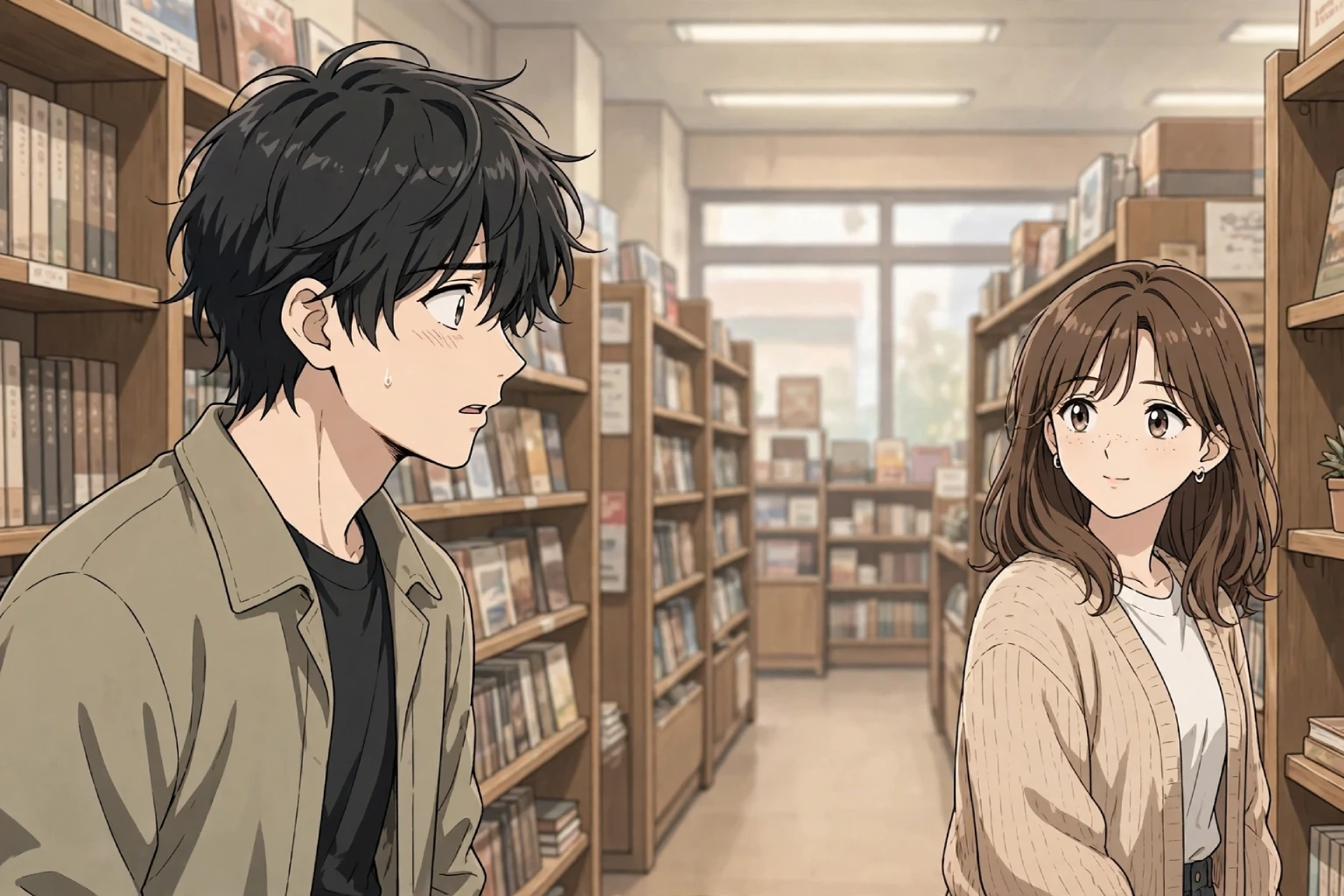
The dishes could have waited until morning. They always said that, and they never did it, and by now the not-doing-it had become its own small ritual — Hana washing, Ren drying, the two of them trading the same three sentences they'd traded a thousand times before without either one noticing they were repeating themselves.
"You missed a spot," Hana said, nodding at the pan still in his hands.
"I did not miss a spot."
"You missed a spot, Ren."
He turned it over, found nothing, and held it up anyway in surrender, and she laughed the particular laugh she only used on him, low and a little smug, before flicking water at him from her fingertips and turning back to the sink.
Outside, the apartment held the ordinary late-evening sounds of a building full of other people's lives — a door somewhere down the hall, a car alarm two streets over that stopped after four rings, the neighbor's television murmuring faintly through the wall, a program they could have identified by its laugh track alone after nine years of living beside it. Ren dried the pan and set it in its place in the cupboard, the third shelf, where it had always gone, where he supposed it would keep going until one of them was too old to reach it.
"Aiko called earlier," Hana said. "While you were still at the office."
"How's the baby."
"Louder. Kenji says he hasn't slept more than three hours straight in a month." She smiled, wiping her hands on the towel he handed her without either of them discussing whose turn it was to hold it. "She wants us to come see him this weekend. The baby, not Kenji."
"We should go."
"We should," she agreed, and something in the ease of the agreement — no plan attached to it, no real intention behind the words beyond the words themselves — was its own kind of familiar. They had been saying versions of *we should* about a great many things for longer than either of them tracked closely anymore. A trip they kept meaning to take. A wall in the second bedroom they kept meaning to repaint, still the same soft gray it had been the day they moved in. A conversation, further back than either of them could easily place now, about children, someday, when things settled — a conversation that had simply stopped being a conversation at some point, the way a hallway light left on eventually just becomes the way a hallway looks.
Neither of them thought about that tonight. There was no reason to. It had never been an argument. It had only ever been a *someday*, and someday, by now, had quietly become simply *not yet*, and *not yet* had become, without either of them deciding it on purpose, the ordinary shape of their lives together.
They settled onto the couch afterward with the television on low, more company than entertainment, and Hana's feet ended up in his lap the way they always did, and he rubbed at her arch with his thumb without either of them commenting on it, an old habit worn smooth from years of repetition.
"Remember the guy at the bookstore," she said, apropos of nothing, eyes still on the screen. "The one who tried to return a book he'd clearly used as a coaster."
"The ring on the cover."
"The ring on the cover." She laughed again, quieter this time. "You were so patient with him. I thought you were going to actually take the book back."
"I almost did. You gave me a look."
"I gave you a very clear look."
It wasn't a story that meant anything to anyone else. It barely meant anything as a story at all — an ordinary customer, on an ordinary afternoon, at a bookstore that had closed years ago and been replaced by a phone shop neither of them had ever gone into. It meant something only because it was theirs, one more small brick in a wall built from thousands of afternoons just like it, most of them already forgotten, a few of them, like this one, resurfacing for no particular reason on an evening otherwise unremarkable enough to disappear from memory by morning.
They went to bed a little after eleven, the way they usually did. Hana fell asleep first, the way she usually did, her breathing settling into its familiar rhythm within a few minutes, one hand still loosely curled against his side. Ren lay awake a little longer, the way he usually did, thinking about nothing in particular — the meeting he had in the morning, whether Aiko's baby would let anyone sleep this weekend, whether they should finally get around to that gray wall. There would be time for all of it. There was always time. Fourteen years had taught him that much, if nothing else — that the two of them simply continued, morning after morning, in the low, unremarkable way that happy things continue when nobody's paying close enough attention to notice how rare that actually is.
He fell asleep beside his wife on an ordinary Tuesday night, thirty-five years old, with absolutely nothing wrong.
---
He woke to a ceiling he hadn't seen in fourteen years.
For a long moment, Ren simply lay there, disoriented in the specific way of a man surfacing from a dream too vivid to immediately release — the popcorn texture overhead, the crack running from the light fixture toward the window, a water stain in the corner shaped like nothing in particular that he'd once joked looked like a rabbit. His old apartment. His first apartment, the one he'd left the year he and Hana moved in together, the one he hadn't thought about in any real detail for longer than he could say.
He sat up too fast, and his body responded wrong — light, easy, unfamiliar, no ache in the shoulder he'd strained lifting a bookshelf three years ago, no stiffness in the knee that complained every winter since he'd fallen on ice outside the office. He looked down at his own hands.
They were not his hands. Or rather, they were his hands from a version of himself that no longer existed, smooth and unmarked, missing the small white scar along his left thumb that he'd gotten from a broken glass at their wedding reception, missing fourteen years of small, accumulated evidence that a life had actually happened to this body.
"Hana." Her name left him before he'd decided to say it, and the room, small and single and utterly hers-less, answered him with nothing at all.
He was alone. He understood, with a clarity that arrived faster than the panic that should have preceded it, that he was alone in a way he hadn't been alone in fourteen years, and that understanding cracked something open in his chest that had no immediate name.
He found a calendar, forgotten and out of date, tacked to the wall by the door — a calendar he vaguely remembered owning, its months displaying the wrong year entirely, a year fourteen years gone. He found a mirror and stared for a long time at a face that was, unmistakably, undeniably, his own face at twenty-one, unlined, uncertain, considerably less tired than the last face he remembered wearing.
The room spun for a moment, and he sat down hard on the edge of the bed, both hands pressed against his own knees as though the solidity of his own body might anchor something that had clearly come loose from the rest of the world.
*This isn't possible,* he thought, and then, immediately, contradicted himself, because it was very clearly, undeniably happening, whether or not it was possible.
He tried, for a while, to make it make sense as something smaller than what it obviously was — a dream, an elaborate and cruelly detailed dream, the kind you sometimes have about a person you've lost, so real that waking from it feels like losing them a second time. He pinched the skin of his own forearm hard enough to leave a mark. He splashed water on his face at the small, unfamiliar sink, cold enough to sting, and the sting didn't fade the way dream-sensations fade. He stood in the middle of a room he hadn't lived in for fourteen years and waited for it to dissolve into whatever ordinary morning was actually waiting for him, and it didn't dissolve. It only sat there, entirely, uncompromisingly real, refusing to be anything other than exactly what it appeared to be.
Somewhere in the middle of all of it, a different thought arrived, quieter than the panic, and it was the thought that would end up carrying him through everything that came after it.
*My life was cut short,* he thought. *Somehow, impossibly, it was cut short, and now I have a chance to finish it.*
He did not think, not yet, not for a long time afterward, that he had already finished it once. He did not think that fourteen years, a marriage, a thousand ordinary Tuesdays, had already been a complete and whole thing in themselves. He thought only of what had been taken — the rest of the mornings, the rest of the gray wall never repainted, the rest of Hana's hand curled against his side while she slept — and he thought, with a wild, rising hope he didn't examine closely enough to distrust, that whatever had happened to him had happened for a reason, and that the reason was her.
He was twenty-one years old again, in an apartment he'd forgotten the layout of, with an entire unlived year stretching out in front of him before he'd even met her the first time.
He got up, and got dressed, and went to find her.
---
The bookstore was exactly where he remembered it, which felt, in that first disoriented week, like the only reliable fact left in the world.
It sat on the corner two blocks from the university, narrow and crowded with more stock than its shelves could properly hold, the smell of old paper and dust thick enough to taste the moment the door swung shut behind him. Ren had worked there for eight months during his second year, a fact he hadn't thought about in years and now couldn't stop turning over, because he remembered, with a precision that frightened him slightly, exactly which Tuesday in early autumn a girl in a pale yellow raincoat had come in out of the rain and asked him, in a voice he would spend the rest of his first life learning every register of, whether they had anything by a poet whose name she wasn't entirely sure she remembered correctly.
He counted the days. He was careful about it, more careful than the situation probably needed, checking the date against the calendar he'd found and a newspaper he'd bought specifically to confirm it, as though a single day's error might cost him something he wasn't yet capable of naming.
When the day finally arrived, he was already behind the counter twenty minutes before his actual shift began, in a green apron he remembered wearing and had genuinely forgotten the weight of, rearranging a display of paperbacks that didn't need rearranging, watching the door with an attention that made his own manager glance at him twice.
It rained, the way he remembered it raining. That, at least, matched.
She came in a little after four, shaking water from a pale yellow raincoat, and Ren's whole chest went tight and strange at the simple, overwhelming fact of seeing her face again — younger than he'd left her, softer somehow, entirely her own and entirely unaware that she was being looked at by a man who had spent fourteen years learning the exact shape of her laugh.
"Sorry," she said, to no one in particular, brushing water off her sleeve. "It really came down all at once out there."
He almost said her name before she'd told it to him. He caught it, just barely, the reflex nearly outrunning his own better judgment, and said something else instead, something forgettable about the weather, his voice coming out rougher than he meant it to.
She smiled at him anyway — polite, easy, the smile of a stranger being pleasant to another stranger — and drifted toward the poetry section without any sense at all that anything unusual had just happened, because for her, nothing had.
Ren stood very still behind the counter for a long moment, watching her trail one finger along a row of spines she didn't fully recognize the order of yet, and felt something in his chest that he wouldn't have language for until much later — not simple joy, though there was joy in it, but the first faint, unexamined edge of a hunger that hadn't existed in him yesterday and was already, quietly, beginning to take up more room than he understood.
"Excuse me," she said, a few minutes later, approaching the counter with a book held loosely in both hands, her damp hair curling slightly at her temples the exact way he remembered it curling on rainy days for the next fourteen years. "Do you know if you have anything else by this poet? I think I heard the name somewhere, but I'm not totally sure I'm remembering it right."
"I can check," Ren said, and his voice, this time, came out almost steady.
He led her toward the shelf he already knew held exactly what she was looking for, and somewhere in the walk across that narrow, dust-thick aisle, watching her from half a step behind, he let himself believe, entirely and without reservation, that he had simply been given his life back, whole and unchanged, and that all he had to do now was live it correctly the second time.
He did not yet understand how much smaller a word *correctly* was going to turn out to be than everything it was about to cost him.
---
She came back three days later, the way he knew she would, because he remembered this part with a clarity that felt less like memory and more like something already written down somewhere he simply had access to.
"You were right," she said, setting the same book on the counter, a little damp again at the corners though it hadn't rained today. "About the other collection. I liked it even more than the first one."
"I thought you might."
"That's a very confident thing to say about a stranger's taste in poetry."
"I have a good feeling about some things," Ren said, and the words came out easier than they should have for a man who had said almost exactly this sentence to her once before, fourteen years and one lifetime ago, in this same shop, over this same counter.
She laughed at that — a real laugh, quick and a little surprised at itself — and something in his chest loosened for the first time since he'd woken up in a room he no longer recognized as fully his. This part, at least, he had gotten right. He held onto that with more weight than the moment probably deserved.
They talked for longer than either of them technically had time for, about nothing that mattered and everything that would eventually matter enormously, and when her curiosity finally ran its course and she made a show of checking the time, he heard himself ask, in the exact register he remembered using once before, whether she might want to get coffee sometime, when he wasn't behind a counter and she wasn't dripping on the floor.
"There's a place two streets over," he added, before she could answer, before he'd fully registered that he was already deciding the location for her. "Small, kind of hidden, most people walk right past it. They do a coffee with cardamom in it that's better than it has any right to be."
Something flickered across her face — not refusal, nothing so clear as that, just a small, private recalibration, the look of someone noticing a detail slightly too specific for a first invitation. "How do you know what kind of coffee I'd like?"
"Lucky guess," Ren said, and the lie came easier than it should have.
She considered him for a moment longer than strictly necessary, head tilted slightly, and then, apparently deciding the strangeness of it wasn't worth abandoning an otherwise pleasant afternoon over, she smiled again. "All right. Lucky guess. Saturday?"
"Saturday," he agreed, and spent the rest of his shift only half present in his own body, the other half already three days ahead, already certain of exactly how the whole afternoon was going to go.
---
Saturday went well enough that his certainty, rather than being tested, simply hardened into something closer to conviction.
The café was exactly as he remembered it, tucked between a shuttered tailor's shop and a narrow stairwell that led nowhere anyone ever used, and Hana laughed when she saw it, delighted in the specific way he remembered her being delighted by places other people overlooked.
"You weren't kidding about hidden," she said, ducking under the low doorway.
"I told you."
She ordered the cardamom coffee he'd described, and made a small, surprised sound at the first sip that he recognized instantly, a sound he'd built entire mornings around for fourteen years, and something in him settled so completely at hearing it again that he had to look down at his own cup for a moment before he trusted his face not to give away how much that single sound had cost him to hear again.
"This is dangerous," she said. "I'm going to want this every day now."
"You could," he said. "It's not far from campus."
"You know where I go to school?"
He hadn't told her that yet. He caught it a half-second too late, the small overreach already sitting in the air between them, and he covered it as smoothly as he could manage. "Lucky guess again. You've got that look."
"What look."
"The look of someone who reads too much and sleeps too little and probably has an exam she should be studying for right now instead of drinking coffee with a stranger."
It landed. She laughed, waved a hand at him in mock offense, called him presumptuous, and the moment closed over cleanly enough that neither of them lingered on it, and he told himself, with the particular relief of a man choosing not to examine something too closely, that it hadn't really been a mistake at all. Just a guess that happened to be right. She would never need to know how many guesses like that he actually had stored away.
He tried the joke next — the one about the bookstore customer and the water-ringed book, adjusted only slightly, the same rhythm he remembered making her laugh so hard she'd had to put her cup down the first time he'd ever told it to her, months into their original courtship, on a night he still, even now, could recall in exact and complete detail.
She smiled at it. She didn't laugh, not the way he remembered, not the helpless kind that used to leave her breathless. "That's funny," she said, politely, the smile staying a beat too long past where the laugh should have arrived, and Ren felt something small and cold move through him before he pushed it back down and told himself the timing had simply been off. He'd told it too early. He'd have another chance to tell it right.
"What do you actually study," he asked instead, steering them somewhere safer, somewhere he still remembered clearly.
"Literature, mostly. I want to teach, eventually. Or write, if teaching doesn't work out, or if it does and I hate it." She wrapped both hands around her cup. "What about you?"
"Business, on paper. I work at the bookstore because I like it more than any of my actual classes."
"That's a very honest thing to admit."
"I've never seen the appeal of pretending otherwise."
She studied him for a moment, something warm and curious in it, and said, "You're a little strange, you know. In a good way. Most people I've just met don't already feel this comfortable."
"Is that bad?"
"I didn't say it was bad." She smiled again, easier this time, more her own. "I just noticed it."
They stayed nearly two hours, well past the length he remembered the first conversation lasting, and when they finally stood to leave, she suggested, unprompted, that they should do this again sometime — a detail that hadn't happened quite this way before, a small forward motion that was entirely hers rather than anything he'd engineered, and it struck him, walking her partway back toward campus afterward, that this alone should have told him something important about how little of what was happening actually belonged to a script he could take credit for.
It didn't tell him that. Not yet. He was too full of the evening's small, accumulating proofs — the coffee she liked, the delight at the hidden café, the way she'd leaned toward him slightly by the end without seeming to notice she'd done it — to weigh properly against the two moments that hadn't gone quite the way memory had promised him they would.
He walked home that night with a lightness in his chest he hadn't let himself feel since the morning he'd woken up in a room fourteen years too small for the life he remembered living. He had found her. He had said mostly the right things, in mostly the right order, and she had responded, mostly, the way he remembered her responding, and the small places where she hadn't — a joke landing a half-beat flat, a question about how he knew things he shouldn't yet know — felt, from where he stood that night, like nothing at all. Noise. The unavoidable static of a life being lived a second time instead of remembered perfectly.
He did not yet understand that the static mattered more than the moments that matched, or that every remembered detail he used in place of discovering her again moved him slightly farther from the woman sitting across from him.
He fell asleep that night still twenty-one, still hopeful, still certain, in the specific and forgivable way of a man who has only just begun losing something he does not yet know he's holding wrong.


.png)
.png)
.png)