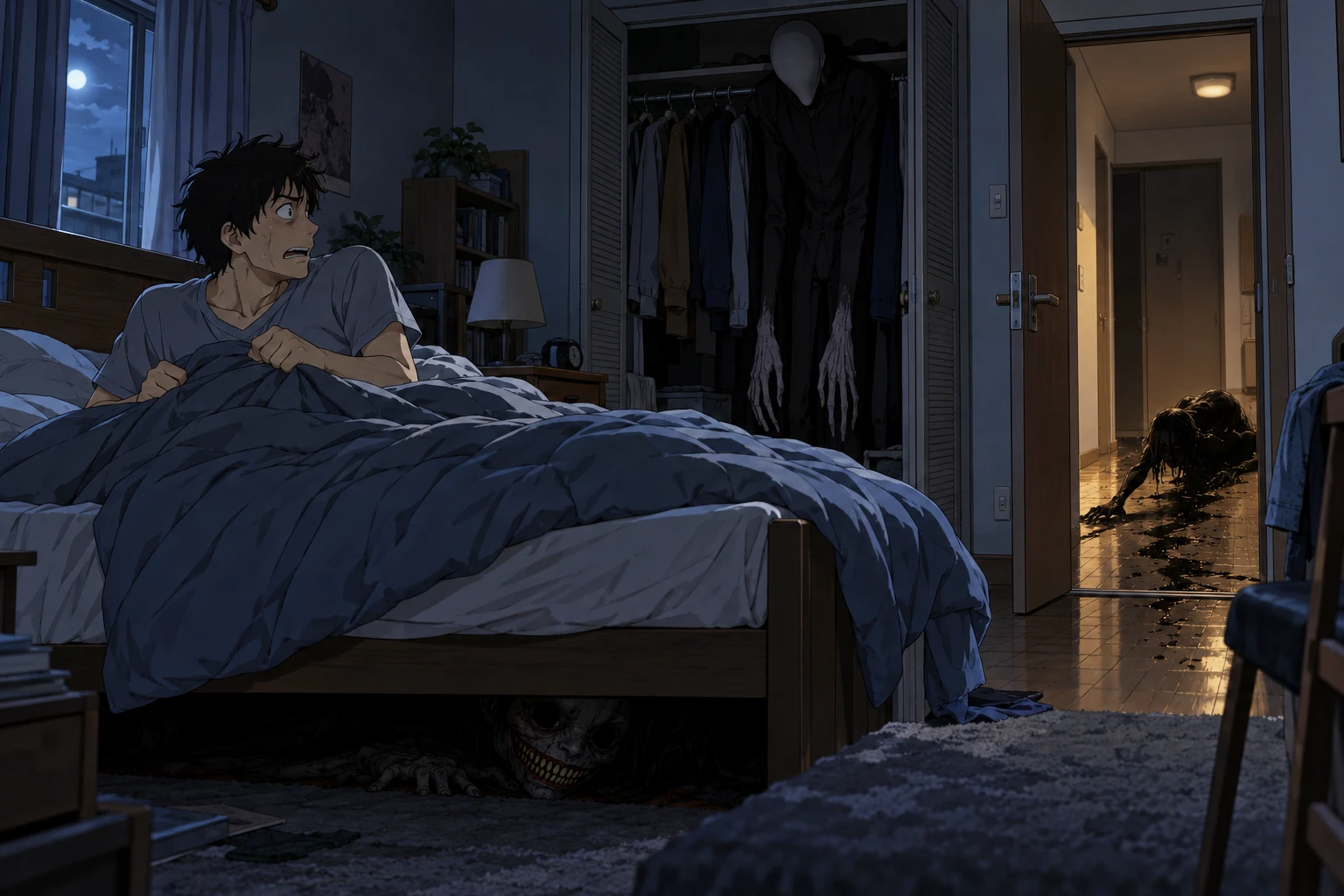
The first one came back on a Tuesday, while he was brushing his teeth.
He saw it in the mirror: not his own face, but the one that used to wait under the bed. Same hollow eyes. Same too-wide smile, teeth yellowed and too many. It was only there for a second—half a second, maybe—before the steam from the hot water cleared and it was just him again, toothpaste foam at the corner of his mouth, heart slamming so hard he could feel it in his wrists.
He told himself it was nothing. Exhaustion. The old apartment's bad lighting. The fact that he hadn't slept properly in weeks.
But he knew the rules. He'd written them down when he was eight, in the back of a notebook he hadn't seen in years, though some of its warnings had never quite left him:
Don't look at them too long.
Don't say their names out loud.
Don't let them know you still remember.
He spat, rinsed, and left the light on in the bathroom when he went to bed.
It didn't help.
Sometime after three, he woke to the sound of something soft and wet dragging itself across the hardwood outside his door. The same sound that used to stop just short of his childhood room. The same sound that had taught him, early, how to lie perfectly still so whatever was out there wouldn't realize he was awake.
This time, it didn't stop at the door.
It remembered where he lived now.
Caleb Weir lay flat on his back and counted his own breaths the way he'd learned to count them twenty-five years ago, slow and even and shallow, the kind of breathing that didn't move the blankets, didn't creak the mattress, didn't give a single thing away.
The dragging sound crossed the threshold of his bedroom and stopped somewhere near the foot of the bed, close enough that he could hear, beneath the wet drag of it, a second sound layered underneath, soft and rhythmic, like something breathing through a mouth that had never quite learned how.
He did not open his eyes. He had learned that lesson earliest of all, the one rule too obvious to even bother writing down: whatever you do, you do not look to confirm it. Looking made it real in a way that lying still and waiting never did. He had survived an entire childhood on that single, desperate piece of logic, and he was not about to test whether it still held at thirty-three the way it had at eight.
The sound circled the bed once, unhurried, pausing at points along its path the way something curious pauses, and he felt, more than heard, the mattress dip very slightly near his feet, a weight settling there that had no business settling anywhere at all.
Something cold brushed, very briefly, against the blanket over his ankle, there and gone before he could decide whether he'd imagined it, and every instinct in his body screamed at him to pull his leg away, and he did not move it, not an inch, because moving had always been the one unforgivable mistake in every version of this he'd ever survived as a child.
He kept counting. Thirty breaths. Forty. Fifty. The counting had always worked, back then, a small private anchor against a fear too large to otherwise hold, and he found, lying rigid in his own adult bed after twenty-five years of believing he'd outgrown the need for it, that his body remembered the technique with a fluency his mind had entirely forgotten it possessed.
The weight lifted again, unhurried as it had arrived, the dragging sound withdrawing toward the door, and somewhere past the hundredth breath, the apartment settled back into the ordinary, empty silence of three in the morning, and he let himself, finally, open his eyes.
The room was empty. The door stood exactly where he'd left it, ajar by the same two inches he always left it. There was nothing on the hardwood to mark where anything might have crossed it, no water, no mark, nothing at all except the lingering, unmistakable certainty that something had been there, and had chosen, this time, to leave.
He did not sleep again that night.
He went to work anyway, because calling in sick felt, in the grey light of morning, like giving something he still half refused to believe in more weight than it deserved, and he sat through two meetings he could not afterward have described in any detail, nodding at the appropriate moments, answering when his name was spoken directly, while some separate, watchful part of him kept replaying the exact weight of that dip in the mattress, over and over, unable to let it rest.
A coworker asked him, at lunch, whether he was feeling alright, and he said only that he hadn't slept well, which was true enough not to require any further explanation, and spent the rest of the afternoon watching the clock with a dread he hadn't felt about going home since he was a child dreading the end of a sleepover and the walk back to his own house after dark.
The following morning he called his sister, because there was no one else left to call who would understand even half of what he needed to say, and Mara picked up on the third ring with the particular brisk cheer of someone already three cups of coffee into a work day.
"Caleb. You never call this early. Everything okay?"
"I need to ask you something strange," he said, and found, now that the moment had arrived, that he didn't entirely know how to begin it. "Do you remember anything about the house. When we were kids. Anything that felt — off, about certain parts of it."
Mara was quiet for a moment, and he could hear her setting something down on a counter, the small domestic sounds of a kitchen he'd never visited, in a city he'd never lived in, a whole separate life she'd built at a careful distance from everything that house had ever held. "Off how?"
"I don't know how to ask it any more plainly than that."
"Caleb, Mom's funeral was a week ago. You sound exhausted. Are you sleeping?"
"Not really," he admitted. "That's rather why I'm asking."
Mara let out a slow breath, and when she spoke again, the brightness had faded from her voice. "There was something, actually. I never told you because I thought you'd laugh, and I figured that if you'd noticed it too, you would've said something."
She hesitated before continuing. "I used to hear Mom talking late at night, sometimes for quite a while. Her voice would come through the bedroom wall, and it sounded like she was having a perfectly ordinary conversation with somebody. But there was never anyone else there."
"Did you ever ask her about it?" Caleb asked.
"Once, when I was about six. She told me she was praying, and I believed her. I didn't really think about it again until after she died."
"And now?"
"Now I don't know what I believed," Mara said. "Why are you asking me this, Caleb? Twenty years later, out of nowhere, the week after we buried her?"
He looked down at the kitchen table, at the cardboard box still sitting unopened in the corner of his apartment where he'd left it three days ago, boxes of their mother's things he hadn't been able to make himself go through yet, and found he didn't have an answer he was ready to give his sister over the phone.
"I'll explain when I understand it better myself," he said. "I promise."
He opened the box that evening, alone, with every light in the apartment burning and the radio playing low in the next room for company, and found, near the bottom, beneath a folded quilt and a shoebox of old photographs, a notebook he recognized instantly despite not having seen it in over two decades: cheap cardboard cover, a faded cartoon rocket ship on the front, the specific soft, worn corners of something that had been handled constantly by a very young, very frightened pair of hands.
His own handwriting, child-careful, filled the first dozen pages.
He had stopped writing in the notebook sometime in his teens, putting it away and telling himself, with the particular confidence of a teenager eager to leave childhood behind, that he had simply grown out of whatever fear had produced it.
He had not remembered packing it among his mother's things. He had not, if he was honest with himself, remembered its existence at all until the moment his fingers found its worn cover in the bottom of that box, and the recognition that moved through him at the contact was not the mild nostalgia he might have expected, but something closer to a held breath finally releasing, a door he'd spent twenty-five years leaning against finally swinging open from the other side.
The entries were simple, a child's careful catalogue of three things he had apparently believed, with total and unshakable conviction, were real.
*The Smiling One,* read the first entry, in handwriting that pressed hard enough into the page to show through on the reverse side. *Lives under the bed. Hollow eyes. Smile too wide, too many teeth, all yellow. Only comes if you look under the bed first. Rule: never look under the bed. If you forget and look, do not look away fast. Looking away fast makes it follow you out.*
*The Crawler,* read the second. *In the hall at night. Sounds wet. Drags something. Stops outside the door if you stay still. If you move, it knows you're awake. Rule: count breaths. Don't stop counting until it's gone.*
*The Coat Man,* read the third, shorter than the others, as though even at eight he had found this one harder to linger over. *In the closet. Only if the door is open even a little. Too tall. No face, just smooth where a face should be. Fingers too long, too many knuckles. Rule: always shut the closet door all the way. Never leave it open, not even a crack, not even for a second.*
Beneath the three entries, in a hand that grew smaller and more cramped as though the child writing it had been running out of page and running out of courage at the same rate, a final line stood alone:
*They stopped coming after Mom talked to them. I don't know what she said. I'm not supposed to ask.*
He went back to the shoebox of photographs beneath the notebook, mostly to have something to do with his hands, and worked through them slowly, school portraits and birthday cakes and a handful of blurred snapshots of a backyard he hadn't thought about in years. Near the bottom, he found one of himself at perhaps seven or eight, asleep on a couch in the old living room, his mother seated in the armchair beside him, awake, her eyes fixed on something just outside the photograph's frame with an expression he had never, as a child, known how to read.
He turned the photograph over. On the back, in his mother's careful hand, a single date and nothing else, no note, no caption, as though she'd meant to write something and had thought better of it. He set it aside, face down, and found he couldn't quite make himself look at it again that evening.
Caleb sat with the notebook open on his kitchen table for a long time after that, the radio still murmuring faintly in the next room, and found himself returning, again and again, to that last line, turning it over the way he might turn over a stone to see what had been living beneath it.
He drove out to the house two days later, ostensibly to collect the last of what the estate agent wanted cleared before the sale went through, though he knew, even as he turned onto the familiar street, that he was really looking for something else entirely.
The house stood empty now, stripped of furniture, their mother's careful, decades-long accumulation of a life reduced to bare walls and pale rectangles on the carpet where couches and bookshelves had stood for as long as he could remember. He walked through it slowly, room by room, feeling less like a man settling an estate and more like someone retracing the path of an old, half-forgotten nightmare, measuring each doorway and closet against the version of it that still lived in his memory.
On his way out to the car for another load of boxes, he ran into Edith Calloway, who had lived next door since before he was born, out on her own porch despite the cold, watching the activity at his mother's house with the particular open curiosity of a woman who considered the whole street, more or less, her own business.
"You've got a long road ahead of you, clearing that whole house out," Edith said, by way of greeting. "Your mother kept more than she ever let on."
"I'm finding that out," Caleb said, setting down the box he was carrying to catch his breath. "Mrs. Calloway, can I ask you something a little strange?"
"At my age, strange questions are the only kind worth answering." She settled back into her chair, arms crossed against the chill. "Go on."
"Did my mother ever seem — tired to you. Not ordinary tired. Something more than that."
Edith was quiet a moment, her expression shifting into something more careful than her earlier easy curiosity. "She did, now that you ask it plainly. For years, actually. I used to see her light on something terrible late, two, three in the morning sometimes, back when I still kept my own odd hours. I asked her about it once, oh, must have been twenty years back now. She told me she had trouble sleeping. I didn't think much of it at the time. Lots of folks have trouble sleeping."
"Did she ever say anything else? About why?"
"Once," Edith said, slowly, as though reaching for a memory she hadn't handled in a long while. "I asked if she wanted me to walk over, keep her company some night when it got bad. She said no, quite firm about it, actually. Said it wasn't the kind of company that helped. Said she had an arrangement, and she meant to keep it herself." Edith studied him for a long moment. "Why are you asking me this now, Caleb?"
"I'm not entirely sure yet," he admitted. "I think I'm only just starting to understand what she meant by arrangement."
He found what he was looking for in his mother's old bedroom closet, in a shoebox pushed far back on the highest shelf, behind a stack of winter blankets nobody had bothered to pack yet. Inside, wrapped in a plastic bag gone soft and cloudy with age, sat a second notebook, leather-bound, considerably older than his own, the handwriting inside unmistakably his mother's, careful and looping in the way he remembered from grocery lists and birthday cards, though it grew noticeably more hurried, more worn down, as the pages went on.
He sat on the floor of the empty closet, the same closet, he realized with a cold, distant certainty, that had once held the Coat Man behind its narrowest crack of open door, and read.
*If he finds this, he isn't meant to understand it yet,* the first entry read, dated some twenty-six years earlier, close enough to his own eighth birthday that his chest tightened reading it. *I found his notebook tonight while I was looking for a library book under his bed. I don't know whether to be more frightened that he's seeing these things, or that I believe him completely.*
The entries continued for pages, his mother's own careful record of a ritual she had apparently built from nothing but desperation and a mother's particular, terrible willingness to trade her own safety for her child's. She had gone, the notebook explained in increasingly plain terms, into his room one night while he slept, and had spoken aloud, into the dark beneath his bed and the dark of the hallway outside his door and the dark of the barely open closet, offering herself in his place.
*I told them I would remember instead,* she had written. *I told them he was only a child and didn't understand what he was carrying, and that I would carry it for him, if they would only let him forget. I don't know why it worked. I don't know what rules govern a thing like that, only that it did work, and has kept working, every night since, as long as I keep my own rules exactly as carefully as he once kept his.*
Further on, an entry dated perhaps a decade into the arrangement caught him by the throat in a way the earlier ones hadn't managed. *Mara asked me tonight why I talk to the dark,* it read. *I told her I was praying. I have never in my life told either of my children so plain a lie, and I don't know how to feel about how easily it came. I think the easiness frightens me more than anything that visits after midnight.*
Another, shorter, a few pages further: *The Crawler came twice this week instead of once. I don't know if that means it's growing hungrier or only growing used to me. Either way I counted my own breaths through both visits, same as I once taught him to, and both times it left when the counting was done. Small mercies.*
Beneath that entry, in a different pen, added some years later by the look of the fading ink, a second set of rules had been written out, a mirror image of his own childhood list turned inside out.
*Let them see me first, so they never go looking for him.*
*Say their names in my own head, every night, before sleep, so they never forget who's holding the memory now.*
*Never let him remember. Not a flicker. Not once. If he starts to remember, they'll know the trade is ending, and they'll go looking for the original debt.*
Caleb closed the notebook slowly, his hands not quite steady, and sat for a long while on the floor of that empty closet with his mother's handwriting pressed flat against his palms, understanding, for the first time in his adult life, the particular shape of every quiet, distant night she had ever spent sitting up long after the rest of the house had gone to sleep, every unexplained exhaustion, every time he had caught her staring into some dark corner of a room with an expression he'd never had a name for until right now.
She had not been praying, all those nights Mara remembered through the wall. She had been paying a debt, in installments, for twenty-six years, so that neither of her children would ever have to learn the currency it was priced in.
The second visitation came three nights later, in his apartment's narrow hallway closet, and it came because he had, without entirely meaning to, left the door open the width of two fingers while he searched for a jacket in the dark.
He sensed it before he saw it. Something was standing inside the closet, something considerably taller than the ceiling should have allowed. The space felt wrong somehow, as though the dimensions of the closet had changed while he wasn't looking.
When he finally forced himself to look, the door stood open on his ordinary hanging coats. Nothing moved, but the air in front of them seemed distorted, briefly revealing the outline of something impossibly tall and narrow.
Then he noticed the fingers hanging down from somewhere above the coat rail. They were unnaturally long, with too many knuckles, catching just enough light from the hallway to make him certain they were there.
He shut the door, hard, both hands flat against it, and stood with his back pressed to the wood for a long time afterward, breathing in the ragged, uncounted way he hadn't allowed himself since childhood, before he remembered, with a fresh stab of cold dread, that counting had always been the rule, and he had just broken it without even noticing.
He did not sleep that night either. He sat instead at his kitchen table with both notebooks open in front of him, his own childhood hand beside his mother's careful, decades-long devotion, and tried to work out, with the same desperate arithmetic that had apparently governed both their lives, what came next now that the debt's original holder was gone and its original debtor had started, however unwillingly, to remember.
He called Mara again the next morning, and this time he told her everything, the mirror and the dragging sound and the two notebooks and the shape in the closet door, and she listened without interrupting once, a long, heavy silence on her end of the line when he finally finished.
"You're serious," she said, finally. "You actually believe this."
"I didn't want to," Caleb said. "I spent one night lying very still, telling myself it couldn't possibly be real, right up until the part where it got into bed with me and I realized believing it wasn't actually optional anymore."
"What do you need from me?"
"I don't know yet," he admitted. "Maybe nothing. Maybe just to not be the only person who knows what Mom actually spent the last twenty-six years doing for us."
Mara was quiet again, longer this time. "She used to look so tired," she said eventually, her voice thinner than he'd heard it since they were children. "I used to think it was just — being a single parent, working two jobs, all of it. I never once thought to ask whether she was tired because of something she was doing on purpose, every single night, so we'd never have to be."
"Neither did I," Caleb said, "until three days ago."
"What are you going to do?"
He looked at the two notebooks lying open on his table, his own child's rules and his mother's inherited ones, and found, for the first time since the mirror on Tuesday, that he had the beginning of an answer, though not one he particularly wanted to say aloud yet.
"I'm going to finish reading," he said. "I think there's more in hers. I think she was building toward something, near the end, and I didn't get that far yet."
The night before he finished reading, the Crawler came twice, exactly as his mother's journal had once described it coming when it grew restless, and the second visit found him exhausted enough, three nights into broken sleep, that he nearly broke the only rule that had ever mattered.
He woke to the dragging sound already in the room rather than the hall, already close, and some old animal panic nearly drove him upright before his mind caught up with his body, a half-second where his hand was already braced against the mattress to push himself up and run, and some last fragment of eight-year-old instinct screamed at him, silently, to stop, to lie still, to not give it the one thing it was waiting for.
He forced his hand back down, flat against the sheet, and made himself breathe, ragged and too fast at first, slowing it by sheer force of will until the counting could catch up to it. The dragging circled once, closer than it had ever come without touching him, and he felt, this time, something that might have been breath against the back of his neck, cold and faintly sour, and he did not move, did not open his eyes, did not do anything at all except count, forty, fifty, sixty, until it finally, slowly, withdrew.
He lay awake afterward with his heart still hammering, and understood, with a clarity that frightened him more than the visitation itself had, that the old rules alone were not going to hold indefinitely. They had bought his mother twenty-six years. He didn't know how many more nights they had left to buy him.
He found the end of his mother's own account two pages from the notebook's final entry, dated only six weeks before her death, the handwriting by then grown shaky enough that some words had to be guessed at rather than read outright.
*I'm tired in a way I don't think rests anymore,* she had written. *I've kept this up longer than I think anyone was ever meant to keep a thing like this up, and I don't know what happens to the debt when the one holding it simply runs out of years to hold it in. I won't tell him. I've decided that much. If it comes back to him after I'm gone, I want him to at least have the choice I never let myself consider: that there might be a third way between carrying it forever and handing it to someone else.*
*I think the rules were never really the point. I think the point was always choosing, freely, to be the one who remembers, instead of being made to remember by something that frightens you into it. I chose that for him once, when he was too young to choose anything for himself. I don't know if it's mine to choose for him again.*
*If you're reading this, Caleb, and I'm gone, and they've found their way back to you anyway — I'm sorry. I tried to make it last forever. Nothing lasts forever, not even the things we build out of pure stubborn love. I don't know if choosing it changes what it actually is, or only changes how it feels while it happens. I have never once, in twenty-six years, found out whether there's a difference. I'm not sure I want you to be the one who finds out either. But it's the only door I have left to offer, and I'd rather leave you a door than a debt.*
*One more thing, and then I'll stop writing in this, because my hand won't hold out much longer tonight. Near the end, you stop being sure which parts of the exhaustion are from losing sleep and which parts are from something slowly being taken out of you a little at a time. I don't know how to describe it better than that. If you ever start to feel that way — ordinary tired turning into something else, something that doesn't lift no matter how you sleep — stop. Whatever you're doing. Stop and call your sister. Don't decide you can manage it alone the way I did.*
The final visitation came that same night, and it came for all three of them at once, as though whatever governed the old arrangement understood, in whatever dim and patient way such things understood anything, that the choice their mother had written of was finally about to be made, one way or another, before the night was through.
He felt the mattress dip first, the same weight settling near his feet that he'd endured once already without looking, and beneath it, layered through the floor, the slow drag of something wet moving down the hallway toward his door, and somewhere behind him, in the narrow closet he had not properly closed this time, on purpose, the faint, patient sound of something very tall shifting its weight against the frame.
Caleb did not lie still this time, and he did not count his breaths.
He sat up slowly in the dark, his mother's notebook still open on the nightstand beside him where he'd left it, and looked, for the first time in twenty-five years, directly at the shape sitting at the foot of his bed.
The Smiling One's hollow eyes caught what little light the room held, its too-wide mouth stretching further the instant his gaze found it, exactly the way his childhood rules had always warned him it would, and he felt the old animal terror rise in his chest exactly as fiercely as it ever had, and he held it there, and did not look away, and did not run.
"I remember you," he said, quietly, into the dark, his voice shaking only a little. "I've always remembered you. I just let someone else carry the memory for a while, because I was too young to carry it myself, and because she loved me enough to let me. I'm choosing this now. Freely. The way she said I could."
The smile did not shrink. It did not grow more terrible either. It only widened, by degrees, far past anything an ordinary jaw should have been able to hold, and for the first time since he'd started speaking, Caleb felt something he hadn't expected to feel at all: a cold thread of doubt, sliding in beneath the resolve he'd built all night, telling him, too late, that he had perhaps misunderstood the shape of what he was offering.
The dragging in the hallway stopped at the threshold of his door and did not retreat. In the closet, the weight did not ease. Nothing withdrew. Everything, instead, went very still, the particular, total stillness of three separate attentions all turning, at once, fully toward him.
"That's what you wanted, isn't it," Caleb said, his voice thinner now, the confidence of a moment ago already draining out of him. "Someone to choose it. Openly. Without being made to."
The Smiling One tilted its head, slow and wrong, the motion carrying on a fraction longer than a neck should allow, and said nothing, because it had never once, in all his childhood, said anything at all, and some distant, sinking part of him understood, watching that silent, patient tilt, that he had never actually known what it wanted. He had only ever assumed, the same hopeful, desperate assumption his mother had made twenty-six years earlier and had never, by her own admission, been certain of.
The cold did not stay in his chest. It moved, slow and deliberate, threading down through him the way frost finds the cracks in old wood, and he felt it settle somewhere behind his ribs with a small, final click, like a key turning in a lock he hadn't known was there.
The weight lifted from the mattress. The dragging withdrew down the hall. The pressure in the closet folded itself back into ordinary shadow between his coats, and within a few long minutes the apartment held nothing in it at all except Caleb, sitting upright in his bed, breathing hard, his hands pressed flat against his own chest as though he might still, somehow, feel whatever had just settled there from the outside.
It seemed to have worked. Whatever had been waiting in his bedroom, hallway, and closet was no longer making itself known.
He told himself that for three days, the particular hollow, careful relief of a man counting a victory he hadn't fully examined yet, and for three days nothing came to his door at night, and nothing waited in his closet, and nothing dragged itself down his hallway at three in the morning, and he began, cautiously, to believe his mother's theory had been right after all.
He noticed the tiredness on the fourth day. Not the sharp, adrenaline-soaked exhaustion of broken sleep, but something quieter and considerably stranger, a flatness settling behind his eyes no amount of rest seemed to touch, and when he caught his own reflection in the bathroom mirror that evening, brushing his teeth exactly as he had on the Tuesday this had all begun, he noticed, for just a fraction of a second too long, that his own smile in the glass had not quite finished catching up with the rest of his face.
He did not call Mara that week. He told himself, each day he didn't, that there was nothing yet worth troubling her with, that he only needed a little more sleep, that the strange new habit he'd developed — sitting up some nights in the dark, murmuring something low and steady to the empty corner of his bedroom, the way he vaguely remembered his mother once doing through a wall — was nothing more than an old house's worth of grief working its way out of him slowly.
It was Mara who finally drove the four hours to see him, three weeks after his last call, worried by the thinness of his voice on their last two conversations and the fact that he'd stopped, entirely, asking her how she was doing, a small reversal she couldn't quite place at first and then recognized, with a chill she didn't examine too closely, as the exact shape of every phone call their mother had ever given her in the last years of her life.
She found him thinner than she remembered, pleasant and a little distant, the particular careful calm of a man holding something very still beneath an ordinary surface. He made her tea. He asked about her drive. When she asked, gently, how he'd been sleeping, he told her, with an easy, practiced warmth that didn't quite reach his eyes, that he'd simply been praying more lately, and found it helped.
She did not ask him what he meant by that. She recognized the lie too precisely to want to hear him repeat it.
She left before dark, hugging him longer than usual at the door, and as she pulled out of the parking lot she glanced back up, out of habit, at the lit window of his apartment, meaning only to see him waving the way he always did.
He wasn't at the window. For one long, suspended moment, something else was, pale and hollow-eyed, its smile far too wide for the glass to properly hold, watching her go with an attention that had nothing resembling her brother left in it at all.
Mara did not stop the car. She told herself, driving the four hours home in the dark with both hands locked tight on the wheel, that she had imagined it, that the light had simply caught the glass wrong, that grief did things to the mind that had nothing to do with anything real.
She told herself that for three more days, right up until her phone rang on a Tuesday evening, her brother's name on the screen, and she stood very still in her own kitchen for a long moment before she made herself answer it, because some old, inherited instinct she hadn't known she carried was already, quietly, counting her own breaths.