%20(1).png)
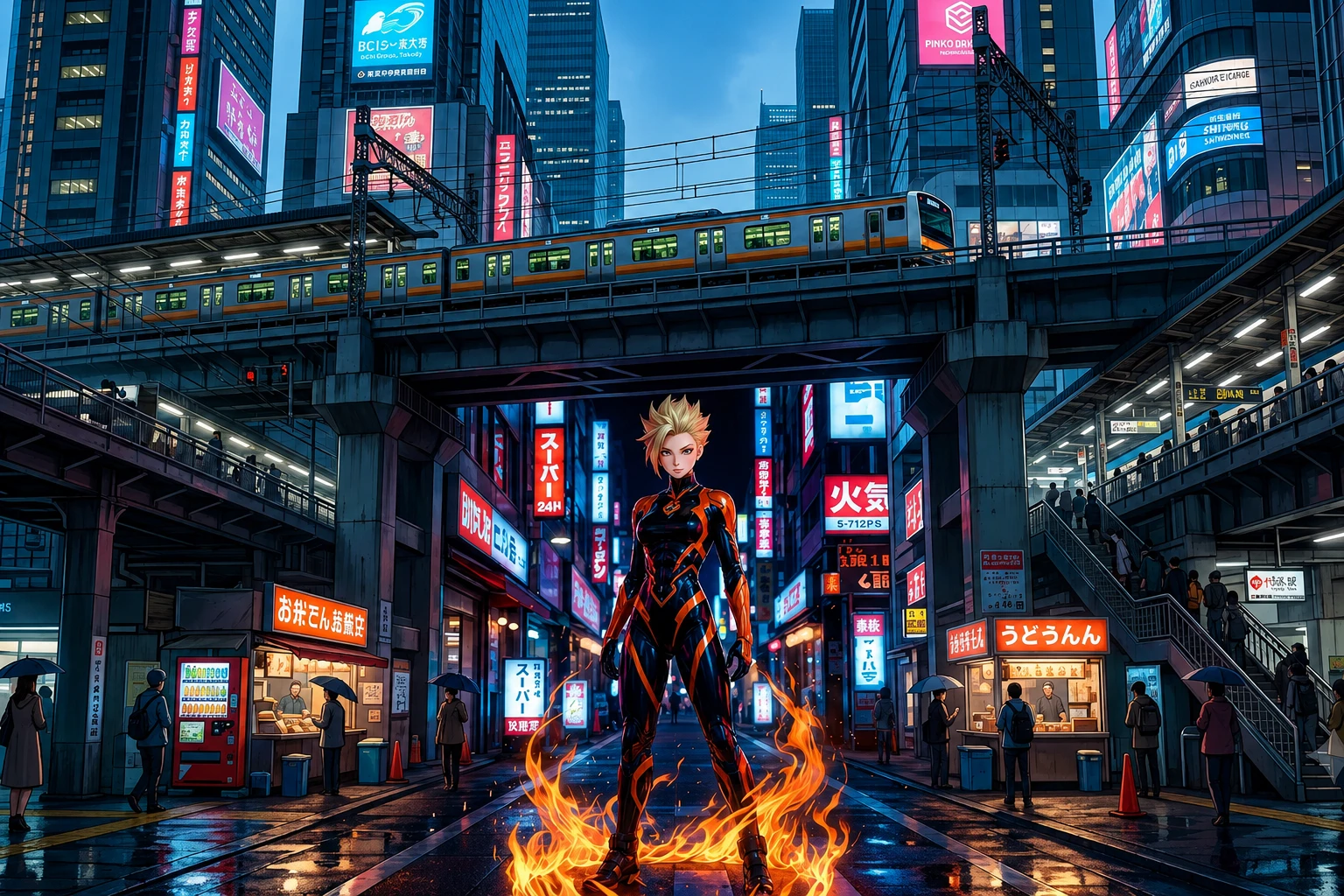
She came in off the elevated line at a dead sprint, orange light trailing off her heels in thin lines that hissed where they hit the rain-wet pavement and vanished.
The Minato Arcade had been dark for eleven minutes. Akane had been moving for nine.
The scene resolved itself as she hit the corner: a transit concourse, glass and steel, three levels of shops and a covered central atrium that should have been warm and lit and full of the ordinary noise of a Thursday evening. Instead the lights were emergency-red and failing, the automatic doors locked in the closed position, and through the glass she could see the breath of maybe two hundred people turning to mist in air that had no business being that cold.
She read the space in the three seconds she had before she needed to start.
Three locked entrance gates across the main facade. Interior crowd massed at the ground level, moving toward the exits in the beginning of a push that would become a crush if it got worse. Frost on the interior glass — not weather frost, the wrong kind, creeping from a central point and spreading outward. And at the far end of the concourse, barely visible through the press of people, something blue-white and humming that did not belong in a shopping arcade.
Akane went through the first gate at a measured burn — her right hand flat against the lock mechanism, two seconds of focused heat, not the lock housing, not the glass, just the bolt and the frozen actuator behind it. The door swung open. She was through before the metal finished contracting.
"Move toward the sound of my voice," she said, loud and even. Not a shout — a shout made crowds flinch and compress. "I need everyone to walk toward the front entrance. Do not run."
People moved. Some of them had seen the orange light through the glass before she came in and were already reorienting; others were still in the part of panic where the brain needed a clear instruction more than it needed an explanation. She gave them the instruction.
She burned a line across the concourse floor — a thin, steady arc maybe three centimeters wide, bright orange, running from the central crowd space toward the open gate. Not fire in any dangerous sense. A path. Something visible that said *this way* in a language that bypassed the thinking part of the brain and went straight to the part that followed light.
At the back of the crowd, a teenage boy was moving the wrong direction, toward the upper escalators. She caught his arm, redirected him, and pointed at the arc without breaking stride. He went. Good.
The second gate took longer — the mechanism had frozen all the way through and the frost was thicker here, the air noticeably colder than at the entrance. She had to work up the temperature carefully, warming the surrounding metal first before touching the lock, or she risked a thermal shock crack in the glass panel that would complicate the exit. Fifteen seconds instead of two. She accepted that.
The third gate she cut — no other word for it, her fingers dragging a clean line through the lock housing, the metal parting in a way that left edges smooth rather than jagged because jagged was how people got hurt. The gate folded back. She propped it with a piece of the housing, held in place by the residual heat in the metal.
The crowd was moving now. Not panicking — moving, which was different. She stood at the gap between the second and third gates and held a low barrier line behind them, a soft orange arc that gently discouraged anyone from reversing into the back of the crowd. Not a wall. Not a threat. Just a visible reason to keep going forward.
When the last person was through she turned back into the concourse.
The thing at the far end was still humming.
---
Up close it looked like a piece of industrial equipment that someone had retrofitted badly — a central housing the size of a large appliance, matte grey, with a ring of emitter nodes arrayed around it at angles that suggested a field projection rather than a point source. Cold was radiating from it in waves she could feel as resistance against the heat she was running. It had locked the doors and frozen the building from the inside and it was still running because nobody had turned it off.
She found the shutoff inside three minutes. There wasn't one.
*Of course there wasn't.* She straightened up and looked at the device and then at the utility conduits running out from beneath it — thick bundled cables going through the floor access panel, not into the building's systems but through them, heading somewhere else.
She pulled the access panel and looked down at the conduit route.
The cables ran north.
She had been hoping they wouldn't.
---
The neon alley between the Minato district and the Shinjin corridor was one of those city spaces that existed because buildings had been built to different plans and nobody had reconciled the gap — three meters wide, forty meters long, walls on both sides covered in signs and pipes and the kind of infrastructure that accreted over decades without anyone reviewing the total. On a normal night it smelled like rain and electricity and the grease trap from a ramen shop on the north end.
Tonight it smelled like her.
The cold field from the Minato dampener extended into the alley as a moving front, and where it hit the heat bleeding off her suit the air became visible — steam rising off the pavement in columns, condensation on every surface, the walls sweating in long vertical runs. She moved through it at pace, reading the temperature differential the way a sailor read current, following the edge of the cold zone as it expanded.
The cables had split into three branches at the first junction. She had gone north, which was the largest branch. Somewhere to the east and west, two more dampener fields were probably already running.
She keyed her comms — the jamming from the Minato unit was patchy at range, and she got a partial connection to the city emergency coordination channel.
"This is Burnline. The Minato device is part of a network. I count three branches from the source conduit, possibly more. You need to get emergency services holding at the outer perimeter — do not send them in yet, the doors are going to be locked until I can kill the primary feed."
Static and a partial acknowledgment. Good enough.
She went up the fire escape on the east wall of the alley at a run, three flights to the rooftop, because the rooftop would give her the sightline she needed.
The frost on the antenna towers was visible from the roof edge — a clear ring of it, maybe eight meters in diameter, centered on a relay node she almost didn't recognize because it had been modified. Someone had added emitter hardware to a standard city comm relay and turned it into a repeater for the cold field network. From up here she could see two others: one on the Shinjin crossing, one somewhere over the Tetsu district.
She also saw the pedestrian bridge.
The Minato-Tetsu footbridge crossed the junction at the second level, and it was currently holding a crowd she estimated at three hundred people — commuters who had been crossing when the lockdown started, now stopped at both ends by gated barriers that had closed automatically. The temperature over the bridge wasn't at dangerous levels yet, but in another fifteen minutes it would be, and the crowd was already dense enough that the cold retention was going to accelerate.
She went off the roof edge in a controlled drop, heat stepping off her feet to slow the fall, and ran.
---
The bridge barriers were rated against crowd pressure, which meant they were built to hold and they did. She didn't try to break them. She burned the hinge pins on the east gate — four precise points, ten seconds each, keeping the heat focused away from the painted surfaces that would char and smoke — and pulled the gate clear. West gate the same. The crowd moved, slow at first and then steadily, and she stood at the center of the bridge and burned a double line down each rail — not fire, just visible orange light running the length of the crossing, something for people to orient by.
She held there until the bridge was clear enough that the remaining people weren't at risk of being separated, and then she dropped to the lower level through a maintenance hatch and found the secondary conduit bundle running through the bridge structure itself.
Following it through the city was the work of twenty minutes that felt like forty. Underground service tunnel between the Shinjin and Tetsu districts, pipes cracking at the joints from thermal stress where the cold field had penetrated the insulation, the sound of stressed metal loud enough in places that she had to filter it out to keep track of where she was going. One branch went east. The main bundle kept going south, and the temperature kept dropping, and the field got stronger the further she went.
She was getting close to the source.
She found the crew first.
They came from a side tunnel, three of them in tech gear, and the initial encounter lasted less time than it took to describe because she wasn't in the business of extended confrontations when there were civilians in frozen buildings. One heat step to close the distance, one burnline across the floor between them and the way they'd come from, and the simple fact of her standing on the wrong side of it for anyone who wanted to leave. They stopped.
"The primary device," she said. "Where."
One of them looked past her left shoulder, involuntarily, which was the answer.
She went south.
---
The control chamber was below the Tetsu district at the third utility level, in a space that had probably been a water authority maintenance facility decades ago and had been converted into something considerably colder. The door was sealed — she burned through the lock in eight seconds, the mechanism more complex than a standard commercial unit but not more complex than she'd seen before.
Inside: walls sheeted in frost, floor slick with it, the air so cold it hurt. Rotating cold fields generated by emitter arrays in the corners, moving in overlapping patterns that were clearly designed to disrupt speed-based enhancements — the temperature drop when a field passed through her was sharp enough to be a genuine impediment, her heat generating stuttering against the cold pressure.
The main dampener was at the center of the room. Larger than the Minato unit by a significant margin, the emitter ring fully deployed and active. And standing between her and it, arms crossed, was a man in cold-tech gear with the relaxed posture of someone who had prepared very specifically for this moment.
"Four civilian extractions," he said. "You're slower than the projections."
"I was thorough," Akane said.
He had the kind of face that had made a decision about being right a long time ago and stopped questioning it. "You're going to lose control in here in about ninety seconds. Your heat generation can't sustain against the rotating fields at this density. I've run the numbers."
"Okay," she said.
He paused. "Fire spreads. Cold contains. I can make this entire district comply without burning a single thing."
"Cold that locks people inside buildings and freezes the pipes isn't containment," she said. "It's just a cage with better optics." She looked at the emitter arrays. "And you're wrong about ninety seconds."
He moved first — she had expected that, someone who ran numbers trusted the numbers and the numbers said she was losing time. A cold lance from a wrist-mount rig, aimed well and fast.
She stepped offline. Not dramatically — two steps, the beam passing through the space she'd been. She didn't counter. She moved to the nearest emitter array in the corner and placed her hand on the housing.
One focused burst. Not a big one. Just enough heat into exactly the right point in the emitter's control circuit that the field it was generating collapsed without disrupting the others violently. The room's rotation pattern shifted, opened a gap.
She used the gap.
Across the floor at an angle he hadn't covered, one flame step over the ice patch that would have taken her down, and then she was at the second array and the process repeated. He was adapting — firing at where she was going rather than where she was, cold-tech aim assist, which was good technique — but she was already not where she was going by the time the beam arrived.
The third array she had to fight for. He'd repositioned to cover it, and the exchange was close enough that the cold lance caught her left arm and frosted the suit surface before she could pull back. The arm worked fine — the suit was rated for worse — but it was a reminder that she wasn't untouchable in here.
She didn't push through on the third array. She went around him, forcing him to track her, and took the fourth instead.
Two arrays down, the rotating field simplified enough that she could breathe without the heat stuttering. She turned to face him properly.
"Last chance on the primary," she said.
He launched everything — both wrist mounts, the chest rig she'd clocked as a backup on the way in. She went low and forward, inside the effective range, and placed one ignition strike on his chest rig's power coupling. Not his chest. The coupling. It shorted cold rather than hot, the discharge going up and outward instead of into either of them, and the rig went dead. She caught his wrist on the follow-through and applied the leverage that ended the conversation.
He went down. She put a contained burnline around him — a clean ring on the frost-covered floor, not enough heat to harm, enough to make the boundary obvious and make crossing it uncomfortable.
"Stay in the ring," she said. "Someone will be here in a few minutes."
She turned to the dampener.
The cold was still rotating from the two remaining arrays, and the central device was still running, and the emitter ring was still projecting the field network through the utility conduits into the rest of the district. She walked the perimeter of the device once, reading the housing, the emitter configuration, the power routing. Looking for what she was looking for.
Every device had a weak point. Not structural — thermal. A place where the heat management was good enough to run the device under normal conditions but not good enough to handle a focused introduction of heat from the outside. It was usually where the engineers had made a tradeoff between thermal performance and weight or space, and it was usually somewhere in the first third of the device on the power intake side.
She found it.
She crouched in front of the dampener's intake housing and placed both palms flat against the surface. Closed her eyes. This was the part that looked like she was doing nothing, which was inaccurate — she was doing the most difficult thing she knew how to do, which was producing exactly the right amount of heat in exactly the right configuration and putting it into exactly the right place while under a rotating cold field that was actively working against her.
Small. Controlled. Patient.
The burnline built from her palms outward — not a strike, not a blast, a line, a precise thread of heat following the intake manifold back to the power distribution node and finding the exact junction where the load was highest and the tolerance was tightest.
She held it there for six seconds.
The dampener made a sound like a sigh and went dark.
The cold fields collapsed all at once — not dramatically, not with a flash, just an absence of pressure that she felt as sudden ease, the air warming immediately from whatever ambient temperature the city had been before all of this started. The emitter arrays in the corners powered down. Somewhere above her, she knew, doors were unlocking, emergency systems were restarting, vehicles were getting through.
She stood up. Her arms were tired in the specific way they got tired when she'd been working precisely for a long time.
She looked at the burnline man in his ring on the floor. He was looking at the dead dampener with the expression of someone whose numbers had been wrong.
"Fire spreads," she said, not unkindly. "But I don't have to."
---
She came up through the maintenance access into the Tetsu district street level in the hour before the city's cameras fully reoriented, in the gap between the incident ending and the coverage arriving. The rain had stopped. Steam was rising off the pavement where the cold field had met the relatively warmer street surface, and the emergency lights were on, and people were moving.
She stood in the steam for a moment and watched them move — not toward anything dangerous, just back into the ordinary current of the city, the way people did when the thing that had been threatening them stopped.
Someone about fifty meters north was pointing at her. She checked the crowd status — the bridge clear, the arcade clear, the Tetsu district warming — and then moved, because staying in the light after the scene stabilized was someone else's job.
The last thing she left on the street at Tetsu junction was not intentional and not a signature. Just the trace of where she'd been — a scorched orange arc on the rain-wet pavement, clean-edged and precise, maybe five meters long, fading at both ends where the heat had dissipated before it had quite finished its path.
A woman walking past stopped and looked at it.
She didn't look up. She just looked at the line on the ground — the place where the cold had stopped, marked in orange, curved like something had been held back at exactly this point and no further.
Then she kept walking, because the train she needed was already pulling in, and the city was moving again, and whatever had happened tonight was already becoming the thing that had happened last night, receding into the past the way cities absorbed everything eventually.
The line on the pavement stayed until the next rain came.


.png)
.png)
.png)