%20(1).png)
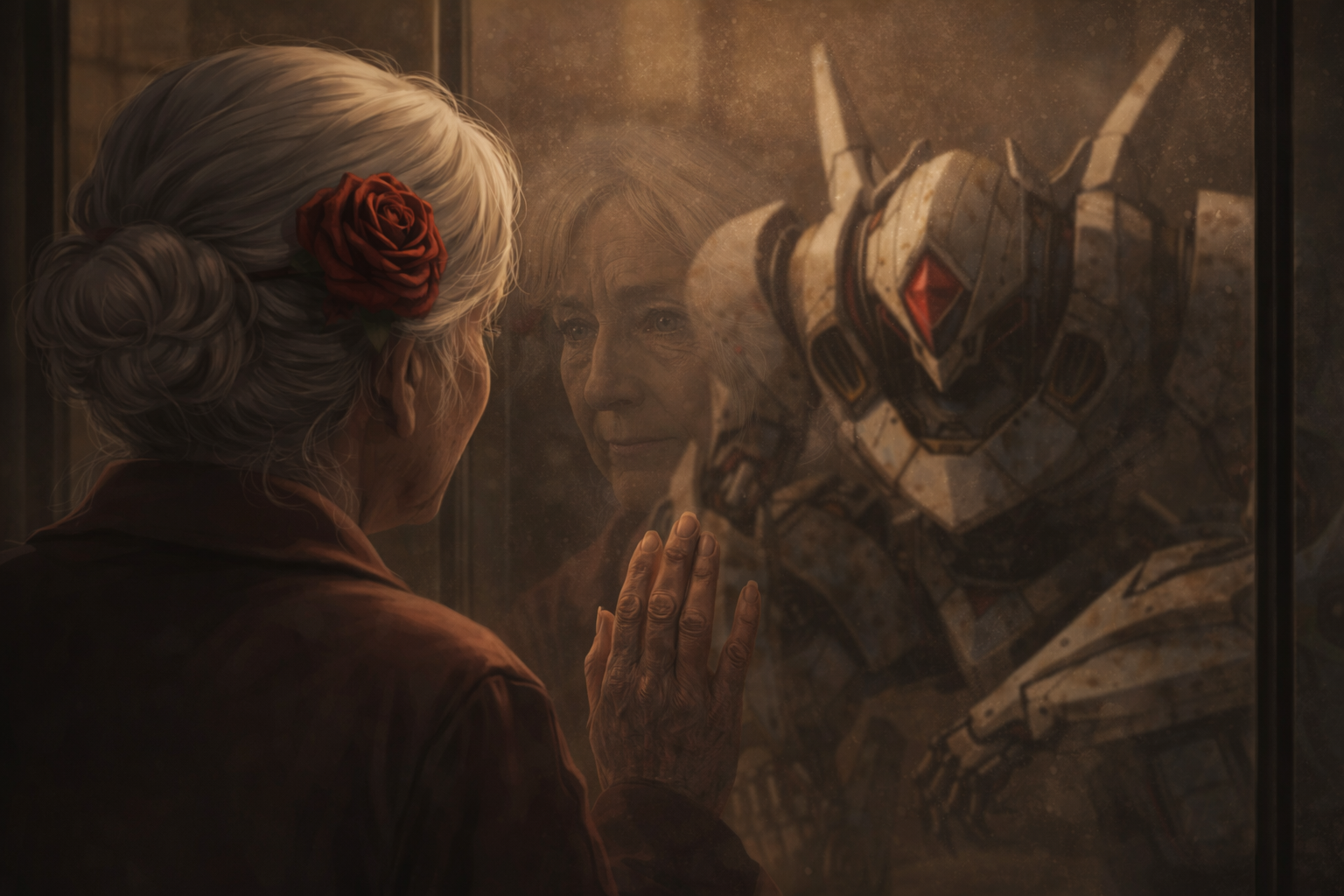
The museum had changed its lighting.
Rosie noticed it the moment she stepped inside.
It was softer now. Less clinical. The overhead panels no longer hummed the way they had decades ago. The air still carried that same faint scent of polished floors and old paper, but the sharpness was gone. Everything felt quieter. Even the echoes seemed slower.
She paused just inside the entryway to let her eyes adjust.
Her hands trembled slightly as she unbuttoned her coat. Not from cold. From age. From the slow, unannounced betrayals of time. She folded the coat carefully over her arm and walked toward the far gallery without needing a map.
She had never needed one.
The hallways were wider than she remembered.
Or perhaps she was smaller now.
A young couple passed her, speaking in low voices about an exhibit on early aviation. A group of students clustered near a docent in another wing. No one noticed the old woman walking alone with deliberate, steady steps.
She had driven herself.
Her children would have protested if they’d known. They would have insisted on coming with her, turning the visit into an outing. A lunch afterward. A careful eye on the stairs. But she had not told them.
This was not something she wanted witnessed.
She turned the final corner.
And there he was.
AEGIS-9B.
Behind glass.
The placard beneath him had been updated. She could tell by the font. The lettering was sharper, modernized. The wording clinical.
Recovered artifact.
Unknown origin.
Composite alloy analysis inconclusive.
No verified operational history.
No verified operational history.
She almost smiled at that.
He stood as he always had in the museum — inert, dignified, slightly bowed forward as if paused mid-thought. The red sensor at the center of his faceplate was dark. The panels along his arms bore faint scratches that no one had ever polished away.
She approached slowly.
Not as a child.
Not as a girl running up the porch steps with her arms raised.
As a woman who had lived an entire life between that moment and this one.
Her reflection appeared faintly in the glass as she drew closer. White hair pinned neatly back. Fine lines at the corners of her eyes. A rose tucked carefully above her left ear.
She had almost not worn it.
There had been a moment that morning — standing in front of her bedroom mirror — when she’d hesitated. It felt foolish, perhaps. Sentimental.
But she had pinned it in place anyway.
She stopped an arm’s length from the display.
Her hands hovered, then settled gently against the glass.
The surface was cool.
She did not speak immediately.
There were people elsewhere in the gallery, drifting in and out. A father lifted his daughter so she could see over the barrier rope. The little girl stared for a moment and then asked something Rosie could not quite hear.
The father leaned closer to the placard.
“It says they don’t know where it came from,” he murmured. “Some kind of experimental machine. Maybe military.”
The girl squinted at the figure behind the glass.
“Does it work?”
“They don’t think so.”
They moved on.
Rosie remained.
Her vision blurred slightly.
She did not wipe her eyes.
She did not want to interrupt the feeling.
Memory did not come to her in a flood. It came in fragments.
A six-year-old’s laughter echoing across wooden porch boards.
The smell of river water in late summer.
Small fingers wrapped around cool metal.
A shadow in the barn doorway.
A rose placed carefully in her palm.
She let out a slow breath.
“You’re still terrible at hiding,” she whispered, barely audible even to herself.
The words felt strange in the air. Smaller than they had once been.
For years after he had disappeared from her life, she had searched.
Not frantically. Not obsessively. Just quietly.
News reports.
Whispers.
Stories that didn’t quite add up.
A generator repaired in the middle of a storm.
A tractor running after midnight.
A camera feed that glitched for exactly twelve seconds.
And then one day, nothing.
Until the article about the museum.
Recovered artifact.
No known origin.
She had known before she finished reading.
She had waited years before coming.
Life had moved around the absence.
She had married.
He had been kind. Steady. A schoolteacher with patient eyes and careful hands. She had loved him.
He had known, of course.
Not everything.
But enough.
He had once found her sitting on the back steps at dusk, staring into the treeline with that same faraway look she wore now.
“Do you think he’s out there?” he had asked gently.
“Yes,” she had said.
He had nodded.
“Then I hope he’s safe.”
He had never mocked her. Never dismissed it as childhood imagination. That had been one of the reasons she had married him.
Years passed.
Children were born.
The house filled with noise.
She had raised them with the same quiet steadiness she had learned from something that did not speak.
Her children had known stories.
Not fairy tales.
Not myths.
Just stories about a protector who did not need recognition.
When her husband died — quietly, in a hospital room that smelled faintly of antiseptic and stale coffee — she had sat beside him and thought about how many names she had been called in her life.
Daughter.
Wife.
Mother.
Grandmother.
Names layered like sediment.
He had been called many things too, in those early years.
Monster.
Machine.
Government property.
Artifact.
She had called him something else.
She looked up now at the motionless figure behind the glass.
“You hated that first one,” she murmured.
She remembered it clearly.
The first time someone had called him “thing.”
She had been eight.
She had stood between them — defiant and trembling — and shouted, “He’s not a thing. He’s my big brother.”
The memory warmed her despite the ache in her chest.
Big brother.
She let the words settle in her mind.
He had been called by many names.
But the one he loved most was what she called him.
Big brother.
Her hand pressed more firmly against the glass.
There had been no grand farewell.
No final moment of understanding.
Just absence.
She had been seventeen.
Packing boxes for college.
Standing on that same porch where she had once thrown her arms into the air.
She had looked toward the treeline one last time.
The river had been quiet.
The barn door slightly ajar.
And he had not been there.
She had known then.
Some things are not meant to stay.
She had carried that knowledge into adulthood like a smooth stone in her pocket.
The museum lights shifted slightly overhead as a timed cycle adjusted brightness for the late afternoon crowd.
Her reflection shimmered faintly over his frame.
She saw herself superimposed on him — old and small against metal and silence.
A young museum attendant walked past with a clipboard and offered a polite nod.
“Ma’am, we’ll be closing in about twenty minutes.”
“Thank you,” she said softly.
She did not move.
Her life had been full.
There had been birthday cakes.
Graduations.
Arguments over curfews.
Quiet mornings with coffee on the porch.
Grandchildren who ran through the same fields she once had.
They lived far away now.
Different states.
Different rhythms.
They called.
They visited.
But the house was quiet again.
The barn sagged slightly more than it used to.
The river still moved the same way.
She had outlived her husband by nine years.
She did not resent that.
Time is not something to resent.
It simply moves.
She leaned closer to the glass.
“You did good,” she whispered.
Not to the machine.
To the memory.
Her tears blurred the edges of the display.
For a moment, the red sensor at the center of his faceplate seemed to shift in her vision.
She blinked.
Nothing.
Just reflection.
The overhead lighting hummed faintly.
A small flicker ran across the ceiling fixtures — barely noticeable.
She held her breath.
It happened again.
A subtle pulse.
A dimming and return.
So brief it could have been her imagination.
The attendant at the far end of the gallery did not react.
No alarms sounded.
No mechanical whir followed.
Just silence.
She did not step back.
She did not gasp.
She only smiled through the tears in her eyes.
Her fingers remained pressed gently to the glass.
For a long moment, she simply stood there.
An old woman.
A rose in her hair.
Looking at something the world did not understand.
The lights steadied.
The gallery returned to its ordinary quiet.
She lowered her hand slowly.
“Goodbye, big brother,” she said.
Not because she believed he would answer.
Not because she needed closure.
But because it felt right.
She turned toward the exit.
Her footsteps were careful but steady.
Behind her, the museum lights held their glow.
And somewhere in the stillness of the room—
A light flickered.


.png)
.png)
.png)