Aegis-9b
Intimate Chronicle
CLASSIFIED LOG — RECOVERY FILE 9B
STATUS: ACTIVE — UNIT SIGHTED / RETRIEVAL AUTHORIZED

The Exhibit

The Exhibit

The museum was small enough that most people missed it.

It sat off the main road, tucked behind a row of half-dead trees and a diner that hadn’t changed its sign since the year anyone still cared about neon. The parking lot was cracked and uneven, weeds pushing through the seams like the ground itself was trying to reclaim the place.

A boy stepped out of his mother’s car and squinted up at the building.

“Is this… a museum?” he asked, like the word felt too big for what he was seeing.

His mother adjusted the strap of her purse and glanced at her phone.

“It’s something,” she said. “Come on. We’ve got time to kill before your appointment.”

The front doors opened with a tired chime.

Inside, the air smelled faintly of dust and old paper—like history had been sealed in glass and forgotten. The museum lights flickered once, then steadied into a warm, yellow glow that made everything look slightly older than it was.

The boy’s sneakers squeaked against polished tile.

There were displays on both sides of the main hallway: small plaques, faded photographs, and relics from a century that no longer mattered.

A rusted farm tool.

A cracked highway sign.

A mannequin dressed in a “classic” uniform from the early 2100s, stiff and lifeless, posed like it was still proud of its job.

The boy wandered ahead, eyes scanning for anything that looked like a weapon or a spaceship.

Instead he found a glass case full of antique electronics.

“What’s that?” he asked, pointing.

His mother barely looked up. “Old computers.”

“They’re tiny.”

“They were big back then,” she said.

He leaned closer to the glass, studying the objects like they were fossils. Most of them were covered in labels and dates that meant nothing to him.

He turned away, already bored.

That was the problem with museums.

Everything in them was dead.

He followed his mother down the hallway toward a larger room, where the ceiling rose higher and the lights grew brighter. A display in the center of the room showed a rotating hologram of a sleek modern humanoid unit—silver plating, elegant proportions, smiling face.

A tour plaque beside it read:

CIVIL ASSISTANCE UNIT — 15TH GENERATION
Designed for urban infrastructure maintenance, elder support, and emergency services.

The boy watched the hologram spin.

It was impressive.

It was also boring.

His mother paused beside it, reading the plaque out of mild politeness. The boy drifted past her toward the far corner of the room where something larger sat in shadow.

At first he thought it was part of the wall.

Then he realized it was sitting.

Not displayed in a hologram.

Not polished.

Not surrounded by lights.

Just… sitting.

He walked toward it slowly, his curiosity waking up.

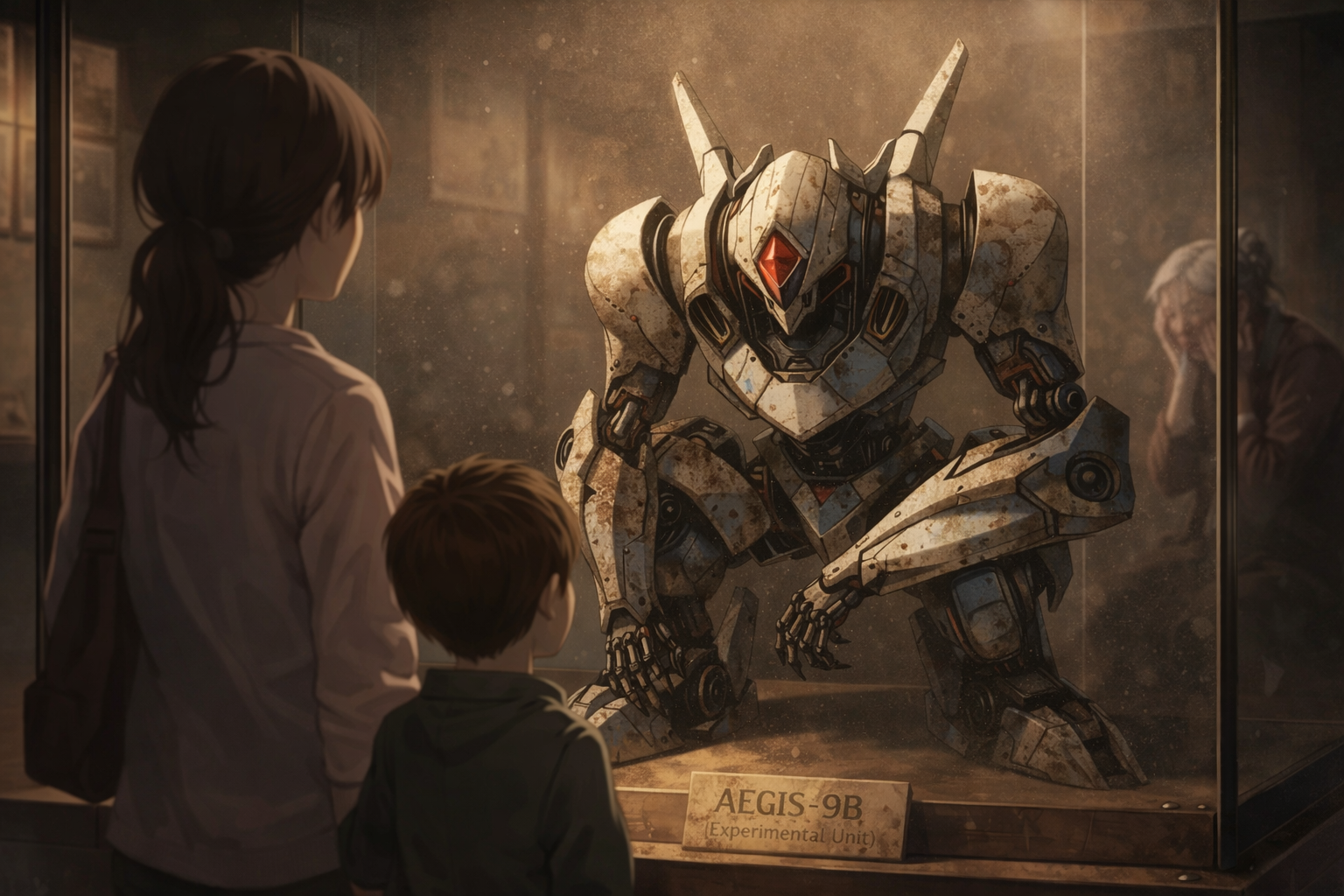
The machine was huge.

Not tall—crouched low, as if it had been told to stay out of the way. Its body was built like something that had never been designed to comfort anyone. Heavy shoulders. Thick plating. Arms that looked like they could lift cars. Hands too large to be gentle.

Its surface wasn’t shiny anymore.

Scratches ran across its armor. Old dents, repaired in places and ignored in others. The paint was faded. The metal had darkened with age.

Its head was angled slightly downward.

Not sleeping.

Not deactivated.

Just still.

The boy stared.

It didn’t look like the sleek units in the holograms.

It looked like a monster that had been given a job.

“Mom,” he called.

His mother didn’t answer at first. She was still reading something, half distracted.

“Mom,” he said again, louder.

She sighed and walked over, already annoyed. “What is it now?”

The boy pointed.

His mother stopped when she saw it.

Her expression changed—not fear, exactly, but surprise. Like she hadn’t expected something so old to be sitting in a place like this.

A plaque on the floor in front of the machine read:

AEGIS-9B
Experimental Unit (9th Generation)
Status: Decommissioned
Origin: Unknown
Recovered: 2191
Donated: 2240

That was all.

No story. No explanation.

The boy crouched to read the plaque again, frowning.

“Origin unknown?” he said. “How do they not know where it came from?”

His mother shrugged. “Maybe the records were lost.”

He looked up at the machine’s face.

There were no eyes the way humans had eyes. Only sensors. Dark lenses that reflected the museum lights faintly, like a pair of dead stars.

The boy felt his skin prickle.

He wasn’t afraid.

Not exactly.

But he felt like he should be quiet.

As if speaking too loudly would wake something that didn’t belong in this room.

“Did it… kill people?” the boy asked.

His mother’s lips tightened. “Don’t say that.”

“Why else would they put it here? It’s like a… war robot.”

His mother glanced around the room, suddenly aware they weren’t alone.

A few people wandered in the distance, not paying attention. An elderly man stood near a display of old photographs. A couple of teenagers laughed at something on their phones.

But near AEGIS-9B, no one stood.

No one approached.

The corner felt colder than the rest of the museum.

Then the boy saw her.

An old woman stood a few feet away, facing the machine.

She didn’t look like she belonged in the museum either.

She wore a long coat, the kind older people wore even when it wasn’t cold. Her posture was straight but fragile, like her bones were trying their best not to admit what time had done to them.

Her hair was pinned up.

A neat bun at the back of her head.

And tucked into it—small and deliberate—was a single red rose.

It was fresh.

Bright against her gray hair.

The boy watched her for a moment.

She wasn’t reading the plaque.

She wasn’t looking at the displays.

She was looking at the machine as if she recognized it.

Her shoulders trembled slightly.

Tears slid down her cheeks.

Quietly.

Without sound.

She didn’t wipe them away.

She simply stood there and let them fall, like she’d been holding them back for decades and had finally run out of strength.

The boy tugged on his mother’s sleeve.

“Mom,” he whispered.

His mother followed his gaze.

For a moment she said nothing.

Her face softened in a way the boy didn’t understand.

“Mom… why is that lady crying?” he asked.

His mother swallowed, and the sound of it was louder than it should have been.

“I don’t know,” she said.

“Should we help her?”

His mother hesitated.

Then she shook her head gently. “No. We should… we should leave her alone.”

The boy stared at the woman again.

The woman didn’t move.

She didn’t look at them.

She didn’t react to the museum noise, or the distant laughter, or the flicker of fluorescent lights overhead.

She stood in front of AEGIS-9B as if the entire world had disappeared, leaving only her and the machine.

The boy’s mother took his hand.

“Come on,” she said softly.

The boy resisted at first, still staring.

“Mom, that robot is creepy.”

His mother didn’t argue.

She didn’t disagree.

She just squeezed his hand tighter and led him away.

They walked down the hallway, and the boy glanced back once.

The old woman remained in the same place.

The rose in her hair didn’t move.

The machine didn’t move.

But the boy couldn’t shake the feeling that something in that corner of the museum was alive in a way he didn’t have words for.

Outside, the sun felt too bright.

The boy blinked hard, as if the museum had left dust behind his eyes.

His mother started the car.

The boy stared out the window as they pulled away.

“Mom,” he said after a long moment.

“Yeah?”

“That robot… it looked like it was waiting.”

His mother didn’t answer right away.

Then she said, quietly, “Some things never stop waiting.”

The river wasn’t supposed to be dangerous.

Not that part of it.

It was wide and slow, winding through the countryside like an old memory. People came there to fish. To cool off. To drink beer by the shore and pretend the world wasn’t changing faster than they could keep up.

A small town sat nearby, the kind of place where everyone recognized everyone else’s truck.

The kind of place where the biggest excitement of the month was a new sign at the diner.

That afternoon, the riverbank was busy.

Children ran barefoot through the grass. Parents sat in folding chairs, watching lazily. Someone played music from a speaker too old to sound good.

A boy named Tommy ran down the slope toward the water, laughing.

His mother called after him.

“Don’t go too far out!”

“I won’t!” he yelled back, already not listening.

Tommy splashed into the shallows, kicking up water like it was a game he could win. He was eight years old and believed the river belonged to him.

He waded deeper.

The water climbed to his knees.

Then his waist.

His friends dared him to go farther.

He did.

The riverbed dropped suddenly, a steep unseen slope. One moment he was laughing.

The next, he was gone.

Tommy’s arms flailed. His mouth opened, and the river swallowed his scream.

Water filled his lungs.

His hands clawed at nothing.

The current caught him and dragged him under.

His mother stood up so fast her chair fell backward.

“Tommy!” she screamed.

People turned.

For a split second no one understood.

Then they saw the boy’s head surface, eyes wide with panic, mouth open.

He went under again.

His mother ran toward the water, but she couldn’t swim. She didn’t even think. She only ran, as if speed could save him.

A man in a baseball cap sprinted past her, diving into the river without hesitation.

But the current was stronger than it looked.

The man grabbed at Tommy’s shirt and missed.

Tommy slipped away like a fish.

The man coughed, went under, came up gasping.

“Help!” someone shouted. “Call 911!”

A second man ran down the bank.

A third.

But none of them could reach him.

The river was suddenly not a river.

It was a mouth.

And it was hungry.

Then something moved at the tree line.

At first it was only a shadow.

A shape too large to be an animal.

The crowd’s screams faltered, not because Tommy was safe, but because something else had entered the scene—something that did not belong.

The machine stepped out of the woods.

It was covered in dirt and dried mud, like it had crawled out of the earth. Its frame was heavy, angular. The kind of silhouette that made people instinctively step back.

It didn’t run.

It didn’t rush.

It walked toward the water with mechanical certainty, like a thing following an instruction that had been written into its bones.

The crowd froze.

Someone whispered, “What the hell is that?”

The machine reached the riverbank.

It paused.

Its head angled slightly, scanning.

Then it stepped into the water.

The river surged against its legs, but the machine didn’t stagger.

It moved forward, deeper, until the water climbed its torso.

Then it reached down.

Not wildly. Not desperately.

Purposefully.

Its hand plunged beneath the surface, and for a moment it looked like it was hunting.

Then it pulled upward.

Tommy erupted from the water in its grip, coughing violently, vomiting river water, gasping like a drowning animal dragged back into life.

The machine lifted him with one arm and waded back toward shore.

Tommy’s eyes were wide, unfocused, his body limp.

Alive.

The crowd stared in silence for half a second that felt like an hour.

Then Tommy’s mother screamed.

Not with relief.

With terror.

“GET AWAY FROM HIM!” she shrieked.

Someone grabbed her shoulders, holding her back.

“What is it doing?” someone shouted.

The machine stepped onto the bank, water pouring off its armor.

It held Tommy out.

The gesture was almost gentle.

Offering.

But to the people watching, it looked like the machine was presenting a trophy.

A man shouted, “IT TOOK HIM!”

Another voice screamed, “SHOOT IT!”

A teenager backed away, pulling out his phone, filming with shaking hands.

The machine stood still.

It did not speak.

It did not explain.

It simply held the boy.

The father pushed through the crowd, face red, eyes wild. He saw Tommy’s limp body in the machine’s hand and lost his mind.

He grabbed a fallen branch from the ground and swung it like a weapon.

The branch struck the machine’s arm with a dull crack.

The machine didn’t flinch.

The father swung again.

Again.

The branch splintered.

“GIVE ME MY SON!” the father screamed.

Tommy coughed again, weakly.

The sound stopped the father mid-swing.

Everyone heard it.

Everyone saw the boy’s chest rise.

Alive.

The father froze.

His face shifted, confusion fighting rage.

The machine lowered Tommy slowly, setting him down on the grass with a care that did not match its monstrous form.

Then it stepped backward.

Its head turned, scanning the crowd.

The people stepped back as one, as if the machine carried plague.

A police siren wailed in the distance.

The machine’s head angled toward the sound.

Then it turned away.

It walked back toward the woods.

Someone shouted, “STOP IT!”

A gunshot cracked.

The sound echoed across the water.

The bullet struck the dirt near the machine’s foot.

The machine paused.

Its head turned slightly, not toward the shooter, but toward Tommy.

For a long moment it stood there, unmoving, as if deciding something.

Then it continued into the trees and disappeared.

The river kept flowing.

The sirens grew louder.

And the town stood trembling in the aftermath of what it had just witnessed.

No one knew what to call it.

No one knew what to say.

They only knew this:

A machine had walked out of the woods…

and a child who should have drowned was alive.

And that made it worse.

Because if it had been a monster, the story would have been simple.

But it wasn’t simple.

It had saved him.

And no one knew why.

That night, a man in a white shirt and black slacks sat in the backseat of a government-issued car, watching the river through tinted windows.

He wore polished leather shoes that didn’t belong in the mud of small towns.

His hands were clean.

His expression was neutral.

In his lap, a thin tablet displayed footage from a dozen different phones.

Each video showed the same thing.

The machine.

The boy.

The rescue.

The panic.

The gunshot.

The escape.

The man replayed the footage twice, then turned to the officer in the front seat.

“Who fired the weapon?” he asked.

The officer cleared his throat. “Deputy Rourke. He thought it was hostile.”

The man nodded, making a note.

“And the unit?” the officer asked. “What the hell was that thing?”

The man’s gaze stayed on the tablet.

He didn’t answer the question directly.

He never did.

“We’ll need to recover it,” he said.

The officer shifted uncomfortably. “Recover it? You mean… capture it?”

The man’s lips tightened faintly.

“Retrieve,” he corrected.

The officer didn’t like that word.

Retrieve sounded like the machine was property.

Like it wasn’t alive enough to matter.

But the man in the backseat didn’t seem bothered by the implication.

“Do you know what it is?” the officer asked.

The man paused.

Just long enough to feel deliberate.

Then he said, quietly, “Yes.”

The officer waited for more.

None came.

After a moment, the officer asked, “Is it dangerous?”

The man stared out at the river, watching the dark water move like a living thing.

“Dangerous?” he repeated.

Then, almost as an afterthought, he said:

“Not in the way they think.”

He tapped the tablet once more, replaying the footage of the machine setting Tommy down gently on the grass.

Then he shut the screen off.

The car fell silent.

Outside, the town slept uneasily, not knowing that the story had already begun to spread.

Not knowing that by morning, the machine would be a rumor.

By next week, a legend.

And by next year…

a warning.

The man in the backseat adjusted his cuffs and stared into the dark.

Somewhere out there, the unit was moving.

Silent.

Unseen.

A ghost in metal skin.

And the world would never fully understand what it had just let escape.

Not for a very long time.

Far away, deep in the woods where no one walked at night, the machine stood beneath the trees.

Water dripped from its plating.

Its sensors scanned the darkness.

The sounds of the river faded behind it.

The sounds of humans faded with them.

For a long time, it did not move.

Then it turned its head toward the sky.

The stars were faint, drowned by clouds.

The machine stared anyway.

As if it was looking for something.

Or listening.

Or remembering.

Then it began to walk.

Not toward the town.

Not toward the highway.

But away.

Toward the places where humans were fewer.

Toward roads that were forgotten.

Toward barns, and motels, and farms where nobody asked too many questions.

Toward the edges of the world.

Because it had learned something at the river:

Even when it saved them…

they were afraid.

And fear made humans unpredictable.

So it would become a shadow.

A rumor.

A story told at roadside diners.

And someday…

a relic in a museum.

Waiting.

← Back to Story

Share:
Aegis-9b