%20(1).png)
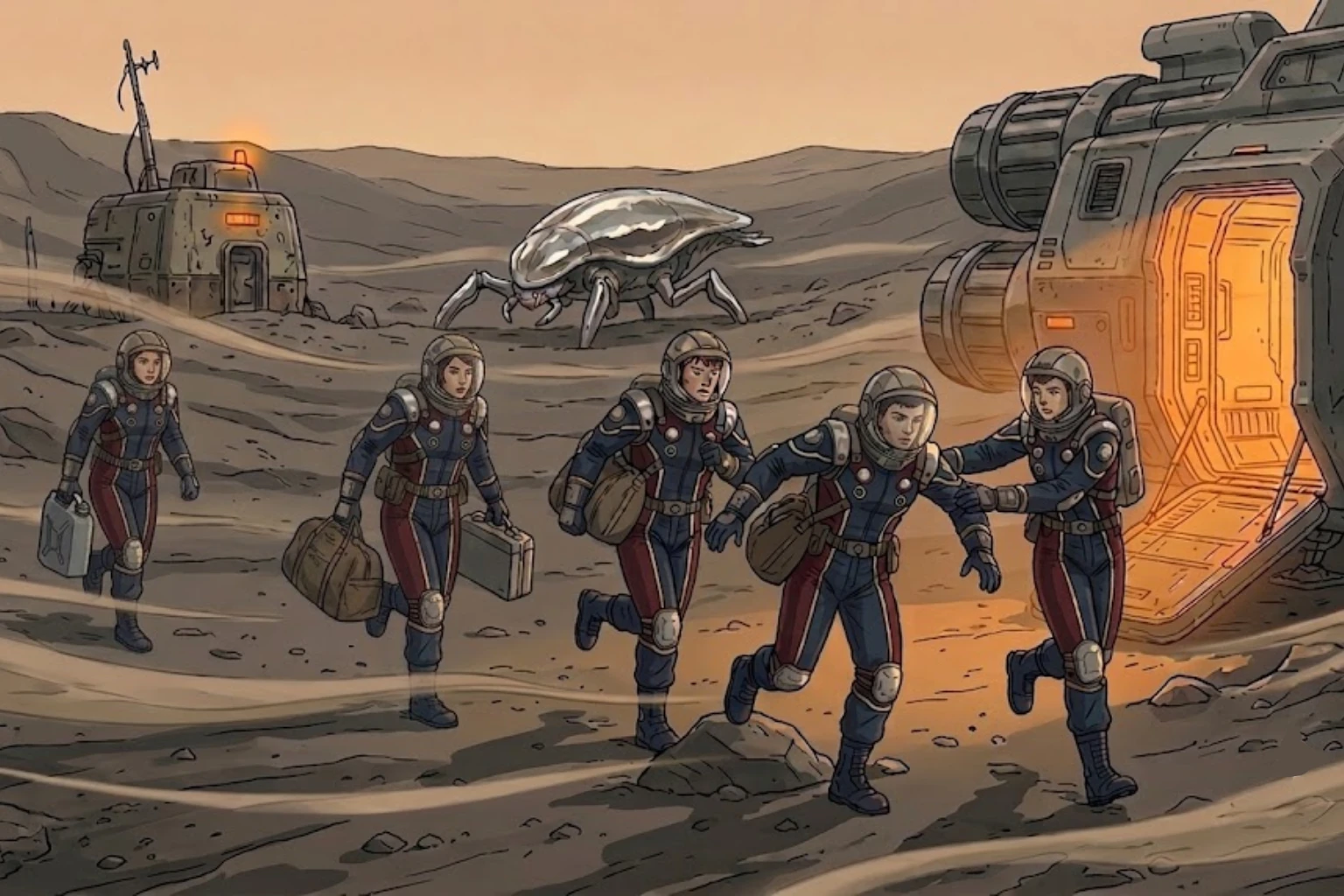
The planet announced itself through the controls before it announced itself through the viewports.
Haru felt it first as a change in the *Haruki Maru*'s attitude — a slight, irregular resistance in the flight systems that told him the ship was encountering something it hadn't encountered since they'd left the academy. Not the smooth mechanics of vacuum and inertia and the occasional gravity well they'd been navigating for weeks. Something variable. Something that pushed back.
Atmosphere.
"We're in the upper layer," Riku said, from the flight console. He had both hands on the yoke in a way he hadn't since the jump corridor — full engagement, not the light monitoring grip of normal flight. "It's thinner than academy standard at this altitude. Picking up turbulence."
"How bad?" Haru said.
"Manageable. For now." A pause as the ship moved through something that Haru felt as a brief shudder through the deck. "Ask me again in ten minutes."
Haru looked through the forward viewport. The planet had been a point of interest in the sensor readings for the past six hours — not much to look at from a distance, grey-brown and cloud-streaked, without the obvious drama of the gas giant or the stark clarity of the silent moon. It looked, from space, like a place that had nothing in particular to offer and was not apologizing for this.
Up close, through the viewport, it looked like a place that had decided to take the approach as a personal challenge.
The clouds were thick at mid-altitude and Riku was threading through them in the way he navigated tight spaces — with total attention and very little conversation. The turbulence came in irregular pulses, some gentle, some sharp, none of them dangerous but all of them requiring active management. Haru watched the flight console over Riku's shoulder and saw the constant small adjustments, the yoke inputs that kept the ship's attitude stable through each pulse.
"Sora," Riku said. "Beacon bearing on final approach?"
"Twenty-three degrees south of current heading," Sora said, from navigation. "The signal is stronger now that we're in atmosphere. I'm reading it clearly."
"Adjusting." The ship tilted, barely perceptibly. "Mei. Landing gear?"
"Online," Mei said, from engineering. "I want to say I'm confident in them. I'm going to say I am cautiously optimistic about them."
"Cautiously optimistic," Riku repeated.
"The port strut had some stress in the initial incident. I've checked it four times. It should be fine." A pause. "Cautiously."
"Terrific," Riku said, in the tone he used when he meant the opposite.
Haru noted the landing gear concern in his notepad and added it to the mental list of things to confirm after landing. Below cautiously optimistic on the port strut, he wrote *confirm immediately on touchdown.* Then he looked through the viewport at the planet coming up toward them and tried to read it the way Daigo read unknown environments — for what it was rather than what it looked like.
It looked hostile. The cloud layer broke at lower altitude into a sky that was not quite any color he had a name for, a dim washed-out tone that fell somewhere between grey and a pale orange, and below the cloud break the surface was visible: dark rock, ridges, a plain that might have been flat once and had been worked over by wind and time into something that was technically flat and practically complicated. The shadows were wrong — too long, cast by a sun that was further away or smaller than the academy's, making everything look like late afternoon even though their orbit calculations said it was local mid-day.
"Daigo," Haru said.
"Looking at the terrain," Daigo said. He was at the secondary sensor station, which was not his primary position but which had the best terrain-mapping display during atmospheric approaches. "The valley Sora's bearing is pointing us toward is bounded on three sides by ridge lines. We'll have good visibility on the approach vector but the landing site itself is going to have multiple blind spots toward the east and north."
"The way station is at the valley floor?"
"Beacon signal is consistent with valley floor placement. Approximately two kilometers from the ridge lines on the south and west. The east and north ridges are closer." He looked at the display. "I don't like the north ridge proximity. It's less than a kilometer from the beacon position."
"Noted," Haru said.
"I'd prefer we land between the station and the south approach. Gives us the most clear terrain between the ship and the ridges."
"Talk to Riku."
Daigo and Riku had a brief exchange about landing approach angles, the kind of conversation that had become easier over the past weeks — Daigo providing the threat assessment, Riku translating it into flight inputs, the two of them finding a working grammar somewhere between security caution and pilot practicality. Haru listened to it and noted, as he often noted, that the crew's inter-role communication had gotten significantly better since the first days on the bridge, when every conversation about anything had the friction of people who weren't used to each other's logic.
The *Haruki Maru* broke through the lower cloud layer and the way station was there.
---
It was squat. That was the first word that came to him — not a description that evoked anything dramatic, just accurate. A low structure on the valley floor, wide rather than tall, built with the same practical philosophy as the relay station: function over form, every design decision made by someone who understood that this structure needed to survive in an environment that had opinions about structures and to provide utility to whoever used it, not to be impressive. The roof was barely visible at this angle, and the walls were the same material as every other station they'd visited, weathered by what looked like decades of the wind that was, at this moment, moving dust across the valley floor in horizontal sheets.
A beacon mast rose from the near corner of the structure — the source of Sora's signal, a simple vertical pole with the transmitter array at its top, two of its three elements intact and functional, the third bent at an angle that suggested something had hit it at some point and it had stayed where the impact left it. Still transmitting. The reliable stubbornness of well-built hardware.
Around the structure: landing lights, most of them dark, one still functioning, a dim amber that pulsed irregularly in the wind. Supply lockers along the exterior wall, half-buried in the accumulated material that wind deposited against anything that stood upright long enough. Manual doors, two visible from this angle, the kind with physical latches and no electronic lock — designed for reliability in conditions where electronics failed.
The valley floor around the station was not flat. Not dangerous, but textured — loose stone, low rock formations, the compressed dark gravel of a place where wind sorted everything by weight over time.
"I have a landing site," Riku said. "Hundred and fifty meters south of the station. It's the flattest section I can find within safe distance."
"How close is the north ridge from there?"
"Seven hundred meters."
Daigo didn't say anything, which meant he had accepted the calculation.
"Set us down," Haru said.
The landing was rough in the way that atmosphere made landings rough — not the clean mechanical precision of vacuum docking, but a negotiation with wind and variable ground effect and the particular stubbornness of a planet that hadn't been consulted about their arrival. Riku worked through it with the same patient attention he'd brought to the cable field approach, making no sudden movements, absorbing the turbulence in his inputs rather than fighting it. The touchdown came in two stages — a soft initial contact that bounced slightly, then a firm settling as the landing struts took the full weight and the drive went to standby.
Haru watched the port strut indicator.
Green. He exhaled.
"Port strut is holding," Mei said, a half-second later. She had been watching the same indicator. "Cautious optimism confirmed."
The wind against the hull was audible now — a low, irregular sound, not constant but recurring, the voice of a planet that had weather and had opinions about visitors. Through the viewport the dust moved in long horizontal ribbons across the valley floor, and the way station's surviving landing light pulsed its amber at them through the drift.
Haru stood up from the command station.
"Mission brief," he said. "Everyone listen."
---
He had been thinking about the brief since the route data had confirmed this waypoint, and he had revised it twice during the descent. The principles were always the same — clear goals, clear roles, clear conditions for return — but each stop on the route had added information that changed how he applied those principles, and the accumulated information of the moon, the greenhouse, the relay, and the deserted station had given him a picture of how these waypoints operated that he was using now.
"Goals," he said. "Route data first — Sora, beacon core copy as priority. Supplies second — we need water, rations, anything in the supply lockers. Power cells if they're compatible. Hull material. Small components that Mei flags as useful." He looked around the group. "We are not trying to take everything. We take what we can carry comfortably and we leave enough capacity to move fast if we need to."
"If we need to," Daigo said.
"This planet has weather," Haru said. "The terrain gives us limited visibility toward the north and east. Those are reasons to work efficiently and stay aware. They are not reasons to panic." He looked at Daigo. "Your job is awareness. Not alarm. Awareness."
Daigo held his eye for a moment. "Understood," he said.
"Team split: I'm going in with Daigo, Hana, and Sora. Mei, you take Yui and the storage systems — power cells, anything in the exterior supply lockers first, then interior if there's time. Riku: you stay with the ship, keep the engines in warm standby, and be ready to spool up on my word." He looked at Riku. "That is not a small job. If we need to leave fast, you are the reason we can."
Riku nodded, which was, for Riku, unusually serious.
"Comm check every ten minutes," Haru said. "If anyone goes out of range, they come back. No exceptions. Any questions?"
Silence.
"Suits are mandatory," Hana said. "The atmosphere sampler says it's breathable but marginal — lower oxygen partial pressure than we'd like for extended exertion. The suits will regulate. Don't take helmets off outside the ship."
"You heard her," Haru said. "Suits on. We go in five."
---
The walk from the ship to the way station was a hundred and fifty meters that felt longer because of the wind.
It wasn't dangerous wind — not strong enough to make walking difficult, not cold enough to threaten the suit's thermal management — but it was persistent and directional and carried enough particulate matter that his helmet visor was getting intermittent hits of material that left no marks but reminded him continuously that this planet was not passive. The sky above the valley was the same dim pale-orange he had seen from the descent, the light flat and directionless, and the ridgeline to the north was a dark irregular shape that rose above the valley floor and sat there in his peripheral vision with the specific quality of a thing that blocked what was behind it.
He counted the group as they walked. Six going in — himself, Daigo, Hana, Sora, Mei, and Yui. Riku at the ship. Seven total. He would count them again when they reached the station, and again coming back, and again loading, and again boarding.
Seven. He needed all seven.
The station's manual door was on the south face — the one farthest from the north ridge, which he noticed and appreciated. The latch was stiff from disuse but yielded to pressure, and the door swung inward on hinges that protested with a sound that traveled oddly in the wind. Inside: the smell of old air and cold metal and something else, something organic, faint and not quite identifiable through the suit's intake but present.
Haru noted it and said nothing about it yet.
"Split as briefed," he said, on the suit comm. "Mei, Yui, exterior lockers first. We'll be inside."
"Copy," Mei said, and she and Yui went to the exterior supply lockers along the station wall while the rest of them went through the door.
---
The interior was the by-now familiar anatomy of a network waypoint: a main space with storage racks along the walls, a secondary space accessible through an inner doorway that was probably originally a service or equipment room, and the systems panel that Yui would normally be working at, which was powered down but not dead — a single status indicator showing the same faint amber as every indicator on every station they'd visited, running on the eternal backup power that the builders had apparently designed as practically inextinguishable.
The main space was not the clean-empty of the relay station's storage sections. It had been lived in — not recently, not by anything human as far as he could immediately tell, but the distinction between *never occupied* and *previously occupied* was visible in ways that Daigo was already cataloguing.
Disturbed dust, in patterns. Not the uniform settlement of undisturbed air; these were marks in it, low on the floor, curved and repeating in a way that was not the pattern of blowing air.
Along the south wall, at a height of about forty centimeters above the floor: marks in the surface coating, parallel, evenly spaced, each one three or four centimeters long. He looked at them and thought about what made marks like that and decided not to complete the thought yet.
Near the interior door: something caught in the lower corner of the frame. He crouched to look. Dry, semi-translucent, papery — the kind of material that had been something else once and was now shed. Not flesh. More like — shell. Or integument. Something's external layer, left behind.
Hana was beside him.
"I see it," she said, quietly.
"What is it?"
"I'm not sure. It's biological. It's not plant material." She was taking a photograph with her suit camera. "The edges are clean — this wasn't torn off, it was shed. Something goes through a process here."
He stood up. "Note it. Keep working."
Sora was already at the inner room, where the beacon core was — she had found the systems panel and was running her data connection cable, the process she had by now done enough times that it had become efficient, the motion of her hands familiar. Daigo was at the door to the exterior, which he had positioned himself next to, not touching it, watching through the small window panel set into it.
Haru went to the storage racks.
The supplies here were in better condition than the relay station's aged stores — newer sealing, the containers less weathered, the material quality consistent with something that had been here for years rather than decades. He pulled one of the larger containers and unsealed it. Ration packs — dense, compact, the kind of emergency calorie source that prioritized shelf life and portability over everything else. He did not recognize the branding or the language on the packaging, but the format was universally recognizable: food, sealed, preserved.
He pulled out three and added them to the carry bag.
"Hana," he said. "Can you assess these?"
She came to him and ran the medical analyzer over the ration pack. "Nutritional profile is — similar to what we had at the greenhouse. High carbohydrate, moderate protein, low fat. No compounds flagged." She looked at the packaging. "The caloric density is higher than academy standard rations. These were designed for energy expenditure."
"We take all of them," he said. "How many are there?"
He counted the containers. Fourteen.
"We take all of them," he said again.
---
Twelve minutes in, the sound came.
He heard it first as something that wasn't quite in the category of the sounds he'd been mentally sorting since they entered — the hiss of the wind, the occasional creak of the station's structure adjusting to the temperature difference between its interior and exterior, the specific sounds of six people working in a space. This was underneath those sounds. Lower in frequency. A scraping quality, not continuous, more like something that moved and then stopped and then moved again.
It came from below the floor.
Everyone stopped.
He looked at the group. Daigo was already turned toward the exterior door. Hana's hands, which had been logging inventory on her wrist unit, were still. Sora's connection cable was in but her fingers were no longer typing.
Six seconds of silence.
"Old pipes cooling," Mei said, on the comm from outside. Her voice was careful.
"That wasn't pipes," Yui said, also from outside, in the quieter voice she used when she was not fully committed to the statement.
"Keep working," Haru said. "Faster."
He picked up the pace on the storage rack, pulling containers and assessing by touch and brief visual check — rations, water, something he put back because he couldn't identify it and the time for careful assessment was over. He passed containers to Hana, who was filling the carry bags with the focused efficiency of someone who had decided that working fast was the right response to uncertainty.
Daigo was not helping with the supplies.
This was the right call. Daigo had positioned himself at the exterior door and was watching through the window, and his role right now was not to carry rations but to watch, which meant Haru had four people doing the carrying and one person doing the watching and that was the correct distribution.
He was about to ask Sora for a time estimate when the second sound came.
Not from below the floor this time. From outside the south wall.
A clicking sound — rhythmic, not mechanical, the kind of rhythm that came from a process rather than a machine, something that produced the sound as a byproduct of movement rather than as its purpose. Three clicks, a pause, two clicks. Different from the first sound in quality and direction and implication.
He felt his heart rate step up.
"Sora," he said, keeping his voice level. "Time."
"Four more minutes," she said. "Maybe three."
"Three," he said. "Three minutes."
"I'll try."
He continued loading. His hands were steady, which he was aware of and grateful for, because the thing about command was that the people around you read you whether or not they meant to, and if his hands weren't steady they would know it and respond to it, and that was information they didn't need right now.
Through the window in the exterior door, Daigo's body had gone to the specific stillness that was different from his usual controlled posture — the stillness of someone who had seen or heard something and was processing it before responding.
"Daigo," Haru said.
"Something passed the south corner," Daigo said. "Fast. Low to the ground."
"Size."
"I couldn't get a clear—" He stopped. "Large."
The clicking sound came again, from a different direction. Not the south wall now. Further east.
Moving.
"Riku," Haru said, on the comm.
"I'm here," Riku said. He was already on a different register — not casual, not performing. Just present and listening.
"Engines?"
"Warm standby. I can be hot in ninety seconds."
"Start the clock," Haru said.
A silence on the comm that was Riku starting the clock.
---
The next six minutes were the most difficult minutes of command Haru had experienced since waking up on the floor of a dark corridor with no idea where he was. The difficulty was not the fear — he was afraid, it would have been wrong not to be, and he had by now learned to use fear as information rather than noise — but the calculation that fear made harder.
They needed what was in this station. They had needed it before they landed and they needed it more now, with seven waypoints left and the jump stabilizer helping but the ship still fragile and their supply margin still thinner than he wanted. Leaving empty-handed or half-loaded because of a sound and a shape in the window was a cost that had consequences. Consequences that would be paid later, in a different kind of danger, when they didn't have the supplies they needed.
But seven cadets in unknown territory on a planet with something in it that was large and fast and making sounds like nothing in the academy's databases was also a cost. And that cost was paid immediately, and it was paid in a currency that could not be recovered.
He held the line between those two costs and kept loading.
"Yui," he said, on the comm. "Status outside."
"Power cells," she said. "I have two out of the three in the external rack. The third is stuck in its housing — the cold has contracted the casing. Mei is working on it."
"How long?"
"Mei?" Yui's voice directed off-comm.
Mei, in the background: "Two minutes. Maybe two and a half."
"Two minutes," Haru said. "Yui, if it's not free in two minutes, you leave it."
A pause. "Understood."
The clicking sound came again, and now it came from two directions at once — south and east — and the two rhythms were different, which told him something about what was making the sound that he did not want to think about clearly enough to name.
Through the interior window, dust was moving in a way that wasn't the wind.
"Something's between us and the ship," Daigo said. He said it factually, the way he said everything, but he said it.
Haru looked at the carry bags. Rations — full complement. Water — three of the four canisters, the fourth was in the secondary room and he did not have time to get it. Hull patch material — two rolls, there were more on the rack. Power cells from the interior — one confirmed, from the supply locker near the systems panel.
It was not everything. It was enough.
"Sora," he said. "Status."
"Almost—" she said, and he heard the catch in her voice that meant she was doing two things at once and one of them was finishing and she needed fifteen more seconds.
He gave her fifteen seconds.
Fifteen seconds was a long time.
The dust moved between the station and the ship. Something passed across the amber landing light that was still functional outside, and the light went dim for half a second as the something moved through its beam, and then the light came back.
"Done," Sora said. She pulled the connection cable and was at the door before she finished saying the word.
"Mei," Haru said, on the comm.
"Coming," Mei said. He heard her voice change, heard the edge that meant she was moving. "Cell is free. We're coming."
"Meet us at the south door."
He picked up the heaviest carry bag and looked at the group. Hana had the second bag. Sora had the data drive and the third bag. Daigo was at the door.
"Ready?" he said.
Nobody answered because nobody needed to.
"Go," he said.
---
They went through the door into the wind and the dust and the pale orange light of a planet that did not know or care about academy cadets, and the first thing Haru did was look toward the ship.
It was there. A hundred and fifty meters, which was one hundred and fifty meters, which he had covered on the academy's track in under twenty seconds and which was an entirely different distance in a suit carrying a heavy bag on uneven stone ground with something in the territory between them and it.
He looked for the something.
He saw it.
It was crossing the space between the north side of the way station and a rock formation sixty meters distant, moving in the direction away from the ship and currently away from them, and the movement was what struck him first — the specific quality of an organism that had evolved in this environment, the way each limb found the ground with precise efficient confidence, the way the body rode over the uneven surface without apparent effort. Low to the ground but large — the body was perhaps four meters long, he estimated, though the estimation was difficult because it was moving and because the dust and wind made the edges of things imprecise. Multiple limbs, more than four, jointed in ways that didn't match the joint structure of anything in the academy's zoology databases, which was not a large database for unknown space but was what he had.
Reflective hide or shell, catching the pale light in irregular patterns as it moved. No visible head in the conventional sense — the forward end of the body was differently shaped from the rear but not obviously differentiated in the way that head and body were differentiated in Earth fauna. The clicking sound was coming from it, or from multiple points on it, and he understood now that the two rhythms he had heard were not two creatures but one creature with multiple sound sources.
It stopped.
The body oriented. Not turned — the whole structure shifted in place, and he became suddenly aware that the way it moved and the way it perceived might be entirely different from any framework he had for interpreting body language, and that meant the movement could mean anything.
He stopped breathing.
He did not say anything. He did not move. He looked at it looking at them — if it was looking at them, if *looking* was even the right word for what it was doing — across sixty meters of dark gravel and moving dust in the dim mid-day light of a distant sun.
A clicking sound. Single. Not rhythmic.
The dust moved around its forward section.
Then it moved. Not toward them — past them, at an angle, crossing the ground between the north side of the station and the east ridge with the efficient ground-eating pace of something that had places to be and wasn't in a hurry.
"Move," Haru said. He said it at normal volume, not a whisper — the thing was past them and the wind was taking sound away from it anyway. "Move now."
They moved.
---
The hundred and fifty meters was neither as long nor as short as he had calculated.
It was long enough that his legs found the suit's thermal management insufficient for the exertion level, sweat starting at his back and neck. It was long enough for him to count heads twice — once when they started running and once halfway, because halfway was when he realized he hadn't seen Hana for three seconds and then found her beside him, having paused for a half-second to grab Sora's arm when Sora had stumbled on a loose stone.
It was short enough that Riku had the hatch open and lit before they crossed the final fifty meters, the ship's interior light cutting through the dust and the dim orange afternoon like something he had not known he was going to be glad to see.
"Creature behind you," Riku said, on the comm, in the voice he used when he was managing information delivery very carefully. "Fifty meters. It turned."
Haru did not look back.
"Mei. Yui," he said.
"Behind you," Yui said. She was twenty meters to his right, Mei beside her.
"Go," he said.
They went.
He was last to the hatch, not by decision but by the logic of carrying the heaviest bag, and as he came through the hatch Daigo was in the frame, having waited, hand out, and the hand-out part registered as information — Daigo, who ran security assessments alone and held positions alone and processed information alone, was holding out his hand in case Haru needed it — and Haru did not need it but the gesture was there.
He came through the hatch and turned.
Forty meters. The creature was forty meters away, having covered ten meters in the time it took him to board, and it was not running, it was just moving, and the difference was that running implied purpose and this movement had the quality of something that was going somewhere and had noticed a disturbance on its way there.
"Hatch," he said.
Daigo hit the close.
"Riku," Haru said.
The engines were already at full spool. He felt it through the floor as he was saying the word.
"Inventory is not secured," Mei said.
"Hold it," Hana said. "Everyone hold something down."
The *Haruki Maru* lifted.
It lifted hard — not panicked, Riku didn't fly panicked, but with the urgency of a pilot who had been watching a creature approach the hull from the cockpit and had very clear priorities about where he wanted the ship to be. The ground fell away, the wind hit the ship's surfaces and Riku compensated for it without flinching, and through the floor viewport panel — the small one in the cargo section that nobody usually looked through — Haru saw the valley floor below them, receding.
He saw the creature.
It had stopped at the place where the ship had been. Not where the ship was now, not tracking the ship's movement upward — it had stopped where they had landed, where the landing struts had compressed the gravel, and it was simply present there, its body oriented toward the sky in a way that might have been watching or might have been something else entirely, something the academy's xenobiology course would have been equipped to interpret and he was not.
Then it moved away, toward the north ridge, with the same efficient unhurried pace.
The planet receded.
---
They broke atmosphere forty minutes later, the turbulence on the way up less dramatic than on the way down or simply less noticeable because nobody's attention was available for it. The crew settled from the acute state into the exhausted state, which were different in important ways: acute was adrenaline and focus and the sharp efficiency of people doing exactly what they needed to do. Exhausted was the same people after the adrenaline cleared, the specific aftermath of sustained fear-and-function, which Haru had learned over the past weeks felt like being emptied out very quickly and then noticing the emptiness.
Hana was moving through the crew with the medical kit before the ship was fully clear of the cloud layer. Not asking, not waiting for permission — she had decided her job was happening and was doing it. He let her.
He sat at the command station and looked at the planet through the forward viewport as it diminished below them, and then he looked at the crew.
Riku at the flight console, hands still on the yoke even though the ship was in normal flight, the specific reluctance to let go of the controls after a high-intensity session. Sora at navigation with the data drive secured in her chest pocket, her free hand pressed flat against the console surface in the way she held things when she needed something solid under her hands. Yui at the communications board with her eyes closed, which was not sleep — it was the private regrouping that she did after intense periods. Mei in the cargo section, he could hear her through the open doorway, checking the bags they'd brought aboard, conducting the inventory she had needed to conduct since they were fifty meters from the hatch.
Daigo was at the secondary sensor station. He was not running scans. He was sitting.
Haru watched him.
Daigo noticed him watching and held his eye for a moment.
"You made the right calls," Daigo said.
Haru looked at him. "We left supplies on the rack."
"We left some supplies on a rack on a hostile planet with an unknown creature between us and the ship," Daigo said. "And everyone is aboard. And we have route data, rations, water, power cells, and hull patch material." He paused. "Those are the correct priorities in the correct order."
"We should have read the exterior signs before we went in," Haru said. "The marks on the door. The shed material. If I had assigned someone to a full exterior survey before entry—"
"We didn't know to look for those things," Daigo said. "We know now."
"Yes," Haru said.
"That is how learning works," Daigo said, with the particular gravity of someone who had thought about this principle and meant it.
Haru nodded.
He picked up the notepad and wrote: *Pre-entry exterior survey for biological activity signs. Mandatory on all planet-side missions.* Then he wrote: *Riku to remain at controls, not hatch-side, during planet-surface operations.* Then: *Load order: route data first, water second, rations third, power cells fourth. Non-priority items carry-if-capacity, abandon-if-not.*
He would share the list at the debrief. He would probably revise it again before the next planet-side stop. That was how learning worked.
"What did we get," he said, to the cargo section.
Mei appeared in the doorway. "Fourteen ration packs. Three water canisters — we left one. Three power cells — we got all three in the end, Yui freed the stuck one right before we had to go. Two rolls hull patch material. The beacon route data." She paused. "The ration packs are higher calorie density than our remaining greenhouse stores. Hana says they're safe. That's probably three weeks of comfortable supply margin if we're careful."
"That's good," he said.
"It's not everything that was in the lockers," she said.
"No," he said. "It's what we could carry."
She held his gaze for a moment. Then: "The route data?"
He looked at Sora.
Sora had the data drive out and was already at the navigation alcove, the connection cable interfacing with the board. "The beacon core had the same format as the relay memory," she said. "I'll have it cross-referenced with the relay data within the hour. But I can already see—" she looked at the first lines of the directory data on her display, "—we're six waypoints from the boundary now. Not seven."
"We passed one?" Riku said, from the flight console. He had turned at that, the controls releasing back to standby.
"The relay station was a waypoint in the count. We were already inside the network when we arrived there." She looked at the display. "Six more stops. Then the boundary. Then home."
Six.
He had not been counting. He was counting now.
Through the forward viewport the planet was below them, grey-brown and cloud-streaked and entirely indifferent to their departure. The valley was not visible at this altitude, just the surface of a world going about the long business of being a world, with its weather and its ridges and its creatures that moved through the gravel of the valley floor in their efficient, unhurried way, living the lives that whatever had built this route had built it around.
He thought about what Hana had said, afterward, when the ship was climbing: *next time, we assume any planet-side stop may have local life.*
It was the right assumption. The route network had been built to be used by travelers in space — which meant it had been built in space, at the orbital stations that existed outside any planet's biosphere, or on the airless surfaces of moons where the only life was whatever life the travelers brought. The planet-side stations were different. The planet-side stations had been built in places that already had something living in them, and whatever that something was had had years — possibly many years — to decide what to do about the station in its territory.
The creature at the valley floor had not attacked them. It had moved through its territory and noticed a disturbance and investigated and decided, in whatever way creatures decided things, that the disturbance was temporary. It had been right.
He thought about the column in the gathering room of the relay station. The care that had gone into building a space where people — whatever kind of people they were — could sit together and exist in a space built for them.
*The road does not belong only to them.*
He had said something like it to himself and had not been sure it was true. He was more sure now.
"Course?" he said, to Sora.
"I'll have it within the hour," she said.
"Take your time," he said. "We're not in a hurry for the next hour."
He put the notepad down on the command station. He looked at the planet through the viewport until it was small enough to be a feature of the sky rather than a ground beneath them, and then he looked at the stars beyond it, which were still wrong and still unfamiliar and were beginning, in the way of things that had been seen many times, to feel like something he knew.
Not home. Something else.
Something he would know the absence of, after, and that was its own kind of knowing.
He got up and went to help Mei with the inventory.


.png)
.png)
.png)