%20(1).png)
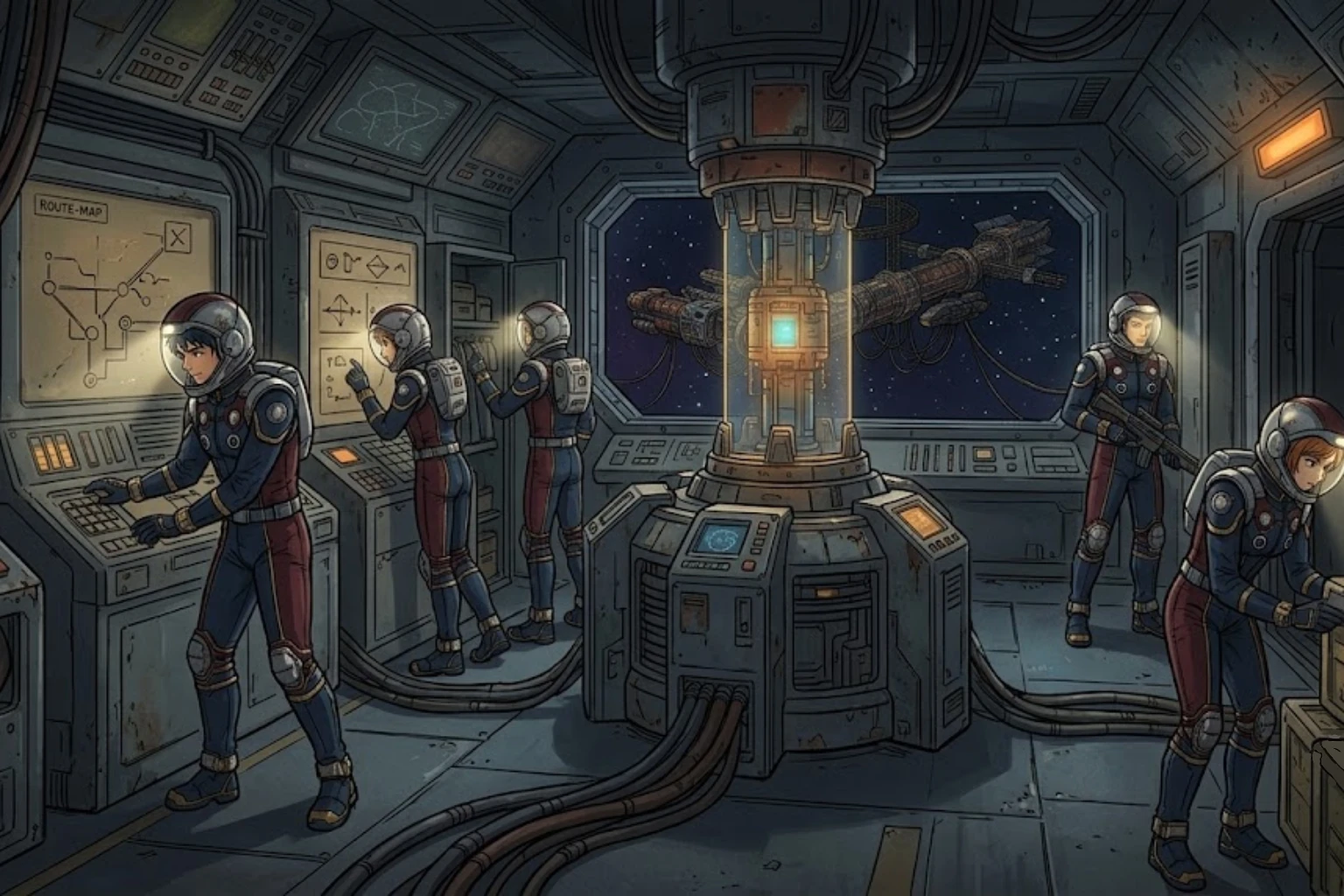
Daigo took point because that was his role and because he was better at it than anyone else on the crew, which were two different reasons that happened to produce the same result.
He had taken point on every entry since the moon, in fact — the airlock cycling, the first step through the hatch, the initial sweep of whatever space they were entering before he signaled the others forward. Nobody had assigned this to him formally. It had simply become the pattern, the way things became patterns in small groups under pressure: someone did something correctly once, and then they did it again, and after the third time it was no longer something they had decided but something they did.
He was, he knew, more comfortable with this particular role than with most social arrangements. Point was clear. Point had defined responsibilities and defined success criteria. Point meant his job was to observe and assess and report, and reporting was something he could do without ambiguity.
The relay station's access tunnel was approximately twelve meters long, which he knew because he counted his steps — two and a half steps per meter, forty-three centimeters per step, the measurement calibrated against known distances in the *Haruki Maru*'s corridors until he trusted his own pace. The tunnel had emergency lighting at the far end, blue-white, the color of power systems running on minimum draw, and the helmet lights of seven cadets had plenty of illumination for the space between.
He scanned as he walked.
No obstructions. No loose debris inside the tunnel — the external debris field around the station hadn't penetrated the interior, which meant the station's hull integrity was intact at least in this section. The walls were the same material as the beacon station and the greenhouse: not academy alloy, something older and slightly different in surface quality, smooth in a way that suggested manufacturing rather than machining. The deck plates were secure — he tested each one with his foot before committing his weight, the way he had been taught for unknown structural environments, and all of them were solid.
He reached the inner hatch at the end of the tunnel and ran his check before opening it: seal integrity gauge on the door frame, both sides, reading as equalized. Power indicator: amber, meaning the lock was on emergency power but functional. Manual override: present and accessible.
"Inner hatch is sealed and equalized," he said, on the suit comm. "Pressure on both sides is matching. No structural alarm."
"Open it," Haru said, from three meters behind him.
He opened it.
The space beyond was a junction — a hexagonal room with six passages leading off it in different directions, the architecture of something designed for traffic in multiple directions simultaneously. Emergency lighting ran around the circumference of the junction, the same blue-white as the tunnel, enough to see by. The room was empty except for things that had been there a long time: a bank of what appeared to be docking control panels on the right wall, dark except for one indicator light that blinked at a slow steady interval; a maintenance locker on the left wall, its door hanging slightly open; and on the floor, the kind of accumulated stillness that came from a space that had not had air movement in years, a thin layer of particulate matter that Daigo's helmet light turned silver when it caught it edge-on.
Not dust from decay. Dust from time. Different quality. He had learned the difference during a training exercise in an abandoned academy observation post on an outer moon, where he had spent forty minutes categorizing the contents of a room that had been sealed for thirty years and was being used as a forensic assessment exercise. The instructor had shown him how much you could determine from the character of a room's stillness.
He scanned the passages.
Three of them had door hatches visible at their ends. Two were open corridors that curved away. One was sealed by an emergency bulkhead that had closed at some point and stayed closed.
"Junction is clear," he said. "Six passages. One bulkhead sealed. No immediate threats." He walked to the center of the room and turned slowly, continuing the scan. "The docking control panel has one active indicator — consistent with the relay pulse Yui was tracking. The maintenance locker is open but I can see the contents from here. Standard replacement hardware, old stock, nothing loose."
The others came through one by one. He watched them as they entered and moved through the junction, noting the different ways each of them used the space.
Yui went directly to the docking control panel. Sora moved to the wall and ran her fingers along the frame of the passage that curved left, looking at something in the construction. Mei opened the maintenance locker further and began examining the contents with the focused attention of someone cataloguing resources. Riku stood in the center of the room and looked at the passages the way Daigo suspected he looked at flight corridors — reading the geometry, assessing the options. Hana did what Hana did, which was check everyone else before checking the room.
Haru came through last and stopped beside Daigo.
"Assessment," he said, quietly.
"Old and abandoned," Daigo said. "Not recently — the particulate settlement in here is consistent with years, not months. The emergency power is running on whatever backup source the station has, which means it's been maintaining minimal function on its own for an extended period." He looked at the sealed bulkhead. "That's the one I want to know about. Emergency bulkheads close automatically under two conditions: hull breach in the adjacent section, or manual activation. I'd like to know which one happened before we go further."
"Can you find out without going through it?"
"The bulkhead control panel should be here in the junction." He scanned the walls and found it — a small panel adjacent to the sealed passage, dark, but with a manual status display that ran on independent power. He crossed to it and read the display. "Manual activation," he said. "And the date stamp — Haru, this bulkhead was closed manually forty-seven years ago."
Forty-seven years. He said it and heard the number settle over the group.
"The station is forty-seven years old?" Riku said.
"The station may be older," Sora said. She had been looking at the wall markings. "The construction style is consistent with the beacon and the greenhouse. Same builder, same period. But the bulkhead was sealed forty-seven years ago, which means someone was here forty-seven years ago and made that decision."
"What's behind it?" Mei said.
"I don't know," Daigo said. "Without opening it, I can't verify hull integrity on the other side. I'd prefer not to open it without more information." He looked at Haru. "There are five other passages."
"Then we take the other passages first," Haru said. "Yui, can you get anything from the control panel?"
"Working on it," she said. She had a connection cable from her suit's data port interfaced with the panel's external port — a direct connection, bypassing the wireless systems that were clearly not functional. "The panel is in low-power mode. I can see system directories but the interface is slow."
"Take your time," Haru said. "We're not in a hurry yet."
Daigo noted the *yet* and appreciated the precision of it.
---
The two right-hand passages led to sections he categorized as storage and maintenance respectively.
The storage section was a long room, lower ceilinged than the junction, with racking along both walls and what had once been a clear center aisle that was now partially occupied by containers that had shifted from the racks over time and settled at angles on the floor. The containers were old — the material was the same as the beacon station's sealed storage box, weather-worn in the thermal sense, expansion and contraction cycling over decades having given the surfaces a particular texture. Some were open. Some were sealed. He checked each one he could reach.
Most contained what you stored in a relay station's warehouse: spare components of types he couldn't fully identify, packaged in the hermetically sealed format of things intended for long storage. A few containers held something that looked like concentrated food supply — sealed, aged, almost certainly past any reasonable safe consumption date. He noted them and moved on.
What he was looking for, and found in the third sealed container he opened, was power cells.
Eight of them, in the same format as the cells from the beacon and the greenhouse, in the protective rack that kept them charged during storage. He ran the charge indicator on the nearest one: sixty-two percent. Not full, but functional. He tagged the container with a location marker and moved to the next rack.
Mei found him in the storage section twenty minutes later.
"What did you find?" she said, looking at his tagged containers.
"Power cells — eight, at partial charge. Spare components I can't identify but you might. Two sealed containers I haven't opened yet on the far rack."
She moved past him to the far rack with the efficiency of someone who had been waiting for this and opened the first sealed container in the time it took him to walk to her position.
"Hull patching compound," she said. "This is — Daigo, this is the same compound I've been using on the fracture. Better grade than what we have, actually." She opened the second container. "Jump coil stabilizer. One unit, secondary grade. Our stabilizer is rated for the jumps we've been doing, but this one—" She held it up and turned it over in the suit's gloved hands. "This is the newer design. More tolerant of stress variance."
"Which means?"
"Which means if I swap this for ours, our jump tolerances improve. The pressure spikes that Riku was fighting in the corridor — this reduces them. Not eliminates, but reduces."
"By how much?"
"Enough to matter," she said, which was Mei for *significantly.*
He tagged the containers and they moved on.
---
The maintenance section was smaller and more immediately useful. Tool racks along the walls, some emptied, some still carrying equipment in formats that were not exactly academy standard but were close enough in function to be adaptable. He found, on one wall, a complete relay maintenance kit in a sealed case — testing equipment, interface adapters, connection cables in formats he couldn't immediately identify but that Yui would almost certainly be able to use.
More importantly: along the back wall of the maintenance section, a series of access panels for the station's power routing system, with manual controls for redirecting emergency power to specific station sections.
He called Haru.
"The maintenance section has power routing controls," he said. "Manual. If Yui needs more power to the control panel interface, I may be able to provide it from here without pulling from the relay's main backup."
"Hold that option," Haru said. "Let Yui see what she can get first."
He held the option and continued the survey.
It was in the maintenance section that he found the first evidence of who had been here.
It was not dramatic evidence. It was a set of marks on the wall beside the aft tool rack — not carved, more like someone had pressed against the wall while working and left a partial impression in the soft surface coating the material had, at some point, still had when it received the impression. A hand, or something like a hand, slightly larger than his own, in a configuration that was not quite human but suggested the same basic structure: palm and fingers, the fingers broader than his, the proportions slightly off.
He stood looking at it for a while.
Not human. The proportions were close enough that the general shape was familiar — whatever had pressed against this wall had been upright, two-armed, of roughly comparable size to a human adult. But the hand was different. Four broad fingers where he had five narrower ones, the thumb-equivalent on the far side rather than the near side.
He photographed it from three angles with his suit camera and did not mention it over the comm.
He needed to look at it for a while first.
---
The two left-hand passages led back to each other in a loop that ran around the outer ring of the station's central structure — a circular inspection corridor with viewport panels set into the outer hull at intervals, looking out at the cable field and the tethered ships. He walked the loop slowly, looking through each viewport as he passed.
The ships were more visible from here than from the *Haruki Maru's* bridge — closer, the angle different, the details he hadn't been able to resolve at distance now clear in the helmet lights that caught the nearest hull surfaces.
The cargo vessel was the largest. He could see the hull markings from this angle — not the same style as the beacon's engravings, different, a more complex marking system with multiple elements that suggested identification rather than navigation. He photographed it. At the forward end of the cargo vessel, where the tether cable attached to the hull, there was a docking collar — standard format, the cable connected through a proper attachment point rather than improvised lashing. Someone had rigged this tether carefully, using the right equipment for it.
They had planned to come back.
That thought arrived with more weight than he had expected. He stood at the viewport looking at the cargo vessel's tether point and held the thought for a moment. They had planned to come back. Whatever reason they had for leaving their ship tethered to a relay station, they had done it with the intention of returning. They had used the right equipment, the proper collar, the kind of attachment you made when you expected the connection to be maintained.
They hadn't come back.
He moved to the next viewport.
The scout vessel was the damaged one — he could see the hull breach now from this angle, a section of the forward hull that had been torn inward by something and then sealed from the inside with patch material. Old patch, the edges worn by whatever temperature cycling this region of space experienced. The breach had happened before the ship was tethered here; the patch was old under the tether marks. The ship had arrived already damaged.
It had been brought here. Or it had come here. And whoever had come with it had left it tethered and gone somewhere, and hadn't come back.
He thought about the manual closing of the bulkhead. Forty-seven years ago. Someone had been in this station forty-seven years ago and had sealed a passage manually and then left.
He was constructing a picture, and the picture was not one he had expected.
"Daigo." Yui's voice on the comm. "I have partial interface with the relay control system. Haru wants everyone back in the junction."
"Coming," he said.
He took one more look through the viewport at the tethered ships, hanging in their patient stillness around the station, cables stretched taut, and then he turned and walked back.
---
The junction had changed in the time he'd been in the outer loop. Yui had brought the docking control panel to a partial active state — not full power, not the complete interface that the station would have had when operational, but enough that the main display was showing information. A reduced, text-only display in the same geometric script as the beacon plates, but with enough standard navigation formatting that Sora was already working through it with her notebook.
"What do we have," Haru said.
"The relay has navigational memory," Yui said. "It's fragmented — sections have dropped out over time, probably corrupted storage — but the core routing data is mostly intact. I'm pulling it now, but it's slow. The interface is old."
"How long?"
"I don't know. An hour, maybe more. I need to copy everything I can find before the connection drops."
Haru looked at the group. "We split the remaining work. Yui stays here with the relay. Sora assists with the navigation data. Mei — what do you need?"
"The storage section power cells and the jump stabilizer," Mei said. "I can start the transfer with help."
"Riku and Hana with Mei. Daigo—"
"The sealed bulkhead," Daigo said. "I want to know what's behind it."
Haru looked at him. "Is it necessary?"
"I don't know yet," Daigo said. "But a manually sealed bulkhead in an abandoned station is information. If there's a hull breach on the other side, I want to know before we've committed to a longer stay here. If there's something else—" He paused. "I want to know."
Haru held his gaze for a moment. "Take the manual override and go slow. Comm me before you open it."
"Agreed."
He went to the bulkhead control panel and began the manual override sequence, which was standard academy emergency protocol and which, fortunately, the station's designers had implemented in a format close enough to academy standard that he could work through it. The override was not fast — it was designed to be deliberate, each step requiring confirmation before the next step was enabled, preventing accidental openings in crisis conditions.
While he worked through it, he thought about the handprint on the maintenance section wall.
He had been thinking about it since he found it. He was, by training and by inclination, a person who categorized threats: known, unknown, probable, possible, active, historical. The handprint was historical — whatever had left it was not present now and had not been present for a significant period. It was therefore not an immediate threat. It was information.
What the information meant was that the people who had built and used this route network were not — or were not exclusively — human.
He sat with that thought.
At the academy, xenobiology and xenoanthropology were senior-track elective subjects. He had taken neither, having focused his elective credits on security systems, forensics, and field assessment. He knew the basic outline: the academy had confirmed evidence of two prior spacefaring civilizations in mapped space, both long extinct, both known only through artifacts and ruins. There were no confirmed active non-human civilizations in the academy's current knowledge base.
This region was outside the academy's current knowledge base.
He filed it under *information* rather than *threat* and continued the override sequence.
The bulkhead status light changed from red to amber — override accepted, ready to open on command.
He keyed his comm. "Haru. Bulkhead is ready. I'm opening it."
"Go ahead," Haru said.
He opened it.
The passage beyond was identical in construction to the other passages — same material, same emergency lighting format. The lighting here was off, which meant the section had lost power at some point, or had been cut off from the power system when the bulkhead was sealed. He switched to helmet light and walked forward.
The passage ended in a room.
The room was not a junction or a storage section or a maintenance area. It was larger than any of those, with a higher ceiling, and the construction of the walls was different — more finished, less utilitarian, the surfaces smoother and the proportions of the space more considered. There were objects in the room that he couldn't immediately categorize: flat-surfaced platforms of varying heights, arranged in a configuration that was not random; a wall installation that had once been lit but was dark now, its surface covered in the geometric script; and in the center of the room, a freestanding column approximately two meters tall, made of the same material as the station but with a quality to its surface that suggested it was not structural — it was placed.
It was a meeting room. Or a reception space. Or something with a social function rather than a mechanical one.
He stood in the doorway and looked at it for a long time.
Then he photographed everything, systematically, and keyed his comm.
"Haru," he said. "You should come see this."
---
They gathered in the room while Yui and Sora continued working the relay interface in the junction — this was not their job right now, and Yui had said very clearly that she needed to focus on the data transfer without interruption. The others came one by one as Daigo called them through.
He watched their faces as they entered and looked around.
Riku said nothing for almost thirty seconds, which was longer than Riku was usually silent.
Mei went directly to the wall installation and examined the surface without touching it, leaning in close, her helmet light at an angle to pick up the texture.
Hana moved slowly through the space, looking at the platforms, at the column, at the construction of the ceiling.
Haru stood in the center and turned slowly, taking it in.
"A meeting room," Haru said.
"Possibly," Daigo said. "The function could be different from what the spatial logic suggests to us. But the arrangement is consistent with a gathering space — multiple surfaces at varying heights could be seating or work surfaces for multiple individuals."
"Individuals," Riku said. "You mean people."
"I mean the beings that used this station," Daigo said. "Who may or may not have been human." He showed Haru the photograph of the handprint on his suit camera display.
Haru looked at it for a long moment.
"Four fingers," he said.
"Yes."
"This station wasn't built by humans."
"Almost certainly not. The construction style is consistent with what the academy has documented from the known extinct civilizations — the material properties, the geometric notation system on the beacon and the greenhouse and here. But I can't make a definitive determination from what I have. I'm not a xenoarchaeologist."
"None of us are," Haru said.
"I photographed everything. When we get home—" He stopped. "If we get home. There are people who can analyze this properly."
"When we get home," Haru said, firmly, and Daigo looked at him and accepted the correction.
"When we get home," he said.
The room was quiet around them — the particular quiet of a space that had been designed for sound and voices and whatever the equivalent of conversation was for the beings who had made it, now reduced to the breathing of seven humans inside sealed suits, the faint sounds of the station's minimal systems somewhere beyond the walls.
He had expected to find danger here. He had come through the bulkhead ready to respond to something — a structural problem, a hazard, evidence of something active that required a security response. Instead he had found a room that someone had cared about. A room with considered proportions and finished surfaces and a central column that served no structural purpose, which meant it had been placed there for a reason other than structure.
A gathering place. Built by beings with four broad fingers who had also built a network of survival stations stocked with food and power cells and position markers, along a route that ran through this corner of unknown space and pointed, however indirectly, toward the direction of home.
He thought about what Sora had said at the greenhouse: *practical and caring aren't exclusive.*
He had not fully agreed with her at the time.
Standing in this room, looking at a column that served no purpose except the purpose of being in the room, he found himself revising his position.
---
Yui's voice on the comm, from the junction: "I have the route data. Or most of it. Daigo — I need you."
He excused himself from the gathering room — that was what he had decided to call it, which was not a technical designation but was accurate — and went back to the junction.
Yui was at the control panel with the focused intensity of someone in the last minutes of a difficult operation, her connection cable still interfaced, her eyes on the display. Sora was beside her with the notebook, writing quickly.
"What do you need," he said.
"The power routing controls in the maintenance section," she said. "The relay memory transfer is going slow because the interface is drawing on the main backup and the main backup is degrading as we use it. If you can reroute from the maintenance section power controls — just the junction and this panel — it might give me enough draw to finish the copy before I lose the connection."
He went.
The maintenance section power routing panel was exactly where he had found it. He ran the manual reroute in four minutes, redirecting the station's secondary power supply to the junction and the docking control panel and cutting the draw from the outer corridor lighting systems, which they were not currently using. The junction power levels, on the indicator he could see through the panel's display, stepped up by a noticeable margin.
"Better?" he said, on the comm.
"Better," Yui said. "Keep it running."
He stayed at the panel and kept it running.
While he waited, he looked at the handprint on the wall again. He had been looking at it intermittently since he first found it, and each time he looked he found something slightly different to notice. The depth of the impression — whoever had pressed this hand against the wall had pressed with comfortable, casual force, not the force of someone bracing against something or falling. The angle — the hand was at a height consistent with a standing being of approximately similar stature to himself, which meant the builders of this station were in his general size range. The four broad fingers radiating from the wide palm, the thumb-equivalent at the outer edge.
He raised his own gloved hand and compared the shapes.
Different. Same purpose. Same basic logic of form following function. Whatever these beings had been, they had developed a form that solved the same problems of dexterity and manipulation that human hands had solved, through a different configuration.
He thought about the forty-seven years since someone had last been here. About the ships tethered outside, carefully attached with proper equipment, by someone who planned to return. He thought about what might have happened forty-seven years ago that had ended the route. That had closed a bulkhead and tethered ships to a relay station and then left everything sitting in the dark with the amber light still turning.
He did not have an answer. He noted the question for when he did.
"Done," Yui said, on the comm. "I have the route data. Cutting the interface."
He released the power reroute and went back to the junction.
---
The station shifted at hour three.
Not dramatically — a movement so slight that he felt it through his boot soles rather than saw it, a small structural adjustment, the kind that happened when old materials that had been at rest for a long time experienced a new load. In this case, the new load was them: seven suited cadets moving through the station, plus the active power draw they had introduced through the junction panel.
The shift was followed, four minutes later, by a change in the docking seal integrity reading on his suit's status display.
"Haru," he said. "Docking seal integrity dropped three points. We're at yellow."
Haru's voice was immediate. "Riku, back to the ship. Warm the thrusters."
"On my way," Riku said.
"Daigo, what else do we need?"
He ran through the list quickly. "Yui has the route data. Mei — what do you still need?"
"The jump stabilizer and the power cells are already in the transfer tunnel," Mei said, from the storage section. "I need one more trip for the patching compound."
"One trip, fast," Haru said. "Everyone else to the junction and ready to move."
The next fifteen minutes had the quality of a controlled departure that was not quite urgent but was not relaxed either. Mei made her one trip for the patching compound — quickly, efficiently, no wasted movement. The others moved to the junction and then through the access tunnel in sequence, Daigo taking the rear position the way he had taken the point on entry.
He stopped at the docking control panel before he left and looked at the single blinking indicator light — the timing pulse, still broadcasting its forty-one-second rhythm into the dark.
He thought about the builders of this station, who had constructed a network of survival waypoints along a route through empty space, stocked them with what travelers would need, built a gathering room with a central column and finished walls, and then one day sealed a bulkhead and tethered their ships outside and gone somewhere and not returned.
He hoped they had found what they were looking for.
He went through the access tunnel and heard the hatch close behind him.
---
Riku undocked carefully, which was the only way Riku undocked anymore, and the *Haruki Maru* eased back from the relay station with the slow control of a ship that had learned patience from its pilot. The cable field slid past outside the viewports, the heavy lines visible and motionless in the way things in deep space were motionless — not because they weren't moving, but because there was nothing to measure the movement against.
They came clear of the field and Riku brought them to a holding position, and they all looked at the station through the viewports.
It looked the same as it had when they arrived. The amber light rotated at the top of the tower, one revolution every thirty seconds. The tethered ships hung in their positions, the cargo vessel's emergency amber still blinking its slow patient signal. The debris drifted in its unhurried way around the whole arrangement.
"What did we get," Haru said, to the room.
"Route data," Yui said. "The relay's navigation memory had the full network directory. Not just the next waypoint — the whole sequence, as far as the relay's records went. Sora is still working through it, but—" She looked at Sora.
"Seven more waypoints after this one," Sora said. "Mapped in the relay memory. The network extends across approximately thirty light-years from this position, running northeast relative to our current bearing." She looked at her notebook. "The last waypoint in the memory is close to the academy boundary. Not inside it — outside, but close. If the network reaches that far, we can reach the boundary from the last waypoint in — I need to do the calculation. But it's possible."
"What else did we recover," Haru said, to Mei.
"Jump stabilizer," Mei said. "When I install it, our jump tolerances improve. The pressure spikes Riku was fighting will reduce — not eliminate, but reduce. Hull patching compound, better grade than what we have. Eight power cells at partial charge, compatible with our systems. I also have a relay maintenance kit that has components I want to look at more carefully — there may be adapter materials in there that I can use for the atmospheric processor integration I've been working on."
"Food?" Hana said.
Mei shook her head. "Sealed containers, but the contents were past any safe date. I didn't bring them."
"We have stores from the greenhouse," Hana said. "We're all right for now."
Haru wrote it all down. "Daigo," he said. "The bulkhead."
The bridge was quiet. He had not yet reported what he found to the full crew — there had been no time during the station visit, and Haru had not pressed him on the comm. Everyone was looking at him.
He told them about the gathering room. He described the construction, the platforms, the column, the finished walls. He showed the handprint photograph on his suit camera to the bridge display.
Nobody spoke immediately.
"Four fingers," Riku said, finally, the same words Haru had said in the room.
"Yes."
"So the people who built the network — the stations, the beacon, the greenhouse—"
"Were not human," Daigo said. "Almost certainly. The geometric notation system is consistent across all three stations we've visited. The beacon, the greenhouse, the relay. The same builder. Not human."
"But they built survival stations," Hana said. "Stocked with things that kept a crew of seven alive and moving."
"Yes."
"Why would non-human beings stock survival stations with things compatible with human life support?"
He had been thinking about this since the maintenance section. "Two possibilities," he said. "The first is that the things they stocked happened to be compatible with human needs by overlap — similar enough biology or similar enough technology that the power cells and food supplies and atmospheric filters work for us too." He paused. "The second is that the network was designed to support a range of travelers. Not specifically humans. Anything in roughly our range of physiological requirements."
"A road," Yui said, quietly. "Built for anyone."
"That's one way to read it," he said.
Another silence.
"There's something else," he said. "The tethered ships. The sealed bulkhead." He looked at Haru. "Someone was here forty-seven years ago. They sealed that bulkhead and they tethered those ships and they didn't come back."
"What happened to them?" Mei said.
"I don't know," he said. "But I found something in the relay data that Yui pulled — she flagged it for me when I came back through the junction." He looked at Yui.
Yui pulled up the notation on her display. "In the route memory, there are warning markers on certain sections of the network. Most of them are navigational — gravity gradients, debris fields, things to avoid during transit. But there's a marker type that appears in a few places that doesn't fit those categories." She showed the display to the bridge. "The notation isn't one I can translate, but the pattern of where it appears in the route — and the proximity of one of those markers to this station — suggests it may be associated with whatever happened here."
"A natural phenomenon," Sora said, carefully. "In the route data, there's a notation near the marker that includes the same geometric elements as the gravity gradient warnings, but on a larger scale. I've been looking at it." She showed her notebook page — the rendering she'd made of the relay notation. "I think it may indicate a compact gravitational event. A dark mass or a gravity scar — a region where spacetime is irregular in a way that affects transit."
"The kind of thing that would throw a ship off course," Haru said.
"The kind of thing that would throw a ship significantly off course," Sora said. "And potentially disrupt navigation, communications—"
"Remote override," Daigo said.
The word settled over the bridge.
"I'm not saying it explains what happened to us," Sora said, carefully. "I'm saying the route data notes it as a hazard. That's all I know."
"But if a dark mass drift intersected with the training route—" Yui started.
"It might explain the gap in the logs," Daigo said. "The interference that degraded the recording. The override going offline." He was thinking aloud, which was something he rarely did, and was aware of the group listening, and continued anyway because the thought needed to be completed. "Not sabotage. A natural phenomenon, powerful enough to disrupt the ship's systems and redirect the jump."
"Which doesn't mean it wasn't also sabotage," he added, because accuracy mattered. "Both things could be true. But it's another explanation."
Haru was looking at him with the expression he had when he was thinking carefully. "Does it change what we do next?"
"No," Daigo said. "We follow the route data either way. We need the waypoints regardless of what put us here."
"Then we follow the route," Haru said.
Outside, the relay station turned its amber light through the dark. The tethered ships were still. The cable field drifted in its slow, patient arrangement, unchanged by their visit, unchanged by the decades before their visit, changed only by the time that passed over everything eventually.
Riku brought the *Haruki Maru* around on the new bearing — Sora's calculation, drawn from the relay's route memory, pointing toward the fourth waypoint in the network. The relay station fell behind them and diminished and became a shape among shapes in the dark, and then the amber light was all that was visible, still turning, still broadcasting its patient signal into a space that was, for the moment, empty again.
Seven more waypoints. Thirty light-years. The boundary of home space, somewhere beyond the edge of the academy's maps.
Daigo looked at the handprint photograph on his suit camera display one more time, and then put the camera back on his belt.
The beings who had built this road had not come back to their ships. He did not know why. He did not know if he would ever know why. But they had built the road, and stocked it, and left it running — the beacons transmitting, the greenhouse growing, the relay still cycling its amber light after forty-seven years — and because they had done all of that, seven cadets from the academy who had ended up forty-one light-years from home in a damaged training ship had food, and power, and a direction to go.
He thought that was worth noting.
He noted it.


.png)
.png)
.png)