%20(1).png)
The ship smelled different.
Riku had noticed it the morning after they left the greenhouse station — something green underneath the usual recycled-air flatness of the *Haruki Maru*'s atmosphere, a biological note that hadn't been there before. Not strong, not unpleasant, just present, the way a room smelled different when you brought plants into it. The food stores were in the cargo section, the seeds in sealed containers in the training bay, and the atmospheric filter media that Mei had pulled from the greenhouse processors was in a temporary housing she'd rigged in the port engineering corridor, already — she claimed — beginning to contribute to their air processing cycle.
He had stood in the corridor outside his bunk on the first morning and just breathed it for a minute.
Nobody had said anything about it. But the bridge conversations were slightly longer than they had been before the greenhouse, and the silences between them slightly more comfortable, and at the meal table people took more time eating instead of finishing quickly and going back to their stations. Riku noticed these things because he was a pilot and pilots read environments, and because he had been scared for seven days and was learning the difference between scared-scared and working-scared, and the greenhouse had shifted the crew from the first kind to the second.
Working-scared was manageable. Working-scared was fuel.
He had spent the two days since the greenhouse at the flight console for most of his waking hours, not because Haru had asked him to but because the jump was coming and he needed to know the ship's flight response as well as he knew his own hands before he put it through something neither of them had done before. He ran attitude thruster tests at intervals. He checked the manual flight controls against the automated systems and noted where the two diverged, because they always diverged and the divergences were information. He read the flight manual for the *Haruki Maru*'s jump system, which he had read twice at the academy and now read again with the different attention of someone who was going to actually use it.
The academy's jump manual was written for supervised training exercises. It assumed an instructor on board, a monitored jump corridor, a destination with beacon confirmation, and a recovery team available if something went wrong.
Their jump had none of those things.
He read the manual a third time and highlighted the sections about manual corridor maintenance.
On the morning of the jump, Mei came to the flight console before anyone else was on the bridge and sat on the edge of the navigation alcove and looked at him.
"How are you feeling," she said.
"Fine," he said.
"That's what people say when they're not fine."
He looked at her. "I'm nervous," he said. "Which is appropriate, given the situation."
"Yes," she said. "It is." She had her engineering log open on her hand terminal and was looking at the drive data, not at him. "The fracture patch is holding. I've been checking it every six hours for two days. The power cell integration is working — we're at sixty-two percent jump efficiency, which is not great, which is actually genuinely not great, but it's enough."
"Enough for this jump."
"Enough for this jump. Not enough for a second jump without significant recovery time and ideally another power source." She looked up. "I need you to understand that the drive is going to strain. Especially in the middle of the jump corridor — that's where the stress on the fracture patch is highest. You're going to feel it in the controls. The ship is going to want to wander."
"I'll hold it."
"I know you'll try. I'm telling you: if I call out that the patch pressure is spiking, you reduce power. Immediately. Not in a moment. Not when you've finished the correction you're in the middle of. Immediately."
"And if reducing power throws us out of the corridor?"
"Then we come out of jump in open space and we deal with that," Mei said. "Which is recoverable. A ruptured drive column is not recoverable." She looked at him steadily. "No flying heroic."
"You're the third person who has told me that."
"Because it needs to be told three times," she said, and stood up and went back to the engineering station, and that was the end of the conversation.
Haru called the full crew to the bridge at 0800. They came in ones and twos — Sora from the navigation alcove where she had already been for an hour, Yui from the communications board, Daigo from whatever he had been doing that involved walking the corridors at early hours, Hana with her medical kit already attached, Mei from engineering. They gathered in the central area of the bridge, which was not a large space for seven people, and stood in the loose configuration they had developed over the past week — not assigned positions, just the places each of them naturally occupied when the group was together.
Haru stood at the command station with his notepad, which meant he had already thought through what he was going to say.
"We have a decision to make," he said. "And I want to make it as a crew, not as a command order." He looked around the group. "Sora has a bearing. Mei says the drive can make the jump if we're careful. Yui says there's no academy signal, no rescue coming, nothing changing about our situation if we wait. Staying here means slower resource depletion, but it doesn't mean getting home." He paused. "The question is whether we trust the route enough to follow it."
"We don't know whose route it is," Daigo said. "We don't know where it ends. We don't know what built these stations or why."
"We know they had food," Riku said.
"We know one of them had food. That doesn't mean—"
"And power cells," Yui said. "And position data. And a directory pointing to the next station."
"A directory we can't fully read," Daigo said.
"I can read the bearing," Sora said. "I can't read the annotation text, but the geometric notation gives me a clear vector. Eight light-years, northeast relative to our current position." She looked at Daigo. "I understand your concern. But staying here doesn't give us more information. Moving gives us the possibility of more information."
Daigo was quiet for a moment. He had the expression he had when he was running a calculation he didn't like the result of but couldn't find the error in. "The risk of the jump itself," he said. "The drive."
"Acceptable risk," Mei said, from the engineering station. "I would not authorize a jump if it were not."
"Staying still is also a risk," Hana said. Her voice was quiet but clear. "We ate well at the greenhouse and we have stores now, but the ship still needs parts we don't have, and the atmospheric systems are still at less than full efficiency, and—" she looked at the group, "—seven people in a damaged ship with no rescue available is not a stable situation. We are not safer by being stationary. We are just slower."
Another silence.
"I know it's a choice between unknowns," Haru said. "I know we can't be certain. But I have a crew that knows their jobs and a ship that Mei says can make the jump, and a navigator with a bearing and a pilot who can fly it. That's what we have." He looked around the group. "I'm making the call. We jump."
No one argued.
Riku turned back to the flight console and started running the pre-jump sequence.
---
The pre-jump sequence for the *Haruki Maru* was a thirty-seven step checklist, which Riku ran in full even though he had run it twice that morning already. Pre-jump checks were the kind of thing you ran in full because they existed for exactly the situations where you were tempted to skip steps, and the temptation itself was the warning sign that you should not skip steps.
He ran them. He called out each one and Sora or Mei or Yui confirmed from their stations, the standard call-and-response that had been academy training protocol and now had the weight of actual necessity.
Drive readiness: confirmed by Mei.
Bearing calculation: confirmed by Sora.
Jump corridor calculation: confirmed by Sora.
Fuel load and efficiency: confirmed by Mei.
Attitude thrusters: tested and confirmed by Riku.
Navigation lock: confirmed by Sora.
Life support status: confirmed by Hana.
Communications monitoring: confirmed by Yui.
Security systems: confirmed by Daigo.
Crew position: all confirmed, all seated or strapped.
The last item on the checklist was *Command authorization*, which was Haru's.
"Authorization confirmed," Haru said. "Proceed when ready."
Riku put his hands on the controls.
He had a way of thinking about flight that he had never fully explained to anyone because it sounded strange out loud. When he was flying — really flying, not running simulations — the ship became an extension of himself, not in a mystical way but in a practical one, the way a tool became part of the hand using it. He felt the thrusters as his own muscles and the drive as his own breathing and the controls as the interface between what he intended and what the ship did about it. It was not magic. It was just the product of ten thousand hours of simulation and three years of academy flight training and the particular way his brain was organized, which his instructors had noted as exceptional and which he mostly thought of as just how flying worked.
He felt the *Haruki Maru* now through the controls the way he always felt a ship — the current state of her systems communicated through the vibration of the controls, the feedback in the manual flight yoke, the pressure telemetry that translated drive status into tactile information. She was nervous. That was not a technical term and he would not have said it to Mei, but it was the accurate description: the controls had a quality they didn't have in normal flight, a slight tenseness in the feedback that told him the systems were running at higher than usual load and were aware of it.
He settled his hands on the yoke.
"Jump in thirty seconds," he said. "On my mark."
"Drive ready," Mei said.
"Bearing locked," Sora said.
"Thirty," Riku said. "Twenty-five."
The lights in the bridge flickered slightly as the drive began drawing power for the jump sequence — not a fault, just the momentary redistribution of energy that happened when the drive went from standby to active jump preparation. The hum that was always present in the ship's structure deepened and changed quality, became more directional, as if the drive were orienting itself the way a compass needle oriented to north.
"Twenty."
Riku watched the jump efficiency gauge — one of the physical analog displays on the flight console, a needle on a round dial, which was the readout he trusted more than the digital display because the needle moved smoothly and showed him rate-of-change in a way the numbers didn't. The needle was sitting at sixty-one percent. He noted it.
"Fifteen."
"Pressure in the secondary column is nominal," Mei said. "Holding."
"Ten."
The drive hum deepened again. The vibration in the deck plates increased by a degree that Riku felt through the soles of his boots. The analog jump corridor alignment gauge — another physical needle — was centered and steady, which meant Sora's bearing calculation was seated correctly in the navigation system and the ship was pointed where it was supposed to be pointed.
"Five."
He took a breath.
"Jump."
He pushed the engagement lever forward.
---
Jump, in every simulation he had run, felt like a brief disconnect — the visual feed cut, the sound changed, and then the exit came and normal space was back. Clean, smooth, the transition sharp enough that you almost doubted it had happened.
This was not that.
The engagement hit the drive and the drive hit back, a surge of vibration that came up through the controls so hard that his hands moved with it instead of against it, absorbing the force rather than fighting it. The forward viewport went white — not the clean white of a well-managed jump entry, a brighter, slightly wrong white that told him the jump corridor wasn't quite as clean as Sora's calculation had predicted. The bridge lights dropped to emergency amber for two seconds and then came back.
"Drive pressure spiking," Mei said. Her voice was level. "Three percent above projected. Holding."
"I have the corridor," Riku said. "Bearing drift?"
"Point-four degrees south," Sora said. "Correcting now." A pause. "Corrected."
The ship was vibrating in a way that normal operation didn't produce — a higher-frequency tremor underneath the usual drive hum, the sound of a system working at the edge of its capacity. Riku could feel it in the yoke. The ship wanted to wander, exactly as Mei had said — not dramatically, not a dangerous yaw, just a constant drift in the jump corridor that he had to maintain steady pressure against, like holding a bicycle upright on a slope that wanted you to lean.
"Halfway," Sora said. "Corridor stable."
"Drive pressure at five percent above," Mei said. "Still holding. Watching the patch."
"Copy," Riku said. He did not say anything else because talking during flight was something he saved for necessary information and he was at capacity for processing flight information.
The corridor vibration increased.
"Six percent," Mei said.
"If it hits ten, call it," Haru said, from behind him. He had said it quietly, and what it meant was: *if it hits ten, we talk about reducing power.* Not pulling out of the jump — you couldn't abort in the middle of a corridor without potentially tearing the drive — but reducing power to let the stress on the patch drop, which would extend the jump and put more stress on their fuel, which was its own problem. There was no clean answer. Riku knew this. He kept the bearing and held the yoke and let Haru and Mei manage the variables he couldn't fly his way through.
"Seven," Mei said.
The vibration in the yoke was significant now. Not dangerous to his hands, just very present, the ship's state communicating itself through every interface it had. The analog jump efficiency gauge had dropped to fifty-eight percent. He noted it and kept going.
"Seven and holding," Mei said. "Patch pressure stable."
"Corridor?" Riku said.
"Clean," Sora said. "You're in the center. Keep it there."
He kept it there.
The remaining time in the corridor was the longest two minutes of his life, measured in the specific currency of maintaining precise manual control over a ship that was vibrating at the edge of its capacity while an engineering patch that he could not see or feel or do anything about was either holding or not holding and would not tell him which until something changed.
He was not, technically, afraid during this time. He was too busy for fear. Fear required attention and he had no attention available.
Then Sora said, "Exit in ten."
He felt the jump corridor begin to release the way a stretched elastic band released — a change in the quality of resistance in the controls, a shift in the drive vibration from the high frequency of corridor maintenance to a different pitch, lower, the sound of transition.
"Exit."
The white went black.
Normal space. Stars. The alien stars they had been living under for a week, still unrecognized, still not the academy sky, but familiar in their wrongness in the way that the smell of the ship's air had become familiar. The bridge lights came back to full immediately this time, without flickering. The drive hum dropped from its working pitch to the lower register of post-jump cooldown.
Riku took his hands off the yoke.
His hands were shaking. He put them in his lap and waited for that to finish.
"Drive pressure is dropping," Mei said, and she let out a breath at the end of it that told him more about how the last eight minutes had felt from her end than anything she had said during them. "Patch integrity confirmed. We are out of the jump corridor and the secondary column is intact."
"Navigation lock?" Haru said.
"Working on it," Sora said.
"Yui?"
"Scanning," Yui said. "No signals yet on the primary channels. Running passive array."
The ship sat in the silence of normal space, drive cooling, crew running their post-jump checks, the momentum of the jump still in the system and slowly dissipating. Riku looked at his hands, which had stopped shaking, and thought about the control feel during the corridor and decided that he could do it again if he had to. Not today — Mei would not allow the drive to jump again today and she would be right — but when the time came. He had a better picture of it now. The gap between the simulation and the reality was something he could account for, build into his calculation of what was needed.
He looked up.
"Hey," Riku said.
It was Yui who said it, from the communications board, but it was what everyone was suddenly doing — looking through the forward viewport at what had appeared in the darkness ahead of them.
"Is that—" Riku started.
"Ships," Daigo said.
"Why are they tied to the station?"
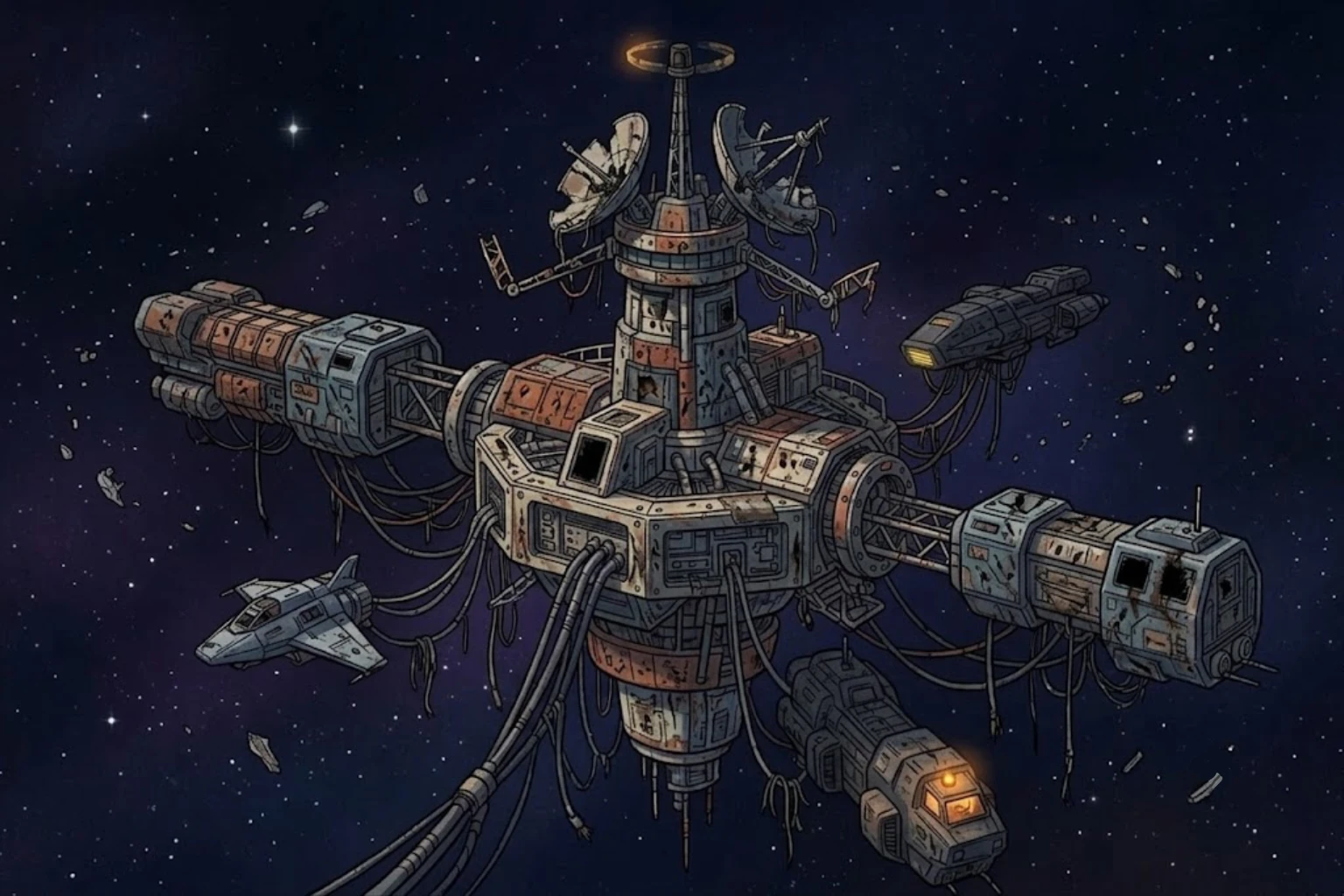
There were seven of them, at first count — or possibly eight, it was difficult to tell because of the way they were arranged, not docked in the usual sense but tethered, thick cables and docking braces and old umbilical lines connecting them to a central structure that sat in the middle of the arrangement like the hub of a wheel. The central structure was a relay station of some kind, larger than the beacon on the silent moon, with a tower section that was dark except for a slow rotating amber marker light at its peak — functional, still working, turning its amber pulse through the darkness at regular intervals.
The ships around it were not academy design. Even from this distance Riku could see that — the hull profiles were different, the proportions wrong in ways that suggested construction for different priorities, different specifications, different environments than the ones the academy built for. One was large and flat-bodied, a cargo vessel of some kind, its hull marked with something he couldn't read yet. One was smaller and leaner, a scout or courier type, its forward section damaged. One was intermediate in size, utilitarian, with external attachments that he thought might be equipment racks. The others were harder to categorize from this distance, partly because of their angles relative to the viewport and partly because debris was drifting around the whole arrangement — slow, not urgent, the drift of things that had been moving for a long time at very low velocity.
Everything was physically connected to the central relay. The cables were thick — heavy-gauge tether lines, the kind you used to secure something you needed to stay connected to something else under stress. Not the delicate umbilical lines of temporary docking. These were tie-down cables. These were *holding* cables.
No lights on any of the ships except the one small emergency amber on the cargo vessel.
"They're abandoned," Yui said.
"We don't know that," Daigo said.
"There's no active signal on any of them," Yui said. "I'd expect at least a maintenance beacon if someone was aboard. Anything occupied runs at least a low-power position signal." She was at the passive array readout now, running the scan. "Nothing."
"People don't tie ships to a station and leave," Daigo said.
"People do all kinds of things," Riku said. "We don't know what happened here."
"That's exactly my point."
"Drive cooldown," Mei said, cutting across the conversation from the engineering station. "I need twenty minutes minimum before I can assess the jump system for anything. Don't ask me about the drive for twenty minutes."
"Noted," Haru said. "Riku, hold position."
"Holding."
The amber light on the relay tower rotated through its cycle. One revolution every thirty seconds, approximately. Slow, patient, the light of something that had been telling the darkness *I am here* for a very long time and expected to keep telling it indefinitely.
"Yui," Haru said.
"Still scanning," she said. "There's — wait." She leaned forward. "There's a pulse from the relay. Very faint. Not on a communications channel. More like a timing signal."
"What kind of timing signal?"
She was quiet for a moment, working at the board. "It's repeating. Interval of—" she checked the timing, "—forty-one seconds." She looked at Sora. "Does that mean anything to you?"
Sora was already at the navigation alcove with her notebook. "Let me check it against the greenhouse directory data." She ran the comparison in silence, in the way she did calculations — completely, without partial updates, presenting the result only when she was sure of it. "The greenhouse directory listed this station's position with a timing marker. I didn't know what the marker was for." She looked at the timing readout on Yui's board. "The timing marker is forty-one."
"So this is the right place," Riku said.
"This is the right place," Sora confirmed. "This relay station is the third point in the network. And—" She looked back at her notebook, where she had the greenhouse panel data still rendered in careful pencil. "There's a next marker. Another bearing."
"From this station," Haru said.
"From this station. If the relay has navigational memory we can access, it should have the full directory data. More complete than what we got from the greenhouse panel."
"If we can access the relay," Yui said. "The signal is faint. I don't know what's functional inside."
"Which brings us to the approach," Haru said. He looked at the viewport — at the relay structure and its constellation of tethered ships and drifting debris. "Riku. What do you see?"
This was the thing about Haru that Riku had figured out sometime in the last week: he asked questions he could find the answer to himself because he wanted the person with the relevant expertise to do the finding. He could look through the viewport as well as Riku could. He was asking Riku because Riku would look at it differently.
Riku studied the arrangement.
"The debris field is loose," he said. "Low drift velocity — nothing is moving fast, so collision risk is manageable if I don't rush. The tether cables are the main navigation hazard. From here I can see six cables radiating from the relay structure to the ships — there are probably more on the far side. They're heavy gauge, which means they'll take a collision impact badly, they won't just push aside, but they're also visible and relatively predictable. I can map their positions before I go in."
"Can you thread through them?"
"I'd want Sora on cable drift monitoring." He looked at her.
"I can do that," she said.
"And I'd want to go slow. This isn't the greenhouse docking — that was a rotation and drift problem. This is a navigation problem. I need to find a path through the cable field and hold it at low speed all the way to the relay docking ring."
"Can you?"
Riku looked at the arrangement again. The amber light turned its slow rotation. The debris drifted in its unhurried way. The tethered ships sat in their positions with the particular stillness of things that had not moved in a long time.
"Yes," he said.
"The relay's docking ring," Mei said, from engineering. She had come around to look at the viewport from the engineering station angle. "I can see one from here — partial view, far side of the central tower. It looks misaligned. Maybe fifteen degrees off standard."
"Can we dock with it misaligned?"
"At very low speed, with the right approach angle." She looked at Riku. "You'll need to come in tilted."
"I can do tilted."
"You'll also need to be slow enough that the adapter has time to find the ring before the contact becomes an impact."
"How slow?"
"Very slow."
Riku looked at the cable field between them and the relay. The calculation was the kind he did naturally — not conscious math, just the spatial reasoning that had always been the way his brain worked, objects and velocities and the paths between them organizing themselves into something navigable. He could see the approach. It would require patience, which was not his strongest quality, but he had been working on patience since the moon docking and the moon docking had gone well.
"I want twenty minutes to map the cable positions before I start the approach," he said. "Passive sensor sweep, full resolution."
"Twenty minutes," Haru said. "Mei, use the time."
"Already using it," she said, and went back to the drive inspection.
---
The sensor sweep took eighteen minutes and produced a partial map — not complete, the far side of the relay structure was occluded, but enough to identify the main cable runs and their approximate positions relative to the approach vector Riku wanted to use. He had Sora check the map against what she could calculate from the debris drift patterns, and she flagged two cables he had missed in the initial sweep, which he added to the map and added to his mental model of the navigation problem.
There were gaps. He identified three possible approach corridors — gaps between cable runs that were wide enough for the *Haruki Maru*'s profile with a margin he was prepared to describe as adequate. Not comfortable. Adequate.
"Corridor B," he said, pointing to the middle option on his sensor display. "It's not the widest but it's the most direct to the relay docking ring, and it avoids the debris cluster on the near side of the cargo vessel."
Sora looked at the map. "Agreed. The south cable run in Corridor B has a drift rate of approximately one centimeter per minute, so it will be twelve centimeters further south by the time you're adjacent to it."
"Twelve centimeters more clearance, or twelve centimeters less?"
She checked the direction. "More."
"Then it improves as we go."
"As long as we're inside forty minutes. After that it starts moving back."
"We'll be inside forty minutes."
"Famous last words," Daigo said, from the security station.
"Encouraging last words," Riku said. "Different thing."
He began the approach.
---
Patience in flight had never come naturally to him. Speed came naturally — the instinct to close distance, to commit to a maneuver, to be decisive. Patience required him to override that instinct continuously, to hold the ship at a speed that felt wrong because it was so much slower than what he would have chosen, and to make adjustments in fractions rather than full corrections.
But he had been practicing.
The greenhouse docking had taught him the first lesson: slow approach gave him time to see problems before they became problems. The cable navigation was teaching him the second: at low speed, the ship responded to smaller inputs, which meant he could be more precise. At the speeds he was used to flying, a small error was still small by the time he corrected it. At these speeds, a small input was the correction.
He threaded Corridor B at a speed that Daigo could have jogged faster than, which Riku reflected on and decided not to share with the group.
"South cable, eight meters and moving favorably," Sora said.
He adjusted half a degree to give more clearance and let the drift do the rest.
"North boundary of the corridor is the cargo vessel's tether line," Sora said. "You have four meters on your port side."
"I see it." He could see it through the port viewport — the heavy cable running from the cargo vessel's hull to the relay structure, passing close enough to the *Haruki Maru*'s port wing that he could see the surface texture of the cable's braiding. Old cable. Heavy. The kind that had been in vacuum long enough to have a particular surface quality, frozen and static and utterly solid-looking.
He gave it five meters instead of four.
"You're through the main cable field," Sora said. "Relay tower directly ahead. Docking ring at your two o'clock, one hundred meters."
He oriented to the docking ring and immediately saw what Mei had identified: the ring was tilted, the mounting bracket that held it to the relay structure having shifted at some point — stress, impact, age, something had moved it away from standard orientation. Approximately fifteen degrees off. He turned the approach tilt in his head, working out the angle he'd need to match the ring's orientation.
"Mei," he said.
"Watching," she said. "Come in three degrees port and eight degrees down-tilt. The adapter's forward lip needs to find the ring first."
"Three port, eight down."
"And slow."
"I know."
He made the adjustments. The relay tower filled the forward viewport now, the amber light rotating above him, the docking ring below and slightly to his left. The ring was standard format — legacy, not academy standard, but the format was universal enough — with the standard contact points around its circumference. He was going to hit three of them if his approach angle was right.
The first contact was the forward lip, just as Mei had said — a slight shock through the hull, the adapter meeting the ring's surface, the sound of it traveling through the ship.
"Hold," Mei said.
He held.
The adapter worked its way around the ring, slow, the docking system doing what it was designed to do when given time and low velocity to work with. He felt the engagement in a series of small sequential contacts — not the single clean lock of a normal docking, more like a zipper closing one tooth at a time.
Then the pressure seal confirmed.
It was a weaker confirmation than the greenhouse docking — the display showed it in yellow rather than green, which meant the seal was established but not at full integrity. Mei was already evaluating it.
"It'll hold for access," she said. "Don't use it as a long-term mooring. If anything shifts on the relay structure, we may need to undock quickly."
"Understood," Haru said. "Riku, good work."
Riku put the thrusters to hold and released the controls and sat back in the flight chair for a moment. He looked at the relay station through the forward viewport — the dark tower, the amber light, the cable field behind them, the tethered ships in their long patient stillness.
Around the bridge, the crew was running the post-docking checks — Yui confirming what signal she could pull from the relay's external ports, Mei reviewing the docking seal integrity, Sora updating the position data, Daigo already pulling up a risk assessment of the relay structure.
Hana appeared at his shoulder.
"How are you," she said.
"I'm good," he said. Then, because Hana had a way of waiting until the real answer surfaced: "My hands shook after the jump."
"That's a normal physiological response to sustained high-function stress," she said.
"Very reassuring."
"It should be," she said. "It means your nervous system is functioning correctly." She checked his pulse with two fingers at his wrist, which was a thing she did that he had learned to accept without comment. "You did well today. Both of them — the jump and the approach."
"The approach was just patience."
"Patience is hard for you," she said. "Doing hard things well is still doing them well."
He didn't have anything to say to that, so he didn't say anything, and she moved on to check Sora.
At the front of the bridge, Haru was standing at the viewport looking at the relay station and the tethered ships beyond it. The amber light made a slow pass across the viewport as it rotated.
"What do we know?" he said, to the room.
"Relay is partially powered," Yui said. "I'm reading faint systems activity on the access port. Not much, but something."
"The tethered ships are dark except the emergency amber on the cargo vessel," Daigo said. "No signals. No movement. Whatever happened here, it wasn't recent."
"Sora?"
"The relay is the third point in the network," she said. "The greenhouse directory data matches. If the relay has functional navigational memory, it should have the complete route from here — every bearing, every station, all the way to—" She looked at her notebook. "All the way to wherever the route ends."
"Home?" Riku said.
"I don't know if the route ends at home," she said, carefully. "I know it ends somewhere. And somewhere is more than we had."
Haru looked at the docking hatch, and then at the crew.
"Suits," he said. "Full seal this time." He looked at Daigo. "Security assessment as we go."
"Always," Daigo said.
They suited up in the training bay, running the full checklist — full seal this time, visors down, every point confirmed. The air on the other side of the hatch was unknown; the atmosphere sampler on the docking adapter had returned inconclusive readings, which meant it was either breathable or not and they were not taking the chance. The suits went on efficiently, everyone moving through the now-familiar sequence without the hesitation of the first time, the muscle memory solid.
Riku sealed his visor and ran the pressure check and stood with the others in the airlock as it cycled.
He thought about the jump — the vibration in the controls, the eight minutes of holding a corridor against a wandering ship, the way the exit into normal space had felt like a release of tension that he hadn't known he was holding through his whole body. He thought about the cable field and the tilted docking ring and the patience that had felt wrong the whole time and had turned out to be right.
He thought about the amber light turning above the relay station, patient and persistent, still broadcasting into the dark after however long it had been broadcasting.
*I am here. I am here. I am here.*
The airlock outer hatch opened.
The access tunnel of the relay station was dark and smelled, through the suit's intake, of cold and old metal and the particular quality of a space that had not had new air in a long time. Emergency lighting somewhere ahead — a faint blue-white at the far end of the tunnel, enough to show them the shape of the passage.
Not enough to show them what was beyond it.
"Lights on," Haru said.
Seven helmet lights came on and illuminated the tunnel.
They stepped through.
The garden had been a place to rest. The beacon had been a place to find direction. This place felt different from both — older, more complex, carrying something in its silence that wasn't emptiness.
More like waiting.


.png)
.png)
.png)