%20(1).png)
Hana had been keeping a medical log since the first hour.
It had started as procedure — academy medical cadets were trained to maintain crew health records during any extended operation, and the *Haruki Maru*'s medical bay had a standard logging template that she had activated during the initial systems check and had been updating three times daily since. Injuries sustained during the initial incident: one bruised shoulder (Haru), one temple contusion (Yui), two cases of mild hand lacerations from debris contact (Riku, Daigo), general muscular strain across all crew from the unexpected position changes during the incident. All minor. All resolving normally.
But the log had grown into something more than the physical record, because Hana had learned in her training that a crew's medical status was not only about the body. It was about the whole person, and whole persons were affected by things that didn't show up on a pressure gauge or an atmosphere readout. So she had added a second column to the log, unofficial, unlabeled, that she updated each evening when she did her rounds.
Day one: everyone shaken, functioning. Haru suppressing anxiety through procedure. Riku converting fear to restlessness. Mei converting fear to work. Daigo converting fear to vigilance. Yui focusing inward on tasks. Sora quieter than usual. All normal crisis responses. All manageable.
Day four, after the moon: better. The surface mission had done something for the crew that the bridge work hadn't — given them a shared physical experience, something they had done together in a new place, and come back from. The bay had been louder that evening. Riku had said something that made Mei almost laugh. That was a meaningful data point.
Day six, en route to the gas giant: Sora was barely sleeping.
Hana had noticed it on the third night — the navigation alcove light on at two in the morning, Sora hunched over the star plate photographs with the focused stillness of someone who had decided sleep was a resource she could defer. Hana had brought her tea on the second night, set it beside the console without comment, and Sora had drunk it without looking up. On the third night Hana had brought tea again and sat down on the spare stool in the navigation alcove.
"Tell me where you are with it," she said.
Sora looked up. She had the particular quality of someone surfacing from deep water — it took her a moment to reorient to a conversation rather than a calculation.
"Closer," she said.
"How close is closer?"
"The dot pattern is a star field. I'm now confident of that." Sora turned the display toward her, showing a rendering she'd built over the past three days — the eleven dots from the beacon plate positioned on a coordinate grid, with lines between them indicating the angular relationships she had measured from the plate's engravings. "This marked dot is a reference star. I've been comparing its relative position to the surrounding ten against every star in the atlas that has the right luminosity class to be visible at a range consistent with our estimated displacement."
"How many candidates?"
"Started with eighty-seven. I'm down to four." She looked at the display. "I need one more data point to eliminate three of them. The bearing lines should give me that — the distance ratios are different for each candidate depending on where in the galaxy you're calculating from. I'm working through the math."
"How long?"
"I don't know. The math is not the hard part. The hard part is that I'm doing it by hand on a system that was designed for supervised training exercises, not independent astronomical analysis." She paused. "I'll get there."
"I know you will," Hana said. "Drink the tea while it's hot."
Sora drank the tea. Hana noted in her private log column: *Sora — sleep deprivation significant but self-regulated, problem-focused, not distress. Monitor. Provide tea. Do not interfere with the work.*
On the morning of day seven, two hours before they reached the gas giant, Sora came to the bridge with her notebook and said: "I have it."
---
The planet announced itself before they were close enough to see detail — a warmth in the spectrum of the forward sensors that Yui picked up first and reported with the careful precision she used for anything she wasn't yet sure how to categorize. Then the color, visible through the forward viewport as a deepening of the black, a presence ahead that wasn't a star but wasn't the uniform dark of empty space either. And then, as Riku adjusted their bearing by three degrees on Sora's instruction, the full reveal: a banded gas giant, amber and cream and a deep burnt orange, larger than anything in the academy's home system, drifting in its long orbit with the massive indifference of a thing that had been doing this since before there were eyes to see it.
"Oh," Hana said.
She was not the only one. The bridge had gone quiet in the specific way it went quiet when everyone was looking at the same thing and deciding how to feel about it.
"That's enormous," Riku said.
"It's a gas giant," Daigo said. "They're large."
"I know they're large. I've seen pictures. That's—" Riku looked at it. "Different."
It was different. Pictures were flat and bounded and existed in a context — a screen, a textbook, a classroom. This was the viewport and the actual planet beyond it, filling a quarter of the visible sky ahead of them, and the difference between the two was the difference between reading about cold and being cold.
"The station is in a trailing orbit," Sora said, from the navigation alcove. She had her position calculation running on the main navigation board now, refined by the last three days of work into something she considered reliable, and she was reading the gas giant's gravity field against it. "Behind the planet relative to our approach, in the gravity shadow. That's why we didn't pick it up on sensors earlier — the planet's mass was masking it."
"How far behind?" Riku said.
"Another two hours at current speed. We'll come around the planet's limb and it should be visible."
"And my bearing calculation," Sora said, to the room, because this needed to be said here, where everyone could hear it. "The reference star from the beacon plate is the fourth candidate. I've eliminated the other three." She looked at the display. "I know where we are."
The bridge was quiet again, differently this time.
"Where," Haru said.
"In relation to the academy, we are approximately—" she paused, because the number needed to be said carefully and received carefully, "—forty-one light-years outside the academy's mapped boundary. In a direction that has no academy expeditions on record." She let that sit. "The good news is that forty-one light-years is a jump distance, not an insurmountable distance. With a functional drive and accurate navigation we can get there. It would take multiple jumps, and we would need to find jump points, and we would need enough fuel—"
"But it's possible," Haru said.
"It's possible," Sora confirmed. "We are not in another galaxy. We are not in a region of space that is fundamentally inaccessible. We are forty-one light-years from the boundary of home space, and I now know which direction home is."
No one spoke for a moment.
Then Mei said, from the engineering station: "The drive needs to be in better shape than it is to make jumps."
"I know."
"And we need fuel."
"I know."
"And jump point data for this region, which we don't have."
"I know all of that," Sora said, with patience. "I didn't say we could leave tomorrow. I said we know where we're going."
Mei looked at her for a moment. Then she nodded, once, and turned back to her console, and Hana thought she saw something in Mei's face that she had not seen in six days — not relief exactly, because the problems were still real and present, but something adjacent to it. The particular feeling of a person who has been working on something difficult and has just learned that the work is pointed in the right direction.
She noted it in her log. *Crew morale: meaningful improvement. First confirmed navigational progress. Watch for energy expenditure spike followed by crash — people often push harder once they have a goal.*
Outside the forward viewport, the gas giant turned slowly in the light of its distant sun.
---
The station came into view as they cleared the planet's limb, and Hana saw the green before she saw anything else.
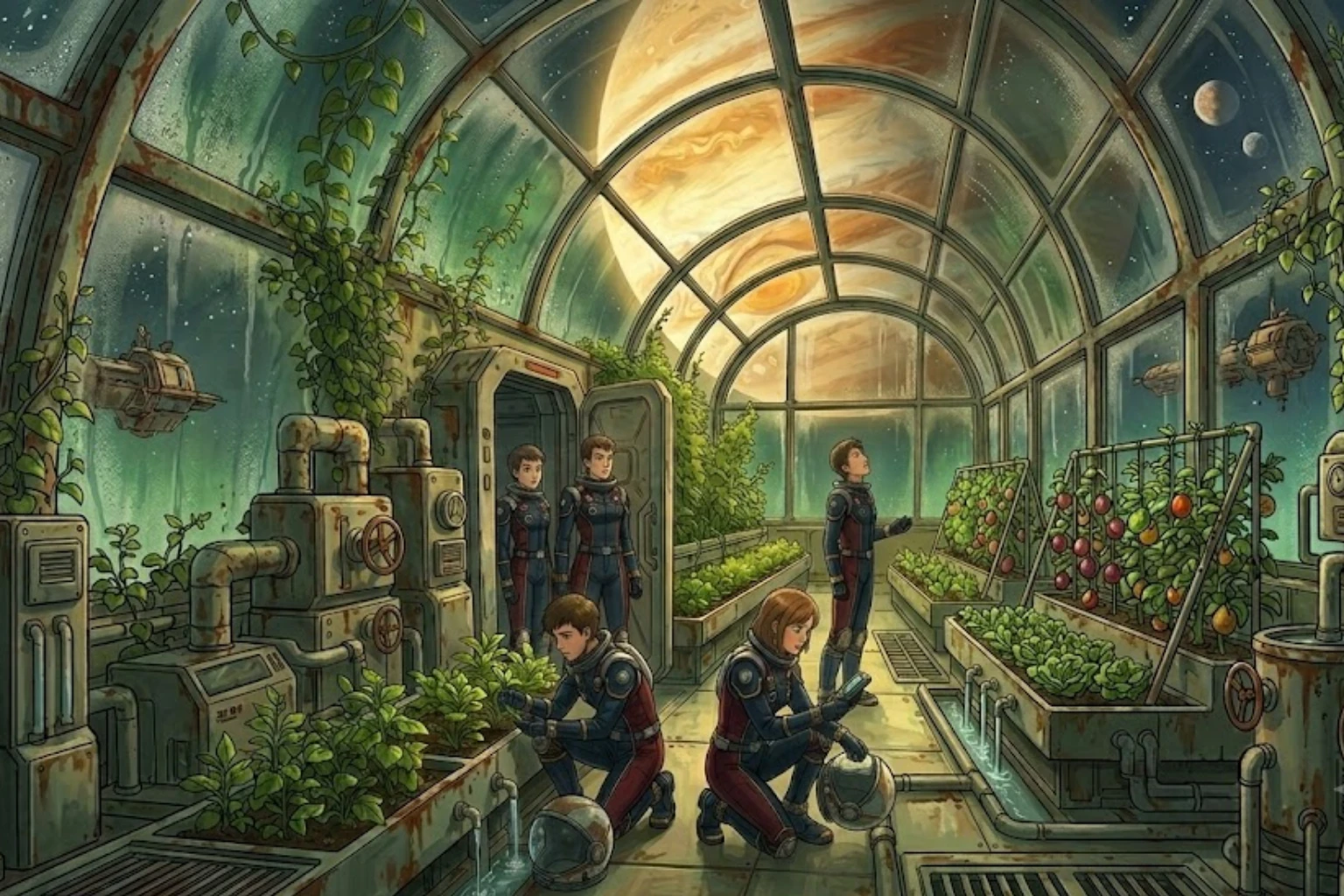
It was visible through the forward viewport as a smear of color against the dark — not a large smear, the station was not large, but unmistakable because color in space was rare and this color was the specific warm deep green of living plants, filtered through what she could see, as they got closer, was a curved transparent exterior. A dome section. Several dome sections, connected by enclosed corridors, the whole structure perhaps fifty meters end to end, built along a central spine with growing modules branching off it like the segments of something organic.
"Is that—" Yui started.
"Plants," Hana said. "That's plant growth. Those are growing sections."
"On a space station."
"It's a greenhouse station. That's what the series bible said—" She stopped herself, because *series bible* was an internal categorization that made no sense here, and what she meant was: "It was built to grow things. And it's still growing things."
"After how long?" Daigo said.
"We don't know how long," Haru said. "Riku, begin approach."
"Beginning approach," Riku said, and his voice had the quality it had when he was looking at something challenging and deciding he was going to enjoy the challenge. "Sora, I need the station's rotation rate and drift vector."
"Working on it," Sora said. "The station is rotating — slow, approximately one revolution every four minutes. It's also in a slight drift relative to the planet's gravity shadow, moving northeast at about two meters per second."
"Two meters per second isn't much."
"It accumulates over a docking approach."
"What's the docking collar design?"
Yui was already pulling the station's external sensor profile. "Standard legacy format — not academy standard, but I'm seeing a collar ring that should be compatible with our docking adapter. Maybe." She looked at the reading more carefully. "The collar is on the central spine, which is not rotating. The growing modules rotate around it."
"So the collar is stable but everything around it is moving," Riku said.
"Yes."
"And the station itself is drifting."
"Slowly."
"And the gas giant's gravity well is going to create some interesting field effects on our approach vector."
"Probably," Sora said.
Riku was quiet for a moment. Then: "Okay. I need everyone off the flight console except me. Haru, I need you on the attitude thrusters — I'll call adjustments, you execute. Sora, I need continuous updates on the drift vector every thirty seconds. Yui, watch the collar and tell me the moment anything changes about it."
"And me?" Mei said.
"Pray to whatever you pray to that the docking adapter is compatible," Riku said.
"I don't pray," Mei said. "I check tolerances." She was already moving toward the engineering station. "I'll monitor the adapter from here and tell you if we're going to have a problem before we have a problem."
Hana strapped into the medical observer seat at the back of the bridge — she had claimed it on day two, the one position on the bridge that had restraints but no active function, which meant she could watch the crew during high-stress operations without being in anyone's way. She checked the atmosphere readout on her wrist unit. All seven suits nominal. She noted the time and prepared to monitor.
What followed was forty minutes that she would later record in her log as *sustained high-function stress, all crew, no performance degradation.* Which was the medical way of saying: it was very tense and everyone did their jobs anyway.
Riku flew the approach the way he flew everything — with his body as much as his hands, leaning slightly into turns that the ship couldn't feel his weight in but that he made anyway, as if the physical commitment helped. He called attitude adjustments in a steady stream that Haru executed without comment, the two of them falling into a rhythm that surprised her given how often they clashed on everything else. On the bridge they were frequently the loudest argument in the room. In a docking approach they were apparently something that worked.
"Drift correction, two degrees port," Riku said.
Haru executed it.
"The collar is holding orientation," Yui said. "Whatever's keeping it stable, it's working."
"Forty meters," Sora said. "Drift vector holding at one-point-eight meters per second northeast. The gravity field is giving us a slight pull — you'll feel it at thirty meters."
"I already feel it," Riku said.
"Then you're early. Good."
At twenty meters the rotating modules of the greenhouse were visible through the side viewports — large curved sections of transparent material, the interior green visible through them, slowly turning past. Hana watched one rotate through her viewport and caught, in the second it was aligned with her line of sight, a clear interior view: rows of something growing in long hydroponic channels, green and dense, leaves she didn't recognize pressing against the transparent exterior from inside.
Her heart did something she noted as outside the range of normal resting rate and also entirely reasonable given the circumstances.
"Ten meters," Sora said. "Drift is increasing slightly. One-point-nine."
"I see it," Riku said. His voice had gone very quiet. "Collar alignment?"
"Collar is stable," Yui said. "You're lined up. You're—" A pause. "Three degrees high."
"Correcting." A slight adjustment, so small Hana couldn't feel it but could see in Riku's posture. "Better?"
"Better. You're at two meters. One meter. Hold—"
The docking connection was not elegant. It was a controlled collision, the way all dockings were — the adapter meeting the collar, the moment of impact absorbed by the docking system's shock dampeners, the metallic sound of connection traveling through the hull and into the bridge as a physical fact.
Then: the pressure of a seal confirming.
Then: silence.
"Docked," Riku said, in the flat tone of someone who has been running very hot and has just been given permission to stop.
Haru let out a long breath. "Good flying."
Riku didn't say anything. He sat with his hands still on the controls for another ten seconds, and Hana watched his heart rate — she was monitoring it through the suit comm, even though he wasn't in a suit — slow from what she estimated was high-stress operating range back toward something more sustainable. She noted it. *Riku: excellent performance under pressure, physiological recovery time approximately ninety seconds. Healthy response.*
"Atmosphere check on the station before we open anything," she said, from the back of the bridge.
Everyone looked at her.
"Before we open the docking collar," she said, "I need to know what's on the other side. Atmosphere composition, pressure, temperature. The station has been growing plants for an unknown amount of time without human intervention. The atmosphere inside could be anything."
"The plants are still alive," Yui said. "That suggests—"
"That suggests the atmosphere has enough carbon dioxide for photosynthesis and enough everything-else for the plants' particular biological requirements," Hana said. "Which may or may not be the same as our biological requirements. I need a reading before anyone opens that collar."
Haru looked at Mei.
"The docking adapter has an atmosphere sampler," Mei said, with the tone of someone who was glad to be asked something she knew the answer to. "Standard on academy vessels. I can run it through the adapter before we break the seal."
"Do that," Haru said.
The sampling took twelve minutes. Hana used them to go through her assessment criteria for unknown atmospheres — the checklist she had memorized in her second year of medical training, designed for exactly this kind of situation and never expected to be actually used. Oxygen partial pressure. Carbon dioxide levels. Nitrogen balance. Trace gas analysis for known toxins.
The readout came back and she read it with the focused attention of someone who understood that this was not an exercise.
Oxygen: 22.3 percent. Slightly elevated from academy standard, consistent with a closed system with active photosynthesis and no human respiration depleting it.
Carbon dioxide: 0.6 percent. Also elevated, but within safe human tolerance for extended exposure.
Nitrogen: 76.1 percent. Within normal range.
Trace gases: multiple organic compounds, consistent with plant biology. None on the known toxin list. Several she couldn't identify from the sampler's database, which was the part she would need to treat carefully.
Temperature: 24 degrees. Warm.
Pressure: 98 kilopascals. Near standard.
She looked at the readout for another moment. Then she said: "The atmosphere is breathable. We can go in without suits." She paused. "I want everyone to tell me immediately if they notice any respiratory irritation, unusual taste or smell, headache, or visual disturbance. Those are the warning signs for the compounds I couldn't identify. If anyone experiences any of them, we put the suits back on immediately."
"Understood," Haru said.
"I'm serious," Hana said. "Immediately. Not when it gets worse. Immediately."
"Understood," said six voices, and she was satisfied that they meant it.
---
The docking collar opened into a short access corridor — dark, the emergency lighting cycling the same amber as their own ship's corridors, the walls close on both sides, the smell of recycled air and something beneath it that she couldn't quite name yet. They moved through in single file with helmet lights on even though the visors were up, the suits on but unsealed, which was the compromise Hana had negotiated: wear the suits as protection and to have them available, but open enough to actually breathe the station atmosphere.
The corridor was about ten meters long.
At the end of it was a door.
Daigo reached it first and checked it — the lock mechanism, the seal status, the structural integrity of the frame — with the thoroughness he brought to every threshold. "Clean," he said. "No pressure differential on the other side. No security lock. Manual latch."
He opened it.
The light that came through was not the amber of emergency systems. It was warm and soft and came from above — from the planet beyond the transparent panels, the gas giant's reflected light filtering through the greenhouse glass and filling the space with a glow that had amber in it but also gold and the particular quality of light that had passed through growing things before it reached the eye.
And the smell.
Hana stopped in the doorway because the smell stopped her. She had grown up in a building with no outdoor space and had spent two years at the academy in recycled air and the *Haruki Maru*'s corridors, and she had forgotten — not known she had forgotten, but discovered it now — what it smelled like to be near living plants in quantity. Green and damp and complex and alive in a way that air was not alive.
Behind her, she heard Riku say, very quietly: "Oh."
She stepped through.
The greenhouse was enormous in the way that enclosed spaces could be enormous — not by dimension, the growing section was perhaps thirty meters long and twelve wide, but by what filled it. Hydroponic channels ran the length of the space in long parallel rows, and in those channels things were growing that had not been tended by human hands in years and perhaps much longer. They had grown the way untended things grew: according to their own logic, following the light from the transparent panels, reaching into the space above the channels, some of them touching the overhead supports, some trailing downward to the walkways between the rows, some growing through other plants in a collaboration that was not what the original designers had planned.
The walkways were overgrown but passable. The overhead lights — supplemental to the planetary glow, running on whatever power source kept the station alive — were on and warm. Condensation ran down the transparent panels in long curved trails. Somewhere in the middle section she could hear water moving through the hydroponic system, a quiet mechanical sound that had been running without anyone listening to it for a long time.
No one said anything for a full minute.
She looked at her crew. Yui was standing still with her head tilted back, looking at the overhead growth. Mei was crouching at the nearest hydroponic channel, already examining what was growing in it. Daigo was at the entrance doing a perimeter assessment but more slowly than usual, as if even his vigilance was willing to pause for a moment. Riku was standing in the middle of the first walkway looking at the light coming through the panels with an expression she had not seen on him before and couldn't immediately categorize — not quite wonder, something more private than that.
Sora was crying.
Just a little — she probably didn't know she was, the way people sometimes cried when they'd been holding something for a long time and something external finally gave them permission to put it down for a moment. Hana moved to her quietly and stood beside her without saying anything, because nothing needed to be said.
After a moment Sora wiped her eyes with the back of her wrist and said, "Sorry."
"Don't be," Hana said.
"It's just—" Sora looked at the growing things, the light, the water sound. "It looks like something from home."
"It does," Hana said. "That's all right."
She gave the crew two minutes to simply be in the space, because she had learned in her training that the medical value of two minutes was real and that rushing past moments of genuine human response was a medical error as much as anything physical. She watched heart rates on her wrist monitor. She watched faces. She noted the data point for her log.
*Day seven. Crew encountered first living environment since incident. Emotional responses: varied, genuine, healthy. This was needed.*
Then she said, "All right. Let's find out what's here and what we can use."
---
The work of the next several hours was the most pleasant work Hana had done since the incident, which she noted was not a coincidence — pleasant work was work that was interesting and purposeful and conducted in good conditions, and for the first time since waking on the floor of a dark corridor she was doing all three at once.
Her primary job was botanical assessment. She moved through the hydroponic rows with a sample kit from the medical bay, taking leaf and stem samples from each distinct plant type she could identify, running them through the portable analyzer she had brought in her kit. The analyzer was designed for biological hazard detection in unknown environments, which was exactly the situation she was in, and it worked by comparing chemical compositions against a toxicology database and flagging anything that showed known harmful compounds.
Most of what was growing showed nothing flagged.
"This row is a variant of leafy greens," she said, photographing the channel. "Probably engineered — the leaf structure doesn't match any wild species in the database, but it's close enough to several cultivated species that the nutritional profile should be similar. Edible. Probably good for us, actually — high iron, based on the color."
"Write it down," Haru said, from the next row over.
She was already writing it down.
There were root vegetables of some kind in the third channel — she identified them by pulling one carefully from the growing medium, a small orange-red tuber that smelled mild when she cut a sliver from it and put it near but not in her mouth. The analyzer said: no toxic compounds, high starch content, moderate protein. She put the sliver on her tongue carefully and waited thirty seconds.
"Hana," Riku said, watching her. "Are you—"
"Evaluating," she said.
"By eating it?"
"By a controlled taste evaluation. Thirty seconds of contact with the mucous membrane allows for preliminary assessment of any compounds the analyzer might have missed." She waited the remaining seconds and removed the sliver. "No burning, no unusual sensation, flavor is mild and slightly sweet. I would assess it as edible."
Riku stared at her. "You just tasted an alien potato."
"I tasted a cultivated root vegetable of unknown origin that the analyzer cleared and that showed no adverse mucosal response," she said. "Which I am noting is consistent with it being edible."
"That's the most medical thing anyone has ever said about eating a potato."
She moved to the next row. "I prefer 'careful.'"
Mei had established herself in the mechanical section of the greenhouse — a service area behind the growing sections where the hydroponic pumps and filters and the station's atmospheric processors were housed. She had opened several access panels and was doing what Mei did, which was reading a mechanical system by examining it directly.
"The atmospheric processors here are biological scrubbers," she said, when Hana came by on her survey. "Not mechanical — they use the plant systems to scrub CO2 and process oxygen. That's why the station kept running without maintenance. The plants are the system. As long as the water flows and the light is on, the plants process the air and the air supports the plants."
"A closed loop," Hana said.
"A very well-designed closed loop. Our own atmospheric processors are mechanical. These are better, honestly — lower power consumption, self-maintaining, and they produce a higher oxygen output than we're currently getting from our systems at sixty-three percent efficiency." Mei looked at the processor array with an expression Hana recognized as professional admiration. "I want to take some of the filter media back. If I can interface it with our systems it might buy us better atmospheric efficiency."
"Can you take it without damaging the station's system?"
Mei considered. "The processor array has redundant units. I can take one of the four redundant filters without compromising the main cycle." She looked at the array. "I'm also taking seeds."
"Seeds?"
"From the root vegetables. And the leafy greens. If we can grow our own food on the ship—" She didn't finish the sentence because the logic was obvious.
"We'd need a growing space," Hana said.
"The training bay. There's a section that gets light through the viewport. It's not ideal but it's something." Mei was already making notes. "You're the botanist."
"I'm not a botanist."
"You're the closest thing we have to one."
Hana looked at the hydroponic channels. She had been interested in plant biology in her second year, before she had focused entirely on medicine — not as a primary subject, but as one of those areas that existed adjacent to what she was studying and kept catching her attention. She knew more about it than she was perhaps currently admitting.
"I'll figure it out," she said.
Daigo had found something in the middle section, behind a row of tall plants that had grown up and over the walkway to form something close to an arch. He was standing in front of a panel mounted on the wall — not the marker plate of the beacon station, but something with more information density, a larger panel with a complex of symbols that included both the geometric notation of the beacon plate and something additional.
Sora was already there when Hana arrived.
"Same builder," Sora said. She was photographing the panel with the shoulder camera, the same systematic documentation she'd done at the beacon. "The geometric notation matches the beacon plate style. But there's more here." She pointed to a section of the panel that was distinct from the star-reference symbols. "This section is a schematic. And this—" she moved her finger to the lower right, "—is another position marker. But it's different from the beacon plate."
"Different how?" Haru said.
"The beacon plate showed where the station was. This panel shows where the beacon plate is." Sora looked at the panel. "It's a directory. This station knows where the beacon station is, and—" she studied the schematic section, "—and knows where to go next. There's another marker. Different distance, different bearing."
"The same network," Daigo said.
"Yes. Whoever built this route built multiple stations. At least three, including this one and the beacon. And at least one more ahead." She looked at the position data. "I need time to calculate the bearing from our current position. But it's there."
"While you calculate," Haru said, "let's finish the survey."
The survey took the rest of the day.
What they found, documented and catalogued by Hana and cross-checked by Mei and Yui: eighteen distinct plant varieties, of which eleven Hana assessed as edible, three as useful for biological compounds that had medical or atmospheric applications, and four as unknown but non-toxic. Enough food in the current growing stock to supply seven cadets for approximately three weeks if harvested carefully and supplemented with their remaining ration supply. Water — the hydroponic system's reservoir was full, and Mei calculated they could draw fifty liters without compromising the station's water cycle. Two redundant atmospheric filter units that Mei wanted. Seeds from seven of the eleven edible varieties. The directory panel, fully photographed by Sora. And in the service area, behind the atmospheric processors, six more of the same power cells they had found at the beacon — same design, same form factor, same compatible interface that Yui had confirmed on the ship.
"This was stocked," Haru said, when they had gathered in the central walkway to compare notes. The planetary light was shifting as the station rotated in its slow orbit, the amber and gold of the gas giant moving across the greenhouse panels above them. "Not just built. Stocked. Someone put power cells here. Seeds. Processor filters. All of it in the same quantity — more than this station needs, less than a permanent installation would carry."
"Enough for travelers," Sora said.
"Enough for travelers," he agreed.
"Someone built a road," Yui said.
Everyone looked at her.
"That's what it is," she said. "The beacon was a road marker. This is a — a rest stop. Food, water, power, and directions to the next one." She looked around the greenhouse. "Someone built a road through empty space, with survival stations at intervals, and we just found the second one."
Hana looked at the growing things around them — the untended, overgrown, magnificent fact of a garden that had kept growing because the system was well enough built to keep itself running without anyone present. Someone had cared enough to build this. Someone had thought about travelers arriving hungry and low on supplies and had built a place that would have food and water ready for them.
She didn't know who. She didn't know when. She didn't know for whom, originally, the road had been built.
But she knew what it felt like to be the traveler who had arrived.
"We should eat dinner here," she said.
Everyone looked at her.
"We have food," she said. "Real food, not ration bars. We have warmth and light and breathable air that smells like something alive. We have been on a damaged ship eating emergency rations for seven days." She looked at Haru. "We should eat dinner here. As a crew. Before we load everything and leave."
Haru looked at the greenhouse around them, at the planetary light on the panels, at the six other cadets standing in the walkway between rows of growing things that someone had planted for reasons they did not yet understand.
"Yes," he said. "We should."
---
The meal was not elaborate. Hana prepared it — she had no cooking equipment, but the root vegetables could be eaten raw once cleaned, and the leafy greens were palatable as they were, and she found, in the service area cabinet, a sealed container of what was clearly a preserved grain product of some kind that the analyzer cleared and that, when opened, smelled faintly of something she associated with food from home. She could not make it into anything fancy. She divided it evenly, served it in the sample containers they'd brought for the botanical survey, and that was dinner.
They sat in the walkway between the second and third growing rows, in the planetary light, and they ate.
Nobody talked much at first. That was all right. There was something in the space that didn't require talking — the sound of the water in the hydroponic channels, the creak of the station's structure, the slow shift of light through the panels as the orbit continued. Hana ate her share of the root vegetable — which was, she confirmed, genuinely good, mild and slightly sweet with a texture that reminded her of something she had eaten as a child and couldn't quite name — and watched her crew.
Riku was sitting cross-legged with his container in his lap, eating steadily and looking at the overhead growth with the expression she had been trying to categorize earlier. She had it now: it was the expression of someone who had been moving very fast for a long time and had just, for a moment, stopped.
Mei was eating with one hand and making notes with the other, which was Mei.
Daigo had positioned himself at the end of the row nearest the access corridor, facing the entrance — even here, even in this, he had chosen the defensible position. But his posture was less rigid than it had been, and he was eating with something closer to appetite than he had shown at meals on the ship.
Yui was looking at the panel on the wall, the directory panel, with the quiet focus of someone whose brain didn't fully stop even at dinner. But she was eating too.
Sora had her notebook open. But the notebook was closed at the moment. She was just sitting, looking at the planetary light through the glass above them, the gas giant's bands visible and enormous through the panels, and she looked, Hana thought, like someone who had been holding herself at a very high tension for a long time and had found, just briefly, a place where it was safe to let some of it out.
Haru was looking at all of them, the way he always was — captain's vigilance, the constant low-level monitoring of what his crew needed and how they were doing. Hana met his eyes across the walkway and he looked slightly startled, caught at it, and she gave him a small nod that she meant as: *they're all right. This is helping.*
He nodded back.
After a while Riku said, "Who do you think built this?"
No one answered immediately.
"Someone who cared about travelers," Hana said. "You don't build survival stations on a route and stock them if you don't care about the people using it."
"Or you do if you need the people using it to survive long enough to get somewhere," Daigo said.
"That's a very Daigo way to think about it," Riku said.
"It's a practical way to think about it," Daigo said, without particular offense.
"Both things can be true," Sora said. "Practical and caring. They're not exclusive." She was looking at the panel again. "The direction it points is roughly toward the academy boundary. Roughly toward home." She paused. "The route goes somewhere. And this part of the route is built to make sure travelers survive long enough to get there."
The planetary light shifted again, the orange bands of the gas giant moving overhead in slow, majestic indifference. The water moved through the channels. The overhead plants reached for the light the way they had been reaching for years, finding it, growing.
"We should get some sleep here," Hana said. "Before we load everything. One night in an atmosphere that isn't ship recycled will do all of us some good." She looked at Haru. "Medically advisable."
"Conveniently," Riku said.
"I am the medical officer," she said. "It is literally my job to advise things that are good for the crew."
Haru looked around the greenhouse. "One night," he said. "Loading starts in the morning."
They slept on the walkway between the growing rows, with their suit jackets folded under their heads and the planetary light shifting slowly across the glass above them. Hana lay awake a little while after the others, listening to the water and the structure and the breathing of six people who had been sleeping poorly in recycled air for a week and were now, one by one, going under completely, deeply, into the first real rest they had gotten since this started.
She noted it in her log. *All crew: sleep quality significantly improved. Recommend extended stops at stable environments when available. The body needs more than function to recover — it needs somewhere that feels like somewhere.*
She looked up at the gas giant through the glass.
She closed her eyes.
She slept.
---
They loaded in the morning with the efficiency of a crew that had slept well and eaten something real and had a direction to go. Mei ran the loading with the same focused authority she ran engineering — everything assigned a place and a person, nothing wasted, the redundant atmospheric filter and the power cells and the food stores and the seeds all accounted for and stowed before midday.
Sora calculated the bearing to the next station during loading, using the directory panel's data and her own established position. She had it confirmed before they were finished stowing.
"Northeast relative to our current position," she said. "Approximately eight light-years. Within jump range if the drive can handle it."
"Can the drive handle it?" Haru said.
"Ask Mei," Sora said.
Everyone looked at Mei.
Mei looked at her notes. She looked at the ceiling. She looked at her notes again. "With the fracture patched and the power cells supplementing our fuel load," she said, slowly, "and if I spend the next two days tuning the drive to optimize jump efficiency—" She stopped. "Maybe."
"Maybe yes or maybe no?"
"Maybe yes," she said. "If everything goes right."
"Then we make everything go right," Haru said.
The undocking was more straightforward than the docking, Riku taking them clear of the rotating greenhouse sections with the particular ease of someone who had learned a thing under pressure and found it simpler the second time. The station diminished behind them as they pulled away, the green of the growing sections visible through the transparent panels until the angle changed and it became just another structure against the gas giant's amber bulk.
Hana stood at the viewport in the corridor outside the training bay and watched it until it was too small to see.
Someone had built a garden in the middle of nowhere.
It was still there.
She turned back to the ship, which smelled like recycled air again, and went to check on her crew.


.png)
.png)
.png)