%20(1).png)
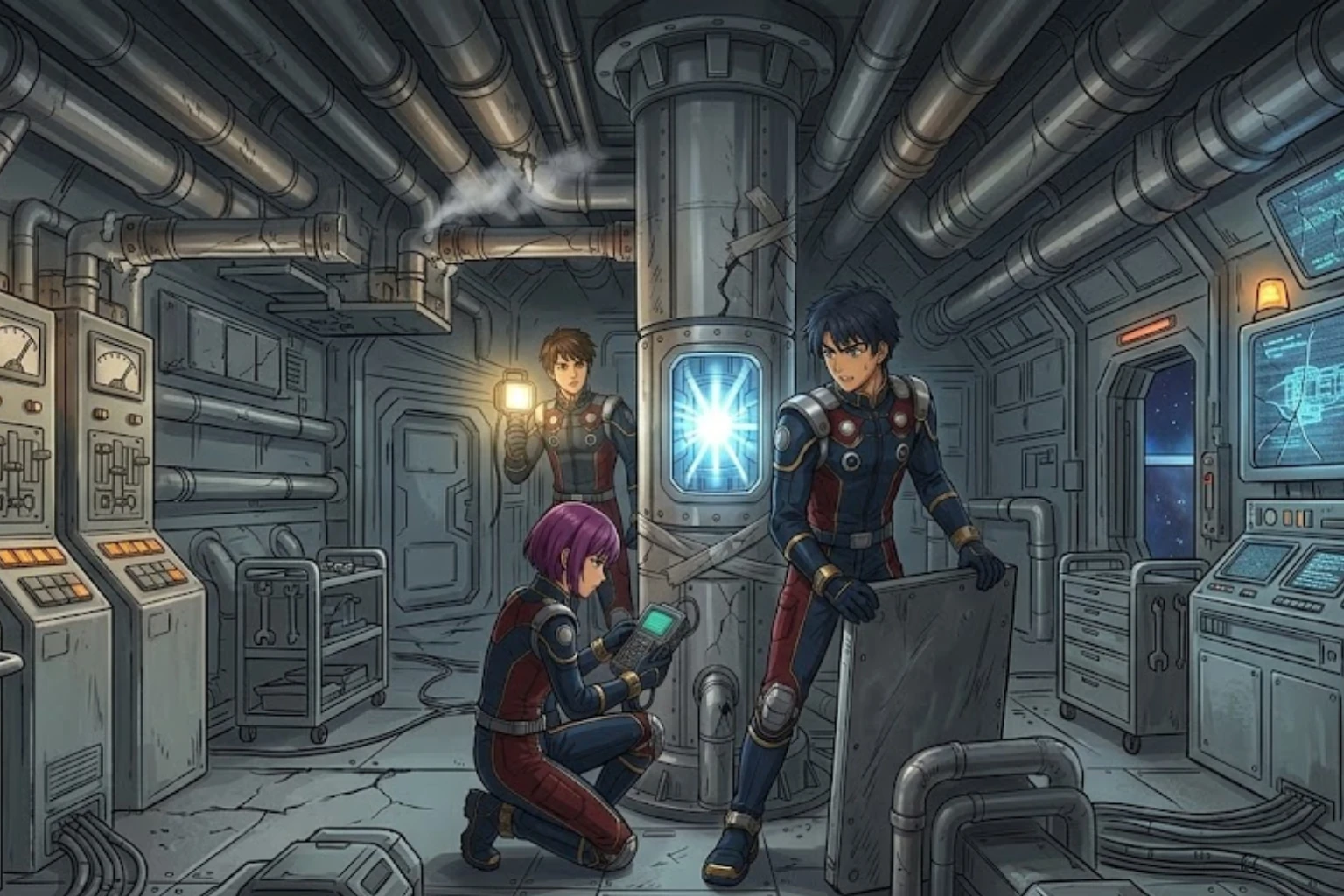
Mei had known the drive was sick before anyone else did.
Not from the bridge readings — those told you what the ship wanted you to know, filtered through sensors and relay boards and whatever interpretation the system decided to apply before presenting the numbers. Mei had learned early that the bridge readings were a summary, and summaries left things out. What she knew came from three hours in the drive compartment the previous afternoon, her hands on the actual hardware, her ear against the casing listening to the particular quality of a machine running below its threshold.
The drive wasn't broken. It was compensating. There was a difference, and the difference mattered, because a broken thing failed and a compensating thing kept going until it couldn't anymore, and the moment it couldn't anymore was always worse than if it had just failed cleanly at the start.
She had added it to the repair list with a priority flag and told Haru the drive needed attention before they pushed it further. Haru had nodded and written it down and then the conversation with Yui and Daigo had happened and the decision to move toward the beacon had happened and the drive had gone from *needs attention* to *currently in use* without the attention part occurring in between.
She had not said anything else about it, because what was there to say. They needed to move and the drive was what moved them.
She had just spent the first two hours of the approach listening very carefully.
The stutter happened at hour three.
She felt it in the deck plates before the bridge registered it — a hiccup in the vibration pattern, half a second of wrongness that smoothed out and then came back a minute later, more pronounced. She was already moving toward the drive compartment when Haru's voice came through the wired intercom.
"Mei. Drive output just dropped eight percent."
"I know," she said. "I'm going in."
The drive compartment was at the aft end of deck two, behind two bulkheads and a pressure door that she had opened and closed enough times in the last day that her hands did it without her thinking about it. The space inside was not large — the *Haruki Maru* was a training vessel, not a cruiser, and her drive section was sized accordingly, a room of pipes and casings and conduit runs and the central drive column that ran floor to ceiling and generated the thrust that moved them. It smelled like hot metal and the particular ozone-adjacent smell of a drive system that had been running hard.
Mei pulled her diagnostic tool from her belt and started at the top of the check sequence.
The problem declared itself in about four minutes. The primary fuel injector on the port-side drive column was misfiring — not consistently, but intermittently, the kind of fault that produced exactly the stuttering output she'd been hearing. The injector itself was accessible, which was good. The cause of the misfiring was a pressure regulator upstream that had been running at the edge of its tolerance since before the mission and had finally started failing under the sustained load of the approach burn.
She looked at the regulator. She looked at her parts inventory, which she had catalogued that morning from the ship's repair locker.
She had one spare pressure regulator. It was not the right size.
She stared at this fact for a moment with the specific feeling she got when a problem had an ugly solution and no clean one.
The intercom crackled. "Mei, we've dropped another four percent. Sora says at this rate we miss the insertion window in about ninety minutes."
"What happens if we miss the insertion window?"
A pause. Sora's voice, calm and precise: "We drift past the moon. Course correction to come back around would cost more power than we can currently spend. We'd have to try for the beacon from a distance, and I don't know if the passive array is sensitive enough to decode it at that range."
So ninety minutes to fix the injector with a regulator that didn't fit.
"Okay," Mei said. "I need help. Send me Riku."
Another pause, this one shorter. "Riku?"
"He's not doing anything useful at the flight console if the drive is failing. I need hands that are good at working fast in tight spaces. Send him down."
She didn't wait for the acknowledgment. She was already pulling the access panel off the fuel injector housing.
---
Riku arrived in eight minutes, which meant he'd run most of the way, which was exactly what she'd expected from him. He looked at the drive compartment with the expression of someone encountering the inside of something they'd only ever operated from the outside, slightly awed and slightly wary.
"What do I do," he said.
"Right now you hold this." She handed him the access panel, which was larger than it looked and awkward to manage in the confined space. "Don't put it down, don't lean it against anything, and don't drop it."
"I can do that."
"I know you can do that. The question is whether you can do it for forty minutes while I work around you without complaining about how uncomfortable it is."
Riku looked at her. "Is it going to be uncomfortable?"
"Very."
"Okay," he said, and took the panel, and settled into a stance that suggested he was prepared for the long version of this.
She got to work.
The regulator swap was the kind of repair that required adaptation rather than procedure — the spare wasn't the right fit, which meant she needed to make it the right fit through a combination of mechanical improvisation and the careful application of sealant compound to compensate for the tolerance gap. It was not elegant. It was the kind of repair that her instructors would have given a passing grade with a note about using the correct components in the future.
It would hold. That was what mattered.
She worked in silence mostly, which was how she worked best, and Riku held the panel and was quiet, which she appreciated more than she would have said out loud. Halfway through, the drive stuttered again — worse this time, a longer hiccup that she felt in her bones and that made Riku's eyes go to the drive column involuntarily.
"That's bad," he said.
"That's why I'm fixing it," she said.
"How bad, specifically."
"Specifically, if the injector fully misfires we lose port-side thrust and the ship starts rotating. Starboard side is fine, but without port we can't correct the rotation, and a rotating ship misses its insertion window considerably faster than a ship at eighty percent thrust."
Riku was quiet for a moment. "So we'd spin past the moon."
"In a manner of speaking."
"While rotating."
"Yes."
"Good to know," he said, and his voice had gone to the particular register he used when he was scared and converting it into focus. She recognized it because she used the same conversion, just in a different key.
She finished the regulator mount at the forty-three minute mark, which left her a margin she was not comfortable with but could work with. She sealed the compound, ran a manual pressure check, and keyed the intercom.
"Bridge. I've replaced the regulator. I need you to run a low-power injector test before I close up the housing."
Haru's voice: "Ready when you are."
"Test now."
The drive column vibrated — clean, even, the stutter absent. She put her hand against the casing and felt it running right for the first time since the approach had started.
"Output is stable," Sora said over the intercom. "Eighty-six percent and holding."
"Good enough," Mei said. She took the panel back from Riku, who had maintained his grip for forty-three minutes without complaint, and started refastening it.
"That's it?" Riku said.
"That's the injector. I still have to check the coolant bleed on the secondary column and there's a hydraulic seal on the thrust vector plate that I flagged yesterday." She looked at him. "You can go back to the bridge."
"I'll stay," he said.
She looked at him more carefully. He meant it — not out of obligation, but something more practical. He had just spent forty-three minutes in an engineering compartment holding a panel, and whatever he'd expected that to be, what it had actually been was useful, and she could see him recalibrating around that.
"The coolant bleed needs two people," she said. "Can you read a pressure gauge?"
"I can read anything with numbers on it."
"Then stay."
The coolant bleed was on the secondary column's lower service point, which required one person at the bleed valve and one person watching the pressure gauge on the far side of the column and calling out readings. It was not complicated work. It was also the kind of work that had no margin for error, because a coolant system bled too fast or not enough caused problems that were considerably harder to fix than the original bleed.
She put Riku on the gauge.
"Call out every change," she said. "Not when it looks significant. Every change. If it moves two units, you tell me."
"Every change," he repeated. "Got it."
He was quiet for the first few minutes while she opened the valve by careful increments, and then: "Down two."
"Good. Keep calling."
"Down one more. Holding." A pause. "Still holding."
She had expected him to be bad at this — not because Riku was bad at things, but because the kind of attention that watching a gauge required was different from the kind of attention that flying required, and most people were better at one than the other. Riku surprised her. He called every movement, small and large, in a steady voice that didn't editorialize or predict or ask whether what he was seeing was good or bad. He just reported, accurately and consistently, which was exactly what she needed.
After twenty minutes she said, "You're better at this than I expected."
"Flying is mostly watching gauges and calling out when they move," he said. "Just faster."
She considered this. It was, in fact, an accurate description of a significant portion of flight operations. "Hm," she said.
"Was that a compliment?"
"It was an observation."
"From you, I think that might be the same thing."
She didn't answer that, but she filed it away as evidence that Riku, when he was not performing confidence at an audience, was someone she could probably work with. That was useful information. They were going to be in close quarters for a long time.
"Down one," he said. "Holding again."
"Almost done," she said.
When the bleed finished she closed the valve and ran the pressure check and found it exactly where it needed to be, which produced the same small internal satisfaction as the regulator repair — the feeling of a system returning to what it was supposed to be. She noted the reading in her log and straightened up.
Riku was looking at the secondary column casing with the expression of someone who had developed a relationship with a machine over the course of an afternoon.
"It's a good ship," he said. "Isn't it. Under everything."
She looked at the column — at the pipes and casings and the whole engineered complexity of a drive system that had taken forces it wasn't rated for and was still, with attention and some improvisation, running. "She's a training vessel," Mei said. "Built to be used by people who don't fully know what they're doing yet."
"That's us."
"That's us," she agreed. "She's designed for that. More tolerant than a working vessel would be." She put her hand flat against the column casing for a moment — not checking anything, just the contact. "But yes. She's a good ship."
Riku nodded, satisfied, as if she'd confirmed something he'd already decided.
---
Haru came down at hour five, when the coolant work was done and Mei was halfway through the thrust vector seal, which was the most awkward of the three jobs because the access point was behind the secondary column in a space that had not been designed with repair access as a priority.
He came in carefully, which she appreciated — people who moved carefully in small spaces were people who understood that the space mattered. He looked at what she was doing and then at Riku, who was sitting on the deck with his back against the wall eating one of the emergency ration bars they'd pulled from the training bay stores, and then at Mei.
"How are we doing," he said.
"Drive is stable. Coolant bleed is fixed. I'm finishing the thrust vector seal and then I need to do a full inspection of the secondary column casing because I heard something in it this morning that I don't have an explanation for yet."
"Something bad?"
"Something I don't have an explanation for yet," she said again, because she had learned that *I don't know* was more useful than a guess, especially when the guess might make a captain make different decisions than the actual situation required.
Haru nodded. He found a place to stand that was out of her way and stayed there. After a moment he said, "Can I do anything?"
She thought about it. "The secondary column casing inspection. I need someone to hold the light steady while I work the far side. Riku's arms aren't long enough."
"My arms are fine," Riku said, from the floor.
"Your arms are fine. They're not long enough. It's not the same thing."
Riku considered this and appeared to decide it was not worth arguing.
Haru held the light. He did it with the careful attention of someone who understood that holding a light was a real job, that if the light moved the person working in the dark couldn't see and the work suffered. She noticed this and filed it away as information about who Haru was under pressure, which was different from who he was on the bridge, which was itself different from who he'd been at the academy, which was a person she had not known well enough to compare to.
The secondary column revealed its secret at the forty-minute mark of the inspection: a stress fracture in the outer casing, small, not yet through-the-material, but present and growing. The kind of fracture that happened when a system took forces it wasn't rated for — like, for instance, an unplanned jump of unknown distance under unknown conditions.
She looked at it for a long time.
"Mei," Haru said.
"Stress fracture in the secondary column casing," she said. "It's not critical yet. If we push the drive hard it could become critical. If we keep thrust below seventy percent it should hold until we can find materials to properly repair it."
"How long at seventy percent?"
"I don't know. A week, maybe more. Depends on what we ask of the drive." She withdrew from the inspection space and stood up, which required a moment for her back to accept after forty minutes of awkward positioning. "We'll make the insertion window. But after that we need to land, find materials, and fix this properly. Not as a preference. As a necessity."
Haru wrote it down. She had noticed that he wrote everything down, and she had decided that was a good quality in a captain — not because writing things down was inherently valuable, but because it meant he was treating the information as real rather than managing it in his head where it could get reorganized into something more comfortable.
She watched him write and thought about the version of Haru she had known at the academy, which had not been well — they had overlapped in two shared courses and she had formed the impression of someone who studied hard and worried more than he needed to and asked good questions. She had not thought much beyond that. You didn't, at the academy, think much beyond the immediate rotation of people you worked with directly.
The Haru who was standing in her drive compartment holding a light and writing down stress fracture data was the same person and also not the same person. Something had shifted in him since the bridge, since the first hours, and she thought it had to do specifically with being here — not on the bridge where everything was readouts and relay boards and information filtered through the ship's interpretation systems, but down here where the ship was actual metal and actual pipe and actual things that broke in ways that had weight and smell and physical consequence.
The bridge told you the ship was at eighty-six percent drive output.
The drive compartment showed you what eighty-six percent drive output looked like from the inside: a patched regulator that wasn't quite the right size, a coolant bleed that had needed doing for probably longer than this mission, a stress fracture in a secondary column casing with a strip of yellow tape on it because the engineer needed to find it again fast if things got worse.
She thought Haru was understanding, for the first time, that those two things — the number on the bridge board and the reality in the compartment — were related but not the same. And that being captain meant being responsible for both, not just the number.
"Seventy percent gets us to the moon," he said.
"Yes."
"And the moon is where we fix the fracture."
"The moon is where we find out if we *can* fix the fracture. I don't know what's down there."
"Neither do we," Riku said, from the floor. He had finished his ration bar and was looking at the drive column with the expression of someone who had spent five hours in its company and developed opinions about it. "But there's a beacon. Which means someone put it there. Which means someone was there."
"Someone was there," Mei said. "Past tense."
"Still counts," Riku said. "People leave things behind. Useful things."
She didn't argue with that. It was, in the absence of better information, a reasonable position to hold.
The intercom clicked. Sora's voice, with the specific quality it had when she was reporting something she found interesting rather than alarming: "We're forty minutes from insertion window. Drive output is holding at eighty-six percent. If Mei can confirm thrust vector is nominal I can give Riku a final approach plot."
Mei looked at the thrust vector seal she had finished two hours ago. She had checked it twice already. She checked the reading on the gauge beside it again anyway, because twice was not three times and three times was what you did when it mattered.
Nominal.
"Thrust vector is good," she said into the intercom. "Riku, go fly the ship."
Riku was on his feet before she finished the sentence, which was the fastest she had seen him move in a direction that wasn't away from something. He squeezed past Haru in the doorway and his footsteps receded up the corridor at a pace that was not quite running and very close to it.
Haru stayed for a moment.
He looked at the drive compartment — at the patched regulator and the fixed coolant bleed and the fractured casing she had marked with a strip of yellow repair tape so she would know exactly where to go when they had materials to work with. At the accumulated evidence of five hours of work in a space that had not been designed for extended human occupation.
"Thank you," he said.
"It's my job," she said.
"I know. Thank you anyway."
She picked up her diagnostic tool and her remaining sealant compound and her light, and began putting the compartment back in order. The *Haruki Maru* was not a beautiful ship — she was a training vessel, functional and somewhat graceless, designed to be operated by cadets under supervision and not particularly optimized for anything except being survivable under a range of mistakes. But she was alive, and she was moving, and for the moment she was going to keep doing both.
"Minase," she said, as he was leaving.
He stopped.
"The fracture is stable. But stable doesn't mean fixed." She looked at him steadily. "When we reach that moon — whatever is down there, we need time. Real time. Not a quick stop."
He held her gaze for a moment. "Understood," he said, and she could tell he meant it.
She listened to his footsteps move up the corridor, and then she was alone in the drive compartment with the clean hum of a repaired engine and the yellow tape on the secondary column casing and the comfortable, specific satisfaction of work that had been hard and had come out right.
Forty minutes later, through the intercom, she heard Riku say *entering insertion approach* in the voice he used when he was exactly where he was supposed to be.
And then, a few minutes after that, Sora said: "I can see it."
Mei closed the last access panel, clipped her tools to her belt, and went to find a viewport.
The nearest one was in the corridor outside the drive compartment, a small reinforced porthole set into the hull at eye level that she had walked past a dozen times without looking through. She looked through it now.
The moon filled most of the frame.
It was not beautiful, exactly — beauty required something to compare against, and she had no frame of reference for what an unknown moon in unknown space was supposed to look like. What it was was immense and immediate and completely real, grey-white surface pocked with craters, the terminator line between its lit and dark sides cutting sharp across the middle of her view as the *Haruki Maru* came in on its approach vector. No atmosphere — the surface was crisply defined the way only airless bodies were, every crater edge exact, no smearing or haziness, just rock and shadow and the particular dead stillness of something that had been exactly like this for longer than anything she knew how to measure.
"Riku," Haru said over the intercom, "begin descent approach on Sora's plot. Slow and steady."
"Slow and steady," Riku confirmed, and she could hear the control in his voice, the pilot's discipline overriding the pilot's instinct to move fast. He was doing it right.
The ship tilted slightly as they came around to the descent angle, and the viewport shifted until she was looking down at the surface rather than across it. It came up slowly — slowly enough that she had time to watch the craters resolve from vague shadows into actual features, rimmed depressions of various sizes, some overlapping, some pristine, one enormous ancient impact basin near the horizon that must have been there since the moon itself formed.
"I have the beacon on passive sensors," Yui said. "Northwest quadrant from our current position. There's a structure."
"A structure," Daigo said.
"Something built. Not large. But it's there."
Mei pressed her face closer to the porthole and looked northwest, and found it — a shape on the surface that was wrong in the way that built things were wrong against natural geology. Angular where the craters were round, geometric where the rock was random. Small. Old, from the look of the surface around it, undisturbed for a long time.
Someone had been here.
She had known that, intellectually, since Sora first mentioned the beacon. Knowing it and seeing the structure sitting on the surface of a moon in the middle of nowhere with her own eyes were different experiences. Someone had come out this far, to a place that didn't appear on any academy chart, and built something and left it running.
The *Haruki Maru* settled into its final descent with the particular series of sounds that meant Riku was managing the landing sequence — attitude thrusters firing in short controlled bursts, the drive throttling back by stages, the whole mechanical vocabulary of a ship putting itself down somewhere new. She had heard these sounds in simulations. They felt different when the somewhere new was real.
The landing was smooth. Riku's landings were always smooth, even when nothing else was going right.
The drive went to standby. The ship was still.
For a moment nobody said anything on the intercom. She thought about everyone else on the bridge, looking out through the forward viewport at an airless moon under unfamiliar stars, at a structure that had no business existing this far from any map.
Then Haru said, quietly: "Suit up. We're going to take a look."
Mei pulled back from the porthole and looked at the drive compartment one more time — at the yellow tape on the stress fracture, at the patched regulator, at the whole carefully maintained collection of fixes that were keeping them alive. They needed materials. They needed time.
Whatever was out there on that surface, she hoped it had both.


.png)
.png)
.png)