%20(1).png)
The thing about signals was that they were never truly gone.
Yui had learned this in her first year at the academy, in the introductory communications course that half her cohort treated as a throwaway credit and she had treated like someone had handed her a key. Instructor Namiki had said it on the first day, in the offhand way instructors said things they considered obvious: *a signal that has passed through a system always leaves a trace. Your job is learning to read what remains.*
She had written it down. She still had the notebook.
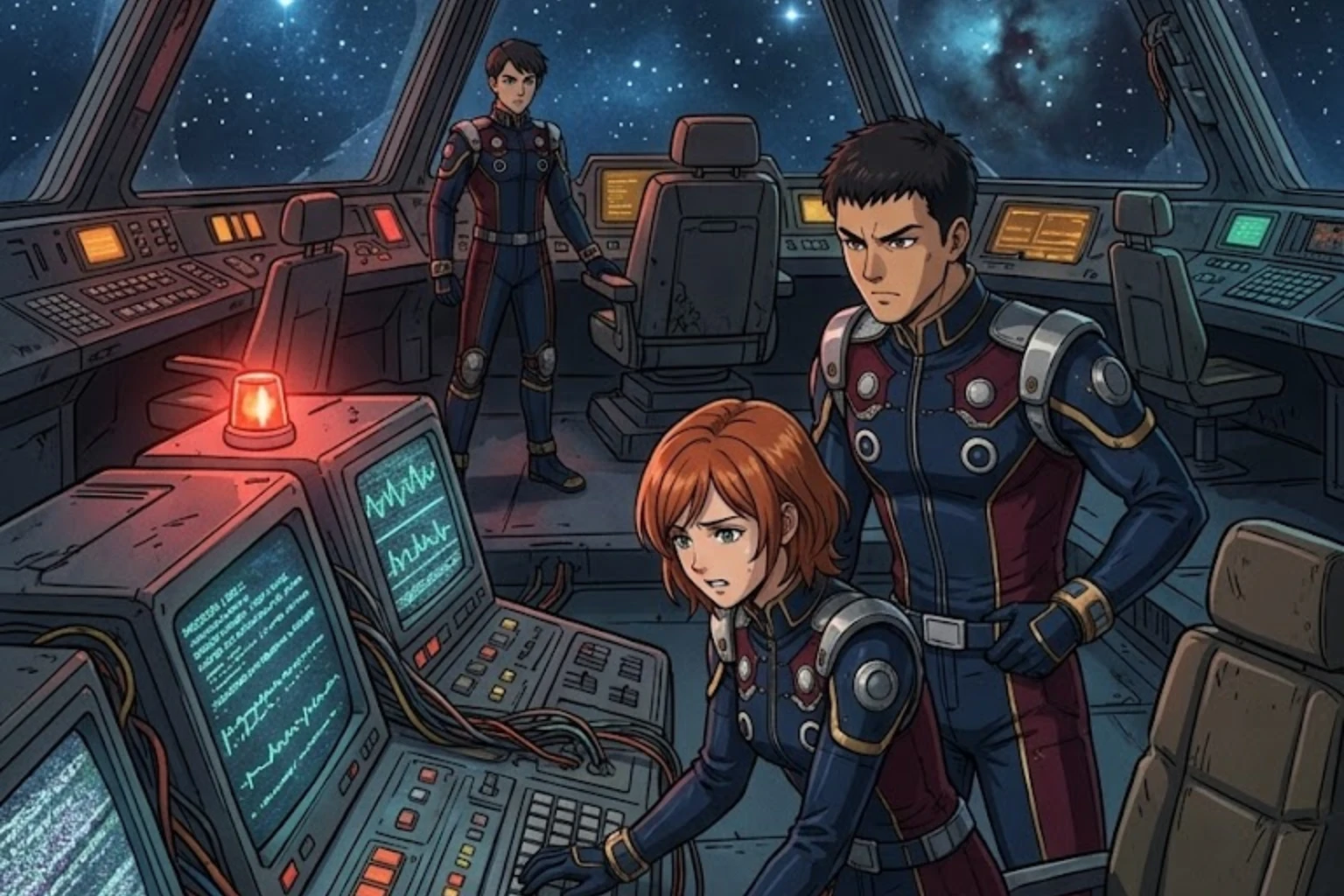
She thought about it now, sitting at the systems board on the bridge of the *Haruki Maru*, twelve hours after waking up on a floor in a dark corridor with a bruise on her temple and no idea where she was. The bridge was occupied but quiet — Haru at the command station with his notepad, Sora in the navigation alcove doing calculations that she periodically reported on in brief, precise sentences, Riku at the flight console running manual diagnostics on systems that kept returning errors. Daigo had come and gone twice, conducting his security sweep with the methodical thoroughness of someone who needed to be moving to feel useful.
Yui was not moving. Yui was reading what remained.
The main communications array was gone — she had confirmed that in the first hour, physically gone in the sense that the primary relay module had burned out so completely that it had fused into a shape that no longer resembled functional hardware. She had shown Mei the remains when Mei came through the bridge corridor, and Mei had looked at it with the expression of someone cataloguing damage, and said she'd add it to the list.
But the array burning out didn't mean the logs were gone. The logs lived in a separate partition of the ship's memory core, isolated from the communications hardware specifically so that a comms failure didn't take the record of everything down with it. It was standard academy design. It was, at this moment, the most important thing about standard academy design.
She pulled the logs.
Or she tried to. The partition was intact — she could see it, access it, confirm that it was there and that data existed inside it. But the data itself was fragmented in a way she hadn't encountered before, not the clean gaps of a simple memory fault but something more like the log had been recording normally and then hit a period of extreme interference that had degraded the signal quality of the recording itself, and then normal recording had resumed on the other side of that period as if nothing had happened.
She stared at the gap.
Forty-three minutes. That was how long the gap ran. From approximately seventeen minutes after launch — she could see normal log entries up to that point, routine transit recordings, Riku's flight inputs, her own systems checks, the academy telemetry link confirming active monitoring — until fifty-six minutes after launch, when the logs resumed showing a ship running on emergency power with six of its seven cadets unconscious and the seventh, Haru, just beginning to move.
Forty-three minutes of nothing.
The ship said the training route had been completed in that window. The logs said nothing about the training route in that window because the logs said nothing about anything in that window.
"What are you finding?"
She hadn't heard Daigo come back. He had a way of moving that didn't announce itself, which she suspected was deliberate and trained. He was standing at the edge of the systems board with his arms crossed and his eyes on her display, and his expression had the particular quality it always had — not unfriendly, but assessing, like he was running a calculation about the reliability of what he was about to be told.
"A gap," she said. "Forty-three minutes of degraded recording. The log is there, the partition is intact, but the data inside that window is — interference. Like someone recorded static."
"Or like something was generating interference strong enough to degrade the recording."
"That's one explanation."
"What are the others?"
She turned back to the display. "Catastrophic sensor overload — if something happened to the ship's systems severe enough to overwhelm the recording equipment. Or a localized memory fault in the partition, though that doesn't explain why it maps exactly to the period we can't account for."
"Convenient fault," Daigo said.
"I know how it sounds," she said, with more patience than she felt. Daigo's suspicion wasn't wrong — it was the right instinct for a security cadet and she understood why he was pointing it in the directions he was pointing it. But suspicion needed to be accurate, not just present, and right now what she needed was to read the data carefully rather than confirm a conclusion she'd already reached. "I'm not ruling anything out. I'm telling you what I can see."
He was quiet for a moment, which with Daigo was usually either acceptance or preparation for a different question.
"The remote override," he said. "It went offline before the gap."
"I know."
"The last log entry before the gap shows the override status as offline. It was online in the previous entry, four minutes earlier." He had his own notes — a small security log he'd been keeping since the first hour, in handwriting smaller and more precise than Haru's. "Four minutes isn't enough time for a standard system failure to propagate from the comms array to the override module. They're on separate power and separate hardware."
"I know that too," she said.
"So either two unconnected systems failed in the same four-minute window through coincidence—"
"Or they didn't fail," Yui finished. "They were taken offline."
She said it because it was the accurate statement of what the data suggested, not because she was ready to fully believe it. Saying it out loud made it feel more real than she wanted it to feel right now. She was aware, in a part of her that she was keeping carefully separate from the technical work, that believing someone had done this on purpose was considerably more frightening than believing something had gone wrong by accident.
Daigo looked at the display for a moment. Then he pulled a stool from under the adjacent station and sat down, which was the first time she had seen him sit since they'd regrouped on the bridge. It made him look, briefly, like a person rather than a procedure.
"I'm not trying to make this worse than it is," he said, and his voice was different when he said it — the assessment quality gone, something more direct under it. "I need to understand what we're dealing with. If someone did this, there's a reason, and the reason affects what we should do next."
"I understand that," Yui said. "And I'm not — I'm not trying to protect anyone, if that's what you're wondering. I'm trying to make sure what we conclude is actually supported by what we have." She looked at him. "If I tell Haru this was sabotage and it turns out to be equipment failure, we make decisions based on a wrong premise. That's dangerous."
"And if it was sabotage and you tell Haru it might be equipment failure—"
"Also dangerous. I know." She turned back to the display. "So I'm going to keep working until I have something more than a gap and two offline systems that could have a different explanation."
Daigo was quiet. Then he said, "Okay," in the way that meant he was accepting the position without fully endorsing it, and that was fine, that was the right relationship between their two roles, and they both knew it.
She kept working. He stayed.
---
The breakthrough, when it came, was not what she expected.
She had been tunneling through the pre-gap log entries, the ones from the first seventeen minutes of the mission that were intact and readable, looking for anything that didn't match the expected sequence of a normal training launch. Most of it was exactly what it should have been — routine, procedural, the small ordinary evidence of seven cadets running a pre-mission checklist for the first time without adults on board. She could see her own entries, the comms checks she'd run at T-plus-four and T-plus-nine, the academy telemetry confirmations, Sora's first navigation marks.
And then, at T-plus-fourteen minutes, a notation in the passive sensor log that she almost scrolled past because it was in a column she hadn't been focused on.
External signal contact. Duration: 0.3 seconds. Frequency: unregistered. Strength: marginal.
She stopped scrolling.
The passive sensor array ran constantly during transit, picking up everything in range and logging it whether or not anyone was actively monitoring. It was background data, the kind that got reviewed after missions as part of the routine debrief, not during. She had never had a reason to look at it in real time on any training exercise.
0.3 seconds. Unregistered frequency. Marginal strength — meaning it was faint, right at the edge of sensor range.
Three minutes before the gap began.
She sat with that for a moment, making sure she was reading it correctly before she said anything. The entry was intact, not degraded, part of the pre-gap log that had recorded normally. It was a real detection, not an artifact of the interference. Something had been out there, at T-plus-fourteen, transmitting on a frequency the academy's databases didn't have a record of.
Something had sent a signal. Then three minutes later the override had gone offline. Then four minutes after that, the gap had begun.
She flagged the entry and pushed her chair back.
"Daigo."
He looked up from his own notes.
"I found something," she said. "It's not — it doesn't answer the big questions. But it's real."
She showed him the entry. She watched him read it twice, the same careful way he did everything, and then look at the timeline she'd marked out.
"Signal, then override offline, then the gap," he said.
"Yes."
"From outside the ship."
"The passive array is outward-facing. Whatever this was, it was external."
He looked at her with the first expression she'd seen from him that was something other than controlled. Not panic — Daigo didn't do panic, or if he did he'd done it privately in some corridor she hadn't been in — but a kind of focus that had sharpened past its usual point, like a question he'd been preparing for had finally arrived.
"We need to tell Haru," he said.
"Yes," she said. "We do."
---
She presented it the same way she'd found it — carefully, in order, without a conclusion attached. The signal entry, the timeline, the gap. What it could mean and what it couldn't yet tell them. She was aware of Daigo beside her wanting to add the interpretation and holding it back because they'd agreed, without formally agreeing, that she would present the data and he would wait.
Haru listened without interrupting. Sora had turned from the navigation alcove partway through and was listening with the particular quality she had when something connected to something else in her head. Riku had pushed back from the flight console. Hana, who had been monitoring the atmospheric readings from the engineering relay station, was still watching her board but with the reduced attention of someone listening to two things at once.
When Yui finished, nobody spoke for a moment.
"An external signal," Haru said finally.
"Logged by the passive array. Real detection, pre-gap entry, no interference degradation on that entry specifically."
"On an unregistered frequency."
"Not in the academy database. That doesn't mean it's unknown everywhere — the academy database covers known space, and we're not in known space. It might be a completely standard frequency out here."
"Or it might not be," Daigo said.
"Or it might not be," she agreed.
Haru wrote something in his notepad. He did that when he was thinking, she had noticed — writing helped him process, or maybe it just gave his hands something to do while his head worked. "Can you find the signal again? Actively search for it?"
"The passive array is damaged. I have partial function on it. If the signal were strong enough — or close enough — I might pick it up again. But I can't go looking for it the way I'd normally search with full systems." She paused. "There's something else."
She had been deciding whether to include this part since she found it. It wasn't directly related to the signal, and it didn't change the immediate situation, and it was the kind of thing that could shift the way people felt in a way that might not be useful right now. But it was true, and she had decided, sitting at the systems board for the last several hours, that true things were what this crew needed.
"In the last intact log entry before the gap," she said. "The academy telemetry confirmation. The one that shows the monitoring link was active." She pulled it up on the bridge display. "It shows the link confirmed. Active monitoring. Remote override online. Standard entry."
"We've been over that," Daigo said.
"I know. But I looked at the confirmation code." She highlighted a string of characters at the end of the entry. "Academy telemetry confirmations use a rotating verification code. The code changes every six hours based on a sequence that both the ship and the academy generate independently and match. If the codes don't match, the confirmation fails." She looked at Haru. "This code doesn't match the sequence for that point in the mission."
Quiet.
"It's a close match," she said, because accuracy mattered. "If you weren't looking specifically for it, you wouldn't catch it. But it's wrong."
"A fake confirmation," Riku said, from the flight console.
"A confirmation generated by something that had the sequence but made a small error in the generation. Or a very good copy that wasn't quite perfect." She let that sit without adding interpretation.
Haru was looking at the display. He had the expression he got when he was deciding something — not hesitation, something more like a person measuring the weight of what they were about to carry.
"Okay," he said. "Here's what I know right now: we have a gap in our logs we can't explain, a signal from something external right before things went wrong, and a confirmation code that isn't right. I don't know what that means in total. I don't think any of us do." He looked around the bridge. "What I do know is that none of that tells us how to get home. And right now, getting home is the job."
Daigo started to say something and Haru held up one hand — not dismissively, just a pause.
"I'm not saying we stop thinking about it. I'm saying we don't let it be the only thing we think about. We have actual problems in front of us that have actual solutions if we work at them." He looked at Sora. "You said there was something."
Sora had been waiting with the patience of someone who had learned when to speak and when to let other things finish. She turned to the navigation display and pulled up the rough position plot she'd been building since the first hour — the edge of the academy chart, the blank region beyond it, and the sparse sensor data she'd been triangulating from.
"There's a mass reading," she said. "About four hours at low thrust from our current position. Small — a moon, maybe, or a large asteroid body. The sensors are too damaged to give me a clean reading, but there's something there."
"Something we can land on?" Mei said, from the doorway — she had come back from engineering at some point in the last half hour, and Yui hadn't noticed her arrive.
"Possibly. I can't confirm surface conditions from here. But there's also—" Sora touched the display. "There's a signal coming from it. Very faint. Not the same frequency as the one in Yui's log. But it's regular. Repeating."
"A beacon," Yui said.
"It has the pattern of a beacon. I can't decode it from here — I don't have enough signal and the comms array is gone. But if it's a beacon, it might have coordinates. A position reference. Something to tell us where here is in relation to somewhere we need to be."
The bridge felt different after she said it. Not lighter exactly, but changed in direction — like a conversation that had been circling something finally finding the thing it was circling.
"Four hours at low thrust," Haru said. "Mei, can we do four hours at low thrust without compromising life support?"
"If we're conservative," Mei said. "I got the drive back to twenty percent capacity this afternoon. It's not jumping us anywhere but it moves us. Four hours at low thrust costs power we can partially recover if we find fuel or materials at whatever that thing is."
"Risk if we go," Haru said.
"Power expenditure. If there's nothing useful there, we're in a tighter position than we are now."
"Risk if we stay."
Mei looked at the life support readings on the engineering relay board. "Nine days was the estimate this morning. I've revised it to twelve with the repairs I've done this afternoon. But twelve days doesn't get us home."
Haru nodded. He picked up the notepad and wrote something, then put it down.
"We go," he said. "Riku, can you plot a low-thrust approach?"
"Already started," Riku said, and there was something in his voice that hadn't been there all day — not quite relief, but movement, the sound of someone whose purpose had found its target.
Yui turned back to her board and began setting up what remained of the passive array to monitor for signals on the approach. The work was familiar in the way that all signal work was familiar — patient, methodical, the kind of thing that rewarded attention over urgency. She had been doing it since she was twelve years old, listening for patterns in static, finding the shapes that didn't belong.
She thought about what Instructor Namiki had said on the first day of comms class, about signals that were never truly gone.
Somewhere out there, something had sent a signal at T-plus-fourteen minutes, on a frequency nobody at the academy had a record of.
She had found the trace.
She would find the rest of it, when the time came, one piece at a time. That was the job. That was what she was for.
For now, the *Haruki Maru* had a direction.
Under the unfamiliar stars, the ship began to move.


.png)
.png)
.png)