%20(1).png)
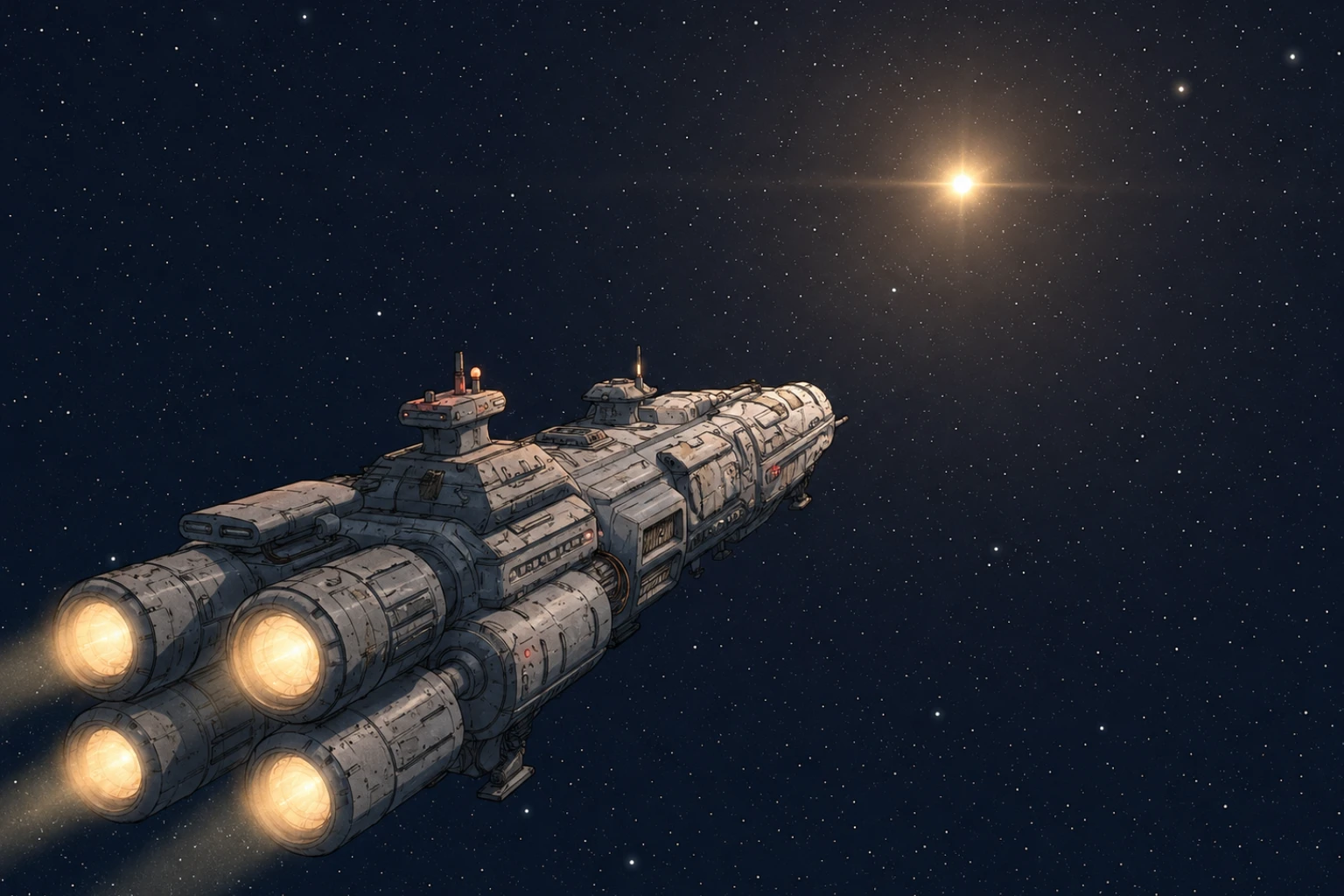
The planet was behind them.
Haru stood at the command station and looked at the ship status display and wrote down what was real, because writing down what was real had been his method since the first morning and it was his method now.
*Port landing strut: lost. No planetary landing capability until replaced.*
*Jump stabilizer: strained beyond rated tolerance. Mei assessing for rebuild.*
*Hull stress: elevated across three points, stable, not progressing.*
*Port engine: recovering. Thermal within acceptable range and declining.*
*Systems offline: secondary sensors, comfort systems, non-essential power draws.*
*Crew: functional. Injuries — Daigo (probable cracked ribs), Sora (bruised shoulder), Mei (hand laceration, bruising), Riku (compression marks, hands), Haru (laceration, left side, treated).*
He stopped.
He wrote one more line.
*All seven aboard. All seven alive.*
He put the pen down and looked at the display for a long moment, and then he looked through the forward viewport at the stars ahead of them — still wrong, still the unknown sky that had been wrong since the first morning, but wrong in the specific way he had come to know over eight weeks, the familiar wrongness of a sky that had become their sky by time and proximity even though it was not and had never been home.
One jump.
"Mei," he said.
"I know," she said, from the engineering station. She had not looked up when he said her name. "I'm already in it."
---
The repair work was quiet.
That was the thing he noticed first — quieter than any repair work they had done, quieter than the greenhouse loading or the relay station salvage or the emergency descent with Mei calling engine temperatures from the console. This quiet was different in quality: not the quiet of concentration, though everyone was concentrating, but something underneath that. The quiet of people who had used all the words available for the situation and were now in the place beyond words where only the work was left.
He moved through the ship at intervals — bridge to engineering to the cargo section and back — doing the things that needed doing and watching the things that needed watching, and in the spaces between the doing and the watching he observed his crew the way he had been observing them since the first morning, cataloguing not just what they were doing but the quality of how they were doing it.
Riku was at the flight console, running the pre-jump checks in the specific sequence he had developed over twelve jumps of varying difficulty and danger, his hands moving through the panel with the familiarity of someone who had learned the instrument by touch. He was not talking. Usually Riku filled the silence with something — not chatter exactly, more the ambient sound of a person who processed the world externally, who thought out loud and reported status conversationally and made small observations that functioned as a running commentary on whatever was happening. That was absent now. He was working and he was quiet, and in the quiet Haru could see that Riku's hands, which had shaken after the first jump and had been steady since, were not shaking. They were still. The particular stillness of something that had been through enough to know what it needed and had settled into it.
---
*Riku's hands moved through the pre-jump sequence and his mind went somewhere else entirely.*
*He thought about a training field — the one at the academy's secondary simulation facility, the outdoor facility that the instructors used for low-altitude formation work in the early morning before the main training days began. He had been there maybe a hundred times. He could picture the landing strip, the corrugated awning over the observation stand, the particular color of the sky at that hour, which was the specific pale blue of early morning before the sun was fully up.*
*He thought about a simulator run with Takahashi and Ogawa, the three of them in the old formation trainer that shuddered if you pushed it past ninety percent, and he had pushed it past ninety percent because he always pushed it past ninety percent and Takahashi had yelled at him over the comms in the specific register of someone who was angry and laughing at the same time. The instructor had made him run the corridor twice more after the session. He had thought it was unfair. He had not thought about unfair in a long time.*
*He wanted one boring landing corridor. He wanted a corridor where the worst that could happen was extra drills. He wanted Takahashi yelling at him. He wanted to take a turn too fast and have it matter exactly that much — extra laps, one more corridor, a note in his assessment file — and no more.*
*He kept his hands steady on the pre-jump checks and thought about that and let it be the thing he thought about.*
---
He found Mei in the engineering section with the jump stabilizer's housing open on the work surface she'd established on the secondary console, its internal components laid out in the organized arrangement she gave everything she took apart. She was working with her right hand more carefully than usual — the cut was not stopping her, it was just present, a thing she was working around the way she worked around every obstacle, by finding the approach that accounted for it.
"What do you need," he said.
"To not be interrupted," she said. "And possibly someone to hold this." She indicated a component she was positioning, her left hand occupied.
He held it. He stood beside her and held the component at the angle she told him to hold it and watched her work. She had the focused quality she always had when doing something that required precision, but there was something else underneath it — not distraction, more like the surface of a person working while something else ran beneath the surface, the way a river ran deep below what was visible.
He did not ask about the something else. He held the component and let her work.
---
*Mei's hands moved through the stabilizer rebuild and her mind went to the workbench at her grandmother's house.*
*She had spent summers there, in the years before the academy. Her grandmother had a workbench in the covered area behind the house where she kept tools for the repairs she did herself because she had always done them herself and saw no reason to change this. The tools were organized in a way that made sense to her grandmother and no one else — not by type, not by size, but by some internal logic of use and association that Mei had never fully decoded but had come to understand was a language.*
*She had borrowed a wrench one summer and put it back in the wrong place, and her grandmother had found it without looking, immediately, the way you found something that was wrong in a space you knew completely. She had not been angry. She had simply said, in the tone she used for everything important: don't rush. The right place takes as long as the right place takes.*
*Every repair she had made in the past eight weeks had been rushed. Every repair had been improvised, under pressure, with wrong tools or missing components or time limits imposed by disaster rather than convenience. Every repair had been, by the standard of her grandmother's workbench, wrong.*
*Every repair had worked.*
*She thought about that and almost laughed, here in the engineering section of a damaged ship in unknown space, and didn't because she needed to concentrate.*
*She thought: when we get back, I am going to take a repair apart for no reason except to understand it. I am going to lay the pieces out correctly. I am going to put them back at the speed they need to be put back.*
*She thought: I am going to tell my grandmother about this and I am not going to be able to explain it and she is going to understand anyway.*
---
He checked on Sora at the navigation alcove.
She was not doing calculations. She had the calculations done — she had finished the final bearing update an hour after they reached stable altitude above the planet and had been rechecking it at intervals since, each recheck confirming the same result, as if she needed to confirm it enough times that she fully believed it. What she was doing now was something he had not seen her do since the first days of the mission, when she had sat in the alcove looking at the wrong stars with the expression of someone who had lost the language they used to understand the world.
She was looking at the stars.
Not working. Not calculating. Just looking at the forward viewport and the stars visible in it.
He sat in the spare seat at the edge of the alcove and looked with her, because he was the captain and captains sometimes sat with their crew and looked at things together.
"The bearing is confirmed," she said, after a moment.
"I know," he said.
"I've confirmed it six times."
"I know that too."
She was quiet. Then: "I have been looking at wrong stars for eight weeks. I have been learning to navigate by them. I know them now — not the way I know the academy sky, but enough. I can find our position in this region without the software, just from the field." She paused. "When we get back, I'm not going to know how to unlearn that."
He thought about what to say. "Maybe you don't," he said. "Maybe you just know more sky."
She looked at the viewport.
"More sky," she said. "Yes."
---
*Sora looked at the stars and thought about a library window.*
*The academy's cartography library had one window that faced the observation dome, and if you sat at the right table at the right angle, you could see through both — through the library window, through the dome's transparency, and out into the actual sky. It was not a view anyone else sought out. The angle was impractical, the light wrong for reading, the table closest to it always the last to be occupied.*
*She had sat at it every week since her first semester.*
*She thought about star charts laid flat on that table, the printed ones she preferred to the digital versions because she could annotate them, the constellations of the academy sky marked in the confident ink of something she had memorized so thoroughly it had become reflex. She thought about the constellations she had named privately, the ones she had never told anyone about because they were not official designations, just the shapes she had seen and named in the secret way people named things they loved.*
*She thought about sitting at that table in the cartography library, looking through the library window and the dome's transparency at the sky she knew, and she thought about how she had never once, in all those hours, thought: I might lose this.*
*You didn't think that. Until you had to.*
*She thought about going back and sitting at that table and looking through those windows at the stars that were where they were supposed to be, and she thought that was the thing she wanted most in a way she had not let herself think about clearly until now.*
*Fixed stars. Stars that stayed.*
---
He found Yui at the communications board, where she was doing the thing she always did during repair periods — listening. The passive array was damaged and its range was reduced, but she had configured what remained of it to cover the frequencies that mattered, and she listened the way she listened to everything: with the complete quality of attention of someone for whom this was not a task but an orientation, the fundamental way she moved through the world.
She had been listening to strange signals for eight weeks. Route beacons and timing pulses and the automated reply of a ship that had been asking the road if it was open for longer than she had been alive. She had gotten good at reading the shape of a signal before she understood its content, the same way you read a person's voice before you understood their words.
"Anything?" he said.
"The route marker ahead," she said. "The signal is clean. We're close enough now that it's clear even on the damaged array." She paused. "And nothing else. Which is—" She looked at the display. "In eight weeks I have never heard a signal environment this quiet."
"No traffic," he said.
"No traffic. No beacon responses. No comm chatter. Just the route." She looked at the communications board. "When we cross the boundary, that is going to change completely."
He thought about what she meant. "Are you ready for that?"
She considered it. "No," she said. "But I'll be glad of it anyway."
---
*Yui listened to the signal environment and thought about ordinary noise.*
*She thought about the academy dormitory corridor at ten o'clock on a weeknight — the specific sound landscape of it, which she had mapped the way she mapped everything, by its components. Tanaka playing music two doors down, always the same three songs rotated in the same order, never a fourth. The environmental system's air handling, which made a sound on the intake that the maintenance report had been describing as scheduled for repair for three semesters. The voice messages she exchanged with her sister at home, which were never useful information and were entirely necessary, which was a distinction she had understood then and understood differently now. The ambient sound of a building full of people going about their ordinary evenings.*
*She thought about how she had never noticed it. She had filtered it out the way you filtered out background information that served no purpose. It was just there, the way the air was just there — not worth attention because it was everywhere, reliable, constant.*
*She thought about what eight weeks of signal environments full of dead ships and ancient route beacons and the automated replies of things that had been traveling an empty road for longer than human civilization had existed in space — what that did to your sense of what ordinary noise meant.*
*She thought: when we get back, I am going to sit in the dormitory corridor and listen to Tanaka's music and the environmental system's intake sound and I am going to feel it the way you feel something when you have not had it for a long time and you understand for the first time what having it was.*
*She listened to the clean empty signal environment ahead and thought about the beautiful impossible noise of a building full of people who were alive and going about their evenings.*
---
Daigo was in the cargo section.
He had been told not to carry anything heavy. He was carrying things anyway, but he was carrying them differently — with more forethought about mechanics, more deliberate weight distribution, the specific adaptation of someone who was working around an injury by being smarter about the physics rather than ignoring the physics entirely. Hana had noted this and updated her log entry for him from *will carry things anyway* to *will carry things anyway, more carefully than expected.*
Haru stood in the cargo section entrance and watched him secure the supply cases with the methodical efficiency he brought to everything.
"How are the ribs," Haru said.
"Present," Daigo said.
"Can you function?"
"I am functioning."
"That's not—"
"Yes," Daigo said. "I can function." He secured the last case and straightened up with a care that was not slowness but deliberateness. "The ribs are present. They will continue to be present for some weeks. They are not preventing me from doing my job."
"They're preventing you from doing your job at full capacity," Haru said.
Daigo looked at him. "At full capacity, I would have seen the case shifting before it hit me," he said. "The ribs are a consequence of a lapse in situational awareness under extreme conditions. They are information about my performance ceiling under those conditions." He paused. "I am filing that information."
Haru looked at him — at the precise posture that the ribs were clearly making costly, at the methodical completion of work that could have been left for after the jump, at the face that was doing the thing Daigo's face did when he was experiencing something he was processing rather than expressing.
"You did your job," Haru said. "Today. Every day before today. You've done your job."
Daigo was quiet for a moment. Then: "So did everyone else."
"Yes," Haru said. "So did everyone else."
---
*Daigo secured the cargo cases and thought about a training yard at dawn.*
*He thought about the year before the academy, when he had trained with his father in the yard behind their house in the specific grey light of early morning that existed between night and actual morning, the light that had no color and no direction and made everything look equally real and equally quiet.*
*His father did not raise his voice. He had never raised his voice, in Daigo's memory, not during corrections and not during disappointments and not during the specific moments when the person being trained made the same error three times in a row. He simply said what needed to be said, at the same volume, with the same patience, as many times as it needed to be said.*
*He had thought this was a training philosophy. He had spent three years at the academy understanding that it was more than that. You did not shout because the person you were training needed to hear you, not fear you. You did not shout because the thing being learned was learned through the body and the mind together, and neither of those learned well from fear.*
*He thought about discipline now differently than he had thought about it in the training yard at dawn. He had understood discipline, before this, as something you held in place against the pressure of what tried to destabilize it. He understood it now as something that held you — not a wall you built to keep things out, but a structure you lived inside, and the structure was not yours alone, it was built by everyone who shared the work.*
*Seven people.*
*He had been carrying the security function of this crew for eight weeks as if it were something that existed separately from the crew — his responsibility, his vigilance, his assessment. He thought about the moment at the hatch when Haru came through the airlock and he had held his hand out, not because he expected it to be needed but because it was the right thing to offer.*
*He thought about the fact that he had not expected to make that gesture and had made it anyway, and what that meant about what eight weeks did to the walls you built to keep things at the right distance.*
*His father, he thought, would have understood.*
---
Hana found him.
This was the pattern she had established since the third week — not waiting for him to come to her, not asking if he was all right, but simply appearing beside him at intervals and being present until he said something or she said something, whichever happened first. He had not consciously registered the pattern until the fifth week and had understood it completely by the sixth.
She had the medical kit on her belt and the specific expression of someone who had already checked on five people and was checking on the sixth.
"How are you," she said.
"I'm — thinking," he said.
"I know," she said. "You've been thinking visibly for the past hour. Which is different from your usual thinking."
"What's my usual thinking?"
"Invisible," she said. "You process internally. Right now you're carrying it on the outside." She looked at him. "That's not a criticism. It's data."
He thought about what he was carrying on the outside. "We're going to jump," he said. "One more jump. With a stabilizer that Mei says will not survive another one after this. Into a bearing that Sora has confirmed six times and that should put us near the boundary." He looked at the forward viewport. "And then we'll either be in known space or we won't."
"Yes," she said.
"And I keep thinking—" He stopped.
"What."
"I keep thinking: what if we get there and it's not what we expect. Not geographically. But — everything else. What we find. What's changed. What hasn't." He looked at her. "We've been gone a long time."
She was quiet for a moment. "We don't know how long," she said.
"No," he said. "We don't."
She held that without trying to fill it in.
"Whatever we find," she said, finally, "we'll find it together. Seven of us. In the same ship." She looked at him with the specific calmness she had when she was telling the truth plainly rather than managing anything. "That's what we have. It's the same thing we had on the first morning."
He thought about the first morning. Seven cadets on a bridge with no adults and no signal and wrong stars.
"It was enough then," he said.
"Yes," she said.
---
*Hana moved through the ship doing final injury checks and thought about Daisy.*
*Daisy was a bulldog, four years old, who slept on the foot of Hana's bed when Hana was home and on the foot of her mother's bed when Hana was not, and who communicated primarily through the strategic deployment of her physical presence — appearing in doorways and refusing to move, sitting on top of things she found interesting, pressing her whole weight against your leg at moments when she had decided you needed pressing-against.*
*She thought about Daisy snoring. It was a sound that had irritated her before she left for the academy and that she now understood, with the absolute clarity of distance, was one of the finest sounds in her personal experience. The specific quality of a living thing breathing beside you in the dark, present and warm and entirely uninterested in anything except being there.*
*She thought about her mother calling Daisy off the couch, in the tone that was supposed to be firm and was never successful, and Daisy's performance of not hearing, which was too deliberate to be convincing but which both of them accepted because the alternative was the couch not having Daisy on it.*
*She thought about coming home and finding Daisy on the couch.*
*She thought about the look Daisy would give her — the specific look, the recognition look, the look of an animal that did not understand time or distance or the difference between eight days and eight weeks, only the fact of being reunited, which was all that was required.*
*She thought: I am going to come home and Daisy is going to be on the couch and I am going to not say anything about it and I am going to sit beside her and that is going to be enough.*
*She finished the injury check and noted everyone's status and thought about that and let it carry her through the next hour.*
---
The repair was complete at the two-hour mark.
Mei came to the bridge with the specific walk of someone who has finished a difficult thing and is not celebrating it, because celebrating was for after, and they were not after yet. She sat at the engineering console and ran the stabilizer status check and read the result and reported it.
"One jump," she said. "Not two. Not one and a half. One." She looked at the display and then at the group. "The rebuild is as solid as I can make it with what we have. The tolerance margins are below rated capacity — if the corridor is clean and the drive maintains output within parameters, we make it. If something spikes above what I've calculated, the stabilizer doesn't survive it." She paused. "I have done everything I can do. The rest is physics."
"And Riku," Riku said, from the flight console.
"And Riku," Mei agreed, in the tone that was the closest thing she had to affection.
Haru looked at the ship status one more time. He looked at the crew. He looked at the forward viewport and the stars beyond it and the bearing marker on the navigation display that Sora had calculated and recalculated and was maintaining with the patient vigilance she brought to everything that mattered.
He picked up the notepad.
He did not write anything. He looked at what he had written on the first page, in the first hours, when he had sat at the command station of a damaged ship and made the first list: *seven cadets, no adults, no signal, wrong stars.*
He turned to the last used page and read the final line from the night before.
*One more jump.*
He put the notepad in the command station drawer.
He did not think he would need it anymore today.
"Stations," he said. "Final readiness."
They moved. Not hurriedly — with the efficiency of people who knew their stations and knew what needed to happen and were ready to do it. It was nothing like the first days, when every task had required explanation and coordination and the friction of people who were still learning each other's language. It was what they had become, which was a thing he had no single word for but recognized: a crew.
"Navigation?" he said.
Sora's voice: "Bearing locked. Correction table loaded. I'm ready."
"Engineering?"
Mei's voice: "One jump. Drive is at stable output. Stabilizer is live."
"Flight?"
Riku's voice: "I can fly it."
"Comms?"
Yui's voice: "Listening. Passive array is on boundary frequencies. I'll know the moment we cross."
"Medical?"
Hana's voice: "Everyone is strapped in. Everyone is functional."
"Security?"
Daigo's voice: "Ship is secured. Cargo is secured."
Haru looked at the forward viewport.
"Jump," he said.
---
The stabilizer began straining at the thirty-second mark.
He could hear it in the quality of the vibration — a higher note in the frequency spectrum, not the deep working hum of normal corridor transit but something with more tension in it, the sound of a component being asked for more than it had been rated for and providing it anyway. The lights flickered once at forty seconds and stabilized; Yui had killed everything non-essential before the jump and the power routing was as clean as eight weeks of improvisation and one of the best systems cadets in the academy could make it.
"Stabilizer margin at sixty percent," Mei said. "And dropping."
"Route bearing?" Haru said.
"Holding," Sora said.
The ship vibrated in the familiar way of jump transit, and then in the less familiar way of a system running harder than it wanted to, and then in a way that had no academy analog, a full-body shudder that moved through the frame and came back from the frame as an echo, the ship resonating with something that was either the corridor's natural vibration at this depth or the stabilizer beginning to reach its limits.
"Forty percent," Mei said.
"Riku," Haru said.
"I have it," Riku said. His voice was quiet and present and entirely focused. "I have the corridor. It's drifting slightly south — Sora, correction?"
"Point-two degrees north," Sora said, and he heard the edge in her voice that meant she had called it from memory because the display had lagged, and the correction was right because she had been calculating this bearing for two days and knew it the way she knew the academy star charts. "Point-two north. Hold it there."
"Holding," Riku said.
"Stabilizer at twenty-five percent," Mei said. "This is — I want to note for the record that I was correct about one jump."
"Noted," Haru said.
"The record will reflect that I was correct," she said.
"Yui," he said.
"Signal environment is changing," she said. "I'm reading — something. Ahead of us. I can't resolve it yet through the corridor distortion but it's there. It's—" A pause. "It's traffic."
The word landed differently than any word that had landed in eight weeks.
Traffic.
Not a route beacon. Not a timing pulse. Not the automated reply of a ship that had been answering the road since before they were born.
Traffic. Ships. People. The ordinary busy signal of a space where human beings were going about their lives, moving through lanes, communicating with each other and with traffic control and with home.
"Stabilizer at ten percent," Mei said, and her voice was different. "Haru. We need to be out."
"Riku," he said.
"Already—" Riku said, and did something with the yoke that Haru felt through the deck, a decisive input that committed the ship to the exit trajectory, and the vibration changed quality one more time, from the deep working note of corridor transit to the releasing quality of a ship coming out the other side, and then—
The white.
---
The bridge was dim.
Systems were reduced. The stabilizer was silent, which meant it was either at zero or gone, and either way it had done the one thing it had been rebuilt to do. The ship was not shaking. The drive was in post-jump cooldown. The hull was not alarming in any new way — the stress warnings were at the same levels they had been before the jump, not elevated, which meant the transit had not added significantly to the accumulated damage.
Nobody moved.
He was not sure how long the nobody-moving lasted. It felt like a long time. It was probably ten seconds.
Then he looked at the viewport.
The stars were not melting.
He looked at them and the first thing his brain registered was the absence of the thing that had been present for eight weeks: the wrongness. These stars were points. Sharp, clean points of light that sat where they sat and did not drift when the ship moved, did not sag at their edges, did not smear into threads or double into ghost copies of themselves. They were fixed. They were where they were.
He did not recognize the specific pattern of them. They were not the academy sky, not the immediate vicinity of home, not a field he had memorized. But they had the quality of stars that could be recognized, stars that existed within a framework that had rules, stars that were where they were supposed to be.
"Sora," he said. His voice came out differently than he expected.
She was already at the navigation display. The software was running its lock sequence — the comparison of the observed field against the catalogue, the matching of positions to known stars, the calculation of a fix from the confirmed points. He watched the lock percentage climb on the secondary display.
Twenty percent. Forty. Sixty.
"Navigation lock," Sora said. "I have a fix." She looked at the display for a moment. "We are inside the boundary. Inside academy-proximate space. The nearest confirmed beacon is—" She stopped. "I know that beacon."
Nobody spoke.
"That's the outer transit beacon," she said. "The one at the boundary of the monitored zone. I have run navigation drills with that beacon a hundred times." She looked up from the display, and her face had a quality he had not seen on it since before the first morning. "We're home."
The word sat on the bridge.
He looked at Riku, who was looking at the stars with his hands still on the yoke and his eyes very still. He looked at Mei, who had both hands on the engineering console and was not reading the display. He looked at Yui, who had one hand pressed against her headset and was listening to something with a quality of attention he had not seen from her since the early days of the mission. He looked at Daigo, who was sitting at the secondary station with his hands in his lap, which was not a posture Daigo ever had. He looked at Hana, who was not checking anyone's status, not monitoring anyone's readings, not doing the job that she had not stopped doing for eight weeks, just sitting and looking at the viewport.
He looked at Sora, who was looking at him.
He nodded. He did not know what the nod conveyed exactly. She seemed to receive it anyway.
Yui said: "Comms are live."
He turned to her.
"Academy traffic control," she said. "They're reading our transponder. I'm getting a response." She put it through to the bridge speakers.
The voice was calm. Professional. The voice of a traffic controller doing a job that had nothing exceptional about it, a normal moment in a normal sequence of moments in a normal day.
"Academy vessel, telemetry confirmed. Maintain present speed. Proceed to vector one-one-five by two-five-four-seven. Estimated arrival: eleven hours, twenty-two minutes."
The bridge was quiet.
He knew the voice was about to say something else. He did not know what it would be. He had imagined this moment across many nights of insufficient sleep and in the spaces between crises when his mind had run ahead of the current problem to the problem of what came after. He had imagined it many ways. He had not imagined this specific quiet, this specific quality of seven people in a damaged ship hearing a voice from home for the first time in eight weeks and not being able to move.
The same voice returned.
"And welcome back."
---
He did not give a speech.
He sat at the command station of a damaged training vessel in academy-proximate space, eleven hours and twenty-two minutes from something that was going to be complicated and unknown and would require every resource they had developed over eight weeks to navigate.
He sat there and he was aware of his crew — of Riku's hands on the flight yoke, finally relaxing from the grip he had maintained since before the jump; of Mei's exhale, which she had been holding; of Sora's hands, which were trembling slightly and which she was not doing anything about; of Yui listening to the ordinary traffic on the open channel with her eyes closed; of Daigo, whose posture had changed in a way that Haru had no word for except that it was the opposite of the posture Daigo had maintained since the first morning; of Hana, who was crying quietly and making no effort to stop.
He let them have it.
He was the captain. He would have things to do in the next eleven hours and twenty-two minutes, things to think about and plan for and prepare. The world on the other side of arrival was not the world they had left — eight weeks was eight weeks, and the route they had traveled was not the kind of route that left the traveler unchanged, and whatever waited for them at the docking station was going to be the beginning of something as much as it was the end of something.
But that was eleven hours away.
Right now there was a voice from home and seven cadets in a damaged ship who had been lost and were no longer lost, and he let them have the moment for as long as the moment needed to be had.
He looked at the forward viewport. At the stars that were not wrong. At the clean dark of a space that had been mapped and named and navigated by human beings before they were born and would be after they were gone. At the beacon marker that Sora had confirmed, the outer transit beacon, blinking its patient signal in the familiar frequency that said: *you are in the right place, you are seen, the road is here.*
He thought about the road they had traveled to reach this one.
He thought about the beings who had built it — the gathered room, the central column, the survival stations stocked with what travelers needed, the patient amber light on the relay tower still turning after forty-seven years. He thought about the unknown ship that had been answering the road for decades. He thought about what Yui had said: *it answered the route.*
He thought about what the route had asked, and what it was like to be the thing that answered.
He thought about morning light.
Not the astronomical phenomenon — not the light of a specific star at a specific angle — but the thing the phrase reached for beneath its literal meaning. The light that came after the long dark. The light that was ordinary and reliable and was there every day you were somewhere to see it. The light that was easy to forget about until you weren't sure you'd ever see it again.
He thought about the morning his mother had reminded him to eat before the academy transit, standing in the kitchen with her tea going cold, and he had been impatient to go. He thought about what he would say to her this morning, the morning they arrived, eleven hours from now.
He did not yet know the answer to that.
But the morning was coming.
After eight weeks of searching, the morning light was coming.
He picked up the notepad from the command station drawer.
He opened it to the first page.
*Seven cadets. No adults. No signal. Wrong stars.*
He turned to a new page and wrote one line.
*We found the way home.*
He closed the notepad.
He put it on the console in front of him, where it had sat every day of the journey, and he left it there.
"Eleven hours," he said. To the bridge. To the crew. To himself.
They were not cheering. They were not celebrating in the ways he had seen people celebrate in stories — no embraces, no declarations, no dramatic moments of catharsis. They were seven exhausted, injured cadets in a damaged ship, eleven hours from the end of something and the beginning of something else, and they were alive and on course and heard.
"Eleven hours," Riku said, and brought the *Haruki Maru* to bearing one-one-five by two-five-four-seven.
The ship moved.
The transit beacon pulsed behind them.
Ahead, at the end of eleven hours and twenty-two minutes, whatever was waiting.


.png)
.png)
.png)