%20(1).png)
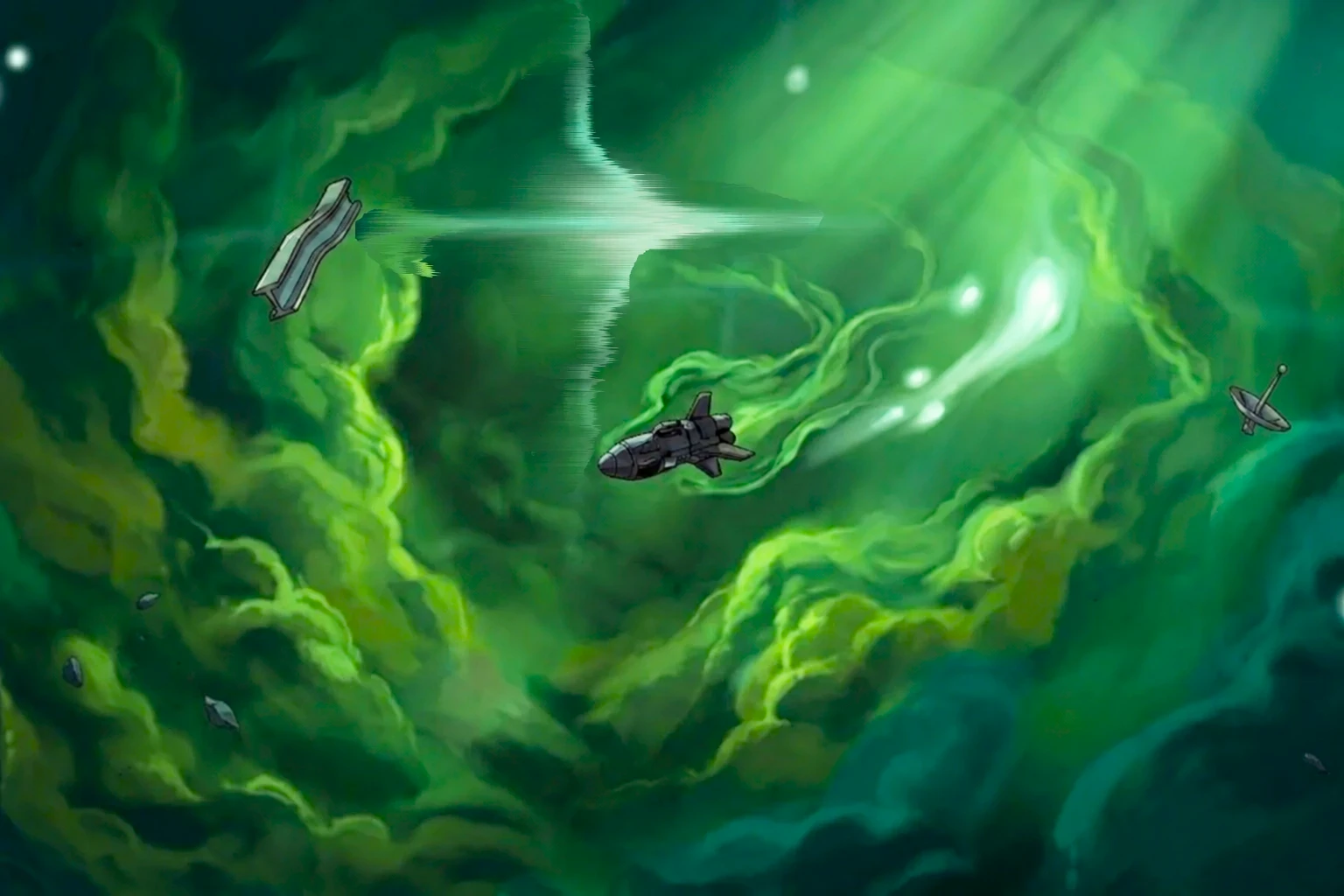
The exit was smooth.
That was the first thing Sora registered — the jump corridor releasing them into normal space with less turbulence than any exit they'd made since the first one. The correction table had done what it promised: the distortion that had characterized the original incident, the forceful displacement that had thrown them from the training route and deposited them forty-one light-years from home, had been counteracted by a bearing calculation precise enough to thread the needle of whatever natural distortion existed in this region. The jump had worked. The ship had not shaken. The drive had complained in the way it always complained and then subsided into post-jump cooling with no additional alarm.
For one breath, she thought: we did it.
Then she looked at the stars.
She had been looking at wrong stars for weeks now. She had catalogued her own process of adjustment — the first days of the profound wrongness of an unrecognized sky, then the slow accumulation of familiarity as the stars they were consistently seeing became known to her as this sky rather than the sky. She had stopped reaching for the academy's atlas when she looked up. She had started reading what was there rather than comparing it to what should be.
She had thought that meant she was prepared for wrong stars.
She was not prepared for these.
The first thing her brain reached for was damage. She looked at the forward viewport with the immediate assessment of someone checking for the obvious mechanical explanation: a crack in the transparency, a film on the surface, condensation, a fault in the imaging layer. But the viewport was intact — she could see that from here, the material clear and undamaged, the frame seating correctly.
The stars she was looking at through that intact viewport were not behaving like stars.
They were soft. That was the word that arrived first, not a technical term, just the honest description of what she was seeing: softness in things that should have been sharp. Every point of light she could see had the quality of something seen through water, the edges of it indistinct, the intensity not concentrated but spread slightly outward from the center. And they drooped. That was the word that came second and was harder to accept because drooping was not a quality that light had, but there it was, an unmistakable visual impression that the stars were running downward like heated wax, or like reflections on a surface that had been disturbed and had not yet stilled.
Some of them were doubled — two images of the same point, slightly offset, as if seen from two angles simultaneously. Some of them had stretched into thin lines, brief glowing threads that traced the direction of whatever force had elongated them. Between the stars, the darkness was not the clean absolute black of empty space. It had depth, or the impression of depth, layered like something transparent that went down further than she could see.
Nobody said anything.
She was aware of the silence on the bridge in the specific way she was aware of sounds — by their pattern and what it indicated. Seven people not speaking was information. The content of the silence was: everyone is looking at the same thing and nobody has found the words for it yet.
Riku said: "Is the viewport damaged?"
She had expected that. She had asked herself the same question and dismissed it.
"No," Mei said, from the engineering station. She had run the check before Riku finished asking, which told Sora that Mei had also been hoping for the mechanical explanation. "Viewport integrity nominal. External imaging sensors are also nominal — the sensor array is reading correctly, it's just reading this."
"The signal is real," Yui said, from the communications board. "Sensor noise is within expected range. This isn't a fault in the instruments."
Sora turned back to the navigation display.
She had the star map running — the complete atlas, the same one she had been working from since they first arrived in unknown space, the document she had come to know as well as she knew anything. The map's positioning system was designed to compare the observed starfield against the catalogued positions and calculate a fix — the same process she ran every time they exited a jump, the process that had given her their position relative to the route network at each waypoint.
The map was trying to lock.
She watched it try. The software ran its comparison algorithms, found candidate stars, tested them against the pattern of what was visible, and kept failing to confirm. She could see why: the stars it was trying to match to catalogued positions were not where they appeared to be. Or they were where they appeared to be and the positions were wrong. The software was built to handle observation error and minor positional drift, but it was not built to handle stars that appeared to be in slightly different positions depending on — she studied the pattern — depending on where the ship was relative to them.
The stars were shifting as the ship moved.
Not by much. A fraction of a degree, barely perceptible, but consistent and real. When she used the attitude thrusters to rotate the ship ten degrees port, the stars in the forward viewport appeared to swim, moving slightly in the opposite direction from what normal parallax produced, as if the medium between the ship and the stars had a refractive quality, bending the light that traveled through it.
"Something is wrong with space," she said.
It was, she thought, the strangest sentence she had ever said out loud. She said it because it was the accurate statement of what the data was showing her, and accuracy was what she had.
"Define wrong," Daigo said.
"The light from the stars is being refracted by the medium it's traveling through," she said. "In normal space, the medium is effectively vacuum — light travels in straight lines and we see what's there at the position it's at. Here, the medium is behaving differently. The light is bending before it reaches us. The stars are real, they're where they are, but we're not seeing them from a straight line. We're seeing them through something that curves."
"The gravity scar," Mei said. "The warning marker from the relay data."
"Yes. I think so." She had been comparing the sector's behavior against the gravity gradient warnings in the route network data since the first minute. "A compact gravitational event — a region where spacetime geometry is irregular. The correction table accounted for the jump trajectory through it, but we're inside the region now. The stars look this way because the space we're in is not flat."
"Not flat," Riku said, with the quality of someone receiving information they would rather not have.
"Spacetime is curved everywhere — near masses, near certain phenomena. Here it's curved in a way that affects light at distance. Hence the visual appearance." She looked at the viewport again. "The stars are real. They are where they are. We're just seeing them through a curved lens."
"A lens made of space," Riku said.
"Yes."
He was quiet for a moment. "That is extremely strange."
"Yes," she said.
---
She let herself look at it for longer than was strictly necessary.
This was not a failure of discipline — she was running the navigation continuously, checking the route marker bearing at intervals, maintaining the position monitoring that was her primary job. But she was also looking at the sector the way she had looked at the gas giant from the greenhouse station's transparent panels, the way she had looked at the silent moon from the airlock ramp, and she was aware that she was doing it and was not stopping herself.
The stars were wrong. They were also extraordinary.
The doubled images had a quality she had never seen in any visual record or simulation — two ghost copies of the same star, offset by exactly the angle that corresponded to the curvature of the region, as if space had briefly become a mirror and was reflecting the past position of each star alongside its present one. The stretched ones made long luminous threads that drew the eye along their length, suggesting direction and motion in something that was, in physical fact, stationary. The clusters that sagged at their edges looked like slow-motion dissolution, like watching a shape forget itself.
She thought about the beings who had built this route network. She thought about the gathering room in the relay station, the central column, the finished walls. She thought about whatever had designed these waypoints and stocked them for travelers and mapped a network of safe passages through a region of space that extended forty-one light-years beyond the academy's boundary.
They had known about this sector. The correction table was proof of that — someone had calculated the trajectory that allowed a jump through this region, which meant someone had measured the distortion, characterized the gravitational irregularity, developed a mathematical model of how the curvature affected jump corridors, and built the correction into the route network's data. Someone had come here, experienced what she was now experiencing, and instead of simply avoiding the sector had figured out how to use it.
She found that, sitting at the navigation console of a damaged training ship with melting stars in the viewport, genuinely beautiful.
"Sora." Haru's voice, even. "Route marker."
"Present," she said, returning to the task. "Bearing is — fluctuating slightly. The distortion is affecting signal timing. The marker pulse is arriving at irregular intervals." She ran the compensation calculation. "Compensating. The underlying bearing is consistent with our expected position. We are still on the route."
"Are we?"
She turned to look at him. He was asking the question she had been sitting with since the first second — not whether the instruments said they were on the route, but whether being on the route meant what it usually meant.
"We are at the position in the network that corresponds to the fourth waypoint's next bearing, as corrected by the table from Chapter 9," she said. "The route marker is present and transmitting. The bearing toward the next waypoint is valid." She looked at her display. "We are on the route."
"But?"
"But the route passes through a region with significant spatial distortion," she said. "The correction table exists because this region cannot be navigated without correction. Which means the route builders knew this sector was here, and they built their network through it anyway." She paused. "I don't know why."
"Because it was the path," Yui said, from communications. "The route has to go through here to get where it's going. You don't build a mountain tunnel because you like being underground. You build it because the mountain is there."
"Or," Daigo said, "this is not the main route."
The bridge was quiet.
"Explain," Haru said.
"The correction table came from the abandoned ship," Daigo said. "The ship that had been drifting for decades with an automated system reporting that it couldn't complete its journey. The relay station memory had a partial correction — not a complete one. The abandoned ship had the complete version." He looked at the viewport. "Why would the relay station's correction be partial if this sector was the standard route?"
Sora had been thinking about this since the jump. "Because it may not be," she said. "The relay memory may have been partial because this sector is an alternate route, not the primary one. The main route may avoid this sector entirely. This branch may be a contingency — a path that can be taken when the main route is unavailable."
"Like a back road," Riku said.
"Yes. Like a back road." She looked at the data. "The abandoned ship's route archive had more complete information than the relay station's memory. That might mean the abandoned ship was using this branch specifically, while the relay station was oriented toward the primary route and had only partial data about the secondary one."
"So we're on a back road," Riku said.
"We may be," she said. "The back road still leads where we need to go — the bearing is valid, the boundary is in the correct direction. But a back road may be a back road for a reason."
"The abandoned ship couldn't get through," Daigo said.
"The abandoned ship's signal said the boundary was unsafe or closed," Yui said. "That may not mean it was closed from this direction. It may mean the ship arrived and found the passage blocked when it got there." She paused. "Which is different from the passage being blocked now."
"Is it blocked now?" Haru said.
"I don't know," Sora said. "I won't know until we reach the boundary approach."
The sector drifted around them in its impossible way, the melted stars running their slow visual distortion, the space between them carrying its layered depth. Sora kept the navigation display running and kept checking the route marker and kept running the position calculation that the software kept struggling to complete and that she kept manually verifying because the software had never been designed for this.
She could navigate here. That was the important thing. The instruments were not broken, the route marker was not gone, and her own ability to read a bearing and track a position was not dependent on the software completing its lock cleanly. She had the beacon. She had the correction table. She had the accumulated weeks of learning to navigate in wrong space.
She could do this.
---
Yui said: "There's something in the debris field."
Sora had been tracking the debris field peripherally since Yui first mentioned it, twenty minutes into the sector. It had appeared gradually — first as interference on the passive array that resolved, on closer inspection, into small objects rather than sensor noise; then as visible material in the distorted starlight as the ship moved toward the route marker; then, as they got closer, as the identifiable shapes of engineered materials drifting in the warped space.
Metal. Structural materials. Things that had not gotten here by natural processes.
She had been letting the navigation take her full attention and had been trusting the others to track the debris. Now she looked at the display Yui was pulling up on the secondary bridge screen.
The fragment Yui was pointing at was large — perhaps three meters across, visible in the optical sensors as a jagged plate that rotated slowly in the warped light. The material had the layered quality of the route network's construction materials, though the distortion made it hard to be certain. And on its surface, partially damaged, partially legible even through the distortion: a marking.
Not the full route symbol. A fragment of it. The circular element with the position marker, the same fundamental element that appeared on every beacon plate and every station panel they had visited, damaged here to the point where only the core was intact. But it was there.
"That's route construction material," she said.
"Or something that uses the same marking system," Daigo said.
"Same thing," Yui said.
"Not necessarily."
"It's close enough to matter for what we're trying to figure out," Yui said, with the patience of someone who had been having variations of this conversation with Daigo for weeks and had found the most efficient way through it.
"Something that was connected to the route network was destroyed in this sector," Sora said. "Or was here and broke apart. Or was transported here from somewhere else." She ran through the possibilities. "I can't determine which from what I can see."
"Can it tell us what happened here?" Haru said.
"I'll scan it," Yui said, and the passive array swung to focus on the fragment.
What the scan told them was: engineered material, composition similar to but not identical to the route station materials they had analyzed at the beacon and the relay. Age uncertain but significant — the surface degradation suggested extended exposure to this sector's unusual environment. No active systems. No life signs. No indication of what it had been part of before it was this fragment.
"There are more," Riku said, from the flight console. He had been scanning the sector visually while the others worked the instruments, the pilot's habit of watching the space around the ship rather than the screens that represented it. "I count — six, seven larger pieces. And a lot of smaller material I can see in the ship's lights. It's a field, not a single wreck."
"A field this size," Daigo said. "From what?"
"A station," Mei said. "That's my estimate. The material volume is consistent with a station-scale structure, not a single ship. Something large was here and is now in pieces."
The silence after that had a different quality than the earlier silences — not awe or wonder but the specific weight of understanding that something had ended here. Something had existed and had been destroyed or had failed and the pieces were drifting in the warped light of a sector that bent the stars and would continue to drift here for as long as the gravity of this region kept them.
"Did the sector do it?" Riku said.
"The sector's gravitational distortion?" Mei considered. "Possibly. A compact gravitational event severe enough to cause this level of visual distortion could, if it was unstable or if something changed about its structure, exert forces on any structure in the region that exceeded that structure's design tolerances." She looked at the fragment display. "Or it was already compromised and the sector's conditions finished it. I can't determine causation from fragments."
"I can tell you one thing," Sora said. "The route marker is still functional." She pointed to the beacon reading on her display. "The fourth waypoint's marker is transmitting. It's in the debris field. It's intact. Whatever happened to the station or the structure that these fragments came from, the beacon survived it."
"Built to last," Riku said.
"Built to last," she agreed.
---
The navigation through the debris field was slow and required continuous adjustment in a way that normal navigation did not.
The problem was not the debris itself — the fragments were drifting at low velocity, slow enough that their positions changed by manageable amounts over the timescales of their transit, and Riku was flying with the particular care that the greenhouse docking and the cable field approach and all the weeks of working in tight spaces had built into his default. He was not struggling. He was being patient in the way he had learned to be patient, which was not his natural mode but had become reliable.
The problem was the distortion.
Distances were unreliable. Not wildly so — nothing that would make navigation impossible — but enough that the margin between a fragment's apparent position and its actual position could be anywhere from a few meters to a few dozen meters, depending on its orientation relative to the curvature of the sector. Sora had been calculating a distortion correction factor based on the readings since they arrived, and it was not a clean factor — it varied with position and direction, which meant she had to recalculate every time Riku changed the ship's heading.
"Large piece, forty degrees starboard, apparent range sixty meters," she said.
"Apparent," Riku said.
"Actual estimate, fifty to fifty-five."
"Copy. Adjusting." A pause. "I hate this sector."
"Noted."
"I want that in the official log."
"Also noted."
Yui said: "Daigo, the fragment cluster at your two o'clock has a drift vector — it's moving toward the route marker bearing."
"How fast?" Daigo said.
"Slow. But consistent." She paused. "All of it is moving. Not randomly. Everything in the sector is moving in the same general direction."
Sora checked the gravity display.
The readings were doing something they had not been doing when she first checked them, twenty minutes after arrival. When she had run the initial gravity survey, the readings had shown the distributed distortion she expected from a compact gravitational event — spread across the sector, highest in the areas of greatest visual distortion, consistent with a region-wide phenomenon. Now the readings were showing something different. Not higher, exactly, but more directional. The gravity was not just present, it was oriented. It was pointing at something.
She tracked the vectors.
They converged. Not at the debris field, not at the route marker, not at any visible object. They converged at a point in empty space approximately thirty degrees off the route marker bearing, at a distance she could not precisely determine because the distortion was highest in that direction and her range estimates were therefore least reliable in exactly the sector where she most needed them.
"There's a gravity focus," she said.
"A what?" Riku said.
"The gravity readings are not uniform across the sector. They're converging on a point. A location where the distortion is strongest." She looked at the position. "It's off our route. We're not heading toward it. But—"
"But the debris is," Yui said. She had been tracking the motion vectors on her display while Sora tracked the gravity. "The fragment motion is consistent with a slow drift toward that convergence point. Whatever is pulling the debris, it's in the same location Sora's gravity reading is focusing on."
"Something in the middle of the sector," Daigo said, "that we can't see, that has gravity, that is slowly pulling the debris toward it."
Nobody argued with that summary.
"Dark mass," Mei said.
"The notation from the relay data," Sora confirmed. "A compact gravitational event — significant mass but no corresponding visible object. Like a very dense remnant. Too small to be a conventional black hole, not visible on optical sensors, but gravitationally real and gravitationally significant." She looked at the display. "The sector is distorted because this object is here. The light bends because the space around the object curves."
"And the debris is being pulled toward it," Riku said.
"Slowly. The drift rate I'm seeing suggests the timescale for any significant change is hours or longer, not minutes." She looked at the route bearing. "Our route passes through the distorted space but not through the convergence point. If we maintain the bearing, we stay on the distorted outskirts of the object's influence. We don't go near the focus."
"Near the focus," Daigo said. "How near is the focus to our bearing?"
"Approximately—" she ran the calculation, which was uncertain due to the distortion, which she flagged, "—approximately eighty to one hundred and twenty kilometers. That's a wide error range because the distortion makes ranging imprecise in that direction."
"That's close," Daigo said.
"It's not dangerously close on a cosmic scale," Sora said. "The tidal forces at this distance from an object of the estimated mass should be within the ship's structural tolerances." She paused. "Should."
"You keep saying should," Riku said.
"Because I keep meaning should," she said.
Haru had been quiet for several minutes, listening. She watched him without appearing to watch him — a skill she had developed since the first days of the mission, the ability to monitor the captain without it being visible, because the captain's state was information.
He looked, at this moment, like a person who had been given a very complicated set of facts and was deciding what to do with them, and was aware that the decision he made would determine where all seven of them were in an hour.
"We have the route bearing," he said, finally.
"Yes," she said.
"The bearing is valid."
"Yes."
"The correction table accounts for the distortion."
"The jump correction. For the transit through the region. The table is designed for the jump mechanics, not for navigating within the sector itself." She wanted him to have the accurate version. "The correction got us here. Whether it fully accounts for conditions at this depth in the sector, I'm not certain."
"What are the options?"
She thought about it. "Continue on the route bearing toward the next jump position. Hold here and reassess. Or attempt to retrace the jump backward, which the drive is not currently in condition to do safely." She looked at the display. "Retracing is not a real option. The drive needs more recovery time, and the jump back through the correction without a table calculated for that direction is a significant risk."
"So we continue or we hold."
"Yes."
"How long can we hold safely?"
"I don't know. The debris drift is slow, but it's consistent. If the convergence is active enough to be pulling the debris, it may affect our position over time as well." She checked the gravity reading. "The ship is not currently showing significant drift toward the focus. But I'd want to run a monitoring period before committing to a long hold."
"How long a monitoring period to be confident?"
She did the math. "An hour, minimum. Two would be better."
"Riku." Haru looked at the flight console. "Fuel expenditure if we hold for two hours with attitude correction for drift?"
"Depends on how much drift correction we need," Riku said. "If the pull is as slow as Sora says, manageable. If it accelerates—" He looked at Mei.
Mei looked at the power display. "We have reserves. Holding for two hours costs something we can afford if nothing changes. If the gravity pull intensifies—"
"If it intensifies we discuss it when it does," Haru said.
He looked at the debris field, the melting stars, the convergence point that was not visible but whose presence was written in the bending of every photon in the sector.
"We hold for ninety minutes," he said. "Sora monitors the drift and the gravity readings. If the readings are stable at the end of ninety minutes, we proceed on the route bearing. If anything increases significantly, we reassess." He looked at each of them in turn. "Nobody approaches the debris. No salvage. Yui, continue scanning for any signal data that might tell us more about what the debris was. Daigo, monitor for any change in the debris motion vectors. Hana—"
"I'm watching everyone," Hana said.
"I know you are." There was something in his voice when he said it that was different from command voice — something more personal, more tired, more honest. "Thank you."
The ninety minutes passed.
She watched the gravity readings. She watched the drift vectors. She watched the route marker bearing. She ran the navigation calculation at ten-minute intervals, each time accepting the software's partial lock and manually verifying the result, each time finding the bearing valid and the route marker present.
The gravity readings did not significantly change.
The drift vectors continued at the same slow rate.
The debris moved at the same patient pace toward the invisible point in the center of the sector.
At the ninety-minute mark she said: "Stable. No significant change in any of the monitored values."
"Jump position?" Haru said.
She had been calculating it throughout the hold. "I have the jump bearing. Corrected for sector distortion. The next waypoint should be clear of this region — the route data shows the distortion zone as bounded, not extending beyond this sector." She looked at Riku. "It's a shorter jump than the previous ones. The distortion may cause some corridor variation, but I've calculated the best-fit trajectory. We should exit into clean space."
"Should," Riku said.
"Should," she agreed. "I'm not in the business of promises in this sector."
"Fair enough."
Haru said: "Jump when ready."
Riku began the spool sequence. The familiar sounds of drive preparation filled the bridge — the deepening hum, the power redistribution that dimmed the lights briefly, the analog gauges stepping up through their ranges. Normal sounds, in a place where nothing else was normal.
She took one last look through the viewport.
The stars ran their soft distorted patterns in the warped space. The debris turned in the slow gravitational drift, patient as everything in this sector was patient, moving toward the point in the middle of it that pulled at everything with the impersonal persistence of mass and space and time. The route marker pulsed at its bearing, the signal arriving in stretched rhythms through the curved medium, still valid, still pointing the way.
She saw, in the last seconds before the jump engaged, that the fragments had shifted.
Not dramatically. Not suddenly. But the configuration of the debris field was different from the configuration she had catalogued on arrival — the pieces had drifted, as she had predicted they would drift, and in drifting they had moved closer to the convergence point, and their orientation relative to each other had changed. They were beginning to arrange themselves around the invisible center the way things arranged themselves when gravity had long enough to work.
She noted it.
"Mei," she said. "The debris is accelerating."
"By how much?" Mei said.
"The rate has increased. Not dramatically, but the drift is faster than the initial readings predicted." She looked at the numbers. "The convergence is active and the rate of pull is increasing."
"How much time before—" Daigo started.
"Jump," Haru said.
The correction table's bearing locked in the navigation system. The drive engaged. The forward viewport went white.
She watched the distorted starfield for the last fraction of a second before the jump took it — the melting stars, the warped darkness, the debris beginning its slow convergence — and then it was gone, replaced by the white of transit and the familiar vibration of the jump corridor.
In the sector behind them, slowly and without urgency and without anyone left to observe it, the fragments of whatever had once been a station or a vessel or a structure of the ancient road continued their patient drift toward the invisible thing that had been pulling them since before the Haruki Maru arrived.
The empty place in the middle of the sector finished drawing the wreckage into something close to a circle.
The melted stars bent a little farther inward.


.png)
.png)
.png)