%20(1).png)
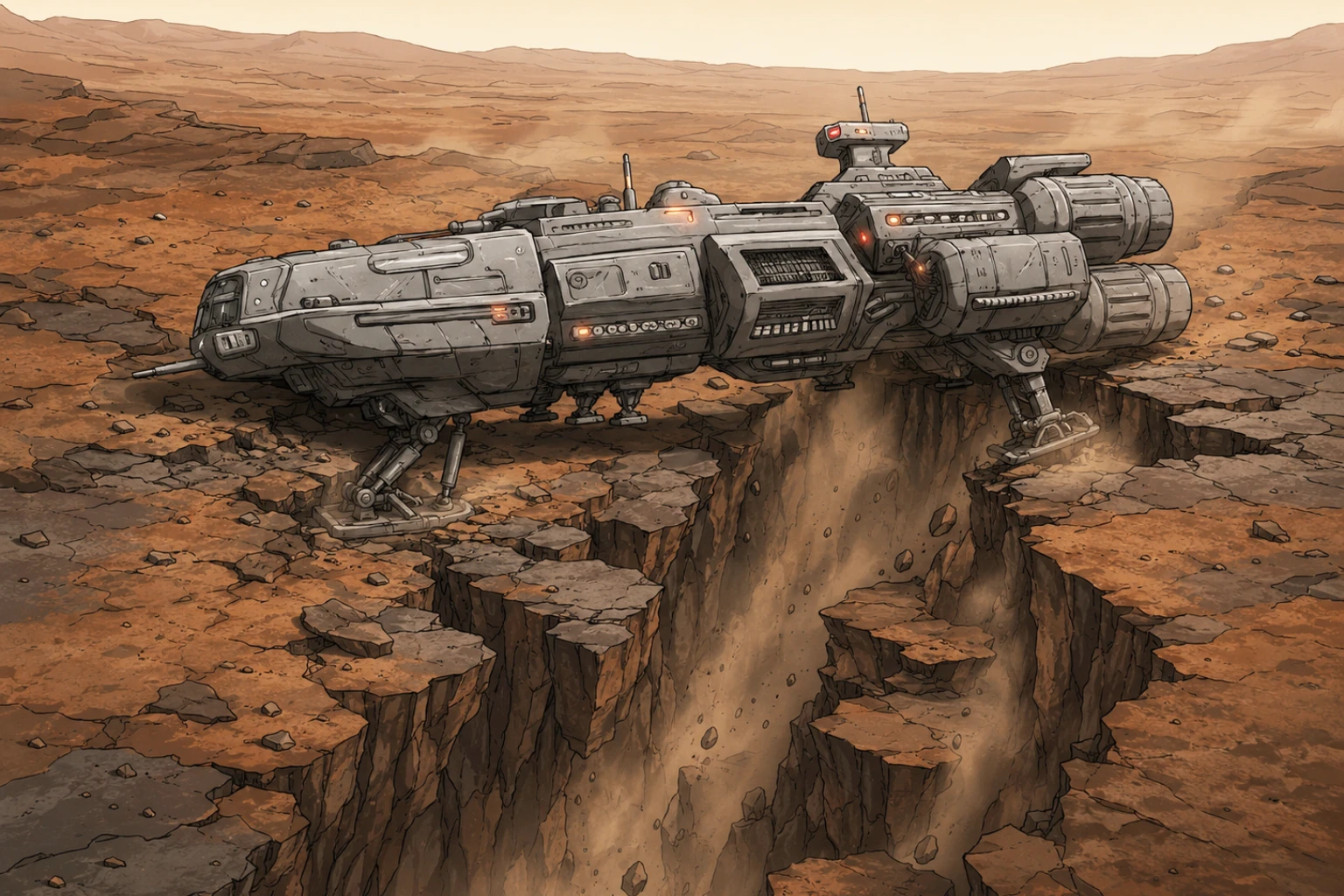
For three seconds after the jump exit, Haru thought they had made it.
The viewport showed clean space — no distorted stars, no warped medium, no melting light. Just the ordinary dark and the familiar wrongness of unrecognized constellations that had, over the past weeks, become the sky he expected to see. The drive was running hot and the stabilizer was complaining in the way it had been complaining since the sector's distortion had pushed against it, but those were known problems with known parameters, and known problems with known parameters were manageable.
Three seconds.
Then the alarms started.
Not one — several, in rapid succession, each one adding a new layer to the picture. Drive imbalance: port engine running significantly hotter than starboard, the thermal differential crossing into the range where sustained operation caused cascade damage. Jump stabilizer: strained past rated tolerance, the unit Mei had installed at the relay station now reporting internal stress that had not been there before the correction table jump. Hull stress: elevated readings at three points on the starboard side, the kind of readings that meant the frame had flexed more than it was supposed to flex during the transit. Port landing strut: weakened, the structural integrity reading dropping to a threshold that triggered its own separate alarm.
And then, underneath the sound of the alarms, the quiet sound of the planet.
Gravity. Not the neutral territory of empty space where the ship's drives determined their motion. Something pulling. Something below them that had opinions about where the *Haruki Maru* was going to be, and those opinions were becoming more insistent by the second.
"Sora," he said.
"Working," she said. She was already at the navigation display, running the position calculation with the focused efficiency of someone who had been doing this for weeks and could produce a result faster than the software could complete its lock. "We are on the route. The boundary bearing is valid. We are — closer than we were. The sector transit moved us forward in the network. We've bypassed two waypoints." She looked up. "But—"
"The planet," he said.
"Yes." She looked at the readings. "We exited the jump significantly closer to the planetary mass than the route data indicated we would. The trajectory distortion from the sector—"
"How close?"
"We are inside the gravity capture radius," she said. "Not deep inside — we're at the margin, which means we have options. But the drive cannot overcome the capture gradient in its current state."
"Riku," he said.
Riku was already on the controls. He had been on the controls since the alarms started — Haru had not needed to tell him, the pilot's instinct responding to the information before the command structure had processed it. "I can feel it," Riku said. "The pull. I'm trying to compensate but the engine imbalance is — the port side is dragging." His hands moved through the adjustments with the steady precision of someone who had been flying longer than they had been afraid. "I'm losing altitude."
"Can you climb out?"
A pause that lasted long enough to mean no. "Not safely. Not with the imbalance this severe. If I push the port engine harder to compensate, I risk the thermal cascade Mei is already warning about. If I don't, we keep losing altitude." He looked at the planet below. "We're going to touch down whether I want to or not. The question is whether I choose how we do it or the planet does."
"Mei," Haru said.
She was already at the engineering console with the drive data in front of her and the expression of someone running a calculation they don't like the answer to. "He's right," she said, without preamble. "The engine imbalance cannot be corrected from here. I need physical access to the port drive housing to realign the fuel distribution. I cannot do that in space. I cannot do it in flight." She looked at him. "We need to land."
The word sat on the bridge with its full weight.
"The planet," he said. "What do we know."
"Geologically active," Sora said, reading from the passive sensor data that was accumulating as they descended into range. "Atmosphere is present but thin — below academy standard for comfortable operation, suit recommended for extended surface work. Surface composition is predominantly silicate and basaltic rock. Temperature is cold but survivable in suits." She paused. "I'm reading seismic activity."
"Significant?"
"The sensor resolution at this range is not sufficient to characterize it fully," she said, which was as close to *I don't know how bad* as Sora got. "There is ongoing ground movement."
"How much time do we have before we lose altitude control entirely?" he said to Riku.
"At current rate?" Riku ran the calculation in his head the way pilots did. "Twenty minutes until I can't maintain a controlled descent. Less if the port engine degrades further."
Twenty minutes.
"Then we land," Haru said. "Riku, find me a site. Flat, away from the ridgelines, as far from whatever the seismic activity is centered on as you can determine. Daigo, I need everything loose secured before we hit the atmosphere. Hana, get the medical kit ready and get everyone's restraints checked. Sora, I need the launch bearing calculated before we're on the ground. Whatever we determine from down there, I want to know where we're going before we get there."
He looked at the planet through the viewport as he said it. From this distance it was a disc — dark stone, pale dust, the cloud structures of an atmosphere thin enough to be transparent in places. Not beautiful the way the gas giant had been beautiful. Not strange the way the sector had been strange. Just a planet that was going to have them on its surface in less than twenty minutes whether it had been consulted about this or not.
"Yui," he said.
"Already on it," Yui said. She had the ship's power management display up and was routing around the damaged conduits that the hull stress had flagged, preserving the systems that would need to be functional on the surface and accepting losses on the ones that could be offline without compromising survival. "I'm losing some secondary sensors. The external imaging array on the port side is running intermittently. I'll get you landing cameras."
"Do that."
He sat down at the command station, which was the right place to be and felt, for the first time since they'd left the sector, like a deliberate choice rather than a response. He looked at the planet below and he breathed and he made the list he always made when there was too much happening at once: what he knew, what he needed, what he was doing.
What he knew: the ship was damaged, the drive was imbalanced, they were being pulled toward a geologically active planet, and they had twenty minutes.
What he needed: a controlled landing, the repairs to make the drive functional for one ascent and one jump, and a launch window before the planet decided they were staying.
What he was doing: everything, with everyone, as fast as it could be done.
"Descent in ten minutes," Riku said. "I have a site — valley floor, two kilometers from the nearest ridge line, appears flat on the sensors. No guarantees from here."
"Best available," Haru said.
"Best available," Riku confirmed.
---
The descent was the most physical flight experience of Haru's life, and he was not the one flying.
He was strapped into the command station and could feel every input Riku made in the ship's response, every correction Riku applied to the imbalanced drive transmitted through the hull and the deck plates as a vibration or a yaw or a sudden lurch that the restraints absorbed and distributed. He could hear Riku working — not his voice, which stayed controlled and quiet throughout, but the sounds of his hands on the physical controls, the manual flight inputs that the autopilot was too confused by the engine imbalance to make and that only a pilot who could feel the ship could compensate for correctly.
"Port engine at eighty-three percent and declining," Mei said, from the engineering console she had refused to leave even when Haru had suggested she might want restraints. She had a grip bar pulled out from under the console and was holding it with one hand and working the drive management with the other. "Thermal is elevated but not yet in cascade range. I'm throttling the port side down to reduce heat load."
"If you throttle it down I lose the compensation," Riku said.
"If it cascades we lose the engine," Mei said.
"What's the middle?" Haru said.
"Seventy-eight percent on port," Mei said. "At that power level, I can manage the thermal load. It limits our descent control but keeps the engine alive."
"Riku," Haru said.
"Seventy-eight is — hard," Riku said. "But workable. Barely."
"Seventy-eight," Haru said.
The atmosphere thickened around them as they descended, and the vibration that had been the smooth resistance of thin upper atmosphere became the irregular buffeting of something more substantial. The ship shook in a way that was not the controlled shudder of a normal atmospheric entry — it was less rhythmic, more responsive to the specific turbulent pockets they moved through, and Riku was managing each one as it came, reading the turbulence a half-second ahead through whatever it was that pilots could feel that nobody else could.
"Landing lights," Riku said.
Yui activated them. The surface below — visible now through the forward viewport as real terrain rather than sensor data — was dark stone and pale dust and the long shadows of a low sun angle, and in the landing lights the ground showed them the nature of what they were landing on: flat, yes, in the sense that there were no major features in the immediate site, but textured with the small irregularities of a surface that wind and seismic activity and the slow work of time had treated as material to be rearranged.
"Five hundred meters," Sora said. "Four hundred."
Haru watched the altitude and watched Riku's hands and watched the surface coming up.
"Two hundred. One fifty."
"Landing gear deploying," Riku said. "Port strut is—" a pause that lasted one second too long, "—deployed. Integrity is yellow."
"It'll hold for this," Mei said.
"It will," Riku said, in the tone of someone making a statement rather than asserting a belief, and brought them down.
The first contact was harder than he had hoped and softer than he had feared — a genuine impact, the ship's weight meeting the ground with force enough to travel through the whole structure as a single sharp compression, and then the bounce, the ship lifting slightly and coming down again, and the second contact was harder and the landing struts groaned with it, and then the ship settled.
Crooked. The port strut had compressed under the impact and held, but had compressed further than the starboard, which left the deck noticeably angled — not dramatically, he could stand without holding something, but perceptibly, the way a floor felt wrong when a building had settled unevenly.
He looked at the crew.
Everyone was alive.
Riku had his hands still on the controls and was breathing through his nose in the focused way of someone regulating their heart rate. Mei was already moving, the grip bar released, crossing to the engineering console's secondary display with a tool already in her hand. Sora was at the navigation alcove, the floor angle apparently not affecting her ability to work. Yui was checking sensor feeds one by one. Daigo was unstrapping and moving toward the cargo section. Hana had the medical kit in her lap and was already running her eyes over the crew.
"Injuries," he said, to Hana.
"Let me check," she said, and was already moving.
He let her check. He stood at the command station and looked at the planet through the forward viewport while she did.
The landing site was exactly what the sensors had suggested and exactly what he'd expected and had hoped for anyway: flat stone ground, pale dust blowing in horizontal sheets across the surface in a wind that was audible against the hull, dark ridgelines at a distance that was far enough to not be immediately threatening. The sun was pale and low and the light it gave the surface had the quality of very early morning or very late evening, without the warmth of either.
The ground was still.
For the moment.
"Bruised shoulder," Hana said, working her way around the bridge. "That's Sora. You're not leaving your station, I assume?"
"No," Sora said.
"Tell me if it worsens." She moved on. "Riku — hands."
"Fine," Riku said.
"Show me."
He held them up. They were shaking. Hana looked at them and said nothing about the shaking, which was medically correct — adrenaline response, not injury.
"No lacerations," she said. "The grip left some compression marks. They'll bruise. Keep flying."
"Plan to," he said.
She completed the circuit. Mei had a cut on her right forearm from the grip bar's edge when the second contact had jolted it — she was aware of it and had been ignoring it. Hana cleaned and sealed it in sixty seconds while Mei kept working, which was the correct interaction and the one Hana had learned to offer rather than insist on. Daigo had a bruise developing on his left side from the equipment case that had shifted during the descent despite his securing work — he had caught the case before it crossed the cargo bay, which had cost him the bruise. He accepted Hana's examination with the same stoic precision he brought to everything.
"Nothing incapacitating," Hana reported. "Nothing that stops any of you from working."
"Then we work," Haru said. "Mei. Time estimate."
Mei was at the engineering console with the drive diagnostic running, her cut arm already forgotten. "Port engine fuel distribution alignment is the primary repair. If I can get exterior access to the port drive housing, I can realign the distribution manifold. That is the repair that enables safe ascent." She was reading the data as she talked. "Secondary priority: the jump stabilizer. The transit through the sector stressed it past its rated tolerance. I need to know if it can survive another jump or if I need to cannibalize something for a partial rebuild."
"Time for the primary."
"Forty minutes for the engine. If everything goes well." She looked at the floor angle. "The ship's attitude is going to complicate exterior access on the port side. I'll need someone with me."
"Daigo," he said. "You're with Mei. Exterior work, port side. Suits on." He looked at the group. "Everyone else: Sora, continuous launch bearing monitoring. Yui, system rerouting and communication. Riku, flight systems prep and thermal monitoring. Hana, crew status and anything Mei needs from the medical kit." He looked at the deck. "Forty minutes. That's the window. We work."
---
Thirty-one minutes later, the first tremor hit.
It was not violent. It was a low vibration, felt before it was heard, traveling through the hull from the ground contact as a sustained rumble that lasted approximately four seconds and then stopped. The quality of it was different from the normal vibration of a ship running systems — it was irregular, rising and falling in a way that mechanical vibration did not, and when it stopped it left the ship slightly different than it had been before. Dust on horizontal surfaces had moved. The tools Yui had laid out on the secondary console had shifted. The landing struts had made a sound.
Everyone stopped.
"Ground movement," Daigo said, on the suit comm. He and Mei were outside, working the port drive housing. "The surface shifted. Not much. But it shifted."
"Confirmed from here," Sora said. "Seismic event. Low magnitude, based on what I could measure through the ship's sensors."
"Is it building?" Haru said.
"I don't have enough baseline data to determine that," Sora said. "I only have one event to characterize."
"Mei," Haru said.
"Still working," Mei said, on the suit comm. Her voice had not changed. "The first alignment bracket is seated. I need thirty more minutes."
"Thirty," he said.
"Thirty," she confirmed. "Maybe twenty-eight if the second bracket cooperates."
He looked at the time. Thirty-one minutes already, and now thirty more. An hour total. He looked at Riku.
"The engines have been cooling during the landed period," Riku said, reading the question before it was asked. "That's actually good — the thermal overheat concern is less acute after ground time. The question is whether the realignment holds when we run hot again on ascent."
"Ask Mei," Haru said.
"I will hold," Mei said, from outside. She had clearly been monitoring the bridge comm while working. "Once it's aligned. Ask me if it holds after we're in the air."
Haru kept moving.
He had developed a habit over the past weeks that he recognized as new — or not new exactly, but developed, the same way a skill developed through practice until it didn't require conscious effort. The habit was: keep moving while you think. Don't stop to worry. Worry while you work. The thinking happened in parallel with the doing, which meant the doing didn't stop because of the thinking, which meant things got done. He moved from the command station to the navigation alcove, where Sora was running her launch bearing calculation with the bruised shoulder she had not mentioned since Hana noted it.
"The bearing," he said.
"Valid," she said. "I've been recalculating every five minutes. The route marker is transmitting. The boundary approach bearing has not changed." She looked at the data. "The jump we need to make is—" She paused. "It's the jump that should put us into the boundary approach zone. Inside academy-proximal space."
"Should," he said.
She looked at him. "Yes. Should. I'm giving you the best calculation I have with the instruments I have and the position data that is reliable in this environment." She held his gaze steadily. "I believe it's right. I can't promise it the way I could promise a supervised training jump in known space."
"That's enough," he said. "That's what we have."
"Yes," she said.
The second tremor hit at the forty-two minute mark.
This one was stronger.
The tools didn't just shift — one of Yui's tool cases went off the edge of the secondary console and hit the floor, and the floor's angle made it slide further than it should have until Yui caught it with her foot. The hull made sounds it hadn't made in the first tremor, structural sounds, the complaint of materials experiencing force from a direction they hadn't been designed to experience it. The landing struts groaned louder.
Through the forward viewport, Haru saw the dust on the surface moving differently — not the horizontal wind drift that had been constant since they landed, but a vertical disturbance, dust lifted by ground movement and hanging in the low gravity before settling back.
"Port strut is at critical threshold," Yui said, reading the structural display. "The tremor put more stress on the weakened strut. It's holding, but—"
"I see it," he said.
"Mei," he said, on the suit comm.
"Second bracket," she said. Her voice was the same as it had been the first time he called her name during the work — entirely focused, not panicked, the voice of someone who was not going to be hurried by the ground shaking because being hurried would not make the bracket seat faster. "Ten more minutes."
"The strut is at critical."
"I know. Ten minutes. Don't tell me about the strut. Tell me when it actually fails."
He decided to trust that and not respond.
Daigo said, on the suit comm: "Ground crack. Forty meters north of the ship. I can see it from here. It's new — it wasn't there before the second tremor."
"How big?"
"Width is — half a meter, maybe more. Length I can't determine from this angle. It runs east-west."
"Are you and Mei clear of it?"
"We're south of it. We're fine." A pause. "For now."
"Ten minutes," Mei said.
"Sora, launch bearing update," he said.
"The tremor affected my readings," she said. "I'm rerunning." A pause. "Corrected. Bearing is still valid. The tremor did not significantly shift our position."
"How much of a shift is 'significant' in this context?" Riku said, from the flight console.
"Less than we experienced," Sora said, which was the honest answer and not the reassuring one, and she gave the honest one.
He noted it and kept going.
The third tremor was worse.
It came at the fifty-one minute mark, nine minutes after the second, and the pattern of escalation was not something he had wanted to confirm was a pattern. This one moved the ship. Not far — a few centimeters, the deck shifting under his feet as the ground beneath the landing struts transmitted the seismic force upward — but the movement was unmistakable and so were its consequences.
The port strut alarm screamed.
"Strut is failing," Yui said. "The shock put it past the critical threshold. It's holding position but I don't know for how long."
Daigo said: "The crack is wider. It's at thirty meters now. And there's a second one starting at — east side of the landing site. Converging."
Converging.
"Mei," Haru said.
"Almost," she said, and he could hear in her voice what he had not heard before — not panic, Mei didn't panic, but the specific compression of a person who has just had their time margin eliminated and is working through it. "The bracket is seated. I need to finish the seal or the alignment will shift under load. Two minutes."
"The cracks are converging on the landing site," he said. "Two minutes may not—"
"Two minutes," she said. "I have to finish the seal. If I don't finish the seal, the alignment fails under launch load and the engine doesn't work and we don't get off the ground. Two minutes."
He stopped arguing.
He looked at Riku. "Get in the seat. Start the launch sequence. Don't wait for my order."
Riku was already moving.
He looked at Yui. "Everything we don't absolutely need — cut it. Give Riku all the power that can be routed to the engines."
"Cutting life support to minimum," Yui said. "Cutting secondary sensors. Cutting — everything I can." Her hands moved fast across the board. "You'll have it when the engines need it."
He looked at Hana, who was at her station with the medical kit secured to her suit and her restraints checked.
"When Mei and Daigo come back in," he said.
"I know," she said.
He looked at Sora.
"I have the bearing," she said, before he said anything.
"I know," he said.
He went to the hatch and stood at it and keyed the suit comm. "Mei. Daigo. Status."
"Seal is—" a sound, the sound of a tool under force, "—ninety percent. Forty seconds."
"The ground is cracking beneath the port strut," he said. "When you're done, you have thirty seconds to get back inside."
"I know," she said.
He stood at the hatch with one hand on the open control and waited.
Twenty seconds.
Thirty.
The ship moved. Not the vibration of a tremor — a different movement, slower and more sustained, the movement of a structure whose foundation was changing beneath it. Through the hatch's small window he could see the surface outside, and he could see that the dust pattern had changed, and he could see the edge of the crack that was now visible at the far left of his sightline, and he could see that the edge was closer than it had been.
"Done," Mei said. "Coming in."
"Move," he said.
He heard them on the exterior — two sets of footsteps through the hull, moving fast, and then the outer airlock door, and then the pressure cycle that was the longest twenty seconds of the evening, and then the inner door opened and Mei came through first and Daigo behind her and he hit the hatch close before Daigo had fully cleared the frame.
"Hatch sealed," he said. "Riku—"
"Already starting," Riku said.
The ship lurched.
This was not a tremor. This was the port strut giving way — he felt it through his feet, the sudden loss of one of the four points the ship was resting on, the deck angle shifting sharply as the damaged strut dropped into what he understood, looking at the viewport, was a crack in the ground that had opened directly beneath it.
The viewport filled with the view of tilting stone.
The ship was sinking.
Not fast — not the catastrophic collapse of a structure failing completely, but the slow, relentless sinking of something being swallowed by a surface that had decided to reclaim it. The deck angle increased. Tools slid. The cargo section made sounds of shifting and impact. Daigo grabbed the nearest handhold and held it. Mei grabbed the secondary console frame. Sora was already strapped in. Hana had a grip on the medical station rail.
"Riku," Haru said.
"Engines are at sixty percent," Riku said. His voice was very quiet. "I need another twenty seconds."
The ship dropped another increment. The angle was significant now — he was leaning into the incline to stand.
"Yui," he said. "Everything."
"Everything is already going to the engines," she said.
Seventeen seconds. He counted them. He counted them while the ship continued its slow descent into the fissure and the alarms that had been building since the tremors started resolved into a continuous sound that was the ship telling him everything that was wrong at once.
Eighteen. Nineteen.
"Riku," he said.
"Now," Riku said.
The engines fired.
---
The *Haruki Maru* did not rise gracefully.
The port drive housing, freshly realigned, came to power and found the load of a ship that was partially embedded in a planetary fissure, angled at fifteen degrees off vertical, with one landing strut trapped in crumbling ground and the remaining three fighting against the seismic forces that were continuing to work on the surface beneath them. The ship groaned. Riku gave it thrust and it gave back the complaint of a structure being asked to do something it was designed to do in conditions it had not been designed for.
But it moved.
The trapped strut — damaged, partially collapsed, bent at an angle from its original position — dragged against the edge of the fissure as the ship rose, and the sound of that contact transmitted through the hull as a screech that Haru felt in his teeth. Then the strut caught, held against the fissure edge, and for three seconds the ship was being pulled in two directions simultaneously: up by the engines, sideways and down by the trapped strut and the continuing seismic collapse of the ground beneath it.
"Strut is going to shear," Mei said. She had made it to the engineering console and was reading the structural data. "Either it shears clean or it tears the housing—"
The strut sheared.
The release of the load sent the ship lurching upward and sideways at the same time, and Riku corrected with a violence that showed in his whole body — both hands on the yoke, his weight going into the correction, the ship responding with a yaw and a roll that came frighteningly close to inversion and then stabilized, barely, into something that was rising and climbing even if it was doing so in a way that looked nothing like the flight manual's recommended procedures.
The viewport filled with dust. Total whiteout — not the white of jump transit but the tan-brown of planetary material blasted upward by the engine output and the seismic event happening simultaneously below them. He could see nothing. The altimeter was the only information that told him they were going up rather than sideways or down, and even the altimeter was behaving strangely in the dust and the disrupted local gravity.
"Altitude," he said.
"Climbing," Sora said. "Two hundred meters. Two fifty."
The ship shook. A different vibration from the earthquake — the vibration of an engine being asked for everything it had and providing everything it had and not being certain that everything it had was enough.
"Engine temperature," he said.
"High," Mei said. "Not cascade. High."
"Three hundred meters," Sora said. "Three fifty."
The dust was thinning. He could see the viewport beginning to resolve into something, the pale tan darkening at the top where the atmosphere thinned, the surface somewhere below still hidden but receding.
"Five hundred," Sora said. "Six."
"Eight," Riku said, and his voice was different. He was breathing. He had not, apparently, been breathing in quite the way a person was supposed to breathe for the previous two minutes, and now he was.
The dust cleared.
The planet was below them. Not the tilting, consuming, cracking surface they had been on — just the planet, seen from above, grey-brown and pale-dusted, the landing site a mark in its surface that was already difficult to identify from this altitude, the fissures that had opened around it invisible at this distance against the general texture of a geologically active world.
The sky above was black.
Space.
Nobody said anything for fifteen seconds.
Then Riku said, quietly, "Please tell me that was the last planet."
Haru looked at the damaged ship status display. Port strut gone — torn off at the base, the housing intact, landing would be complicated in the future. Engine temperature declining now that the strain of the ascent was behind them. Jump stabilizer strained but present. Hull stress at the highest levels they had seen, the frame having flexed beyond what it had been designed to accept, but the readings were stable rather than progressing. The ship was in the worst condition it had been in since they woke up on the corridor floor eight weeks ago.
It was alive.
They were alive.
He did not answer Riku's question immediately, because the answer was: he didn't know, and he was not going to say something untrue to make a moment feel better.
"Hana," he said.
She was already moving. "Give me five minutes," she said. "Nobody is critically injured. Everyone is going to have something. Give me five minutes."
He gave her five minutes. He sat at the command station and looked at the planet below and listened to the sounds of his crew — Mei talking to the engine data, Sora running the post-ascent position check, Yui restoring the systems she had cut to power the launch, Daigo moving through the cargo section checking what the tilted landing and violent launch had done to their supplies, Riku doing the post-flight evaluation that good pilots did after any flight where things had not gone according to plan.
He wrote in the notepad.
*Port strut lost. Cannot make a planetary landing on three struts. Add to the constraints for remaining route.*
*Engine realignment appears to be holding. Thermal is declining to acceptable range.*
*Jump stabilizer strained past tolerance. Mei to assess before next jump.*
*Hull stress elevated. Structure is intact. Monitor.*
*Crew: functional. Injuries minor. Morale — uncertain. Monitor.*
The last line he stared at for a moment before he wrote one more line below it.
*We are still on the route.*
Hana finished her circuit. "Sora has a bruised shoulder that I've immobilized slightly — she has full range of motion, it will be sore. Riku has compression marks on his hands that will bruise. Daigo has two cracked ribs — I cannot confirm without imaging, but the presentation is consistent. He has been told not to carry anything heavy. He will carry things anyway. I've accepted this." She looked at him. "Mei has the cut from earlier and two new bruises. She has been told to rest her right hand and will not. Also accepted." She put her kit down. "And you."
"I'm fine," he said.
She looked at him with the specific patience of someone who had been hearing *I'm fine* from people who were not fine for the entire duration of this mission.
"You took a blow to the left side when the ship lurched at the strut shear," she said. "I was watching from the medical station. You didn't fall, you caught yourself, and you kept going. Show me the side."
He showed her the side. She confirmed what she already knew and sealed a skin cut he hadn't noticed making, and handed him an analgesic that she told him to take, which he took.
"Sora," he said.
"I have it," she said. "The next bearing. The boundary approach."
He made himself say the next part carefully. "What are we looking at."
"One more jump," she said. "One jump, if the stabilizer holds." She looked at the navigation display, at the route data, at the calculations she had been running since they landed and had continued running through the ascent. "The bearing puts us into the approach zone for the academy boundary. I cannot guarantee what we find there — the route data ends at the boundary, it does not tell me what happens on the other side. But the bearing is valid and it points home."
One jump.
He looked at the ship status. He looked at the crew. He looked at the planet below, diminishing as Riku gave them distance from it, the grey-brown surface becoming a feature and then a shape and then a disc and then a thing in the dark.
"Mei," he said. "The stabilizer."
She had already been working. "I need an hour," she said. "I can partially rebuild the tolerance margins using components from the secondary drive relay. It won't be full rated capacity. It will be enough for one jump."
"One jump," he said.
"One jump," she confirmed. "After that, the stabilizer is done. We're going to need a replacement, and I don't know where we're getting one of those."
"After that jump, we'll be home," he said. Or we won't be anywhere at all. He didn't say the second part.
"Yes," she said.
He looked around the bridge. The crew was bruised and shaken and quiet in the way they went quiet when something had just tried to kill them and had not quite managed it. Riku was watching the drive readings with the specific focus of a pilot who needed to know what the ship was capable of before he flew it again. Sora was updating her calculations. Yui was restoring sensor coverage to full. Daigo was in the cargo section securing what had come loose, moving carefully because of the ribs, which meant he was doing exactly what Hana had predicted.
Hana was watching all of them, the way she always watched, the way she had been watching since the first morning on the bridge.
He thought about the eight weeks since he had woken up on the floor of the bridge corridor with a bruised shoulder and no idea where he was. He thought about the seven cadets who had stood in front of the forward viewport looking at wrong stars, and the seven people who were in this bridge now.
Not the same. The same cadets. Not the same people.
"One more," he said. To the bridge. To the crew. To himself.
"One more," Riku said, from the flight console.
"One more," Sora said, from navigation.
It moved around the room that way, not because he had asked them to repeat it but because it was the thing that needed saying and each of them found it and said it, and when it had gone around the room Haru looked at the route bearing on the navigation display and the planet behind them and the stars ahead and wrote one last line in the notepad.
*One more jump.*
He underlined it once and put the pen down.


.png)
.png)
.png)