%20(1).png)
Yui had a system for signals.
It was not the academy's system, though the academy's system was the foundation of it — the standard protocols for signal identification, classification, and response that she had spent two years memorizing and one week discovering were insufficient for the situation she was actually in. The academy's system was built for known space: known signal types, known frequencies, known sources with known intentions. Apply the protocol, identify the signal, respond appropriately. Clean, logical, complete.
Her system was built on top of that one, the way you built something new on a foundation that was solid but didn't go far enough. It had additional categories the academy's system didn't have. *Unknown but structured* was one of them — the category for signals that clearly had purpose and pattern but didn't match any format in the database. *Unknown and structured and responding* was a subcategory she had added after the relay station, when the timing pulse had turned out to be the route network's heartbeat.
She had not added a category for what she found three hours after the jump exit, because she had not known she would need one.
She was adding it now.
The jump had been cleaner than the first one — the stabilizer was doing what Mei had promised it would do, and the pressure spikes that Riku had been fighting in the first corridor had been reduced to the kind of manageable variance that produced tension in his posture rather than in his voice, which was an improvement Yui had noted and appreciated. The exit into normal space had felt almost controlled, the ship settling into the new region with the practiced quality of a crew that had done this before and knew what to do with the first few minutes.
She had run the standard arrival sequence: passive array scan, signal environment mapping, beacon check, threat assessment, position confirmation. All of it in the order she had established over the past weeks, the sequence that had become her own version of the checklist the academy had given her and that she had personalized through application until it fit the specific situation of a damaged ship in unknown space with a partial sensor array.
The beacon was there — the fourth waypoint in the relay's route memory, showing up on the passive array as a faint pulse at the expected frequency and the expected bearing from where Sora had calculated they'd arrive. That was good. That was the confirmation they needed.
And then she had kept scanning, because she always kept scanning after the initial check, and eight minutes into the arrival she had found the other signal.
It was not the beacon. It was not the right frequency for the beacon, not the right timing, not the right bearing. It was coming from a different direction — forty degrees off the beacon bearing, further away, at the edge of what the passive array could reliably resolve. The signal had structure. Not the repeating simple rhythm of the route beacons, something more complex, with intervals and pauses that had a quality she associated with encoded information rather than simple navigation pulses.
She had flagged it and cross-referenced it with everything in her database and found nothing.
Then she had looked at the bearing and run the sensor enhancement at that direction and found the ship.
"Haru," she said. "There's a vessel."
---
The next twenty minutes were the kind that organized themselves efficiently because everyone had a role and the roles were now, after weeks of practice, actually functioning the way they were supposed to function. Sora confirmed position relative to the route marker. Daigo ran threat assessment on the passive sensor data. Mei examined the ship's drive signature — cold, no active propulsion, low-power systems in standby. Riku held their position and watched the approach vector. Hana monitored crew responses with the quiet attentiveness she brought to everything the crew did under pressure.
Yui looked at the ship.
It was distant enough that the optical sensors at full enhancement gave her a picture that was detailed in some respects and unclear in others — the overall shape, the surface characteristics, the structural features that were large enough to resolve at this range. What she saw was not anything she had a framework for.
Not academy design. That was the first determination, and it was easy — academy design had a grammar, a set of proportions and component arrangements that derived from decades of the same engineering traditions. This ship didn't have that grammar. It had its own grammar, and she could see the grammar in the fact that it was internally consistent — the design decisions were coherent, the structure made sense as an object, she just couldn't read the language it was written in.
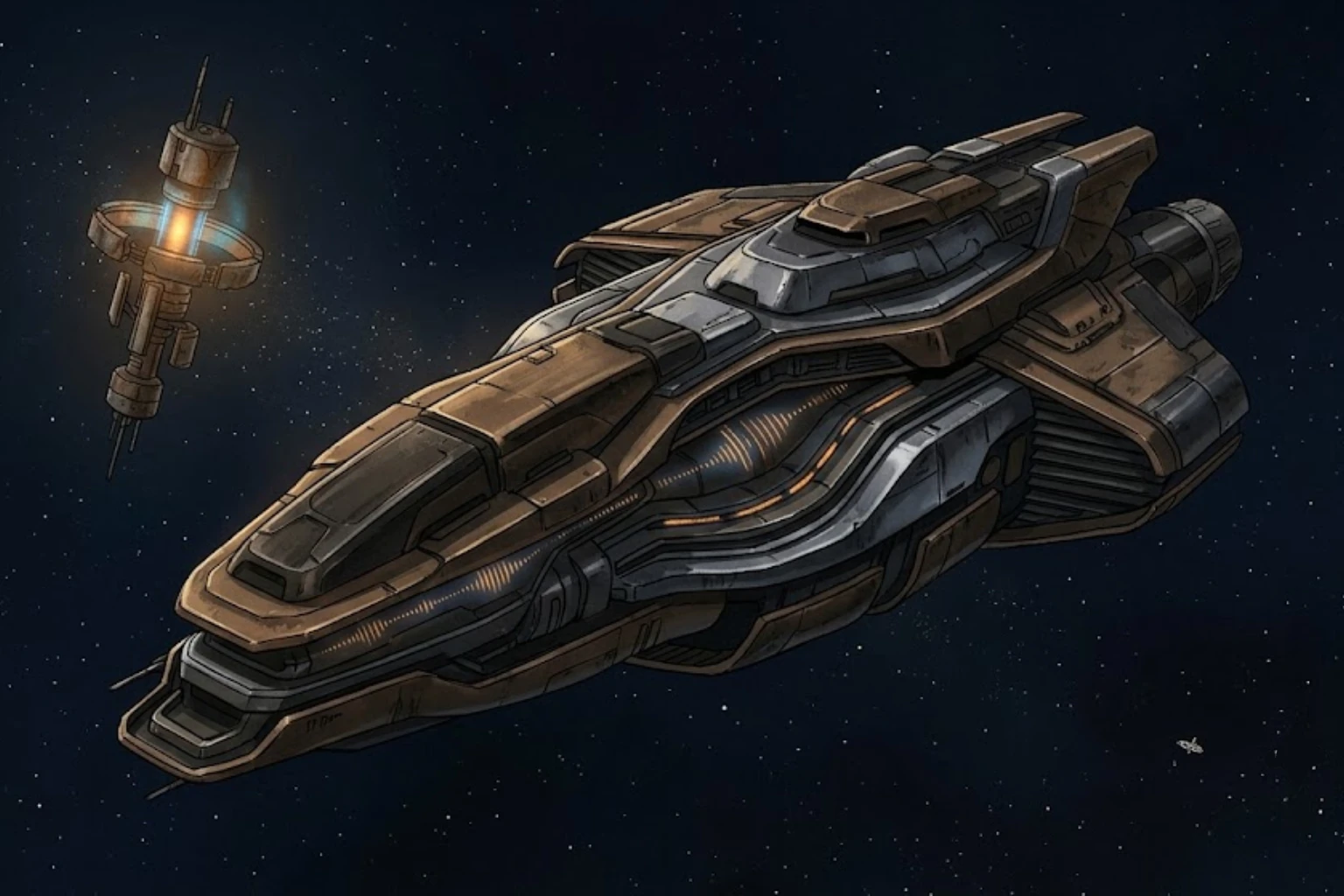
Asymmetrical. That was the feature that struck her most — human ships were generally bilaterally symmetrical, the same on both sides, because the drives and navigation systems worked best when the mass distribution was balanced. This ship was not. The port side was differently shaped from the starboard side, not randomly but deliberately, as if the function of each side was different enough to require different geometry. The engine housings — if they were engine housings, which was an inference based on their position and structure rather than any marking she could read — were circular and recessed rather than the rear-facing thruster arrays she was used to. The hull was a dark bronze color, or appeared so in the passive sensor imaging, with a texture that suggested layering — plates over plates, the way a thing accumulated protective additions over a long time.
And on the forward section, visible even at this distance because of its scale, a marking. Not the geometric notation of the route network beacons, something different — larger, more complex, the lines of it suggesting a different visual tradition. But at its center, she could see the same circular element with the marking at one position on the circumference that appeared on every beacon plate. The same fundamental symbol, embedded in a different context.
This ship knew the route.
"Hail it," Haru said.
She sent the standard academy hail on three frequencies, the general emergency channel, and the scientific contact protocol she had memorized in a xenocommunications module she had taken in her first year and mostly forgotten until this moment. Standard identification, friendly intent, request for response. She sent it on a thirty-second repeat.
No answer.
"Try the route format," Sora said, from navigation. She had been looking at the ship too, and she had the same instinct Yui had had.
The route format was the timing sequence Yui had identified from the relay station's pulse — a specific rhythm she had documented and could reproduce. It wasn't a language, it was a handshake, the kind of thing systems used to identify each other as part of the same network. She had been thinking about trying it since she found the ship and had been waiting to propose it.
She reproduced the timing sequence and sent it.
The answer came back in four seconds.
Not a voice. Not a human message. Not even a format she recognized from the database. A pulse code — complex, rhythmic, structured in a way that was unmistakably intentional: intervals that varied according to a pattern, pauses that were different lengths in a way that was clearly not random, a repetition structure that suggested it was providing the same information in multiple passes.
She listened to it for fifteen seconds before she said anything.
"This is not noise," she said.
"That's a response?" Riku said, from the flight console.
"Yes."
"To our hail?"
She thought about it. "To the route handshake. I think." She ran the signal through the analyzer. "The timing pattern — it's similar to the route beacon format, but it's not the same. It's responding in the same language we spoke, but saying something more complex than the route beacons say."
"How much more complex?" Haru said.
"I don't know yet. The academy's translation software doesn't recognize the format. The structure is there, but I don't have a key for it." She was already running comparisons — the signal against the relay station's timing pulses, the signal against the beacon plate notation she had documented at the moon, the signal against everything she had collected since they'd been out here.
"Daigo," Haru said.
"Four seconds," Daigo said. "It answered in four seconds."
"What does that mean?"
"It means it was already listening," Daigo said. "Something on that ship was monitoring the route frequency before we sent the handshake. It answered before anything on that ship should have had time to process the hail and generate a response." He looked at Haru. "The response was ready."
Yui put that into the signal analysis column in her head and looked at what the shape of the analysis was suggesting. A ship in standby mode, most systems low-power, but one system still active — a communications or route-interface system that had been listening to the route network continuously. Waiting. Not for them specifically, but for the route.
"Is it crewed?" Haru said.
"I see no life signs on the biosensor," Hana said. "But the biosensor is damaged and the range to that ship is at the edge of what it can reliably read." She paused. "I can't say with confidence. The absence of a reading at this range doesn't mean absence of life."
"Can we get closer without approaching?" Haru said to Riku.
"We're at four hundred meters. If I take us to two hundred, we improve the sensor resolution but we're committed to a longer retreat if we need to leave in a hurry."
"Two hundred," Haru said. "Slowly."
Riku moved them slowly.
At two hundred meters the optical sensors gave her a picture she could work with, and the biosensor gave Hana a reading she could report with more confidence.
"No life signs," Hana said. "At this range I'm confident. Whatever is on that ship, it's not living."
"Not living, or not living in a way your biosensor can read?" Daigo said.
Hana considered this with the care she gave to accurate medical statements. "The biosensor reads for thermal signatures and metabolic chemistry consistent with biological life. If there is something aboard that ship whose biology is sufficiently different—" She paused. "I can't rule that out. But I can say nothing on that ship produces a signature my sensor can identify as life."
Daigo nodded. Not satisfied, but accepting.
The signal had been repeating continuously since the first response. Yui had been listening to it and watching the waveform and working on the pattern, and she had found something.
"The signal has a structure I can partially map," she said. "It's not a language in the sense of vocabulary and grammar — or if it is, I don't have anywhere near enough sample to start identifying vocabulary. But it has something like phrasing. Blocks of information that are internally consistent and separated from each other by a specific pause marker." She had the waveform displayed on her board with the blocks color-coded by the pause-marker separations. "Seven blocks. Repeating."
"What do they mean?" Haru said.
"I don't know yet. But Sora—" she looked at navigation.
Sora had already been comparing the signal against the route notation system she had been studying since the beacon plate on the moon. She had the notebook open and was working through something, and Yui could see from across the bridge that she was finding connections because the pace of her notation was increasing.
"Some of the geometric elements in the beacon plate notation appear in the signal," Sora said. "Not all — the signal uses more elements than the plate notation, which means either it's using an expanded version of the same system, or the beacon plates were a simplified form intended for travelers who didn't know the full notation." She looked at Yui. "If I give you what I have on the geometric elements—"
"Yes," Yui said.
They worked together for twenty minutes, which was the most productive twenty minutes of collaborative navigation-and-communications analysis Yui had done since this began. The match rate was not high — she could say with confidence that approximately thirty percent of the signal's elements had parallels in the route notation system, which was enough to suggest a relationship but not enough to produce any reliable translation.
What she could get from the thirty percent match was fragmentary. She was careful to present it as fragmentary.
"Seven blocks," she said, to the bridge. "Based on the notation parallels I can identify, I'm reading the following partial content — and I want to be clear this is partial, it's based on incomplete matching, and the blocks I can't read at all may be providing context that changes what the readable blocks mean." She looked at her notes. "Block one: something about a vessel or craft being present. Block three: something about alignment — the route, or a bearing, failing or being lost. Block five: a destination, and an associated concept I'm reading as unresolved or incomplete. Block six: something about a boundary — the same boundary marker that appears in the route data, possibly the edge of known space — and a concept that might be unsafe or closed or blocked." She looked up. "Block seven: a request. Or a waiting. Something directed toward the route itself."
The bridge was quiet.
"The ship is reporting its status," Haru said.
"Yes," she said. "I think so. I think the automated system on that ship has been sending a status report to the route network on a repeating cycle. For—" she looked at the signal degradation and the power profile of the transmission, "—for a very long time."
"How long?" Riku said.
"I can't say with precision. The power cell degradation on the signal suggests years, possibly decades." She paused. "The ship has been drifting here, with this system running, reporting its status to the route, since — since something happened to it that prevented it from completing its journey."
"What happened to it?" Daigo said.
"I don't know. The blocks I can't read might tell me. Or there might not be an answer in the signal at all." She looked at the ship through the forward viewport — the dark bronze hull, the asymmetrical profile, the marking on its forward section. "It's not calling for help. It's not distressed in the way we'd use that word. It's — reporting. Status. Condition. Position. To the road."
She had been a communications cadet for three years, and in those three years she had studied signals from the point of view of the sender and the receiver and the medium they traveled through. She had thought about what a signal was — not technically, but essentially. A signal was a thing one party sent into the world with the intention that another party would receive it and understand it. The sender and the receiver were the point. The medium was just how.
But there was a kind of signal that was different from that. A signal that sent itself not to a receiver that could understand it and respond with meaning, but to a system that simply registered it. A weather buoy reporting conditions. A positioning beacon marking location. An automated recorder keeping the log.
Not communication in the sense she had been trained to think about it. Transmission without conversation. Sending without expecting to be heard.
Something had traveled this road and become stranded on it and had been sending its status into the void for years with no expectation that anyone would hear it and no certainty that anything was left to hear it.
She found that, sitting at the communications board of the *Haruki Maru*, almost intolerably lonely.
---
The debate about boarding was shorter than she expected.
Haru laid out the considerations the way he laid out everything — both sides, honestly, without visibly weighting either. The potential gain: route data, possibly a correction table for the next jump, components compatible with the network infrastructure they'd been drawing on. The potential risk: unknown design, sealed atmosphere, a system that had already demonstrated behavior they didn't fully understand.
Daigo made the case against. Mei made the case for. Sora said she wanted the route data if it could be accessed safely. Hana said she would stay on the *Haruki Maru* unless someone needed medical attention, and noted that whatever they found was unlikely to be biologically hazardous since the biosensor showed no life signs, but that the atmosphere was unbreathable and the suits were mandatory.
Haru said: "We go to the access corridor and primary systems chamber. We go no further. We do not separate. If anything on that ship indicates instability, we withdraw immediately. No argument, no delay."
He looked around the group.
Nobody argued.
"Yui, Sora, Daigo, Mei," he said. "The rest of you hold the ship."
Riku accepted this without comment, which told Yui something about how he had changed since the first days on the bridge, when staying behind had been something he pushed back on. He accepted it and moved to the flight console and began the warm standby sequence without being asked.
---
Docking was Mei's problem, and Mei solved it the way she solved everything — by examining it directly, understanding exactly what the mismatch was, and finding the adjustment that compensated for the mismatch without either forcing or assuming. The unknown ship's docking collar was almost standard, in the way that several things they'd found on this route were almost standard: the same fundamental logic, a slightly different implementation. Mei compensated for the difference in collar diameter with a physical adapter she assembled from components in the docking kit while Haru and Daigo watched the seal indicators.
"It's going to hold," she said, when the seal confirmed. "I don't love the confirmation rating — it's at yellow instead of green — but it's holding and the differential is minimal. We're not at risk unless something on the other ship changes the load on the seal."
"And if something does?" Daigo said.
"You'll know when I tell you and not before," she said, in the tone that meant she was monitoring and they should ask her for updates rather than trying to read it themselves.
The hatch opened into a corridor that was narrower than the *Haruki Maru*'s corridors, and lower — not dramatically lower, she was not crouching, but she was aware of the reduced headroom in a way that reminded her that the beings who had traveled on this ship had been close to her size but not the same size. The walls were the same bronze material as the hull exterior, the texture the same layered quality, and the panels set into them were positioned at heights and angles that were slightly off from what she expected.
The lighting came on as they entered.
Not abruptly — slowly, in bands that progressed from the entry end of the corridor toward the interior, a progression that gave the impression of the ship becoming aware of their presence and lighting their path. The light color was slightly different from what she was used to, cooler in tone, and it came from embedded strips rather than overhead panels, which meant the illumination came from the sides rather than above and threw no shadows in the usual directions.
She moved her helmet light off. The embedded lighting was enough.
"Airless?" Daigo said, checking his suit integrity display.
"Correct," she confirmed. "Helmet stays on."
"The atmosphere processor shows a trace gas mix but not breathable levels of anything," Mei said, from the rear of the group. "The ship may have been vented at some point, or may have had a different standard atmosphere than ours to begin with."
No bodies.
That was the thing she was most aware of in the first minutes in the corridor — the absence of bodies, which was both practically reassuring and, in a different register, significant. If something catastrophic had happened to whatever had been aboard this ship, there was no evidence of it here. No remains, no scattered belongings, nothing that suggested a sudden ending. The corridor was empty in the clean way of a place that had been emptied rather than abandoned in haste. Whatever had been here had left — or had been moved — or had never left physical evidence of itself in these spaces to begin with.
The markings on the wall panels were dense and complex. Not the geometric notation of the route beacons but the same tradition that had produced the marking on the hull — an etched script that covered the panels at regular intervals, looking more tactile than visual, the lines cut deep enough that she found herself wanting to run her hand over them through the suit's gloves.
She photographed them all.
The corridor ended in a junction — smaller than the relay station's junction, two directions instead of six, with a sealed door in one direction and an open passage in the other. Daigo checked the sealed door and reported it as pressure-sealed from the other side, integrity unknown, and suggested they leave it alone, which Haru agreed with.
The open passage led to the primary systems chamber.
---
The chamber was the equivalent of the relay station's control room, or a bridge, or some combination of both — a central space with operational panels arranged around the perimeter, oriented not toward a forward viewport — there was no obvious forward viewport in this chamber, the ship's navigation apparently not relying on visual reference in the way human ships did — but toward each other, a circular arrangement that suggested the travelers who had used this space had worked facing inward, facing each other, rather than facing forward toward the destination.
She stood in the center of the circular arrangement and turned slowly, looking at each panel.
The surfaces were covered in the same etched script as the corridor panels, but here the script was interspersed with what were clearly operational interfaces — contact surfaces, embedded indicators, input areas. She could see which elements were which not because she could read the script but because the interfaces had the universal grammar of things designed to be touched and responded to: certain areas were worn smooth by repeated contact, certain indicators still showed active states, certain input areas were positioned at heights and angles consistent with regular use.
"There," Sora said.
She had found it before Yui had — the panel with the active signal. It was distinguished from the others not by any marking Yui could read but by the faint rhythmic pulse of light that ran along its lower edge, synchronized with the signal Yui had been receiving on the Haruki Maru's communications board. The route-interface module, still running, still transmitting its status report to the road.
Yui approached it carefully.
The connection interface was in the lower section of the panel, and it was not the same format as the relay station's external port — different connector type, different positioning. She had brought the relay maintenance kit adapters, and she went through them methodically, the same process of matching and adaptation that she applied to every unfamiliar system, until she found the combination that produced a connection acknowledgment on the panel's indicator.
"Connected," she said.
The panel responded to the connection by increasing the pulse rate of its indicator lights — not a malfunction, she decided, but a response to the new input. The system was doing what it had been doing for years: registering and responding to contact from the route network.
"It thinks I'm the route," she said.
"Can you copy the archive?" Sora said.
"I'm working on it." The copy protocol was the same as the relay station's, which meant the adapter was handling the translation between formats and she was managing the copy speed and the data verification. "The archive is — larger than the relay's. There's more here."
"How long?"
She checked the copy rate. "Twenty minutes, minimum. Possibly thirty."
"Start copying," Haru said. "Sora, what can you see in the first data?"
Sora had a secondary connection running from her own data unit, pulling the directory data that was faster to access than the full archive. She was reading it in real time, filtering through the geometric notation with the facility she had been building since the moon's beacon plate.
"The route network," she said. "A more complete version than the relay memory. I can see — many more waypoints than we had. Including some in the segment we've been traveling that have different warning markers than the relay data had." She paused. "And a correction table. For the next jump. The relay data's correction table was partial — this one is complete."
"What does it correct for?" Haru said.
"I'll need time to calculate it properly. But the marker type in the correction table—" She looked at the notation. "It's the same marker type that appears in the relay data around the dark mass notation."
"The gravity scar," Daigo said.
"There's something in the next sector," Sora said, carefully. "The correction table compensates for it. If I use the correction, we should be able to transit through without the same—" she paused, choosing words, "—the same kind of displacement we experienced."
The same kind of displacement that had put them here in the first place.
Yui kept the archive copy running and thought about that. She thought about the ship around her — the circular arrangement of panels, the corridor with its tactile script, the asymmetrical hull that had been engineered for a different set of needs than the academy's ships were engineered for. She thought about whatever had traveled in this ship, worked at these panels facing each other instead of forward, sent its ship along the route network toward a destination that it had never reached, and had left an automated system running to report its status to the road for decades after it was gone.
She thought about what the signal said. What she had been able to read of it. *Route alignment failed. Destination unresolved. Boundary unsafe.*
The same boundary. The edge of known space, in whatever coordinates this ship's navigation had used. Unsafe. Blocked. Something wrong with the passage through.
"Were they trying to get through too?" she said, quietly.
Nobody answered immediately.
"Through to what?" Riku said, on the comm from the *Haruki Maru*.
"I don't know," she said. "Through the boundary. Toward wherever the route leads, on the other side. Or—" She looked at the route data on Sora's display. "Through from the other side."
"Through from the other side," Haru said.
"The route goes both ways," she said. "Routes do. The stations are stocked for travelers in both directions. The beacons transmit in all directions. Whatever the route is, it was built to be used by travelers going both ways." She looked at Sora. "Where does the route come from? On the other end — the end we haven't been talking about because it's further from home."
Sora looked at the route data. "The archive has data on the full network. Let me—" She pulled up the directory structure. "The network extends in both directions from the central relay. The direction toward home — toward the boundary — that's the direction we've been traveling. The other direction—" She followed the data. "The route data ends. The network terminates." She looked at Yui. "Whatever is on the other side of the boundary, the route data doesn't show it."
"But the route was built by something that came from somewhere," Yui said. "Something that was traveling."
"Yes," Sora said.
"And this ship was traveling the same route."
"Yes."
"And it couldn't get through the boundary."
"Based on the signal, something about the passage was — problematic. The warning marker—" Sora looked at the notation. "I can't fully read it. But the correction table suggests the problem is navigational, not structural. A correction to the jump calculation should resolve it."
"Should," Daigo said.
"Should," Sora agreed, without pretending it was stronger than it was.
The archive copy reached sixty percent and Yui checked the copy rate. Still holding. Fifteen more minutes.
She looked at the operational panel and at the route-interface module's status indicator, still pulsing its rhythm. Seven blocks, repeating. She had been listening to it since they arrived at this position and it had not changed — the same blocks, the same intervals, the same information cycling through the same report.
Block seven. The one she had read as a request, or a waiting. Something directed toward the route itself.
She had been thinking about what it meant since she first read it, in the way she thought about signal problems — letting the analysis run in the background while she did other things, waiting for the piece that resolved it. She thought she had the resolution now, in the context of everything she had learned from the ship's interior and the archive data.
It wasn't a request for rescue. It wasn't waiting for someone to come and fix what had gone wrong. It was — a query. The automated system, faithfully sending its status report for decades, asking the route the same question on every cycle.
*Is the road open yet?*
The answer had always been silence. The route beacons didn't respond to queries. They broadcast, and they received, and they registered contact, but they didn't answer questions in the way she answered questions. They were systems, not responders.
The ship had been asking a silent road if it was safe to travel, for longer than she had been alive.
"Yui." Mei's voice. "Docking seal."
She looked at her suit status display. The seal integrity, which had been at yellow since they docked, was dropping.
"What's happening?" Haru said.
"The ship's power cycle is increasing," Mei said. "The route-interface module — the connection Yui made is drawing more power than standby. The ship's automated systems are cycling up to support the increased draw. The power surge is changing the load on the docking seal."
"How much time?" Haru said.
"At this rate, the seal drops to critical in—" Mei paused, calculating. "Seven minutes. Maybe eight."
"Copy status?" Haru said.
"Eighty-two percent," Yui said. "I need nine more minutes."
A silence that had a specific shape to it.
"Options," Haru said.
"I can disconnect the copy and take what we have," Yui said. "Eighty-two percent of the archive is better than nothing. The correction table for the next jump is in the first section — I have that."
"Or?"
"Or I keep the copy running and we risk the seal dropping to critical. If it drops to critical, Mei can hold it with manual systems, but—"
"But then we can't undock quickly if something else changes," Daigo said.
"Yes."
Haru was quiet for two seconds. "Is the correction table secure?"
Yui checked. "Yes. And the route network data. And the warning markers." She checked again, because this was the information that mattered and she needed to be sure. "Yes. Everything we need is in the first eighty-two percent."
"Disconnect," Haru said. "We take what we have."
She disconnected.
The panel's indicator pulse changed immediately — not erratic, but slower, the power cycle stepping back down as the copy draw ended. She noted that it didn't go dark; it returned to its previous standby state, the same slow pulse it had been maintaining for decades.
Still reporting. Still asking.
She pulled the adapter and secured it in her kit and looked at the panel for a moment before she turned away.
"Thank you," she said. She said it quietly, not on the comm, to the ship around her and the system that had been running itself for longer than she had been alive.
It was not a rational thing to say. She said it anyway.
---
The undocking was careful and successful. Mei managed the seal through the disconnection sequence with the competence that had become her constant, the manual adjustment compensating for the load shift as the connection released. The corridor lighting faded back to its low standby bands as they moved through it, the ship going dim behind them the way a house went dark after the last light was switched off.
The *Haruki Maru*'s hatch closed.
Through the viewport, the unknown ship drifted at its original distance, the hull markings visible, the beacon pulse on the passive array still running its rhythm.
She went to the communications board and listened.
The signal was continuing. Seven blocks. The same seven blocks it had always been.
She replayed the handshake exchange — her route-format transmission, the ship's four-second response. She overlaid the ship's response against the route marker pulse from the fourth waypoint beacon, which was still visible on the passive array at its bearing and frequency.
The timing aligned.
Not perfectly — the ship's response had its own structure, its own additional content, more than the route beacon's simple pulse. But the foundational rhythm was the same. The same timing, the same baseline structure, translated into a more complex form.
"It did not answer us," she said.
Sora looked up from the navigation alcove. "What?"
"The handshake. When I sent the route format and it responded in four seconds." She looked at the overlay on her display. "It wasn't answering our hail. It was answering the route marker. We transmitted the route format, and its system registered that as the route network making contact, and it replied to the route network." She looked at Sora. "It answered the route."
Sora was quiet for a moment. Then: "It's been answering the route. That's what the signal has always been."
"Yes."
"For years. No one was there to hear it, and it kept answering."
"Yes," Yui said.
Sora looked at the display — the overlay, the timing alignment, the ship visible through the viewport with its patient pulse. "And what did the route ask it?"
Yui looked at the ship.
Block seven. The final block. The one that cycled on every repeat, the question-or-wait she had been trying to read since she first received the signal.
"I think the route broadcasts its status," she said slowly. "It tells travelers: the network is here, the beacons are running, the road exists. And the ship — its automated system — responds to that broadcast. It registers the route's presence and reports its own status back. Every time the route broadcasts, the ship answers." She paused. "The route asks, in the only way it knows how: *is anyone on the road?* And the ship answers: *I am here. I have not made it through. I am still waiting.*"
The bridge was very quiet.
"And what did the route ask it?" Haru said, finally, after a long moment.
Nobody had a better answer than silence.
She looked at the ship one more time. At the hull markings, the asymmetrical profile, the route symbol on its forward section. She looked at the route marker beacon bearing, forty degrees away, still pulsing its patient signal in the direction of the next waypoint.
"Sora," she said. "The correction table. How confident are you in the jump calculation?"
"Confident enough," Sora said. "The correction compensates for the navigational distortion the relay data flagged. With the complete correction table, I can give Riku a bearing that should put us through the gravity interference rather than displacing us the way the original incident did."
"Should," Daigo said, which was by now a known quantity of skepticism that everyone had learned to receive as *I noted the uncertainty, proceed with caution.*
"Should," Sora confirmed, in the same spirit.
"Riku," Haru said. "Bearing when Sora has it."
"Ready," Riku said.
Yui recorded the ship's signal one more time — a full cycle, all seven blocks — and added it to the growing archive of everything they had collected since the moon. The beacon plates, the greenhouse panel, the relay station memory, the correction tables, the route data. All of it building, one waypoint at a time, toward something she was not sure of and was getting more sure of at the same time.
She looked at the route marker bearing on her display.
Six waypoints. Then the boundary. Then home.
Through the viewport the unknown ship drifted, its signal still transmitting, its system still answering the road in the only conversation it knew how to have.
Riku brought the *Haruki Maru* around to Sora's bearing.
The route marker ahead pulsed once — its standard forty-one second cycle, bright and steady.
The unknown ship pulsed back.
Yui watched the exchange on her board, the two signals crossing each other in the dark, and then the jump engaged and the viewport went white and the dark between was gone.


.png)
.png)
.png)