%20(1).png)
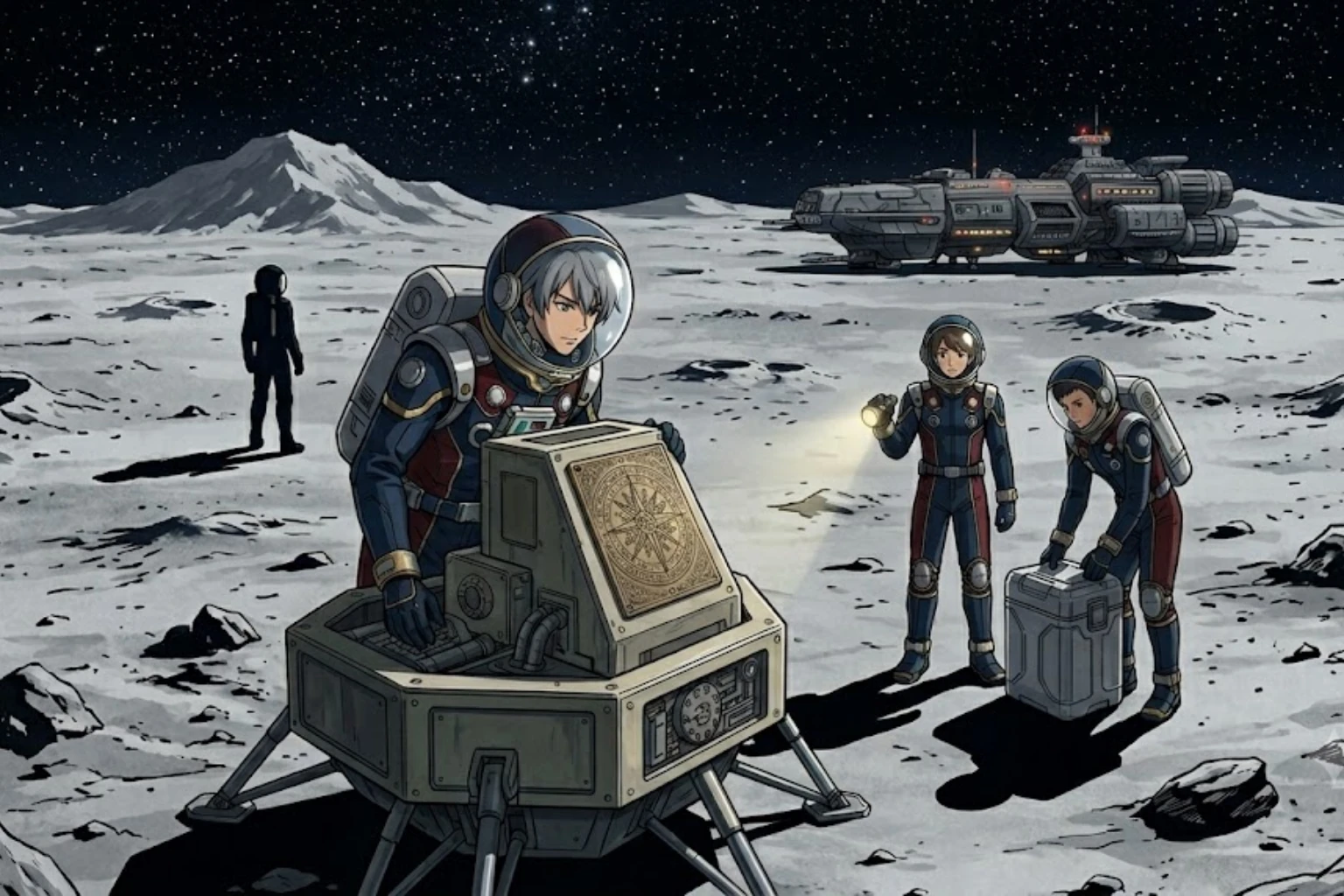
The suits were in the equipment locker at the end of the training bay corridor, seven of them, sealed in individual storage casings with the academy crest on each door and the cadet designation printed below in the clean stencil font that the academy used for everything it considered official. Sora's read KANZAKI, S. / NAV / CADET 2ND YEAR, which she had always found slightly absurd — as if someone on a training vessel might forget which suit belonged to which cadet, or as if the designation made the suit feel more like hers, which it did not. It was academy property. She was borrowing it for the duration of the mission.
She pulled it from the casing and laid it out on the bay floor with the methodical care she gave to anything that, if done wrong, would cause her to stop breathing.
"Walk-through," Haru said, from the center of the bay. He had his own suit half-on and was running the pre-check with his notepad in one hand, reading the steps in the sequence order, which was exactly correct procedure and also slightly unnecessary because they had all run the EVA suit check in simulations enough times that the sequence was memorized. But he said it anyway, and Sora thought that was right — this was not a simulation, and the value of saying the steps aloud was exactly that it acknowledged the difference.
"Primary seal, collar ring," he said.
"Checking," said six voices, at slightly different moments.
Sora ran her fingers around the collar ring and felt the seal confirm — the slight give and then the solid resistance that meant it had seated correctly. She moved to the next item.
The suits were academy standard EVA training models — not the lightweight exploration variants that senior field teams used, heavier and more conservative in their engineering, built for cadets who might make mistakes and needed the margins that accounted for those mistakes. Each one had four hours of independent atmosphere on a full charge, a short-range suit comm, a heads-up display in the visor that showed suit status and a simple compass heading, and a safety tether attachment point on each hip. They were not elegant. They were very hard to kill yourself in by accident, which was the design specification that mattered.
Daigo had his suit on first and was doing a second check of his own seals before anyone else had finished the first check. He had attached a safety line to his equipment belt and was running it through his hands, testing the strength of the clips, which were rated for forces well beyond what this moon's surface gravity would ever generate.
"Lines," he said, to the room in general. "Everyone check your tether attachment points. Both hips."
"Daigo," Riku said, "we're not going into a jump shaft. It's a moon walk."
"It's an uncharted surface in an uncharted location with unknown terrain features and no rescue capability if someone goes into a crater," Daigo said, without inflection. "Check your tether points."
Riku checked his tether points.
Hana moved through the bay with her medical kit strapped to the outside of her suit — she had modified the attachment herself, repurposing one of the equipment loops to carry the kit in a position she could reach with either hand. She had also, Sora noticed, clipped a small readout unit to her left wrist that showed suit atmosphere levels for all seven suits simultaneously, fed through the short-range suit comms. She was monitoring everyone's air before they even stepped outside.
"Hana," Mei said, noticing the readout. "That's—"
"Standard medical field protocol," Hana said. "Monitor the team's vitals during surface operations."
"We don't have a medic in standard surface operations."
"We do now," Hana said, pleasantly, in the tone she used when something was decided and she was being polite about it being decided.
Mei looked at the readout for a moment. "Can you add a suit pressure indicator to that feed?"
"I can try."
"Try while we walk. I want to see if the suit seals are holding under surface conditions."
"Done," Hana said, and made a note on the unit, and that was that.
Yui was at the bay's navigation terminal doing something with the passive sensor data she'd pulled during the approach, transferring coordinates to her suit's heads-up display with the careful focus of someone who understood that being the person who knew where the beacon was made her the most important person on the surface team whether or not anyone had said so. She had the bearing logged, the estimated distance, and a waypoint marker loaded.
"Seven hundred and forty meters northwest," she said, when Sora came to look over her shoulder. "Give or take twenty, depending on how accurate my triangulation was."
"It was accurate," Sora said. She had checked Yui's triangulation during the approach and found nothing to correct.
"Give or take five, then," Yui said.
Sora finished her suit check, ran the seal confirmation twice because twice was her personal minimum, and then did what she had been wanting to do since the landing: she walked to the bay's small external viewport and looked out at the surface.
It was grey. Not the grey of overcast sky or concrete or the inside of the *Haruki Maru*'s corridors — a different grey, older, the grey of rock that had been exactly this temperature and exactly this color for longer than any human civilization had been measuring colors and temperatures. The surface stretched away from the ship in long shallow curves, interrupted by the rims of craters both small and large, the shadows inside them absolutely black because there was no atmosphere to scatter the light and soften the edges. Everything was either fully lit or fully dark, the terminator line of the moon's day-night boundary visible in the far distance as a sharp and merciless division.
She could see the structure from here.
It was to the northwest, exactly where Yui's data had placed it, a low angular shape that sat against the horizon with the deliberate wrongness of something that had not been formed by the same processes that had formed everything around it. She had known it was there — she had spotted it from the viewport during landing — but looking at it now with the surface spread out between her and it, seven hundred meters of airless grey rock with not a single footprint anywhere on it, she felt the distance differently.
Nobody had walked that ground in a very long time.
"Ready," Haru said, from behind her.
She turned. Seven cadets in academy EVA suits, visors down, standing in the training bay of a damaged ship on an uncharted moon. The overhead lights caught the academy crests on each suit and made them look, briefly, official. Like people who were supposed to be here.
She put her visor down.
"Ready," she said.
---
The airlock cycled with the sound she recognized from simulations and the feeling she did not recognize from anything, because simulations did not give you the specific physical reality of pressure equalizing around a sealed suit, the slight pop in your ears as the lock went to vacuum, the moment the outer door opened and there was nothing between you and the surface except the suit and your own nerve.
Haru went first, because he was captain and that was the order. He stepped down the short ramp and onto the surface and stood there for a moment without saying anything, which Sora appreciated — it was the right response to stepping onto ground that no one from the academy had ever touched.
Then he said, "Suits nominal. Surface is stable. Come on down."
Riku went second and immediately took two quick steps away from the ship, testing the gravity, which was low enough that his steps had a slight float to them — not the dramatic bounding of very low gravity, but a lightness, a delay between foot leaving ground and foot returning that changed the rhythm of walking in a way that took the first few steps to calibrate.
"Oh, that's strange," Riku said, and took another step, longer, and floated a half-second longer. "That's really strange."
"Don't bound," Daigo said, coming down the ramp behind him. "Low gravity means your center of mass shifts differently than you expect. If you bounce too high and come down wrong on uneven ground—"
"I know," Riku said. "I'm a pilot. I understand momentum."
"Understanding it and feeling it in a suit on an unfamiliar surface are different things."
"I said I know, Daigo."
"One meter per step maximum until we've assessed the terrain," Daigo said, and he was not wrong, which Sora suspected was the more annoying part for Riku.
She came down the ramp and took her first step and felt the gravity shift under her and stood still for a moment, just experiencing it. The suit's boots had grip pads on the soles, textured for uneven rock, and she could feel the surface through them — not warmth or cold, the suit insulated for that, but texture, the slight unevenness of rock that had been fractured and refractured by ancient impacts and then left alone to settle into its current arrangement.
She looked up.
The stars were wrong, as they had been since she first looked out the forward viewport on the bridge. But from the surface, without the ship's hull around her and the bridge framing the view, they were wrong in a way that was harder to hold at arm's length. She turned slowly in a full circle, letting her eyes move across the sky, and she found nothing — not a single pattern, not a single grouping that matched anything in the complete star atlas she had memorized during her first year at the academy.
Somewhere in that sky was the home system, with its specific star and its specific planets and the academy that sat in orbit around the second of those planets. She could not see it. She had not been able to identify it from any of her calculations since they'd arrived in this region, which meant either they were too far away for the home star to be a visible feature of the sky, or it was below the moon's horizon at this position, or her calculations had a fundamental error she hadn't found yet.
She thought about that as she walked, and set it aside as something she would return to.
"Northwest," Yui said, on the suit comm. "Bearing two-seven-three from the ship. I have the waypoint on my HUD if anyone needs to sync."
"Sync to me," Sora said, and a moment later the waypoint marker appeared in the lower right of her visor display — a simple arrow and a distance readout. Seven hundred and twelve meters. She could see the structure ahead of them without the HUD, but having the number was grounding.
They walked.
---
The surface was not flat, which was obvious from the ship and somehow still surprising to navigate in person. The craters were the main feature — ranging from small depressions barely worth stepping around to larger ones that required genuine detours, their rims uneven and their interiors hidden in the shadow that was absolute and impenetrable in a way that Earthbound shadow was not. Sora found herself looking into the shadows as they passed and seeing nothing, not even the suggestion of shape, just darkness that had been there since before any human was alive to see it.
"Crater rim, left side," she said, for the benefit of the group. She had been narrating terrain features since they started moving, not because anyone had asked her to but because it was what a navigator did on a surface mission, and it felt right to be doing it.
"I see it," Riku said, from her left.
"The slope on the near side looks stable," she continued. "Far side I can't assess. Give it a meter of clearance."
They gave it a meter of clearance. The rim passed without incident. She noted the bearing and kept walking.
Mei had been moving with her head down more than up, which was different from everyone else — most of them were looking out, taking in the surface and the sky and the structure ahead. Mei was looking at the ground.
"What are you seeing?" Sora asked her, falling back a step to walk beside her.
"The regolith here has a metallic component," Mei said. "See the way it catches the light? That fleck." She pointed at a patch of ground a few steps ahead that did, now that she pointed it out, have a slight shimmer to it under the direct sunlight. "There are alloys in this rock. I want to know which ones."
"You're prospecting."
"I'm assessing potential materials." Mei looked up long enough to check the bearing and then back down. "The secondary column fracture needs a specific alloy grade to patch properly. If this moon has the right mineral composition, that's not nothing."
"How do you know if it has the right composition from looking at the ground?"
"I don't. I'm noting locations that look promising so I can sample them on the way back." She had a small marking device on her belt and was using it, Sora realized — a trail of tiny flags behind them in the regolith, placed at intervals wherever Mei had seen something worth returning to.
Sora looked back at the trail of flags and thought about how each of them was doing exactly what their training had shaped them for, even here, even in conditions none of them had trained for specifically. Yui navigating by beacon. Daigo managing the group's spacing and assessing hazards. Riku calibrating his movement to the gravity. Hana watching the suit readouts. Mei reading the ground. It was not the academy's training exercises, which had been organized and supervised and corrected in real time by instructors who knew the outcome. This was the training working the way training was supposed to work — becoming reflex, so that when the situation was real the trained behaviors were already running.
She was thinking about this when Daigo stopped.
"Hold," he said.
The group stopped. Sora looked ahead and saw what he had seen: a crater, not large, maybe fifteen meters across, that their current path took them directly alongside. The near rim was stable. The issue was what the crater had done to the ground on the far side of it — the impact had fractured the surface in a starburst pattern that extended from the rim outward for another ten meters, and some of those fractures were wide enough to be visible from where they stood.
"Fractured surface," Daigo said. "I don't know the depth of those cracks. We go around."
"It adds a hundred meters," Riku said, having apparently already calculated this.
"It adds a hundred meters," Daigo confirmed. "We go around."
"The suits are rated—"
"Riku." Haru's voice, even. "We go around."
Riku went around. He did it without further argument, which Sora noticed and filed — there was a version of Riku who argued on principle and a version who argued when he thought he was genuinely right, and they were not the same version. This had been the first kind, and he'd recognized it.
The detour added four minutes. The fractured ground was, on the far side, exactly as problematic as Daigo had assessed — she could see the gaps in the surface clearly as they passed, some of them narrow, some of them wide enough that she would not have wanted to find one under her boot.
"Good call," she said, to Daigo, quietly.
He nodded once, which was his version of acknowledgment.
---
The structure resolved into detail as they got closer.
It was a beacon station — she had known that from the signal, but seeing it physically was different from the signal's abstraction. A central housing roughly two meters tall and one meter across, hexagonal in cross-section, made of a material that was not quite the alloy she was used to seeing in academy hardware but was clearly engineered rather than found. Around the base, six anchor struts driven into the regolith at angles that would resist the leverage of a low-gravity fall. On the top, a transmitter array — compact, old, the emitter elements slightly corroded in a way that told her they had been here for a significant time without maintenance but had continued to function because the design had built in the margin for exactly that.
Around the base of the station, arranged without any visible pattern, were things that had been left.
"Stop," Haru said, before anyone got too close. "Don't touch anything yet. Look first."
They looked.
There were panels — flat pieces of alloy material, stacked against the station's base, three of them, each approximately a meter by half a meter. There was a container of some kind, sealed, about the size of a footlocker, the material weathered by long exposure to the surface's temperature cycling. There were two cylindrical objects that Sora recognized after a moment as power cells — old design, not academy standard, but the form factor was universal enough that the function was clear. And there was, embedded in one of the anchor struts at eye level, a plate.
She walked to the plate.
It was mounted flush with the strut, secured with four fasteners, the surface protected by a cover that had been designed to open — a latch, simple, mechanical, not electronic. She looked at Haru.
"Can I open it?" she said.
He considered for a moment. "Yes."
She opened it.
Inside the cover, protected from the surface environment, was an engraved plate of the same material as the station housing. The engraving was in three scripts — she recognized none of them individually, but one of them had characteristics that suggested it might be a variant of a written form she had seen in the academy's xenolinguistics reference files, which were not a subject she had studied but which she had read through once out of curiosity during a long stretch of night watch in her first year.
Below the scripts, in a fourth rendering, were symbols.
Not text symbols — geometric ones. A circle with a mark at one position on its circumference. Lines radiating from a central point, each with a different length. A series of dots in a pattern that was not random.
She stared at the symbols for a long moment.
"What is it?" Riku said, from behind her.
"I think it's a star reference," she said. "A position marker. Someone set up this beacon and left a record of where it is in relation to other things." She traced the pattern of dots without touching the plate. "These could be reference stars. If I can identify even one of them against my star atlas, I can use the relative positions to build a coordinate framework."
"Can you identify them?" Haru asked.
"Not out here. I need the navigation console and time." She straightened up. "But I'm photographing all of it." She had a suit-mounted camera on her left shoulder and she used it now, documenting the plate from multiple angles, close and far, making sure every symbol was captured clearly.
"The panels," Mei said, from the other side of the station. She had gone directly to the alloy panels and was running a handheld sensor over them — a compact materials analyzer from the engineering kit. "Sora. Come look at this."
Sora crossed to her. Mei held up the analyzer's readout.
"Tensile alloy, high chromium content, impact-resistant grade," Mei said. "This is — this is very close to what I need for the secondary column patch. Not exact, but close enough that I can work with it."
"Someone left repair materials?"
"Someone left panels. Whether they were intended as repair materials or something else—" Mei looked at the panels, three of them stacked neatly against the base. "Three panels. Each one large enough to patch the fracture with material left over." She looked at Sora. "That is a very convenient number of panels."
"You think they were left for someone who'd need them."
"I think someone stocked this station with things that travelers might need," Mei said. "Panels, power cells, a position marker. This is a waypoint station. Not an exploration site, not a research installation. A waypoint. Someone was building a route through this region."
The word *route* settled over the group.
Daigo said, "Who?"
Nobody had an answer for that.
"Check the container," Haru said.
The container was sealed with a mechanical latch, the same philosophy as the plate cover — no electronics to fail over time. Daigo opened it, having produced a multi-tool from his equipment belt, and they gathered around.
Inside: more power cells, six of them, in a protected rack. A folded material that turned out to be a heat-retention sheet, the kind used in emergency shelters, not academy standard but functionally identical. And underneath the sheet, a data card in a protective case.
Yui reached for the data card before anyone else moved.
"Is that readable?" Haru asked.
Yui turned it over in her gloved hands. "The form factor is non-standard. But the connector type — I think I can interface it through the comms board's auxiliary port. It might take some work."
"Add it to the list," Haru said.
She added it to the list.
---
They spent two hours at the station.
It was Haru who decided on two hours — he said it to Hana first, quietly, who confirmed that two hours at their current exertion level was well within the suit atmosphere margins with time to spare, and then he told the group. Two hours was enough to document everything, collect what was useful, and assess the terrain around the station without rushing.
Sora spent most of those two hours photographing the plate and then sitting with her back against the beacon housing — an odd place to sit, perhaps, but it felt appropriate — sketching the symbol patterns into a small notebook she had brought because she was the kind of person who brought a notebook to an unknown moon. She was building a preliminary analysis: which symbols were likely positional markers, which were likely reference indicators, which she couldn't yet categorize.
The dot pattern was the most promising. Eleven dots in a field, with one marked distinctively — brighter in the engraving, more deeply cut. She counted the relative positions and started comparing them mentally against the star atlas she had memorized.
It was Riku, of all people, who sat down next to her after forty minutes of ranging around the station's perimeter with Daigo.
"Anything?" he said.
"Maybe." She showed him the sketch. "If this marked dot is a reference star — a particularly distinctive one, something bright enough and stable enough that it would serve as a navigational anchor — then the surrounding dots could be nearby stars. The relative distances and angles between them would tell me where in space this station was built."
"And where it is relative to home."
"Potentially. If I can identify the reference star from our current position, and match it to the academy atlas, yes." She looked at the sketch. "The problem is I have eleven dots and the sky has considerably more than eleven stars. I need more constraints to narrow it down."
"The lines on the plate," Riku said.
She looked at him. "What?"
"The lines radiating from the center. Different lengths." He took the notebook from her, carefully, and pointed at the rendering she'd made. "In navigation — in flight navigation — those would be distance indicators. Like bearing lines with range marks."
She stared at the sketch. "You're right."
"I know what bearing lines look like."
"No, you're — the lengths indicate distances. Relative distances from the station to each reference point." She was already recalculating. "If I have angles and distances both, that's a full positional reference. That's — Riku, that might be enough to locate us on a map."
"Even without knowing whose map."
"Even without knowing whose map. A position is a position. If I can place us somewhere, I can calculate a vector to somewhere else. If I can calculate vectors—" She stopped.
"You can find home," he said.
She did not say yes, because she was careful about what she said yes to, and there was still a great deal of work between the sketch in her notebook and a verified position in known space. But she looked at the sketch and felt something she had not felt since she first saw the wrong stars through the forward viewport — not the certainty of knowing where they were, but the possibility of finding out.
"I can try," she said.
Riku handed the notebook back and stood, brushing the regolith dust off his suit's knees — unnecessary in vacuum, a habit from a world with air, but she understood it. "That's enough," he said. "For now."
She looked at him.
"Come on," he said. "Haru's starting the materials inventory. Mei's going to need help carrying the panels."
---
The panels were heavier than they looked, which Mei informed them was because the alloy had a high-density core, which was also why it would work for the fracture patch. In the moon's gravity they were manageable — two cadets per panel, one at each end, the carry slow and careful over the uneven surface. Sora took one end of the first panel with Riku at the other, and they walked back toward the ship in the trail of Mei's marker flags, the beacon station diminishing behind them.
She looked back at it once.
It was already small against the scale of the crater-pocked surface, the low hexagonal shape sitting under the stars it had been broadcasting into for what she estimated was a very long time. Still transmitting. Still waiting for someone to come close enough to receive.
It had waited for them.
She didn't know what to do with that thought yet, so she carried it the way she was carrying the panel — carefully, with both hands, not setting it down.
The airlock cycling the group back in took three trips and twenty minutes, and by the time the last trio came through — Hana, Daigo, and Haru — the first group had already started the process of removing suits and stowing equipment. The training bay was warmer than the airlock and smelled like the ship's recycled air, which was not a pleasant smell exactly but was a familiar one, and Sora felt the familiar-ness of it in a way she had not expected — the relief of an enclosed space with known air and known gravity and the sound of the ship's systems running around her.
She sat on the bay bench with her helmet in her lap and looked at the notebook.
Haru sat down beside her. "What do you have?"
She walked him through it — the plate, the symbols, the dot pattern, Riku's observation about the bearing lines. He listened the way he listened, without interrupting, writing things down.
"How long to work it out?" he said, when she finished.
"I don't know. Days, maybe. The symbol analysis alone—" She shook her head. "I have to match the patterns against the atlas without knowing which of the atlas stars I'm looking for. It's — I'm not going to give you a number. I'll work as fast as I can."
"That's enough," he said.
He said it simply, without the edge of pressure she had been bracing for, and she looked at him and found him looking at the notebook with an expression she recognized as one she probably wore herself fairly often — the look of someone confronting the gap between what they needed to know and what they currently knew, and deciding to close the gap with work rather than worry.
"Mei says she can start the fracture repair tomorrow if we offload the panels tonight," he said. "The power cells are compatible with our auxiliary power supply — Yui confirmed it. That buys us another four days on the conservative life support estimate."
"So we're better off than we were this morning."
"We're better off than we were this morning," he said. "We have materials, we have power, we have a possible position reference, and we have a data card that Yui is already trying to interface." He closed his notepad. "We leave when Mei says the fracture is patched and you have enough from the plate to give us a direction."
She nodded.
Outside the ship — she knew, because she had just walked on it — the surface of the silent moon extended in its long grey curves under the unfamiliar stars. The beacon station was out there, seven hundred meters northwest, still transmitting its quiet signal into the void it had been transmitting into since long before any of them were born.
Someone had built a route through this region.
They were on it.
She opened the notebook to a fresh page and started working.


.png)
.png)
.png)