%20(1).png)
The mail run was one of Dani's favorite small errands, mostly because it meant a walk down to the station's administrative ring, past the docking offices and a pair of old vending machines stocked with the kinds of things people bought when they were on the move or wanted a late-night snack, to the row of slotted boxes where the weekly transport dropped off whatever paper mail, small packages, and printed notices still made their way along the route the old-fashioned way.
Most of what came through was mundane — route bulletins, supply confirmations, the occasional printed permit that some inspector somewhere still insisted had to arrive on physical paper — but there was something satisfying about sorting it all out afterward, laying it across the counter like a small puzzle that told you who around the station had a mother writing to them, or a subscription still coming through, or a supplier finally sending the parts they'd promised three weeks ago.
She came back with the usual mix tucked under one arm: a stack of route notices for Tomas, a supply confirmation addressed to Sol regarding an order of dry goods, a folded printout for Chef that turned out to be nothing more exciting than an updated fire inspection schedule, and, near the bottom of the stack, a narrow cardboard mailing tube wrapped in plain brown paper, addressed in neat block lettering to Ivo Reyes, Cosmic Bar and Grill.
"Huh," Dani said, turning it over. There was no return address, no sender information printed anywhere on the wrapping, just Ivo's name and the restaurant's berth number.
She found him in the back hallway, breaking down a delivery box from that morning's produce order, and held it out.
"Ivo, this came for you."
He looked up, genuinely startled, wiping his hands on his apron before taking it from her like it might be some kind of mistake. "For me?"
"Says right there. Ivo Reyes."
He turned it over, same as she had, searching for a sender's name that wasn't there. "Who's it from?"
"Doesn't say."
"That's weird."
"A little," Dani agreed, watching him with open curiosity. "You gonna open it?"
"Later," Ivo said, which surprised her a little, because if their positions had been reversed she'd have torn into it on the spot, but Ivo tucked it carefully under his arm instead and disappeared toward the crew quarters without further comment, leaving Dani to shrug and go finish sorting the rest of the mail, filing the small mystery away without much more thought than that. Packages weren't unheard of. People got things sent to them sometimes, spare parts or requested items or, once memorably, a box of Sena's favorite tea that her sister had mailed all the way from three systems over. It wasn't strange that Ivo would get something. It was only strange that he never had before.
He waited until he was alone in his bunk, door shut, the low hum of the station's systems the only sound, before he peeled back the paper with the careful, deliberate patience of someone who wanted the moment to last a little longer than it needed to.
Inside was a poster — glossy, carefully rolled inside the tube, printed with the kind of professional tour artwork he'd seen a hundred times on data feeds and transit displays but had never actually held in his hands. Lumi Vale, mid-performance, violet hair caught in motion, one hand raised toward an unseen crowd. Across the bottom corner, in looping handwritten script over the printed image, was a signature, and beneath it, in the same handwriting, a short note:
For Ivo —
Thanks for making the station feel like home.
Save me a seat next time.
Lumi Vale
He read it twice, then a third time, sitting very still on the edge of his bunk with the poster held carefully by its edges so as not to smudge anything, though there was nothing to smudge, the ink long since dry from wherever and whenever she'd written it. He thought about the evening months back, the ramen and the burger and the way she'd teased him gently about pretending not to know her songs, and felt something warm and slightly embarrassing settle in his chest that he had no intention of describing to anyone.
He unrolled the poster carefully, weighted the corners against his desk, and spent a few minutes deciding exactly where on the wall it ought to go — not directly across from the door, where anyone glancing in might see it right away, but off to the side, near the shelf where he kept the few other things that mattered enough to keep. He found tape in his desk drawer and hung it with more care than the task probably required, stepping back afterward to look at it, and allowed himself exactly one small, private smile before he folded the wrapping paper up small and tucked it into a drawer, because you never knew when good wrapping paper might come in handy again.
Dani caught him again later that evening, wiping down tables after the dinner rush had cleared, and asked, with the easy, unbothered curiosity of someone who had genuinely already half-forgotten about it, "Hey, what was in the package, anyway?"
Ivo, stacking chairs at the next table over, didn't quite look at her when he answered. "Nothing."
Dani raised an eyebrow but didn't push. "Nothing, huh."
"Yeah. Just — nothing. Junk mail thing." He kept his eyes on the chairs. "Wasn't anything."
"Okay," Dani said, easy about it, because if there was one thing she'd learned in two years of working alongside a fourteen-year-old who occasionally needed the dignity of keeping something to himself, it was when to let a thing lie. "Let me know if you need help with the rest of these."
"I got it."
She left him to it, and if she noticed, later that week, a new poster tacked to the wall of his bunk when she came by to drop off clean laundry, she didn't say anything about that either, which was its own kind of kindness, even if Ivo never knew to thank her for it.
The travel writer arrived two days later on the evening transport, with a single soft-sided bag over one shoulder and the slightly rumpled, unhurried look of a man whose schedule had, by his own admission, "fallen apart in the most convenient way possible."
His name, according to the guest registry Tomas processed at the berth office, was Adrian Voss, though it took Dani exactly one look at him settling onto a stool at the bar — mid-forties, comfortable gray sweater, a battered data tablet he set down on the counter and then immediately ignored — before something clicked into place in her memory.
"Wait," she said, setting a glass of water in front of him with more enthusiasm than the gesture usually got. "Are you the Adrian Voss? The one who writes the travel column? The one about the shuttle terminal in — where was it, the one with the noodle stand that had been there forty years?"
Adrian looked faintly caught out, in the manner of a man who was not used to being recognized but was too polite to pretend otherwise. "That would be me, yes. I'm surprised anyone out here reads that."
"I read everything you write," Dani said, delighted. "You did the one about the couple who ran the ferry dock on Halvern for thirty years and never took a vacation because they liked their jobs too much. I cried a little at that one, not gonna lie."
"That one did well," Adrian admitted, a small, wry smile appearing. "People like a story about contentment. Rarer than you'd think."
"So what brings you out here? Big story on some route diner nobody's heard of?"
"No story," Adrian said, and there was something almost rehearsed in how quickly he said it, like he'd been saying it to people since before he'd even boarded the transport. "Actually, no story at all. I had a connection fall through — the shuttle I was supposed to catch got rerouted, and the next one isn't for four more days, and rather than sit in a terminal lounge for four days pretending to work, I decided to just... stop somewhere. This seemed like as good a somewhere as any."
"You're not working?"
"I am absolutely not working," Adrian said, with the particular firmness of a man trying to convince himself as much as her. "I am on vacation. An unscheduled, entirely accidental vacation, but a vacation nonetheless."
"Huh," Dani said, clearly delighted by the novelty of this. "We don't get a lot of people on vacation. Mostly people passing through on business, or route work, or repairs."
"Which is exactly why I picked here," Adrian said, and there was something genuine underneath the dry humor now, something that sounded almost relieved. "Nobody's going to ask me what I thought of the ambiance."
Sena, coming by to check on the bar, caught the tail end of this and smiled without commenting further, sensing correctly that the best thing to do with a man determined not to be working was to simply treat him like anyone else who'd wandered in for dinner, which was, in the end, exactly what the restaurant was built to do.
"Kitchen's still open if you're hungry," she said. "Menu's on the counter there. Nothing fancy, but it's good."
"That," Adrian said, picking up the menu with visible relief, "is exactly what I was hoping to hear."
He took a spare bunk in the crew quarters — a small, plain room usually reserved for the rare emergency layover or the occasional traveler whose ship needed unexpected repairs, functional rather than comfortable, with a narrow bed and a shelf and a window looking out at the docking ring rather than open space, but it suited him fine, he said, because he'd stayed in considerably worse places for considerably worse reasons over the years.
His first morning at the Cosmic Bar and Grill started earlier than he'd meant it to, less out of any particular intention than the simple fact that the crew quarters had thinner walls than his apartment back home, and the low, ordinary clatter of a kitchen coming awake — the hiss of the flattop heating, Sol's voice calling something to Chef about the delivery that hadn't come in yet, the scrape of chairs being set right-side-up after the previous night's cleaning — turned out to be a difficult thing to sleep through once his body had decided it was morning.
He wandered out in the same gray sweater, hair not quite settled, and found the restaurant in that particular pre-rush hour where the lights were on but the day hadn't quite started in earnest, a handful of early regulars scattered at the counter and along two of the booths, mugs already steaming, the room smelling like coffee and something Sol was working through on the flattop that he couldn't yet identify.
"You're up early for a man on vacation," Dani said, sliding a mug in front of him before he'd even fully claimed a stool.
"Force of habit. I usually have a filing deadline that doesn't care what time zone I've decided to be in." He wrapped both hands around the mug, grateful for it in the specific, uncomplicated way of someone who hadn't quite adjusted to the station's slightly cooler recycled air yet. "This is very good coffee, by the way. I wasn't expecting that."
"Sol takes it personally if people don't like the coffee," Dani said. "So, good instinct."
The room filled in slowly around him over the next half hour in a way he found himself watching despite every intention not to — two cargo handlers he recognized from the evening before coming in for a quick breakfast before their shift, trading some ongoing argument about a supply manifest that neither of them seemed particularly invested in winning; an older woman in a maintenance jumpsuit who came in alone, ordered without needing to look at a menu, and read something on a battered tablet of her own while she ate; a pair of younger crew members who'd clearly just come off a long shift, quiet and half-asleep, letting Nari set their plates down without either of them saying much at all.
Nari moved through it all with a kind of unhurried attentiveness that Adrian found himself noticing more than once — refilling a cup before it was empty, setting down a plate of toast for the half-asleep pair without being asked, exchanging maybe four words total with the maintenance woman that nonetheless seemed to convey everything necessary about how she wanted her eggs.
"Does she always remember what everyone wants?" Adrian asked Dani quietly, at one point, nodding toward Nari as she set a glass of juice — not water, not coffee — in front of one of the cargo handlers without being told.
"Pretty much," Dani said, like this wasn't remarkable at all. "She just pays attention. Drives me a little crazy, honestly, because I forget what I had for breakfast most days and she remembers what a guy who came through six months ago liked in his coffee."
Sena moved through the room too, though differently — less a matter of remembering individual details and more a steady, calming presence that seemed to keep the whole floor oriented, checking in briefly at each table, trading a word with Chef through the pass-through window, making sure the two cargo handlers got their check before their shift started without either of them having to ask for it. It was, Adrian thought, watching her without quite meaning to, a kind of competence that didn't announce itself, the sort of thing a person only noticed if they were paying attention to how a room worked rather than what was happening in it.
He caught himself doing exactly that — paying attention to how the room worked — twice within the first hour, and each time made a small, private effort to stop, picking up the mug, or looking out the window at the docking ring instead, or reminding himself, with the particular sternness of a man negotiating with his own bad habits, that he was not, in fact, on assignment.
It didn't entirely take. He noticed, without meaning to, that Stirling greeted each of the early regulars by name as they came in, occasionally offering some small, oddly specific piece of information gathered from a previous visit — informing the maintenance woman, apropos of nothing she'd asked, that the part she'd mentioned needing three weeks ago had apparently come in on the last supply run, a fact that seemed to genuinely please her.
"How did you know that?" Adrian asked, once Stirling had circled back around to refill his coffee.
"I make a point of remembering details that guests have mentioned in prior visits," Stirling said, with the calm, slightly formal satisfaction of someone answering a question he considered entirely reasonable. "It is, in my assessment, good hospitality."
"That's a very thorough approach to hospitality."
"I do not believe there is a partial approach worth taking," Stirling said, and refilled Adrian's mug exactly to the line he seemed to consider correct, and moved on to the next table with the same unhurried formality, leaving Adrian looking after him with the specific, faintly bemused fondness of a man cataloguing a detail he told himself, again, he wasn't going to write down.
By the time the early rush thinned out and the room settled back into its slower midmorning rhythm, Adrian had finished two cups of coffee, eaten more than he'd meant to of something Sol had put in front of him without being asked, and hadn't opened his tablet even once, a fact he noted to himself with some surprise.
Over the next two days, he settled into the restaurant's rhythms with the ease of a man who had spent a career learning how to fit into places quickly. He took most of his meals at the counter, chatted easily with whoever happened to be sitting nearby, and made a visible, occasionally comic effort not to take notes, though Nari noticed — quietly, the way she noticed most things — that his eyes still moved across the room the way a writer's eyes moved, cataloguing details out of old habit even when his hands stayed away from the tablet.
He noticed, for instance, that the same three cargo handlers came in every other week and always sat in the same booth. He noticed that Stirling addressed every departing guest by a small personalized farewell, tailored to whatever they'd ordered or mentioned during their visit. He noticed the patched section of wall near the corner booth, and asked Sena about it once, almost apologetically, like he knew he wasn't supposed to be asking questions like that anymore.
"Old impact damage, actually," Sena told him. "Nothing dramatic — a supply crate got loose during a docking maneuver years back, dented the wall pretty good. Tomas patched it up but never bothered matching the paint exactly. We've just sort of left it that way."
"You could have it repainted properly."
"We could," Sena agreed. "Doesn't really bother anybody, though. Feels more like the room's actual history than a flaw in it."
Adrian turned that over for a moment, something thoughtful crossing his face, before he seemed to catch himself and shook his head slightly. "Sorry. Force of habit. I wasn't going to ask you about the wall."
"You can ask about the wall," Sena said, amused. "I don't mind telling you about the wall."
"I appreciate that. I'm just — trying very hard, this week, not to turn every conversation into material."
"How's that going?"
"Poorly," Adrian admitted, and they both laughed, and he went back to his coffee with the faint, good-natured resignation of a man who suspected this particular habit wasn't going to break itself in four days, however much he wanted it to.
Ivo, for his part, regarded the writer with the specific skepticism of a fourteen-year-old who had strong opinions about people who got paid to have opinions about other people's lives.
"So you just, what, go places and write about them?" he asked, during a lull in the kitchen when Adrian had wandered back to compliment Chef on the soup and ended up lingering by the pass-through window instead of returning to his stool.
"More or less."
"That's the whole job?"
"That's the whole job. It's harder than it sounds."
"How's it hard? You just look at stuff and then describe it."
Adrian considered this with visible amusement rather than offense. "Try it sometime. Describe this kitchen to somebody who's never seen it, in a way that makes them actually want to know more about it, without making anything up and without it sounding like a grocery list."
Ivo frowned, glancing around the kitchen as though seeing it freshly — the scuffed steel counters, the low hum of the exhaust fan, Sol working the flattop with the unhurried economy of someone who'd done it ten thousand times, Chef checking a pot on the back burner without needing to look at a clock to know it was close to ready.
"I don't know. It's just a kitchen."
"That's the trick, though. Everything's just something until somebody makes you look at it properly." Adrian shrugged, easy about it. "I've been doing it long enough that I forget it's a trick most days. Just goes off automatically now, whether I want it to or not."
"Sounds tiring."
"It can be," Adrian admitted, and there was something a little more honest in it than he'd probably meant to let show, before he waved it off with a small smile and went back to his coffee, leaving Ivo to consider the exchange with more thought than he let on, because for all his skepticism about writers in general, he found he didn't mind this particular one nearly as much as he'd expected to.
Nari found her own way of taking care of him without making anything of it, the way she took care of most regulars once she'd learned their patterns — refilling his coffee before he'd quite noticed it was low, remembering that he liked it black in the morning but with a little cream by evening, setting down the burger without the pickles the second time he ordered one after she'd noticed him quietly picking them off the first time and setting them at the edge of his plate.
"You didn't have to remember that," Adrian said, the second time it happened, genuinely a little startled.
"It's not much to remember," Nari said. "You just didn't eat them last time."
"Most places don't notice that kind of thing."
"We're not most places," Nari said, without any particular emphasis, like it was simply a fact of the room rather than a point of pride, and went to go check on another table, leaving Adrian looking after her with the specific, quiet appreciation of a man whose job normally required him to notice things about other people, and who wasn't quite used to being on the receiving end of that kind of attention instead.
Stirling, meanwhile, had taken it upon himself to research the concept of "writer's block" after overhearing Adrian mention, in passing, that part of the appeal of the unscheduled stop was escaping it for a few days.
"I understand you are currently experiencing writer's block," Stirling said, setting a fresh soda water in front of him on the second evening, with the grave seriousness of someone addressing a medical condition.
"Not exactly. I'm not blocked, I'm just — not writing. On purpose. For a few days."
"According to my research, writer's block is typically resolved through structured routine, a change of environment, and moderate physical activity." Stirling folded his hands together with evident satisfaction at having a solution ready. "I would recommend a short walk along the outer ring corridor, followed by a period of quiet reflection, and possibly a warm beverage."
"I appreciate the diagnosis, Stirling, but I promise you, the problem isn't that I can't write. The problem is that I've forgotten how to do anything else."
Stirling considered this with visible recalibration, yellow eyes dimming slightly the way they did when he was updating a file somewhere behind them. "That is a somewhat different condition than the one I researched."
"It usually is."
"I do not currently have a recommended treatment for that."
"Nobody really does," Adrian said, not unkindly, and took a sip of the soda water, and Stirling, undeterred, filed the correction away for future reference with the quiet determination of someone who intended to have a better answer ready next time, even if he wasn't entirely sure what that answer would be.
The slow evening arrived on his third night at the station, the kind of unhurried lull that settled over the restaurant every so often when the docking schedule happened to align just right — no big freighter crews rotating through, no urgent repairs keeping anyone tethered to their ship, just a scattering of regulars content to linger over their drinks a little longer than usual.
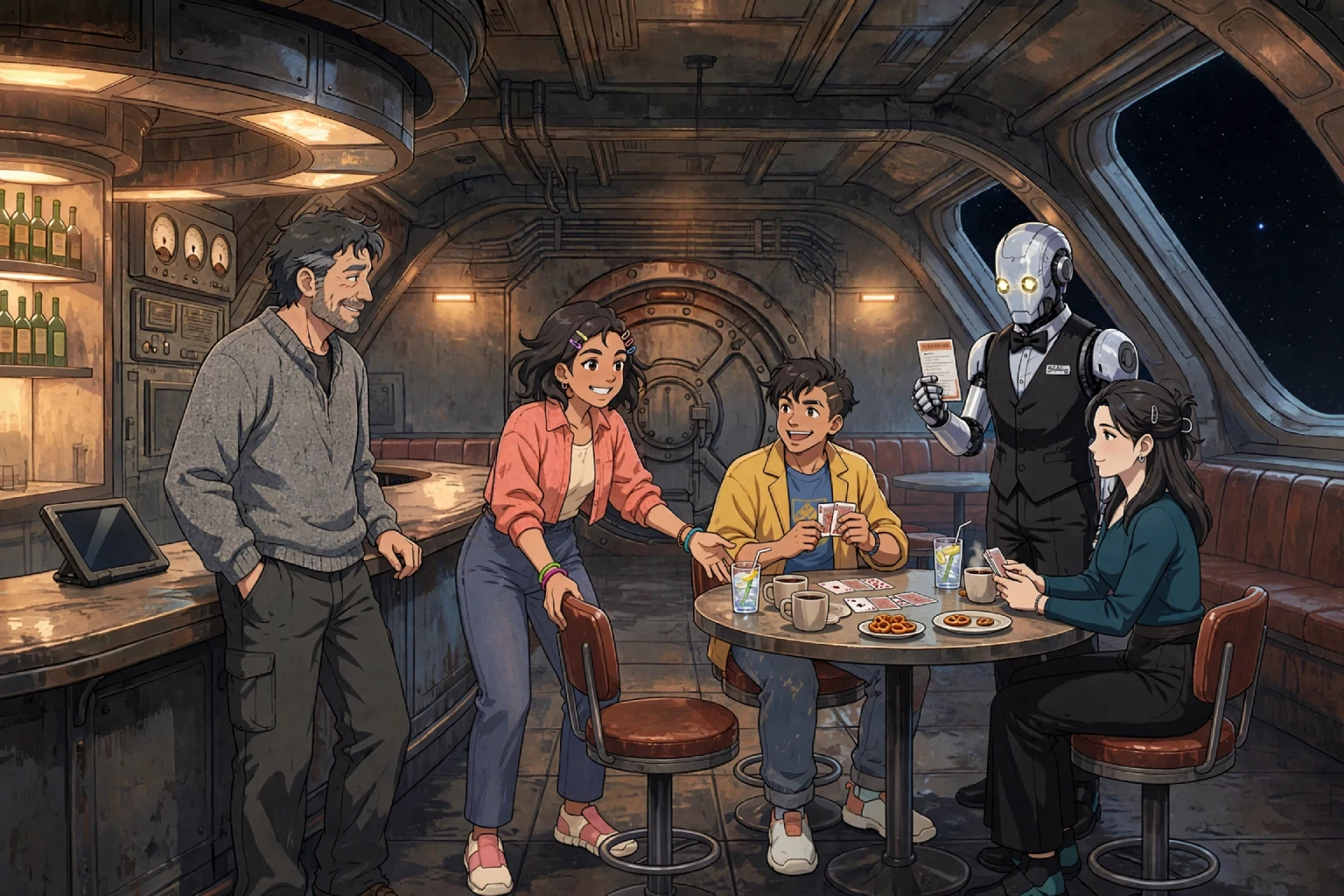
It was Sena who suggested the game, the way she occasionally did on nights like this, pulling a battered box down from behind the bar — a card game the staff had picked up somewhere along the route years back, simple enough to teach a stranger in five minutes but with enough small strategic wrinkles that a good game could run for an hour if people were paying attention.
"Game night," she announced to the room, mostly to Dani and Nari, though a couple of the regulars still lingering at the counter perked up with interest. "Who's in?"
"Obviously me," Dani said, already sliding off her stool.
"Me too," Nari said.
Ivo, wiping down the counter nearby, said, with studied casualness, "I guess I could play. If you need a fourth."
"We always need you, Ivo, don't be modest," Sena said, already dealing out the first hand at the corner table, and glanced over toward the bar, where Adrian was still perched on his stool with his tablet closed beside him and his coffee mostly finished. "You want in?"
"Oh — no, I'm fine," Adrian said, waving a hand easily. "I'll just watch. I'm good at watching."
"That's a very lonely thing to be good at," Dani said, not unkindly, already dragging a spare chair over toward the table anyway. "Come on. It's not hard. Ivo picked it up in like ten minutes and he complains about everything."
"I do not complain about everything," Ivo said.
"You complained about the hats for a week."
"That was different."
"Come on," Dani said again, to Adrian this time, patting the chair. "One round. If you hate it, you can go back to watching and I'll never bring it up again."
Adrian hesitated, the particular hesitation of a man who had spent so long occupying the edges of rooms, taking notes, staying just outside the circle so he could describe it properly later, that actually stepping into the middle of one felt slightly unfamiliar, like a language he used to speak fluently and hadn't practiced in years.
"One round," he said finally, and came to sit down.
Sena explained the rules with brisk efficiency — a simple trick-taking game, suits and a shifting trump, a handful of special cards that broke the normal order in small, mildly chaotic ways — and Adrian nodded along, asking a couple of clarifying questions with the careful precision of someone used to getting details exactly right before committing to anything.
"So the third card in the deck beats everything except the fifth."
"Right."
"Except during the second round, when the fifth doesn't count."
"You're overcomplicating it," Ivo said. "It's not that hard."
"I'm making sure I understand the rules before I lose to a fourteen-year-old."
"You're gonna lose to me anyway," Ivo said, with total confidence, and Dani laughed hard enough that she nearly dropped her cards.
"What happens if two people play the same value in different suits?" Adrian asked, still turning his starting hand over as though it might rearrange itself into something more comprehensible.
"Whoever led wins the tie," Nari said. "Unless it's the second card. Second card always loses ties, no matter what."
"Why?"
"Nobody remembers," Sena said. "It's just always been the rule."
"That's an excellent answer and also deeply unhelpful."
"Welcome to game night," Dani said.
Stirling, drawn over by the gathering, inserted himself into the proceedings with characteristic thoroughness, producing a small laminated card from somewhere behind the bar that turned out to be a complete, formally organized breakdown of the game's rules, evidently created at some point in the past for exactly this purpose.
"I have prepared an official rules reference," he announced, setting it in the middle of the table, "in the event of a dispute."
"We've never needed that before," Sena said.
"There is a first time for everything," Stirling said, with the calm satisfaction of a man — or robot — who had simply been waiting years for the opportunity to use it, and settled in nearby to observe, ready to adjudicate at a moment's notice.
The first round went to Sena, who played with the same steady, unhurried competence she brought to the floor, and the second went to Dani, who won more through enthusiasm and a run of lucky cards than any particular strategy, celebrating loudly enough that Chef, passing through with a rag over one shoulder on his way to wipe down the counter, paused long enough to observe, mildly, "You're playing the fourth card wrong. It only beats trump if you led with it," which turned out, upon consultation with Stirling's official rules card, to be entirely correct, and led to a brief, good-natured argument about whether Dani's win actually counted.
"It counts," Dani insisted. "Nobody said anything at the time."
"Chef just said something," Ivo pointed out.
"Chef wasn't even playing."
"Chef doesn't have to be playing to be right," Sol called from the kitchen doorway, not looking up from whatever she was doing, which settled the matter more firmly than any rules card could have.
By the third round, Adrian had stopped hesitating and started actually playing, and it became apparent fairly quickly that he was better at the game than he'd let on, tracking the played cards with the same careful attention he brought to everything else, laying traps two rounds in advance that had Ivo groaning in outrage by the third round when they finally paid off.
"You've been sandbagging," Ivo accused.
"I've been playing correctly," Adrian said, with visible enjoyment. "There's a difference."
"That's what someone who's been sandbagging would say."
"I genuinely don't know what that word means in this context, but I resent the accusation regardless."
"It means you were pretending to be worse than you are so you could win big at the end."
"I was simply learning the rules at my own pace," Adrian said, entirely too innocently, and won the round, and Ivo threw his cards down with the theatrical outrage of a fourteen-year-old who took the game far more seriously than he would ever admit to an adult stranger.
The next round, Adrian actually argued a rule himself — a genuine, if minor, dispute about whether a card played out of turn during a moment of confusion should count — and it was such a small, ordinary thing, a grown man leaning forward over a battered deck of cards insisting, with real if lighthearted conviction, that Sena had misplayed her hand, that Dani caught Nari's eye across the table and grinned, because somewhere in the last twenty minutes, without anyone quite marking the moment it happened, Adrian Voss had stopped watching the game and started playing it.
Stirling, called upon to settle the dispute, examined his laminated card with the gravity of a judge reviewing case law, tracing one finger down the relevant section before delivering his verdict. "The card in question was played within the allowable window of confusion. Sena's hand stands."
"I object," Adrian said.
"Objection noted and overruled," Stirling said, entirely unmoved, and set the card back down in the center of the table, and Adrian laughed — a real laugh, surprised out of him — and conceded the round with considerably more grace than his objection had suggested he possessed.
They played on through another hand after that, and then another, the game settling into an easy rhythm of small victories and smaller grievances, Ivo narrowly recovering the trick he'd lost two rounds prior with a play that made Dani groan and Sena raise an eyebrow in genuine respect, Nari winning a quiet, unassuming round almost nobody noticed until she was already gathering the cards back up, and Adrian, somewhere in the middle of it all, ordering a second soda water without once glancing toward the tablet still sitting closed on the bar behind him.
"You're really getting into this," Nari observed, amused, dealing out the next hand.
"I am," Adrian admitted, sounding faintly surprised by his own answer. "I don't think I've actually played a game like this in — God, years, honestly. Normally I'm the one taking notes at the next table over."
"Feels different, being the one playing instead?"
"It feels," Adrian said slowly, turning his cards over in his hand, considering the question with more weight than the moment probably called for, "like something I forgot I was allowed to do."
Nobody made a large thing of that observation. Dani gave him a small, warm smile, and Sena dealt the next round, and Ivo immediately accused him of sandbagging again, and the game rolled on into its next hand without anyone stopping to underline the moment further, because it didn't need underlining. It simply was what it was — a man who'd spent years learning to notice every table from the outside, finally sitting down at one instead.
By the time the game wound down, close to an hour and a half later, Adrian had won two rounds outright, lost narrowly to Sena in a final tense hand that had the whole table leaning in, and laughed more freely than he had in the three days since he'd arrived, the easy, unguarded laugh of a man who had, for a little while, entirely forgotten to be anyone's careful observer.
"I want a rematch," Ivo said, as they finally packed the cards away.
"You'll get one," Adrian said. "I'm here until tomorrow morning, and I intend to use every remaining hour defending my honor."
"You don't have any honor left, you cheated the whole first round."
"I did not cheat. I strategized. There's a difference."
"That's what a cheater would say," Ivo said, echoing his own earlier accusation right back at him, and Dani laughed so hard she had to put her cards down entirely, and even Chef, wiping down the counter nearby, allowed himself a small, private smile at the sound of it.
His transport was scheduled to depart the following morning, and he came down for breakfast dressed for travel again, bag over one shoulder, looking rested in a way that went beyond simple sleep, the particular ease of someone who has genuinely stopped moving for a few days rather than merely stopped traveling.
"Four days," he said to Dani, settling onto his usual stool at the counter one last time. "Four whole days, and I don't think I opened that tablet more than twice, and both times it was to check the shuttle schedule."
"Successful vacation, then."
"Wildly successful. My editor is going to ask what I was doing all week, and I genuinely have no material for her. Just — card games and good coffee and an argument about pickle placement."
"Sounds like the best kind of week to me," Dani said.
Chef came out from the kitchen with a paper bag, setting it down on the counter in front of him without much ceremony. "For the trip. Couple of burgers, in case the shuttle food's as bad as everybody says it is."
"It's worse than everybody says," Adrian said, taking the bag with genuine gratitude. "Thank you. Really. For all of it — the bunk, the food, letting me hide out here for a few days without asking too many questions about why."
"Wasn't hard," Chef said, with his usual plainness. "You ate what we put in front of you and didn't complain. That's most of the job right there."
"I complained about the rules of a card game for an hour last night."
"That's different," Sena said, coming by with his check, which he waved off entirely and left cash for anyway, well beyond what the meal had actually cost, an act Sena tried to argue against and lost.
Ivo appeared from the kitchen doorway just as Adrian was gathering his things, and lingered for a moment with the particular awkwardness of someone who wanted to say something and hadn't quite decided how.
"You gonna write about this place?" Ivo asked finally.
Adrian considered the question carefully, the way he seemed to consider most things. "I don't know yet, honestly. Maybe eventually. Not the way you're probably thinking, though — not a review, not a 'here's a great diner you should visit' piece. If anything ever comes of it, it'll probably be about something else entirely, and this place might not even get mentioned by name."
"That's a weird way to write about somewhere."
"Most of the good ways are weird," Adrian said, and held out a hand, which Ivo shook with the slightly overformal seriousness of someone shaking hands for one of the first times in his life and wanting to do it properly. "Watch yourself with that trick where you hold back the third card until the last round. It's a good move, but Sena's onto it now. She was watching you do it all night."
"I have other tricks."
"I don't doubt it."
He said his goodbyes around the room after that — a warm word for Sena, a genuine thank-you to Sol through the kitchen pass, a small formal nod to Stirling that Stirling returned with evident solemnity, and a last, easy wave for Dani and Nari both — and headed out toward the docking ring with his bag over his shoulder and his tablet, Nari noticed, still closed and untouched in the side pocket where it had mostly stayed all week.
"You think he'll actually write about us?" Dani asked, once the restaurant had settled back into its ordinary morning rhythm, wiping down the counter where he'd been sitting.
"Doesn't sound like it, not really," Sena said. "Sounds more like he needed somewhere that wasn't going to end up as material for once."
"That's kind of nice, actually. Being the place nobody has to write about."
"It is," Sena agreed, and went back to refilling the sugar caddies, and the morning carried on the way mornings usually did, the restaurant settling back into the comfortable, unremarkable rhythm of route workers and regulars and the low hum of the station around them, no different, on the surface, than it had been three days earlier.
Except that somewhere in a bunk that would be cleaned and reset for the next traveler who needed it, there was the faint impression of a man who'd arrived tired of watching every table from a careful distance, and left having finally, if only for a few days, remembered how to sit down at one.
And in another bunk down the hall, a poster of a violet-haired singer hung carefully on the wall, catching the low light of the room each evening, a small private reminder that sometimes people who seemed impossibly far away turned out, when you actually met them, to want nothing more than an ordinary seat at an ordinary table too.


.png)
.png)
.png)