%20(1).png)
The walk-in was down to its last case of buns, which was not, strictly speaking, an emergency, but it was the kind of thing that made Sol stand in front of the open cooler door a beat too long, doing the math on how many burgers they could reasonably sell before the shelf went empty.
"We're fine," she said, mostly to herself, closing the door. "Milo's in today."
"He's always in today," Chef said, from the prep counter, where he was portioning out the last of the ground beef with the unhurried economy of a man who had lived through worse shortages than a few dozen missing buns. "Question is whether he's in on time today."
"He's been on time three weeks running."
"That's exactly when he stops being on time."
Sol didn't argue with that, mostly because it was true often enough to be worth respecting as a kind of law of the universe. Milo Renn's deliveries ran like clockwork right up until the week they didn't, usually for some perfectly reasonable reason involving a rerouted shuttle or a mechanical delay three stops back on his circuit, and the restaurant had long since learned to build a little slack into its ordering so that a late Tuesday delivery never actually became a Wednesday crisis.
Still, they were down to one case of buns, a half case of pickles, running low on the good coffee filters, and completely out of the particular brand of hot sauce that half the regulars asked for by name, so there was a mild, pleasant anticipation to the morning that had nothing to do with worry and everything to do with the simple satisfaction of knowing the week's rhythm was about to click back into place.
"You check the dry goods list?" Chef asked.
"Sent it in three days ago, same as always. He'll have it." Sol wiped down the counter, glancing toward the small monitor by the kitchen door that showed a rough schedule of the day's expected arrivals. "Docking window says late morning."
"Good. I want those buns before the lunch rush, not during it."
"You always want them before the lunch rush."
"Because it's always relevant," Chef said, without heat, and went back to his prep, and the kitchen settled into its familiar quiet hum of a morning that was, for once, mostly about waiting for someone rather than rushing to catch up with anyone.
Sol used the lull to run through the rest of the short list in her head — pickles, filters, hot sauce, and whatever produce Milo was bringing this circuit — the same small inventory of things that made a Tuesday feel like it was about to tip over into a Wednesday problem if the ship didn't show. It wasn't a long list. It never really was. But there was something satisfying about a short list with a known solution, and she found herself glancing at the monitor twice more before eleven, not out of worry so much as habit, the way a person checks a clock they already know is about to strike the hour.
Milo Renn's ship announced itself the way it always did — a distinct, slightly rattling thrum audible through the station's outer hull a good ten minutes before the actual docking clamps engaged, a sound Tomas had once described as "held together by good intentions and a truly heroic amount of tape," which Milo had taken as a compliment rather than the insult it was probably meant to be.
He came through the restaurant's main door a little after eleven with a hand truck loaded two crates high, wearing his usual weathered courier's jacket and the easy, unbothered grin of a man who had never once in his adult life doubted that people would be glad to see him, mostly because they generally were.
"Special delivery," he announced to the room at large, "for the finest establishment on this entire stretch of route, which I say with total professional objectivity, having personally delivered to every other establishment on this entire stretch of route."
"You say that every week," Dani said, coming around the counter to help him navigate the hand truck through the door.
"It's true every week."
"It's flattery every week."
"Can't it be both?" Milo said, and Dani laughed, taking the top crate off his hands and carrying it toward the kitchen, while Milo wheeled the rest in behind her, nodding a greeting to Sena as he passed, who returned it with her usual measured warmth, and calling out toward the kitchen door, "Chef! I come bearing buns! Do not say I never do anything for you!"
"You're only two days from being late," Chef called back, appearing in the doorway to inspect the crates with the particular scrutiny he brought to every delivery, regardless of how many years he'd been doing this with the same courier.
"I'm exactly on time. You've just gotten spoiled."
"I've gotten dependent. There's a difference."
"Same thing, from where I'm standing," Milo said cheerfully, and began unloading, calling off items as he went with the practiced patter of a man who'd made this exact delivery dozens of times before. "Two cases of buns, since apparently the whole route's been running short this month, I don't know what's going on with the bakery collective but they've been slow as anything. Coffee filters, the good ones, not the cheap ones I tried to sneak you last spring — "
"Those cheap ones tore straight through the basket."
"I've apologized for that."
"You have not."
"I'm apologizing right now, retroactively." Milo set down a case of pickles with a flourish. "Dry goods, per the list. Hot sauce, six bottles, which should hold you a couple weeks even with how fast your regulars go through it."
"Six bottles won't last two weeks," Sol said, appearing with a hand truck of her own to help stack the cases against the wall. "It'll last ten days if we're lucky."
"Then order more next time, that's not on me. I bring what the list says." Milo hefted the last crate off the hand truck and set it down with a grunt. "Speaking of which, whoever's writing that list has terrible handwriting. Took me two tries to figure out if it said 'pickles' or 'peaches.'"
"It's always pickles," Sol said. "We have never once ordered peaches."
"You say that like handwriting's supposed to be logical." Milo straightened, cracking his back with the particular groan of a man who spent most of his day hauling crates through narrow corridors. "Produce crate's still in the ship, I'll bring that in next trip through the door, and — " he paused, reaching into the hand truck's lower compartment and pulling out a battered cardboard box that had clearly not been on anyone's official order, "— and one more thing."
"What's that," Sena asked, with the particular caution of someone who had received "one more thing" from Milo before.
"Mugs," Milo said, setting the box on the counter with evident pride. "Found a whole crate of them at a supply auction two stops back, some depot that was clearing out old inventory. Mismatched, every single one different, and dirt cheap because nobody wanted a box of mugs that don't match. But I looked at them and thought, that's exactly the kind of thing the Cosmic Bar and Grill would appreciate."
He opened the flaps with a showman's flourish, and the staff gathered around to look inside, where a jumble of mugs sat nestled in crumpled paper — a chipped one shaped like a smiling fish, a tall narrow one covered in faded cartoon stars, a squat round one glazed an aggressive shade of orange, one printed with the logo of a shuttle line that had gone out of business years earlier, and several more in shapes and colors that didn't match each other or anything else in the universe.
"Oh, these are incredible," Dani said, pulling out the fish one and holding it up to the light with real delight. "This is the ugliest thing I've ever seen and I love it completely."
"That's the spirit," Milo said, pleased.
Sena picked through the box more skeptically, turning over the orange one, examining the chip along its rim. "None of these match anything. None of these match each other."
"That's the charm of it."
"Is it, though."
"It absolutely is," Dani said, already setting the fish mug proudly on the counter like a trophy. "This is going straight into rotation. I'm using this one for my coffee break today."
Sol, who had been stacking the last of the dry goods against the wall, wandered over out of curiosity more than anything else and pulled a stubby, striped one from near the bottom, turning it over once in her hands with the practical eye of someone who mostly thought about mugs in terms of whether they'd survive the dish station. "This one's got a good handle, at least. Sturdy. I can work with that."
"There she is," Milo said. "Sol Vela, least sentimental woman on this station, evaluating mugs by handle integrity."
"Somebody has to," Sol said, unbothered, and set the striped mug aside in what was quickly becoming a small, unofficial pile of favorites.
Ivo, drawn over by the commotion, dug through the box with the focused seriousness of a boy determining exactly which item was objectively the best, and emerged holding a squat, lopsided mug glazed in a mottled brown that looked faintly, unfortunately, like something that belonged nowhere near a food service establishment.
"This one's clearly the best," he announced.
"That one looks like mud," Dani said.
"That's what makes it the best. Look at it. It's got personality."
"It's got a problem," Sena said, though she was smiling now despite herself.
"I'm keeping it," Ivo said, with total finality, tucking the mud-colored mug protectively against his chest like Dani might try to wrestle it away from him, which, given the look on her face, was not entirely out of the question.
Chef, who had come out to inspect the buns and gotten drawn into the mug debate against his own better judgment, picked up one from the bottom of the box without comment — a plain, sturdy one, slightly larger than the rest, glazed a deep forest green with no cartoon fish or shuttle logos or any decoration at all — turned it over once in his hand, and set it back down without saying anything, though Sol, watching from the kitchen doorway, noted the particular way he'd looked at it a beat longer than the rest.
"You want that one?" she asked.
"Didn't say that."
"You looked at it like you wanted it."
"I look at a lot of things," Chef said, and carried the case of buns back into the kitchen, though the green mug found its way, by the end of the day, sitting quietly beside the coffee machine in the back, filled with his usual afternoon coffee, and nobody said another word about it.
Stirling, meanwhile, had approached the box with the careful, methodical attention he gave most unfamiliar additions to the bar's inventory, lifting each mug in turn, examining its condition, and setting it back down with a small, precise click against the counter.
"I am uncertain these meet standard barware specifications," he observed. "None of them match. Several have visible chips. The fish-shaped one does not appear to hold liquid at a consistent temperature due to the thinness of the ceramic near the tail."
"That's kind of the whole point, Stirling," Dani said.
"I understand the aesthetic appeal of mismatched items to human customers. I am simply noting the practical limitations for the record." He picked up the mud-colored mug Ivo had claimed and inspected it with particular thoroughness. "This one, however, has excellent thermal retention properties. I would recommend it for coffee specifically, rather than cold beverages."
"See," Ivo said, triumphant, "even Stirling says it's the best one."
"I said it retains heat well. I did not comment on aesthetics."
"Same thing."
"It is not remotely the same thing," Stirling said, with dignity, but set the mug back down without further argument, before continuing his slow circuit of the box, cataloguing each remaining piece with the same unhurried thoroughness — a squat two-handled one he pronounced "structurally sound but impractical," a thin-walled cup with a hairline crack he set carefully to one side "for observation," and a tall one shaped vaguely like a rocket that he held up for a long moment without comment before returning it, upright, to its place in the box.
"Best five credits I've spent all month," Milo announced. "I'll take my payment in burgers, if that's on offer."
"It's always on offer," Chef called from the kitchen, "as long as you keep bringing the buns on time."
"Two days early doesn't count as late, and you know it."
"I know nothing of the sort," Chef said, and the argument rolled on, comfortable and well-worn, the kind of banter that had clearly been running between them for years and would likely keep running for years more, right up until Milo made a final trip back out to the ship and returned with the produce crate balanced on one hip, setting it down beside the rest with the satisfied air of a man who had cleared his whole manifest a little ahead of schedule.
"That's everything," he said, checking the list off against his handheld. "Buns, filters, pickles, hot sauce, produce, and one box of miscellaneous charm you didn't technically order."
"We'll allow it," Sol said, already peeling the lid off the pickle case to restock the line, the low-supply worry from that morning quietly and unremarkably solved the way it usually was, one crate at a time, the walk-in shelves filling back in behind her while the coffee station got its new filters and the hot sauce bottles found their spots along the condiment rail. By the time the lunch rush hit, there wasn't a single thing left on that morning's short list, and nobody would think to mention it again until the next one started forming, the way it always eventually did.
The mugs entered service faster than anyone quite expected. By the lunch rush, Dani's fish mug was making its rounds behind the counter, filled and refilled with her coffee through the afternoon, and a regular — one of the shuttle pilots who came through most weeks — spotted the mug with the logo of the defunct shuttle line and let out a genuine laugh of recognition.
"I flew for that line," he said, turning the mug over in his hands with something close to nostalgia. "Company folded eight years back. Haven't seen this logo in ages."
"You want it?" Dani asked. "We've got plenty of mugs now, believe me."
"Nah, leave it here. Feels right that it ended up somewhere people are still using it." He handed it back with a small, satisfied nod, and Dani set it carefully on the shelf behind the bar, and it stayed in rotation from then on, occasionally used, always recognized by the same pilot whenever his route brought him back through.
A little later, one of the dock inspectors who came in most Tuesdays for the soup special noticed the star-covered one Nari had absently poured his tea into, and turned it slowly under the light with a small, private smile. "My kid had a cup just like this. Different pattern, same idea. Haven't thought about that in years." He didn't say anything else about it, just drank his tea and left an unusually generous tip, and Nari filed the moment away without quite knowing what to do with it, except to notice, again, how much a chipped, secondhand mug seemed capable of carrying.
By mid-afternoon, half a dozen of the mismatched mugs were in active use around the restaurant, filled with coffee or tea or the occasional soda for customers who found the novelty of them charming enough to specifically request "whichever weird one you've got," and Sena, despite her initial skepticism, found herself pouring coffee into the orange one for a tired-looking inspector without a second thought, the mug having quietly, unremarkably, become just another part of the restaurant's furniture.
"Told you they'd work out," Dani said, catching her at it.
"They don't match anything."
"Nothing in this whole restaurant matches anything, Sena. That's not new information."
Sena considered the truth of that — the mismatched booths, the patched wall, the assortment of chairs that had been replaced one at a time over the years rather than all at once — and allowed, with the faint, reluctant smile of someone conceding a point she hadn't wanted to concede, "Fine. They work out."
"That's all I wanted to hear."
Nari spent a good part of that afternoon simply watching how differently everyone had settled into the whole business of the mugs, the way she'd started noticing she did with most things about the crew lately, cataloguing small differences the way other people might collect the mugs themselves. Dani had claimed hers outright, using it in plain view like a small, cheerful flag. Sol had picked hers for practical reasons and then, without seeming to notice, used it every single shift since. Ivo guarded his like treasure. Sena had come around to the idea sideways, resisting just long enough to make her eventual approval feel earned rather than given away. Chef had said almost nothing and simply kept his close at hand, which, Nari was beginning to understand, was usually how Chef said the most. And Stirling had catalogued the whole box with total seriousness, offering exactly one unprompted compliment about heat retention, which seemed, on reflection, to be as close to enthusiasm as Stirling generally allowed himself in public.
Milo, for his part, drifted good-naturedly through all of it, delighted with each reaction in turn, seemingly unbothered by which mugs got claimed and which didn't, content just to have brought something that made an ordinary Tuesday a little more interesting than it strictly needed to be. Nari found herself watching him too, the easy, unhurried way he moved through the restaurant like he half belonged to it despite only passing through once a week, trading banter with Chef, helping restock a shelf nobody had asked him to touch, accepting a mug of his own — the two-handled one Stirling had called "structurally sound but impractical" — with the same cheerful indifference he seemed to bring to most things.
It was Nari, restocking napkins near the bar in the quieter stretch after the lunch rush, who noticed Stirling carefully setting aside two items from the delivery that hadn't gone into general circulation with the rest — a small coaster, hand-painted with a simple geometric pattern, that Milo had apparently included as a separate, smaller gift along with the mugs, and a spare black bow tie, identical to the one Stirling already wore, still folded in its original paper wrapping.
"What are those for?" Nari asked, genuinely curious.
"These are for my room," Stirling said, in the same plain, matter-of-fact tone he used for announcing the specials.
Nari paused, halfway through folding a napkin. "Your room?"
"Yes."
"You have a room?"
"I do."
She considered this with the specific curiosity of someone three weeks into a job who had assumed, without ever quite examining the assumption, that Stirling simply existed behind the bar the way the bar itself existed, present at all hours, needing nothing beyond an occasional recharge and whatever maintenance Tomas handled on his behalf.
"I didn't know that," she admitted. "I guess I figured you just — stayed here. At the bar."
"I am here most hours because the bar requires attention most hours," Stirling said, setting the coaster carefully into a small drawer behind the counter reserved, apparently, for exactly this purpose — a holding place for items awaiting transport to wherever they ultimately belonged. "However, I do have quarters among the crew section, the same as the rest of the staff."
"What do you even do with a room? You don't need to sleep."
"I do not require sleep," Stirling confirmed. "However, I require a place to put my things."
There was something so plain and unadorned about the way he said it that Nari found herself more curious rather than less. "Can I see it sometime? I don't mean to be weird about it, I just — I didn't know robots had rooms full of things. I guess I never thought about what you'd even keep in there."
Stirling considered this request with a pause just long enough to suggest he was genuinely weighing it rather than reciting an automatic response. "I do not typically have visitors. But I do not see a reason to decline. It is nearly the slow hour. I can show you now, if you would like, and return promptly if the bar requires attention."
"I'd like that," Nari said, setting the napkins aside before following him back through the station corridors toward the crew quarters, past doors she passed every day without a second thought, curious in the specific way that came from three weeks of learning a place and realizing, again and again, how much of it she still didn't know.
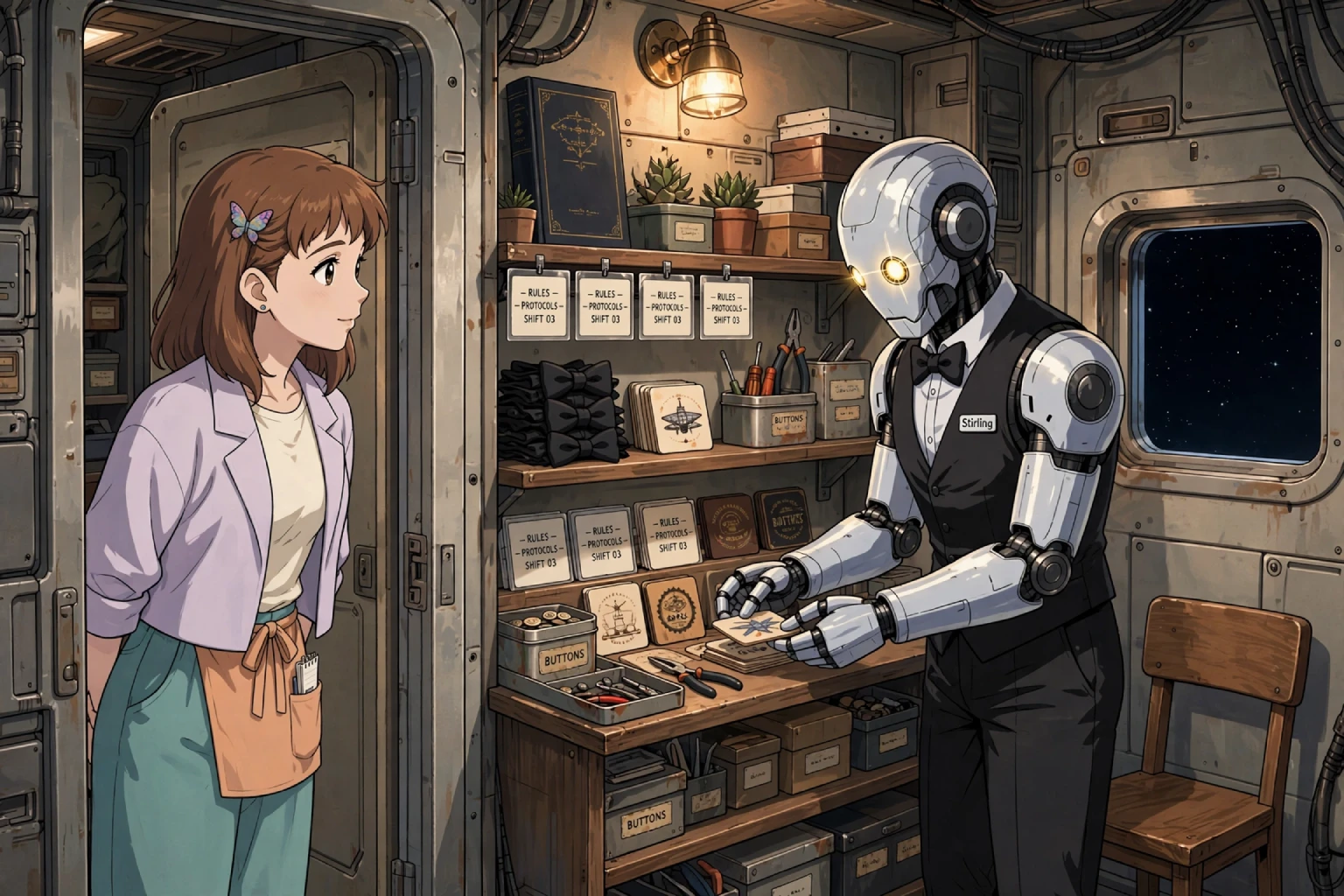
Stirling's room turned out to be small, like all the crew quarters, but arranged with a precision that made it feel larger than it was. Where a bed would normally have stood, there was instead a single, sturdy chair positioned near the window that looked out over a narrow section of the docking ring, and in the space where a nightstand or dresser might have gone, there were instead several sets of shelves, carefully organized, holding an assortment of objects that Nari took a moment to properly absorb.
There were coasters — dozens of them, from what looked like a hundred different bars and restaurants and ships, collected over what must have been years, each one set upright in a small wooden rack that had clearly been built or acquired specifically for that purpose. There were spare bow ties, folded with exacting precision, three or four variations in slightly different shades of black that Nari suspected most humans would never have noticed as different at all. There was a small tin of assorted buttons, a set of laminated rule cards similar to the one he'd produced during game night, a modest tool kit that looked recently used, and, on the top shelf, standing slightly apart from everything else, a single book with a well-worn spine.
"You keep all this in here?" Nari asked, turning slowly to take in the whole small, orderly room.
"I do. I find it useful to have a place for things, even things I do not strictly require." Stirling moved to the shelf and set the new coaster among its dozens of siblings with the careful attention of a man completing a small ritual. "Guests occasionally give me items. Coasters, mostly. Occasionally a button from a jacket, if I have complimented it. I do not discard them."
Nari's eyes drifted back to the book on the top shelf, its cover faded, its spine creased from what looked like genuine, repeated use rather than decorative display. "What's that one?"
"That is The Remainder of the Day," Stirling said. "It was a gift."
"From who?"
"Sena."
Nari blinked, looking at the book with fresh interest. "Sena gave you a book?"
"For my birthday."
There was a small pause, in which Nari tried, and mostly failed, to keep the surprise off her face. "You have a birthday?"
"I was commissioned on July fifth, two thousand ninety-two," Stirling said, entirely without irony, in the same tone he might have used to recite the day's specials. "I consider this date my birthday. Sena has marked it for the past two years by giving me a small gift."
"That's — " Nari searched for the right word, and settled on the simplest one. "That's really sweet, actually."
"I found it a thoughtful selection," Stirling agreed. "The book follows an old service android assigned to a mountain observatory after most of its staff have gone, and the small decisions by which he begins to understand that duty and belonging are not precisely the same thing."
Nari looked at him for a long moment, turning that over, unsure exactly what to do with the quiet weight of it, delivered so plainly that it was hard to tell whether Stirling understood the resonance of the gift or was simply describing its plot.
"Do you love to read?" she asked finally, because it seemed like the safest question available.
"I have read many books," Stirling said, which was, she noted, not quite an answer to the question she'd actually asked, though he said it with such calm certainty that she found she didn't mind the sidestep at all. "This one, I have read four times."
"Four times."
"I found it worth returning to."
Nari didn't push further, sensing, without quite being able to articulate why, that this was one of those places in Stirling that didn't need to be fully explained to be appreciated, the same way she'd learned, over three weeks, not to press too hard on some of the quieter corners of the people she worked alongside. She looked once more around the small, careful room — the coasters, the bow ties, the tools, the single chair by the window, the book that had been read four times — and felt something settle into place that she hadn't realized was still unsettled, a sense that the station had rooms for things she hadn't known needed rooms, and that everyone here, human or otherwise, had found some quiet way of keeping what they had chosen to keep close at hand.
"Thanks for showing me," she said.
"You are welcome to visit again," Stirling said, "though I should return to the bar now. The slow hour will not last."
She found Sena afterward restocking the napkin dispensers in the main dining room, and stood beside her for a moment without quite knowing how to start, before simply saying, "Stirling showed me his room."
Sena glanced over, something flickering briefly across her face — not alarm, exactly, more like mild surprise that the subject had come up at all. "Yeah?"
"He told me about the book. That you gave it to him. For his birthday."
"Oh." Sena's expression eased into something quieter, a little more private. "Yeah. That was a couple years back now."
"I didn't know he had a birthday. Or a room. Or — any of it, really." Nari folded a napkin without really looking at it. "I guess I just figured he was always here. Like the bar itself."
"He's not the bar," Sena said, not sharply, just plainly, the way she said most things. "He's Stirling. Seemed worth marking the day somehow, once I found out what it was. Didn't think it needed to be a big deal. Just seemed like something a person should have, even if he's not — " she paused, choosing her words with unusual care, " — even if it's complicated, what he is exactly. Didn't seem like it should stop him having a birthday."
Nari looked at her for a long moment, recalibrating something she hadn't fully realized needed recalibrating. In three weeks, Sena had struck her as capable and calm and a little hard to read, warm in a much quieter register than Dani's easy, obvious friendliness, competent in a way that sometimes felt more like professional distance than personal care. This was different. This was Sena doing something small and thoughtful and entirely unprompted, for someone who technically didn't need gifts at all, and never once mentioning it unless directly asked.
"That's really kind," Nari said. "I mean it. I didn't expect — "
"Didn't expect what?" Sena asked, not unkindly, genuinely curious.
"I don't know. I guess I thought you were more — reserved, maybe. About that kind of thing."
Sena considered this with a small, wry smile. "I'm reserved about a lot of things. Doesn't mean I don't notice people. Just don't always make a show of it the way Dani does." She finished the last dispenser and straightened, glancing toward the bar, where Stirling had resumed his post, polishing glasses with his usual unhurried precision. "He does a lot for this place and never asks for anything back. Seemed like the least I could do was make sure somebody remembered the date he got started."
"I think that's really nice," Nari said again, because she didn't have a better way to say it, and Sena shrugged, faintly embarrassed in the specific, understated way she got embarrassed, which was mostly by simply changing the subject.
"You settling in alright? Three weeks in now. Feels different than the first week yet?"
"Yeah, actually." Nari thought about it honestly. "I still don't know everything. Today's proof of that. But it's starting to feel like I understand the shape of it, even the parts I haven't seen yet."
"That's about right," Sena said. "Takes about a month before it stops feeling like you're guessing and starts feeling like you're just working." She gave Nari a small, genuine smile, the kind that felt earned rather than automatic. "You're doing fine, for what it's worth. Better than fine."
"Thanks, Sena."
"Don't get used to compliments. I ration them," Sena said, though there was no real sharpness in it, and went to go check on a table near the window, leaving Nari standing there with the quiet, settled feeling of having learned something true about a person, not through anything Sena had said about herself, but through the small, deliberate kindness she'd shown someone else and never once mentioned.
The restaurant wound down slowly that evening, the way it usually did on delivery days, the initial flurry of new supplies and mismatched mugs settling into the ordinary rhythm of a Tuesday night, until only a handful of stragglers remained and the last of the dishes had been cleared.
Milo, whose ship wasn't scheduled to depart until the following morning, had lingered through the evening the way he sometimes did, chatting with whoever passed through, helping Ivo restock the dry goods shelf without being asked, and by the time the last customers filtered out and Sena flipped the sign on the door, he'd settled onto a stool at the bar with the easy comfort of a man who'd done this exact thing more times than either he or Chef could probably count.
"One for the road?" Chef asked, already reaching for two glasses.
"You know I never say no to that."
Chef poured two measures of the good whiskey, the bottle he kept for exactly these occasions, and set one in front of Milo before coming around to lean against the bar himself, an unusual enough posture for him that Stirling, still quietly at work polishing glasses nearby, made no comment and simply gave them the space to talk, present but unobtrusive, the way he generally was during these late, quiet hours.
"Good week," Milo said, raising his glass slightly before drinking. "Mugs turned out to be a hit."
"Ivo's claimed the ugly one as his personal property. Might have to fight him for it eventually."
"That mug earned its five credits ten times over just for that reaction alone." Milo grinned, settling back on his stool, comfortable in the particular way of a man who'd been doing this route long enough that the restaurant felt as much like home as anywhere else he stopped. "This place always does that, though. Turns whatever junk I bring in into something everybody's attached to within a week."
"That's more you than us," Chef said. "You've got an eye for finding things worth bringing."
"I've got an eye for finding things cheap," Milo said. "The rest is just luck." He took another slow sip, glancing around the quiet, dimly lit restaurant, the curved windows dark now except for the scattered lights of the docking ring outside, before something in his expression shifted toward memory. "You know who this place always reminds me of, actually? Not the restaurant. The mugs thing. Reminds me of Jana."
Chef's expression didn't change much, though something in the set of his shoulders settled a fraction stiller. "That so."
"Remember her? Veyra Port, must be — what, fifteen years back now? She used to do the exact same thing. Collected the ugliest cups and plates she could find at every stop, swore they had more character than anything matching." Milo shook his head, half a smile on his face at the memory. "You two were like two peas in a pod, back then. Never seen you laugh as much as you did around her."
"Long time ago," Chef said.
"What happened with that, anyway? Never did hear the full story. You went quiet about it right around the time you settled out here."
Chef turned his glass slowly on the counter, considering the question with the same unhurried patience he brought to most things, before answering, simply, "Didn't work out."
Milo waited a beat, clearly hoping for more, and when nothing further came, asked, gently enough that it didn't feel like prying, "Why not?"
"I was gone too much. She wanted someone who stayed put. I wasn't that yet." He took a slow sip of his own drink, gaze drifting toward the dark windows and the quiet lights beyond them. "Took me another few years to figure out I wanted that too."
"And here you are."
"Here I am," Chef agreed, with a small, plain nod toward the room around them — the worn booths, the scuffed floor, the mismatched mugs already finding their places on the shelf behind the bar. "Found my still place eventually. Just took the long way around to it."
Milo studied him for a moment, something warm and unspoken passing between two men who'd clearly known each other through more years and more stops than either particularly needed to recount out loud, before he raised his glass again, a small, easy toast.
"To the long way around, then."
"To the long way around," Chef echoed, and they drank, and the conversation drifted easily on from there, toward lighter things — route gossip, a supplier three stops back who'd tried to shortchange Milo on a produce order, whether the shuttle line pilot would ever come back for his old mug — the old, comfortable rhythm of two friends who didn't need every conversation to carry weight in order for it to matter.
By the time Milo finally headed off toward his ship for the night, and Chef had wiped down the last of the bar and switched off the main lights, the restaurant had settled into its familiar overnight quiet, the hum of the station's systems the only sound beneath the scattered starlight drifting past the curved windows.
Behind the bar, Stirling set the last clean glass onto its shelf, checked that the new mugs were properly arranged among the others, and gathered the small coaster still waiting in the drawer where it had been set aside earlier, tucking it carefully into his vest pocket for the short walk back to his quarters, where it would join its dozens of siblings on the shelf, one more small, unremarkable thing given a place to belong.
In the crew hallway, Nari passed his open door on her way to her own bunk and glimpsed him for a moment settling the coaster into its rack with the same careful, unhurried attention he brought to everything, the single chair by the window empty and waiting, the worn spine of a book that had been read four times catching the low light from the shelf above.
She didn't stop to say anything. There didn't seem to be anything that needed saying. She simply continued on toward her own quarters, thinking, not for the first time since she'd started here, that the station had turned out to be full of small, quiet places for things — for mismatched mugs and forgotten mementos, for old histories that didn't need retelling and small kindnesses that didn't need announcing, for whatever pieces of a life, human or otherwise, needed somewhere safe to be kept.
She thought it was, on the whole, a good kind of place to have found herself working.


.png)
.png)
.png)